
Form BOE-237-A, Supplemental Affidavit for BOE-237, is the yearly affidavit that the Riverside County Assessor-County Clerk-Recorder prints for tribes and tribally designated housing entities that claim the lower-income housing exemption on form BOE-237. It is one of the Riverside County property tax forms handled by the Assessor, and it is filed for a fiscal year by 5:00 p.m. on February 15. The affidavit names the person signing, lists the households that qualify and recaps the property's housing units. On this page you can fill out the form online on FillingPDF and download or print the completed PDF; the county publishes the original at the official link, and filing follows the Assessor's channels.
Last updated
What is BOE-237-A?
Form BOE-237-A, Supplemental Affidavit for BOE-237, is the affidavit a tribe or tribally designated housing entity files with the Assessor to support its form BOE-237 claim, Exemption of Low Income Tribal Housing, for housing occupied by lower-income households.
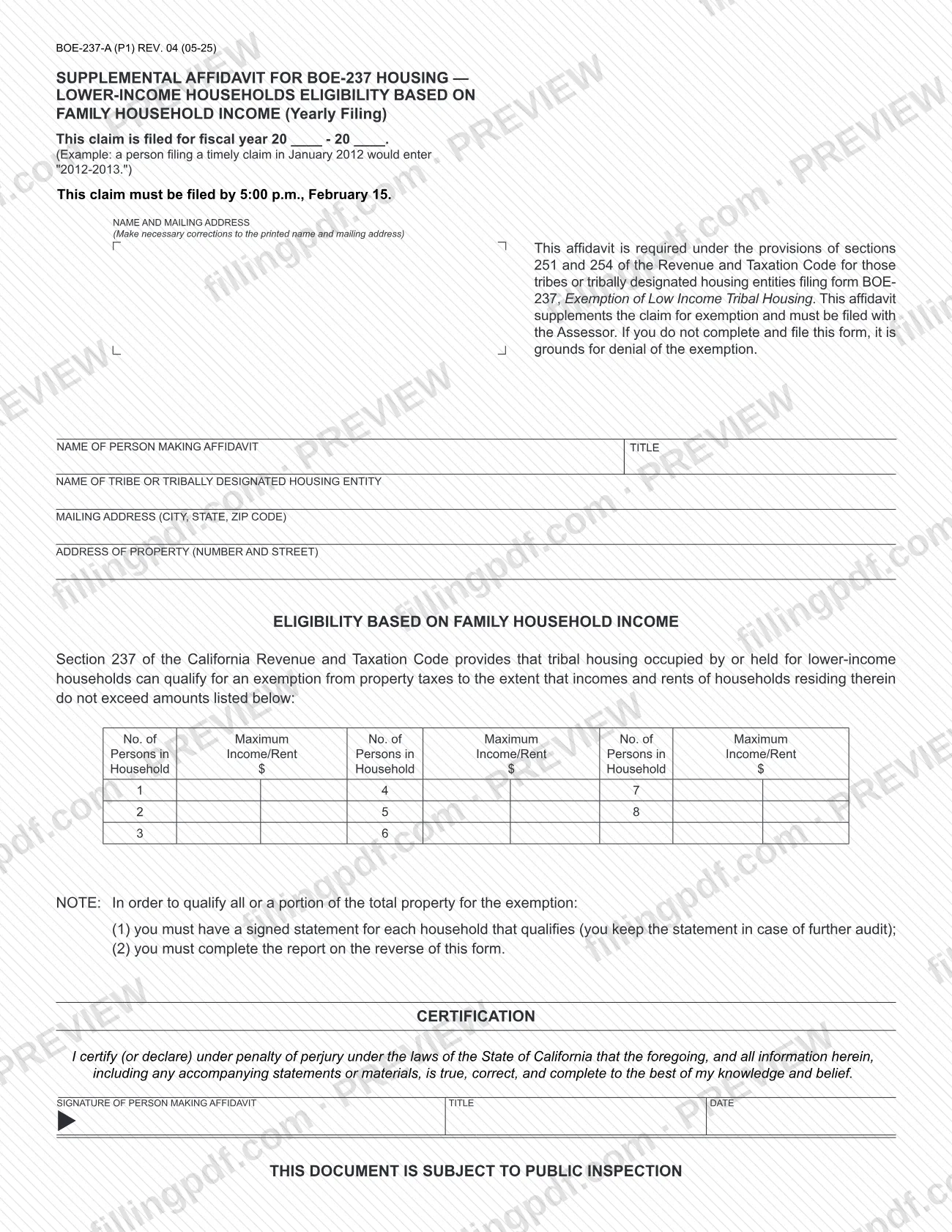
The form is titled "Housing — Lower-Income Households, Eligibility Based on Family Household Income (Yearly Filing)" and is issued by the Riverside County Assessor-County Clerk-Recorder. It is required under sections 251 and 254 of the California Revenue and Taxation Code. It supplements the claim for exemption and must be filed with the Assessor; the form states that not completing and filing it is grounds for denial of the exemption.
Section 237 of the Revenue and Taxation Code provides that tribal housing occupied by or held for lower-income households can qualify for a property tax exemption to the extent that the incomes and rents of the households living there do not exceed the amounts listed on the form for each household size.
The package has several parts. The first page holds the certification and the income/rent limits for households of 1 to 8 persons. The reverse holds A. List of Qualified Households and B. Recap for All Families, Eligible and Ineligible. The form's instructions page follows, then a suggested Lower-Income Households — Statement of Family Household Income for each household and a suggested tenant verification form. The affidavit itself is subject to public inspection; the household statements are not.
Who needs to file BOE-237-A?
The claimant files Form BOE-237-A: a tribe or tribally designated housing entity that files form BOE-237, Exemption of Low Income Tribal Housing, for housing occupied by or held for lower-income households. A person who signs for the tribe or entity enters a name and title on the affidavit.
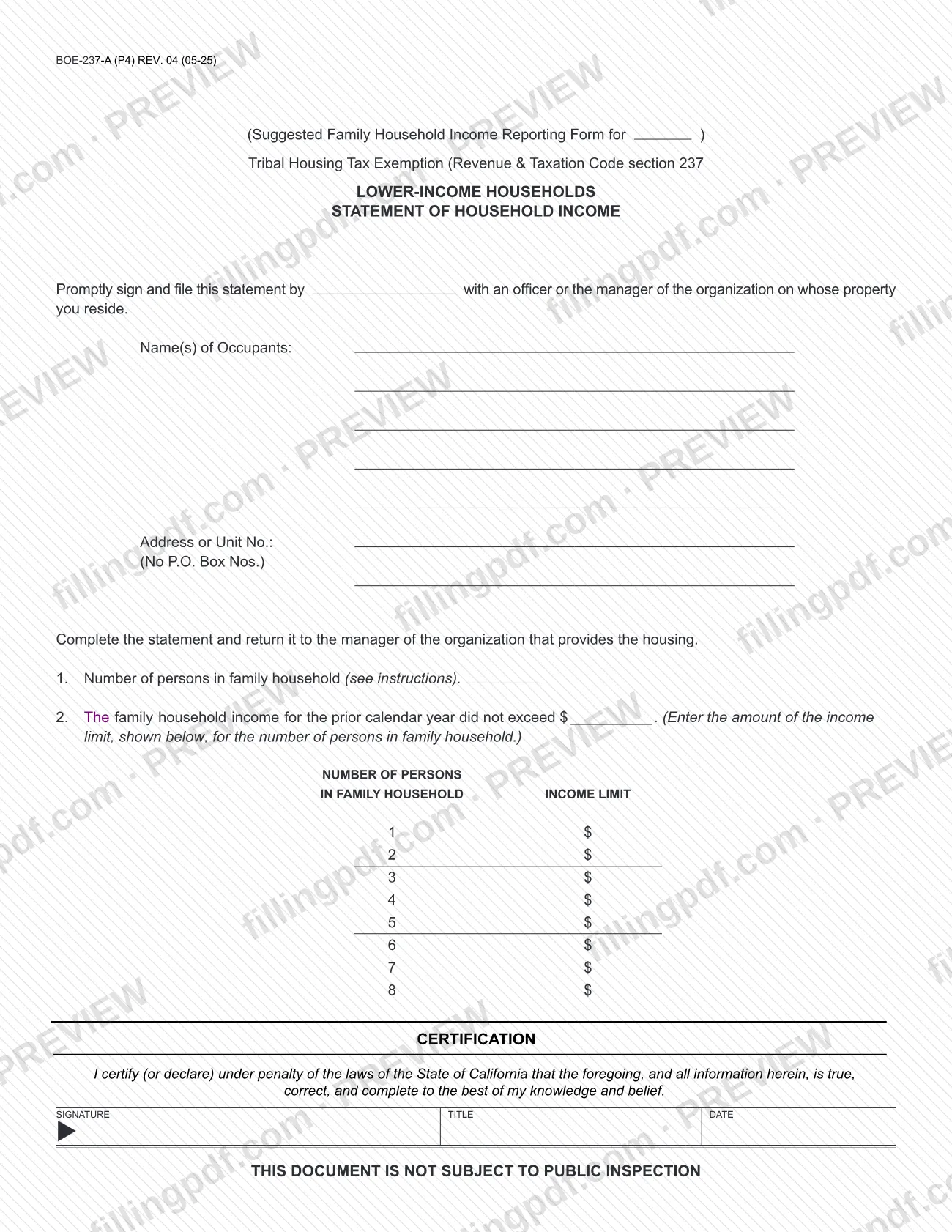
Households living on the property do not file this affidavit. The claimant gives each household a copy of the Statement of Family Household Income, and a household signs it only if its combined income is the same as or less than the income limit for its size. A household whose income is more than the limit should not file that statement.
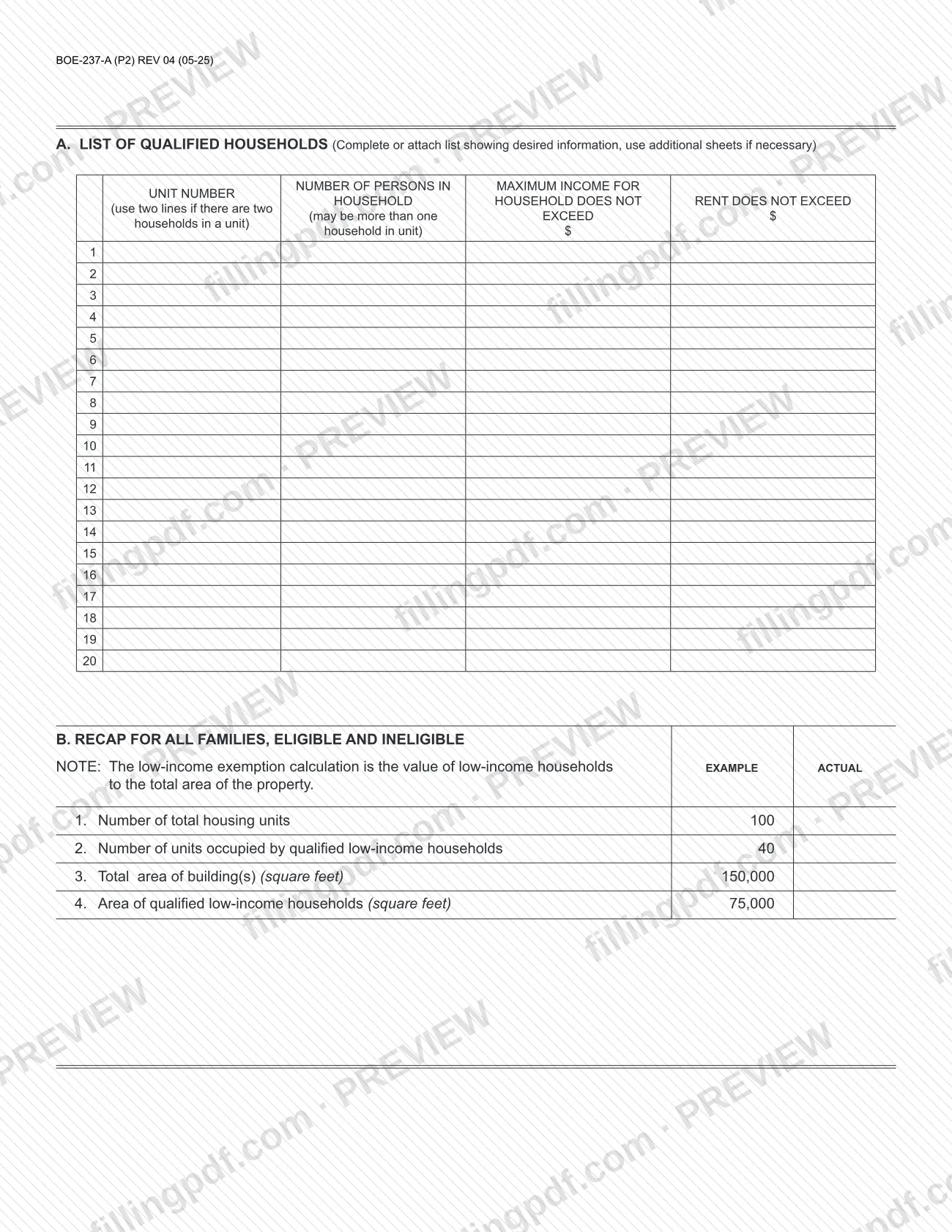
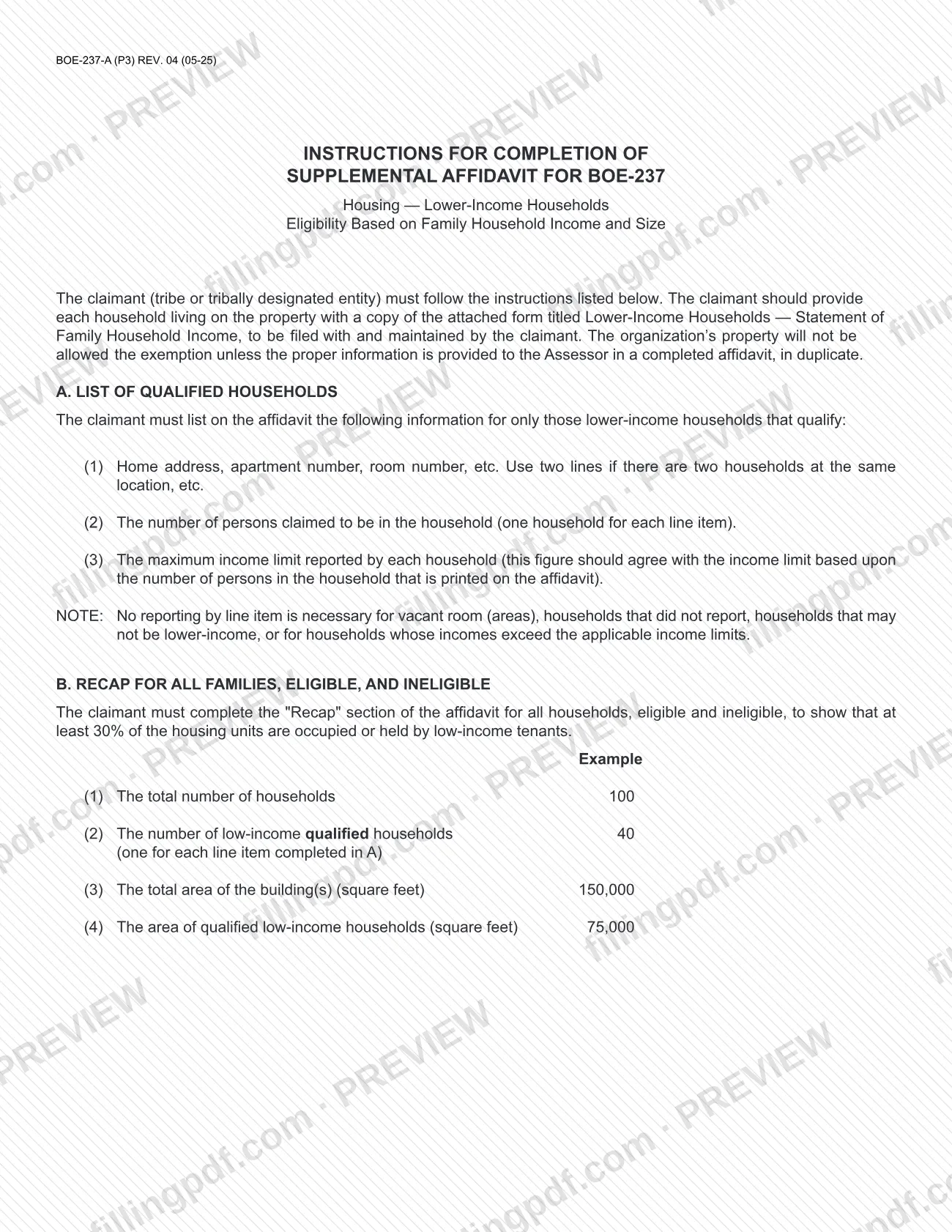
Only qualifying households are listed in Section A. Vacant rooms or areas, households that did not report, households that may not be lower-income and households whose incomes exceed the limit need no line item. They still count in the Section B recap, which covers all households, eligible and ineligible.
The form is for the claimant's own claim. It is not a household application, and it has no section for another person to file on a household's behalf.
When to file BOE-237-A
The claim must be filed by 5:00 p.m. on February 15, according to the form. It is a yearly filing: the top of the form asks for the fiscal year, written as two years, and the form's example is that a person filing a timely claim in January 2012 enters "2012-2013."
The affidavit supplements the BOE-237 claim, so it goes to the Assessor with that claim. Collect the signed household statements before you complete it. The household statement asks that it be returned promptly to an officer or the manager of the organization, so the claimant has time to finish the form that must be filed with the Assessor.
The form says that the organization's property will not be allowed the exemption unless the proper information reaches the Assessor in a completed affidavit, in duplicate.
Documents you need
- Form BOE-237, Exemption of Low Income Tribal Housing: the claim this affidavit supplements, filed with the Assessor.
- A second copy of the completed affidavit: the instructions require the information to be provided to the Assessor in a completed affidavit, in duplicate.
- A signed Lower-Income Households — Statement of Family Household Income from each qualifying household. The claimant keeps these in case of further audit; the form does not say to attach them.
- An attached list or additional sheets, only if the 20 lines of Section A are not enough for the qualified households.
How to fill out BOE-237-A
Enter the fiscal year
On the line "This claim is filed for fiscal year 20 ____ - 20 ____," write the two years, as in the form's example "2012-2013."
Correct the name and mailing address
Under Name and Mailing Address, make any necessary corrections to the printed name and mailing address.
Identify the person and the claimant
Enter the name and title of the person making the affidavit, the name of the tribe or tribally designated housing entity, its mailing address (city, state, ZIP code) and the address of the property (number and street).
Fill in the income and rent limits
In the Maximum Income/Rent $ column, enter the amount for each household size, 1 through 8 persons. The figures you list in Section A should agree with these limits.
Collect signed household statements
Give each household a Statement of Family Household Income. Keep the signed statement for every household you will list as qualified, as you need one for each in case of audit.
List the qualified households
In Section A, enter each unit number, the number of persons and the maximum income and rent figures. Use two lines for two households in a unit, and attach additional sheets if needed.
Complete the Section B recap
For all households, eligible and ineligible, enter the total housing units, units occupied by qualified low-income households, total building area in square feet and area of qualified households in square feet.
Sign and date the certification
On the first page, the person making the affidavit signs, enters a title and dates the certification made under penalty of perjury.
Review, download and copy
Check every entry against the household statements. Download or print the completed PDF from FillingPDF, make a second copy for the duplicate filing and submit it as described under How to submit.
How to submit BOE-237-A
Form BOE-237-A is filed with the Assessor by mail or in person. The Riverside County Assessor-County Clerk-Recorder says its forms do not allow online submission and must be delivered by mail or in person to the local Assessor-County Clerk-Recorder office.
- By mail: the form header lists the office as Assessor-County Clerk-Recorder, PO BOX 751, RIVERSIDE, CA 92502-0751.
- In person: take it to your local Assessor-County Clerk-Recorder office. Questions go to (951) 413-2757 or www.rivcoacr.org.
The package is the completed affidavit in duplicate, filed with the BOE-237 claim it supplements. It must be filed by 5:00 p.m. on February 15. The county asks that its forms be printed in black ink on 8 1/2" x 11" white paper. Keep the signed household statements with the claimant, in case of further audit. The form mentions no fee. FillingPDF lets you fill out and download the PDF; submission follows the channels above.
Common mistakes to avoid
- Filing after 5:00 p.m. on February 15, the deadline printed on the form.
- Not completing and filing the affidavit, which the form says is grounds for denial of the exemption.
- Submitting a single copy when the instructions call for the completed affidavit in duplicate.
- Listing households that do not qualify in Section A; only qualifying lower-income households get a line item.
- Completing the Section B recap for qualified households only, when it must cover all households, eligible and ineligible.
- Entering an income limit in Section A that does not match the limit printed on the affidavit for that household size.
- Writing a single year in the fiscal-year line instead of two years, such as the form's "2012-2013" example.
- Leaving out the signature, title and date on the certification, which is made under penalty of perjury.
- Collecting no signed household statement for a household you list as qualifying; the form requires one for each, kept for audit.
Frequently asked questions
What is Form BOE-237-A?
Form BOE-237-A is the Supplemental Affidavit for BOE-237, issued by the Riverside County Assessor-County Clerk-Recorder. A tribe or tribally designated housing entity files it with the Assessor to support its BOE-237 claim for the lower-income tribal housing exemption.
When is Form BOE-237-A due?
The form says the claim must be filed by 5:00 p.m. on February 15. It is a yearly filing, and the fiscal year is written at the top as two years, such as "2012-2013" in the form's example.
Who has to file the supplemental affidavit for BOE-237?
The claimant: a tribe or tribally designated housing entity filing form BOE-237. The affidavit is required under sections 251 and 254 of the Revenue and Taxation Code. Individual households do not file it; they sign a household income statement instead.
Do I send the household income statements to the Assessor?
The form says the claimant keeps each signed statement in case of further audit, and does not say to attach it. You need a signed statement for every household you list as qualified. The statement is not subject to public inspection.
What happens if I do not file Form BOE-237-A?
The form states that failing to complete and file it is grounds for denial of the exemption. The instructions add that the property will not be allowed the exemption unless a completed affidavit, in duplicate, gives the Assessor the proper information.
What counts as household income on the household statement?
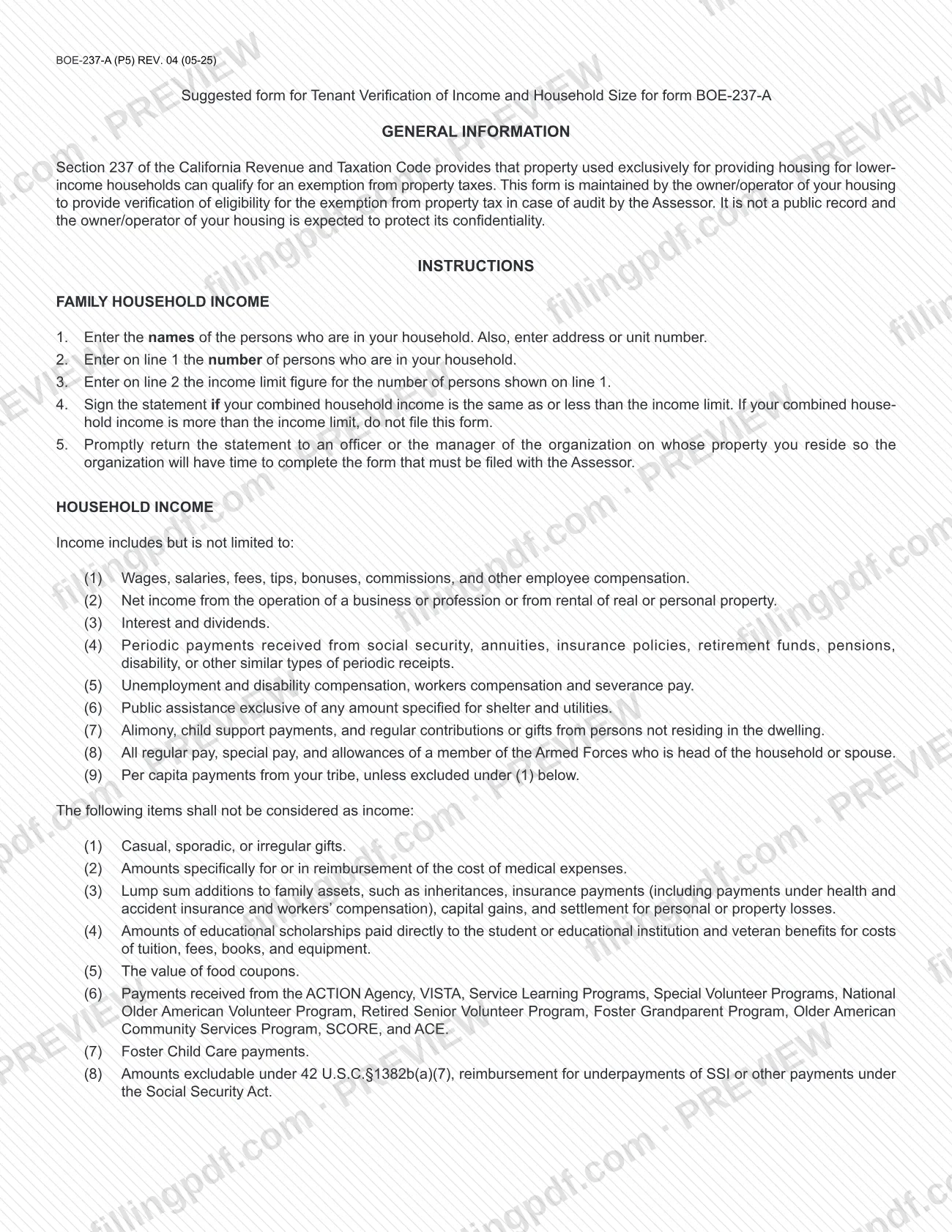
The form's tenant verification page lists wages, business or rental income, interest and dividends, periodic payments such as pensions or Social Security, unemployment, public assistance, alimony and per capita tribal payments. Casual gifts, medical reimbursements and scholarships are among items excluded.
Can I file Form BOE-237-A online?
No. The Riverside County Assessor-County Clerk-Recorder says its forms do not allow online submission and must be delivered by mail or in person. You can fill out the PDF online on FillingPDF and download it, but FillingPDF does not file it with the county.
What goes in the Section B recap of the affidavit?
Section B covers all households, eligible and ineligible. You enter the total housing units, the units occupied by qualified low-income households, the total building area in square feet and the area of qualified households. It shows that at least 30% of the units are occupied or held by low-income tenants.
Ready to fill out BOE-237-A?
Fill out BOE-237-A now