
Form BOE-261-GNT, Disabled Vets Change of Eligibility, is the report the Riverside County Assessor-County Clerk-Recorder sends to people who receive the Disabled Veterans’ Exemption so they can tell the Assessor that they no longer qualify. It is one of the Riverside County property tax forms and is meant only for claimants whose eligibility has ended; those who still qualify do not return it. On this page you can fill out the form online on FillingPDF and download or print the completed PDF. The original is published by the agency at the official link.
Last updated
What is BOE-261-GNT?
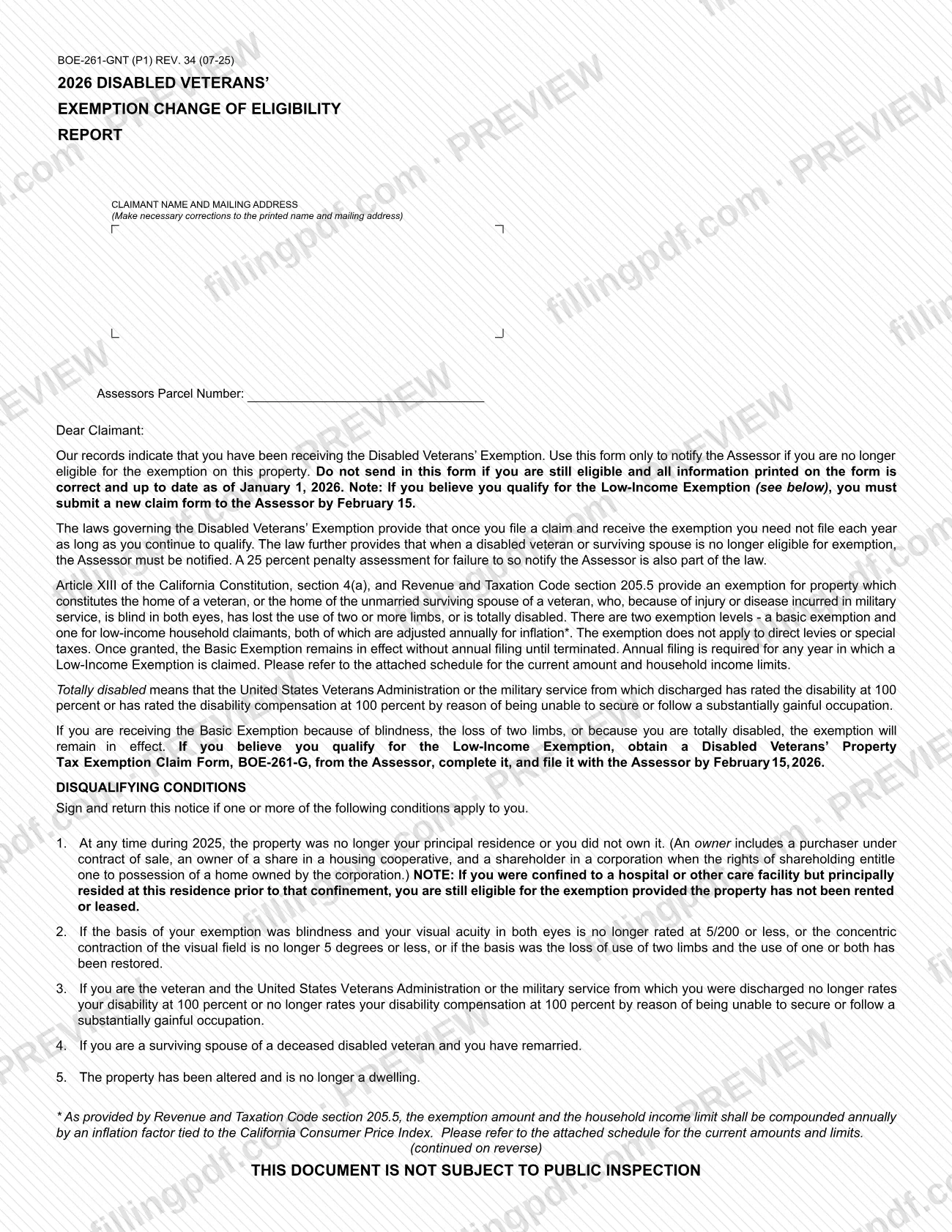
Form BOE-261-GNT, printed as the 2026 Disabled Veterans’ Exemption Change of Eligibility Report, is the Riverside County Assessor-County Clerk-Recorder form on which a claimant reports that they no longer qualify for the Disabled Veterans’ Exemption on a property.
The exemption comes from Article XIII of the California Constitution, section 4(a), and Revenue and Taxation Code section 205.5. It covers the home of a veteran, or of the unmarried surviving spouse of a veteran, who because of injury or disease incurred in military service is blind in both eyes, has lost the use of two or more limbs, or is totally disabled. There is a basic exemption and a low-income exemption, both adjusted annually for inflation, and neither applies to direct levies or special taxes.
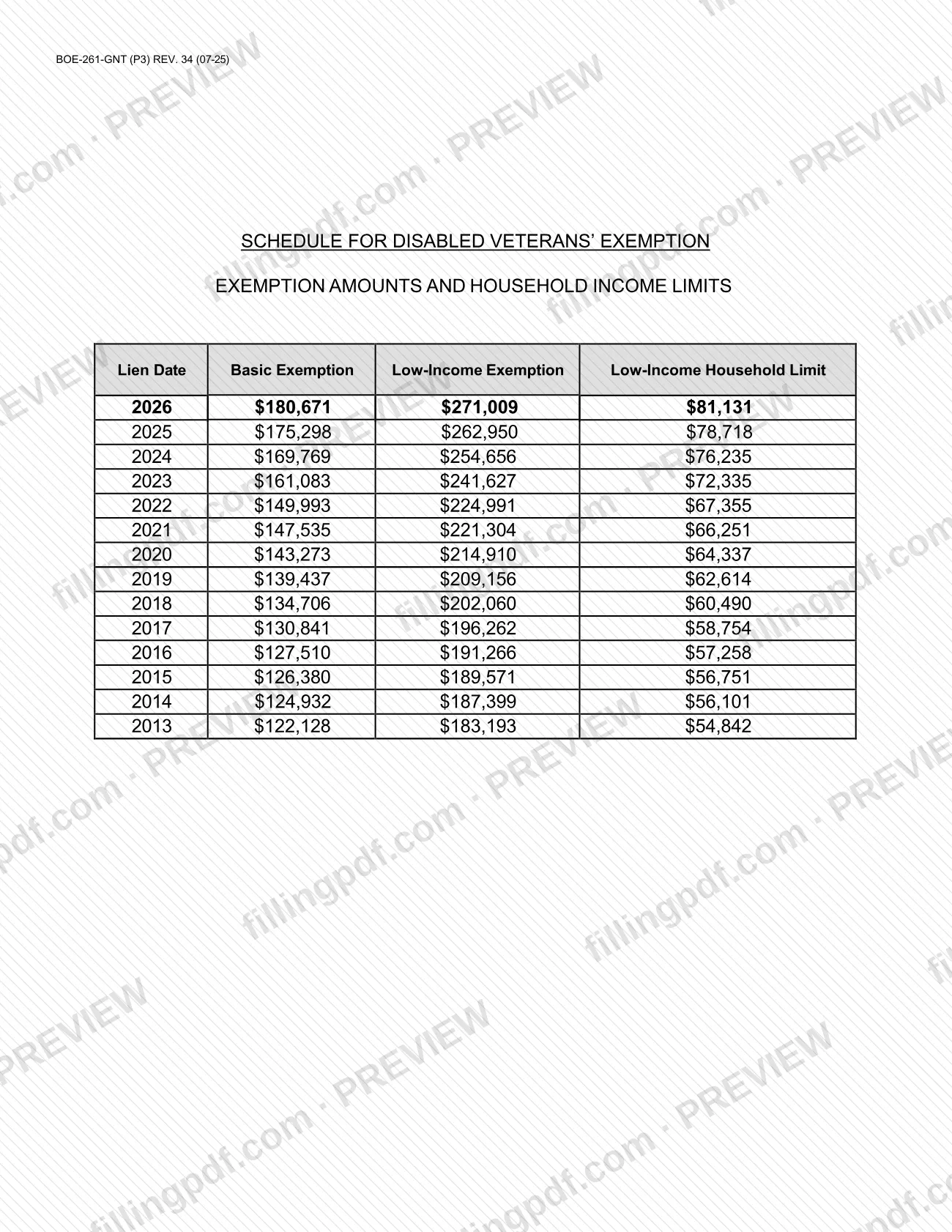
Once the basic exemption is granted it stays in effect without annual filing until it is terminated. That is why the law requires the claimant to tell the Assessor when eligibility ends, and why the form warns of a 25 percent penalty assessment for failing to do so. Page 3 of the form is a schedule of exemption amounts and household income limits by lien date; the Assessor’s schedule, not this page, is the place to read them.
BOE-261-GNT is a notice, not a claim. A veteran who believes they qualify for the low-income exemption files a different form, the Disabled Veterans’ Property Tax Exemption Claim Form, BOE-261-G. The form states that it is not subject to public inspection.
Who needs to file BOE-261-GNT?
The main group is claimants who receive the Disabled Veterans’ Exemption and no longer qualify for it as of January 1, 2026: the disabled veteran or the unmarried surviving spouse of a veteran. The form lists these disqualifying conditions:
- During 2025 the property was no longer your principal residence, or you did not own it. An owner includes a purchaser under a contract of sale, an owner of a share in a housing cooperative, and a shareholder in a corporation whose shares entitle the holder to possess the home.
- Your exemption was based on blindness and visual acuity in both eyes is no longer 5/200 or less, or the concentric contraction of the visual field is no longer 5 degrees or less; or it was based on loss of use of two limbs and use of one or both has been restored.
- You are the veteran and the U.S. Veterans Administration or your military service no longer rates your disability, or your disability compensation, at 100 percent.
- You are a surviving spouse and have remarried.
- The property has been altered and is no longer a dwelling.
Do not send the form if you are still eligible and all the printed information is correct and up to date as of January 1, 2026. A claimant confined to a hospital or other care facility who principally resided at the home before the confinement remains eligible, provided the property has not been rented or leased.
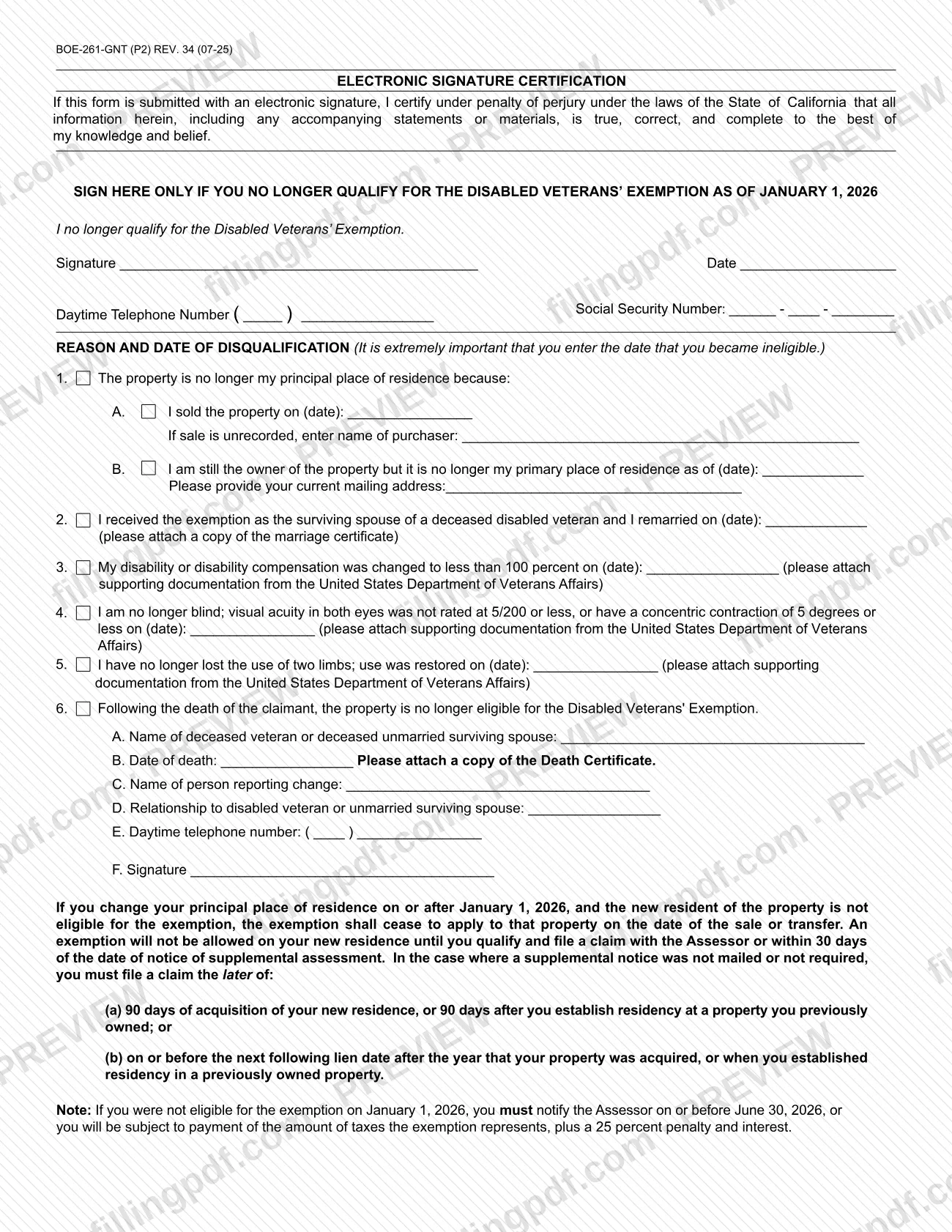
After a claimant’s death, another person reports the change in item 6 of the form and gives their name and relationship to the veteran or surviving spouse.
When to file BOE-261-GNT
The triggering event is losing eligibility for the Disabled Veterans’ Exemption. If you were not eligible on January 1, 2026, the form says you must notify the Assessor on or before June 30, 2026, or you will owe the taxes the exemption represents, plus a 25 percent penalty and interest. Enter the date you became ineligible on the form; the form calls it extremely important.
Two related timing rules appear on the form. A low-income exemption claim is a separate filing, due to the Assessor by February 15, 2026. If you move on or after January 1, 2026 and the new resident is not eligible, the exemption ceases on the date of the sale or transfer, and your new residence is not exempt until you qualify and file a claim. The form sets that claim's deadline as within 30 days of the notice of supplemental assessment or, where no notice was mailed or required, the later of two dates it describes.
Documents you need
- Copy of the marriage certificate, if you received the exemption as a surviving spouse and remarried (item 2).
- Supporting documentation from the U.S. Department of Veterans Affairs, if your disability or disability compensation was changed to less than 100 percent (item 3).
- Supporting documentation from the U.S. Department of Veterans Affairs, if you are no longer blind under the rated visual acuity or visual field limits (item 4).
- Supporting documentation from the U.S. Department of Veterans Affairs, if use of two limbs was restored (item 5).
- Copy of the death certificate, if you are reporting the change because the claimant died (item 6).
How to fill out BOE-261-GNT
Correct your name and address
In the claimant name and mailing address block, make any necessary corrections to the printed name and mailing address. Check the Assessors Parcel Number printed above it.
Confirm you no longer qualify
Read the five disqualifying conditions on page 1. Complete and return the form only if one or more applies to you as of January 1, 2026.
Choose the reason for disqualification
In the Reason and Date of Disqualification section, complete the item that matches your situation (items 1 through 6). Enter the date you became ineligible.
Report a change in the property
For item 1, check A and enter the sale date (and the purchaser's name if the sale is unrecorded), or check B and enter the date the property stopped being your primary residence plus your current mailing address.
Report a remarriage or disability change
Item 2: remarriage date, with the marriage certificate attached. Items 3, 4 and 5: the date the rating changed, vision improved or limb use was restored, with Department of Veterans Affairs documentation attached.
Complete item 6 after a death
Enter the deceased claimant's name (A), date of death (B), the name of the person reporting (C), their relationship (D), daytime telephone number (E) and signature (F). Attach the death certificate.
Sign and date the form
Sign and date under the statement that you no longer qualify, and enter your daytime telephone number and Social Security Number. The form includes an electronic signature certification made under penalty of perjury.
Review and download the completed PDF
Check the dates, attachments and signature, then download or print the completed PDF from FillingPDF. Print it in black ink on 8½" x 11" white paper and send it as described under How to submit.
How to submit BOE-261-GNT
Form BOE-261-GNT is returned by mail or in person to your local Assessor-County Clerk-Recorder office. The agency’s forms page says its forms do not allow online submission and must be delivered by mail or in person.
- By mail: the form’s header gives the office’s mailing address as Assessor-County Clerk-Recorder, P.O. Box 751, Riverside, CA 92502-0751.
- In person: deliver it to your local Assessor-County Clerk-Recorder office; locations are listed at www.rivcoacr.org.
- Questions: the header lists (951) 955-7006.
The agency asks that forms be printed in black ink on 8½" x 11" white paper. Sign the form, and attach the supporting documents that apply to the reason you check (see Required documents). The form does not mention a fee. FillingPDF lets you fill out and download the PDF; submission follows the channels above.
Common mistakes to avoid
- Sending the form when you are still eligible and the printed information is correct as of January 1, 2026; the form says not to.
- Leaving out the date you became ineligible; the form calls it extremely important.
- Notifying the Assessor after June 30, 2026 when you were not eligible on January 1, 2026, which exposes you to the exemption amount in taxes, a 25 percent penalty and interest.
- Omitting the marriage certificate, the Department of Veterans Affairs documentation or the death certificate that items 2 through 6 ask you to attach.
- Using this notice to ask for the low-income exemption; that requires a new claim on Form BOE-261-G filed by February 15.
- Checking item 1B without writing your current mailing address.
- Assuming a hospital or care facility stay ends eligibility; the form says you remain eligible if the property is not rented or leased.
- Trying to submit the form online when the agency says its forms must be delivered by mail or in person.
Frequently asked questions
What is Form BOE-261-GNT used for?
Form BOE-261-GNT is the Riverside County Assessor-County Clerk-Recorder form for telling the Assessor that you no longer qualify for the Disabled Veterans’ Exemption on a property. It records the reason and the date your eligibility ended.
Do I have to return BOE-261-GNT every year?
No. The form says not to send it if you are still eligible and the printed information is correct as of January 1, 2026. The basic exemption stays in effect without annual filing until it is terminated.
What is the deadline to report that I am no longer eligible?
If you were not eligible on January 1, 2026, notify the Assessor on or before June 30, 2026. After that date you may owe the taxes the exemption represents, plus a 25 percent penalty and interest.
What documents do I attach to BOE-261-GNT?
It depends on the reason. Attach the marriage certificate for a remarriage, Department of Veterans Affairs documentation for a rating, vision or limb-use change, and the death certificate when reporting a claimant's death.
Can I submit BOE-261-GNT online?
No. The agency says its forms do not allow online submission and must be delivered by mail or in person to your local Assessor-County Clerk-Recorder office. The header lists P.O. Box 751, Riverside, CA 92502-0751.
Can I fill out BOE-261-GNT online on FillingPDF?
Yes. You can fill out the PDF online on FillingPDF and download or print it. FillingPDF is independent of the county and does not submit the form; you deliver it to the Assessor yourself.
Can I use this form to claim the low-income exemption?
No. BOE-261-GNT only reports lost eligibility. To claim the low-income exemption, get the Disabled Veterans’ Property Tax Exemption Claim Form, BOE-261-G, from the Assessor and file it by February 15, 2026.
What if I sell my home or move?
Report it in item 1 with the date. If the new resident is not eligible, the exemption ends on the date of sale or transfer, and your new home is not exempt until you qualify and file a claim with the Assessor.
Ready to fill out BOE-261-GNT?
Fill out BOE-261-GNT now