
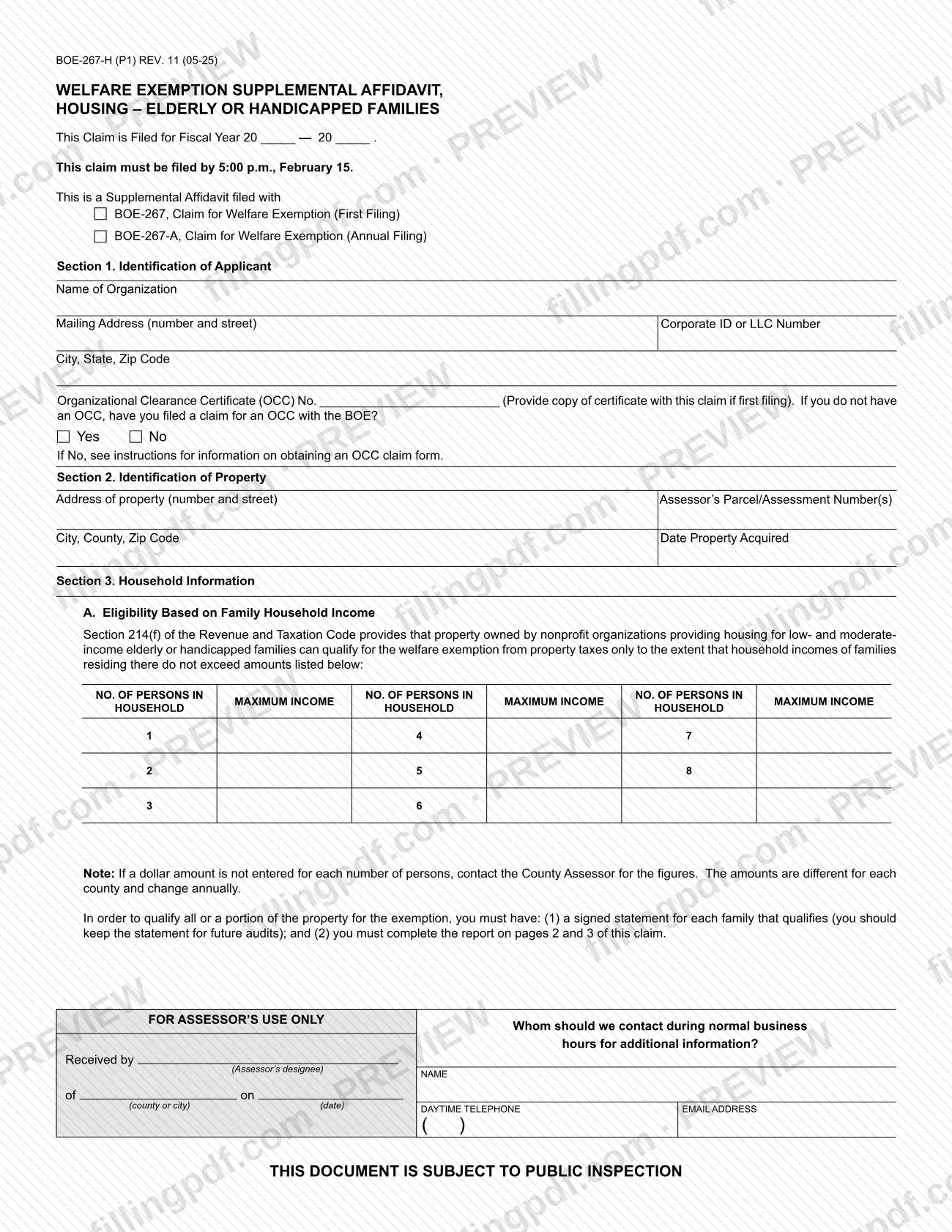
Form BOE-267-H, the Welfare Exemption Supplemental Affidavit, Housing - Elderly or Handicapped Families, is the form a nonprofit housing owner files with the Riverside County Assessor-County Clerk-Recorder to support a welfare exemption claim. It is one of the Riverside County property tax forms, and it must accompany the claim on BOE-267 or BOE-267-A. On this page you can fill out the form online on FillingPDF and download or print the completed PDF; the county publishes the original at the agency's forms page and receives the affidavit only through its own channels.
Last updated
What is BOE-267-H?
Form BOE-267-H, Welfare Exemption Supplemental Affidavit, Housing - Elderly or Handicapped Families, is the affidavit a nonprofit organization or eligible limited liability company files with the county assessor to seek the welfare exemption on housing for low- and moderate-income elderly or handicapped families.
The form states that it is required under sections 214(f), 251 and 254.5 of the Revenue and Taxation Code. It supplements the claim for welfare exemption and is filed with either BOE-267, Claim for Welfare Exemption (First Filing) or BOE-267-A, Claim for Welfare Exemption (Annual Filing). This copy is issued by the Riverside County Assessor-County Clerk-Recorder.
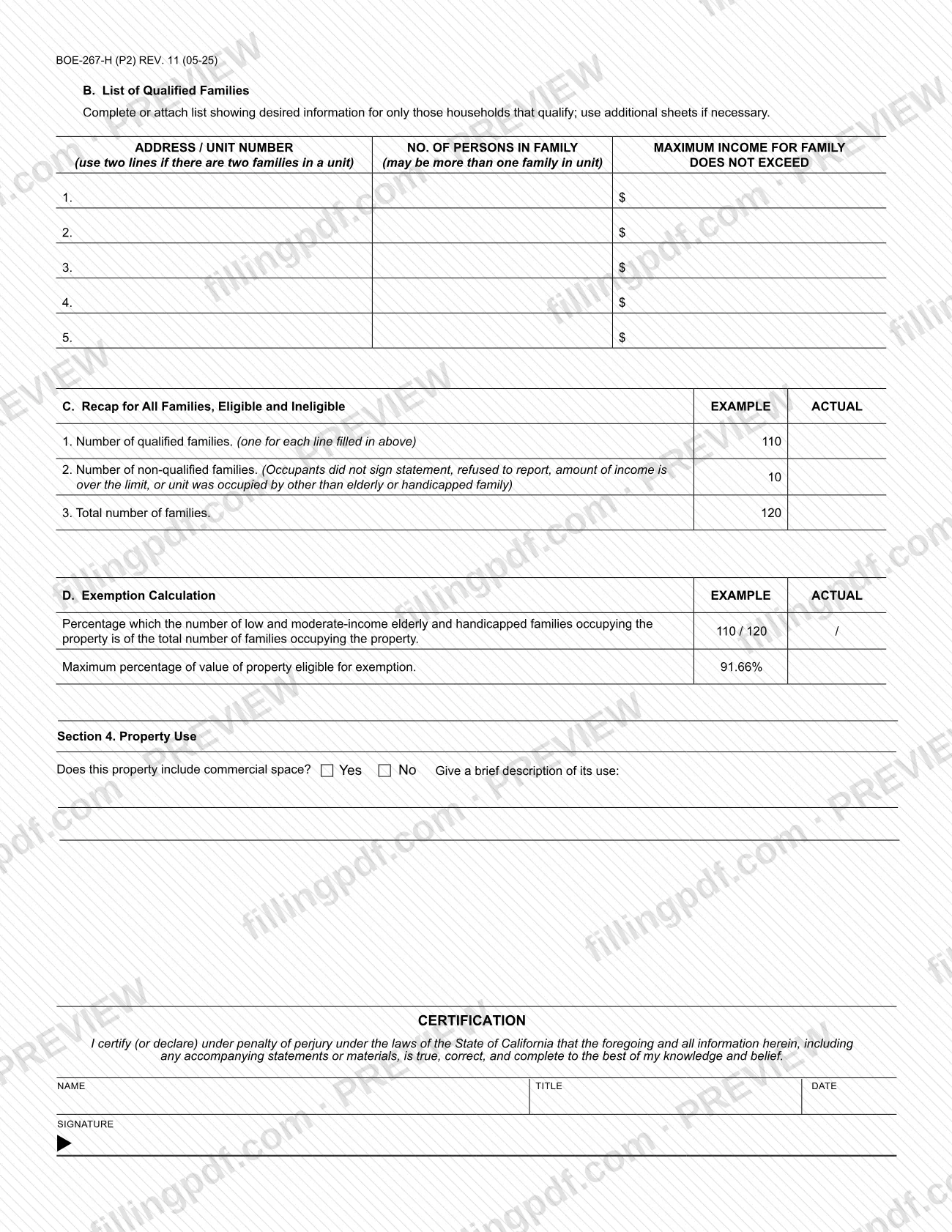
Under section 214(f), the property qualifies only to the extent that the household incomes of the families living there do not exceed the maximum amounts for each household size, from 1 to 8 persons. The form has four sections: identification of the applicant, identification of the property, household information (the income table, a list of qualified families, a recap and the exemption calculation) and property use, followed by a certification under penalty of perjury.
The exemption percentage is the number of qualified families divided by the total number of families occupying the property. For the printed example, 110 qualified families out of 120 gives a maximum of 91.66% of the property value.
A separate affidavit must be filed for each location. The form states that it is subject to public inspection.
Who needs to file BOE-267-H?
A nonprofit organization, or an eligible limited liability company, that owns and operates housing for elderly or handicapped families and is seeking the welfare exemption on that property files Form BOE-267-H.
- Use it for each location: a separate affidavit must be filed for every property.
- File it together with the exemption claim, BOE-267 for a first filing or BOE-267-A for an annual filing.
- The income of the occupants must not exceed the limits in section 3 of the form; only qualifying households count toward the exemption.
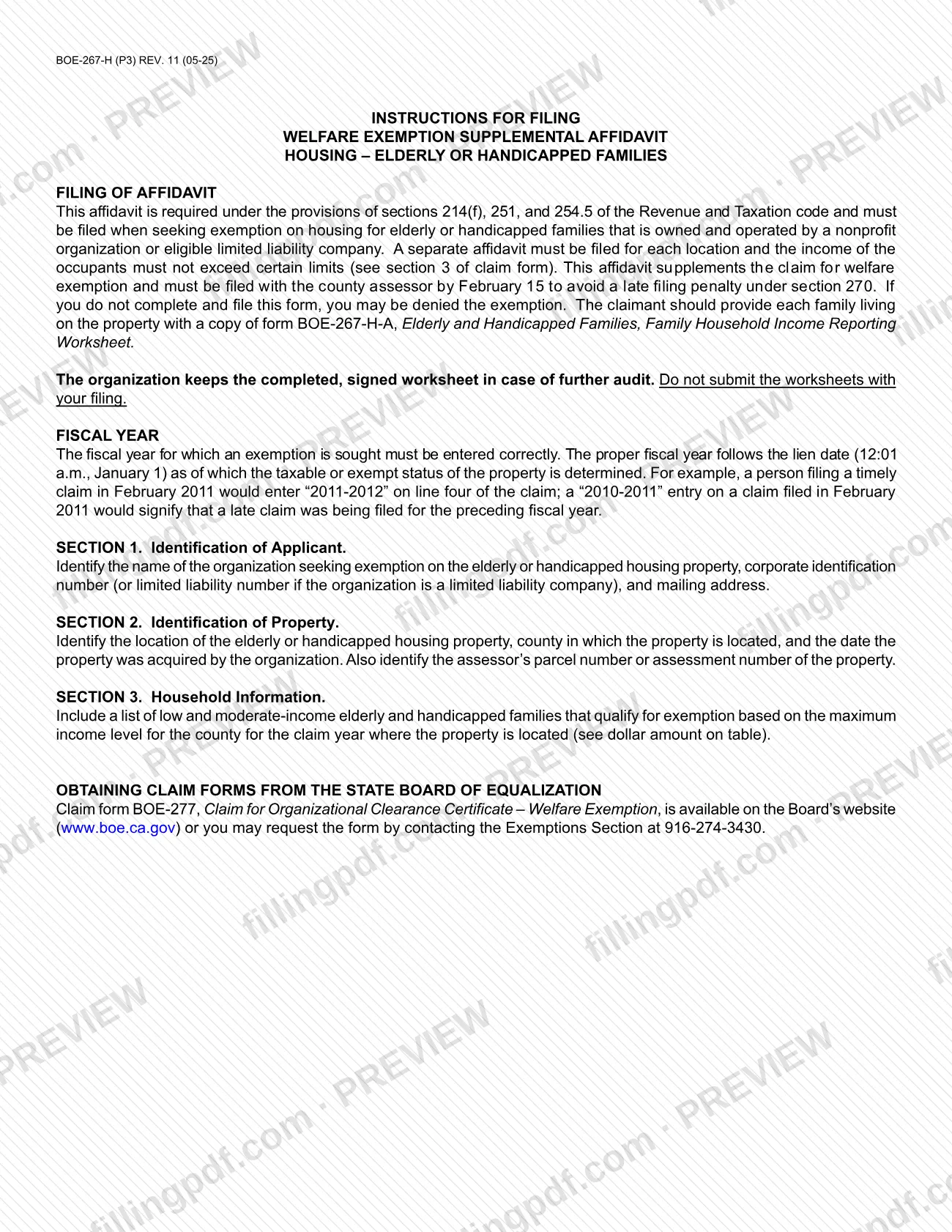
Families living on the property do not file this form. The claimant gives each family a copy of form BOE-267-H-A, Elderly and Handicapped Families, Family Household Income Reporting Worksheet, and keeps the signed worksheets in case of audit.
The instructions warn that if you do not complete and file the affidavit, the exemption may be denied.
When to file BOE-267-H
The claim must be filed by 5:00 p.m., February 15. The instructions say the affidavit must be filed with the county assessor by that date to avoid a late filing penalty under section 270, and that omitting the form may lead to denial of the exemption.
The fiscal year you enter must follow the lien date (12:01 a.m., January 1) that fixes the property's taxable or exempt status. The instructions give an example: a timely claim filed in February 2011 enters "2011-2012", while "2010-2011" on that claim would signal a late claim for the preceding fiscal year.
The affidavit has no due date of its own beyond this: it travels with the BOE-267 or BOE-267-A claim. Collect the signed family worksheets before you complete pages 2 and 3.
Documents you need
- Form BOE-267, Claim for Welfare Exemption (First Filing), or BOE-267-A, Claim for Welfare Exemption (Annual Filing): this affidavit is a supplement filed with one of them.
- A copy of the Organizational Clearance Certificate (OCC), only with a first filing.
- If you have no OCC: the claim you filed with the BOE for one; form BOE-277, Claim for Organizational Clearance Certificate – Welfare Exemption, is available from the BOE.
- The report on pages 2 and 3 of this form: the list of qualified families (or an attached list with the same information), the recap and the exemption calculation.
- A signed statement for each qualifying family, on form BOE-267-H-A. Keep these for audits; the instructions say not to submit the worksheets with your filing.
How to fill out BOE-267-H
Enter the fiscal year
At the top of page 1, enter the fiscal year of the claim in the "20 ___ — 20 ___" spaces. It follows the January 1 lien date.
Confirm the claim it supports
Note that this affidavit is filed with BOE-267 (First Filing) or BOE-267-A (Annual Filing); prepare that claim to go with it.
Identify the applicant (Section 1)
Enter the organization's name, mailing address, city, state and ZIP code, and the Corporate ID or LLC Number. Enter the OCC number, or check Yes or No for whether you have filed an OCC claim with the BOE.
Identify the property (Section 2)
Enter the property address, city, county and ZIP code, the Assessor's Parcel/Assessment Number(s) and the Date Property Acquired.
Fill in the household income table
In Section 3A, enter the maximum income for each household size from 1 to 8 persons. If you do not have the amounts, contact the County Assessor.
List the qualified families
In Section 3B on page 2, enter for each qualifying household the address or unit number, the number of persons and the maximum income it does not exceed. Use additional sheets or an attached list if needed.
Complete the recap
In Section 3C, enter the number of qualified families, the number of non-qualified families and the total number of families.
Calculate the exemption percentage
In Section 3D, enter qualified families over total families to get the maximum percentage of property value eligible for exemption.
Describe the property use
In Section 4, check Yes or No for commercial space and give a brief description of the property's use.
Add a contact for the assessor
On page 1, give the name, daytime telephone and email address of the person the assessor should contact. The "For Assessor's Use Only" box is left blank.
Sign and date the certification
Enter the name, title and date, then sign under penalty of perjury.
Review and download the PDF
Check that pages 1 to 3 are complete and consistent, then download or print the completed PDF from FillingPDF and submit it with your claim as described under How to submit.
How to submit BOE-267-H
The form is filed with the county assessor, by mail or in person; the Riverside County Assessor-County Clerk-Recorder says its PDF forms do not allow online submission.
- By mail: Riverside County Assessor-County Clerk-Recorder, PO BOX 751, Riverside, CA 92502-0751, the address printed on the form.
- In person: deliver it to your local Assessor-County Clerk-Recorder office.
File the affidavit together with your BOE-267 or BOE-267-A claim so that it arrives by 5:00 p.m., February 15. Print the forms in black ink on 8 1/2" x 11" white paper, as the county requires. Do not submit the signed family income worksheets; keep them for audit. For questions, call (951) 413-2757 or visit www.rivcoacr.org. FillingPDF lets you fill out and download the PDF; submission follows the channels above.
Common mistakes to avoid
- Filing after 5:00 p.m. on February 15, which exposes the claim to a late filing penalty under section 270.
- Entering the wrong fiscal year; a claim filed in February with the preceding year entered signals a late claim.
- Filing one affidavit for several locations when a separate affidavit is required for each location.
- Sending the signed family worksheets (BOE-267-H-A) with the filing; the organization must keep them for audit.
- Listing families on page 2 whose household income exceeds the maximum for their household size or who did not sign a statement; only qualifying households belong in the list.
- Leaving the maximum income table blank instead of contacting the County Assessor for the county's figures, which change annually.
- Omitting the OCC copy on a first filing, or not saying whether you have filed an OCC claim with the BOE.
- Not filling in or not signing the certification, which is made under penalty of perjury.
Frequently asked questions
What is Form BOE-267-H used for?
Form BOE-267-H is the supplemental affidavit a nonprofit organization or eligible LLC files to seek the welfare exemption on housing for elderly or handicapped families. It lists the qualifying families and calculates the share of the property eligible for exemption.
When is the BOE-267-H due in Riverside County?
By 5:00 p.m., February 15. The instructions say it must be filed with the county assessor by that date to avoid a late filing penalty under section 270, and that failing to file it may result in denial of the exemption.
Do I file BOE-267-H on its own?
No. It is a supplemental affidavit filed with BOE-267, Claim for Welfare Exemption (First Filing), or BOE-267-A, Claim for Welfare Exemption (Annual Filing). It supplements the claim and does not replace it.
Do I send the family income worksheets with the affidavit?
No. Give each family a copy of form BOE-267-H-A, collect the signed worksheets and keep them for audit. The instructions say not to submit the worksheets with your filing; you submit the list of qualified families on page 2.
Do I need an OCC to file Form BOE-267-H?
Section 1 asks for your Organizational Clearance Certificate (OCC) number, with a copy of the certificate on a first filing. If you have none, state whether you have filed an OCC claim with the BOE; form BOE-277 is available from the BOE.
Where do I send Form BOE-267-H?
Mail it to Riverside County Assessor-County Clerk-Recorder, PO BOX 751, Riverside, CA 92502-0751, or deliver it to your local office. The county says its PDF forms cannot be submitted online. Call (951) 413-2757 with questions.
How is the exemption percentage calculated on this form?
Divide the number of qualified low- and moderate-income elderly and handicapped families by the total number of families on the property. The form's example of 110 qualified out of 120 total gives 91.66% of the property value.
Can I fill out Form BOE-267-H online on FillingPDF?
Yes. You can fill out the PDF online on FillingPDF and download or print it. FillingPDF is independent of Riverside County and does not file the affidavit; you deliver it to the Assessor-County Clerk-Recorder by mail or in person.
Ready to fill out BOE-267-H?
Fill out BOE-267-H now