
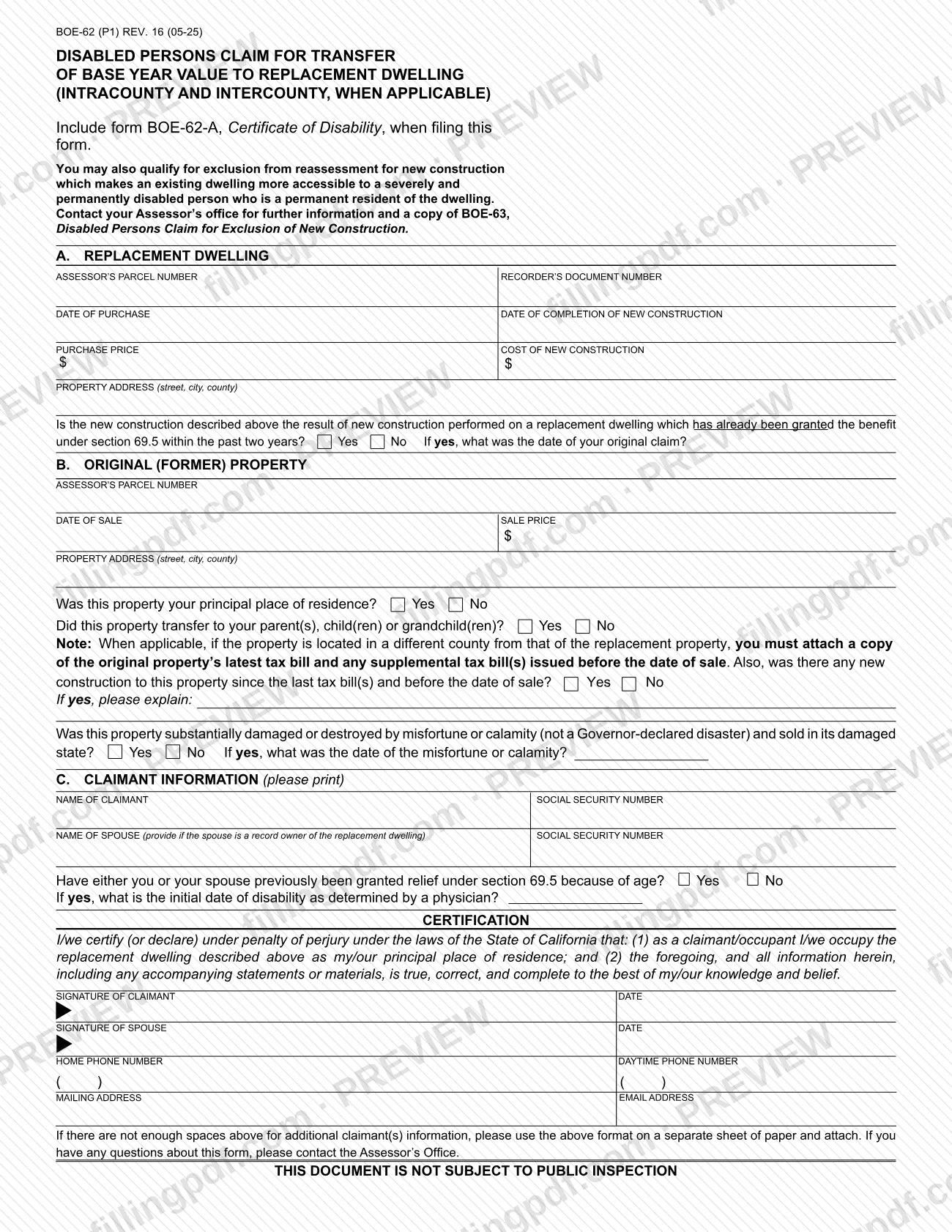
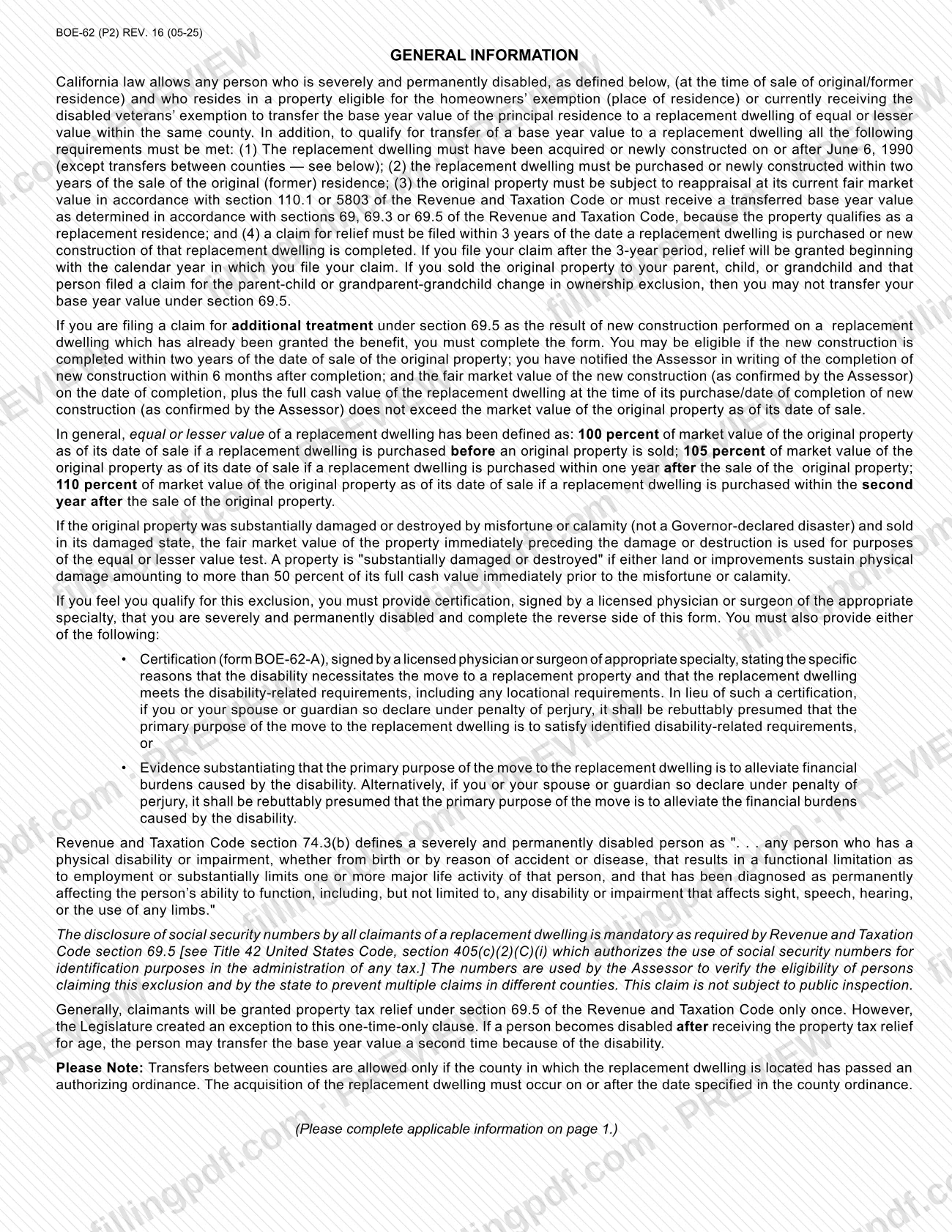
Form BOE-62, Disabled Persons Claim for Transfer of Base Year Value to Replacement Dwelling, is the claim that a severely and permanently disabled person files with the Riverside County Assessor-County Clerk-Recorder to carry the base year value of a former home over to a replacement dwelling. It is one of the Riverside County property tax forms, and it is tied to Revenue and Taxation Code section 69.5. On this page you can fill out the form online on FillingPDF and download or print the completed PDF; the form and its filing rules come from the Assessor-County Clerk-Recorder, and the claim is delivered to that office by mail or in person.
Last updated
What is BOE-62?
Form BOE-62, Disabled Persons Claim for Transfer of Base Year Value to Replacement Dwelling (Intracounty and Intercounty, when applicable), is the claim a severely and permanently disabled person files to move the base year value of a principal residence to a replacement dwelling of equal or lesser value.
The Riverside County Assessor-County Clerk-Recorder distributes this edition. Under the general information printed on the form, California law lets a person who is severely and permanently disabled at the time of sale of the original residence, and who lives in a property eligible for the homeowners' exemption or receives the disabled veterans' exemption, transfer the base year value within the same county. The form is the claim under section 69.5 of the Revenue and Taxation Code.
The form has three parts: A. Replacement Dwelling, B. Original (Former) Property and C. Claimant Information, followed by a certification signed under penalty of perjury. Page 2 holds the general information, including the definition of "severely and permanently disabled" in Revenue and Taxation Code section 74.3(b), the equal-or-lesser-value test and the rules for transfers between counties.
Two companion forms are named on the form: BOE-62-A, Certificate of Disability, which must be included when filing, and BOE-63, Disabled Persons Claim for Exclusion of New Construction, for new construction that makes an existing dwelling more accessible to a severely and permanently disabled permanent resident. Form BOE-62 does not replace BOE-63.
Who needs to file BOE-62?
Any person who is severely and permanently disabled, as defined on the form, at the time the original (former) residence is sold, may file Form BOE-62 to transfer the base year value. The person must live in a property eligible for the homeowners' exemption or currently receive the disabled veterans' exemption, and the replacement dwelling must be of equal or lesser value.
Further conditions printed on the form:
- The replacement dwelling must have been acquired or newly constructed on or after June 6, 1990, except for transfers between counties.
- The replacement dwelling must be purchased or newly constructed within two years of the sale of the original residence.
- Transfers between counties are allowed only if the county of the replacement dwelling has passed an authorizing ordinance.
- A spouse is listed on the claim if the spouse is a record owner of the replacement dwelling.
- Claimants generally receive section 69.5 relief only once. A person who becomes disabled after receiving the relief for age may transfer the base year value a second time because of the disability.
Do not use this claim to transfer a base year value if you sold the original property to your parent, child or grandchild and that person filed a claim for the parent-child or grandparent-grandchild change in ownership exclusion. The same form is used for additional treatment when new construction is done on a replacement dwelling that has already received the benefit.
When to file BOE-62
File the claim within 3 years of the date the replacement dwelling is purchased or the new construction of that dwelling is completed. If you file after the 3-year period, relief begins with the calendar year in which you file the claim.
The replacement dwelling must itself be purchased or newly constructed within two years of the sale of the original residence. The form states that the equal-or-lesser-value test depends on timing: 100 percent of the original property's market value on its date of sale if the replacement is bought before the original is sold, 105 percent if bought within one year after the sale, and 110 percent if bought within the second year after the sale.
For additional treatment after new construction on a replacement dwelling that has already received the benefit, the new construction must be completed within two years of the date of sale of the original property, and you must notify the Assessor in writing of its completion within 6 months after completion. For transfers between counties, the replacement dwelling must be acquired on or after the date specified in the receiving county's ordinance.
Documents you need
- Form BOE-62-A, Certificate of Disability, signed by a licensed physician or surgeon of the appropriate specialty; the form says to include it when filing.
- Certification signed by a licensed physician or surgeon that you are severely and permanently disabled; the form requires it from anyone claiming this exclusion.
- Evidence that the disability requires the move: BOE-62-A stating the specific reasons and that the replacement dwelling meets the disability-related requirements. A declaration under penalty of perjury by you, your spouse or guardian can stand in for the certification.
- Alternatively, evidence that the primary purpose of the move is to alleviate financial burdens caused by the disability, or a declaration under penalty of perjury by you, your spouse or guardian to that effect.
- Copy of the original property's latest tax bill and any supplemental tax bill(s) issued before the date of sale, when the original property is in a different county from the replacement property.
- A separate sheet in the same format, if there is not enough room for additional claimants' information on the form.
How to fill out BOE-62
Identify the replacement dwelling
In A. REPLACEMENT DWELLING, enter the assessor's parcel number, the recorder's document number, the date of purchase and the purchase price, and the property address (street, city, county).
Enter new construction details
If the replacement dwelling involved new construction, enter the date of completion and the cost of new construction. Answer whether the new construction is on a dwelling already granted the benefit under section 69.5 within the past two years, and if yes, give the date of your original claim.
Describe the original property
In B. ORIGINAL (FORMER) PROPERTY, enter the assessor's parcel number, the date of sale, the sale price and the property address (street, city, county).
Answer the original property questions
Check Yes or No for whether it was your principal place of residence and whether it transferred to your parent(s), child(ren) or grandchild(ren). Also answer whether there was new construction since the last tax bill(s) and before the date of sale, and explain if yes.
Report any calamity damage
Check Yes or No for whether the original property was substantially damaged or destroyed by misfortune or calamity (not a Governor-declared disaster) and sold in its damaged state. If yes, enter the date of the misfortune or calamity.
Enter claimant and spouse information
In C. CLAIMANT INFORMATION, enter the name and Social Security number of the claimant. Add the spouse's name and Social Security number if the spouse is a record owner of the replacement dwelling.
Answer the prior relief question
Check Yes or No for whether you or your spouse previously received relief under section 69.5 because of age. If yes, enter the initial date of disability as determined by a physician.
Sign and date the certification
Read the CERTIFICATION made under penalty of perjury. Sign and date as claimant, and have the spouse sign and date if applicable.
Add contact details
Enter the home and daytime phone numbers, the mailing address and the email address at the bottom of page 1. Use a separate sheet in the same format if you need room for more claimants.
Review and download the completed PDF
Check that every entry is complete, that BOE-62-A and any other attachments are ready, and that the original property's tax bills are included for an intercounty claim. Download or print the completed PDF from FillingPDF in black ink on white 8 1/2" x 11" paper and deliver it as described under How to submit.
How to submit BOE-62
Form BOE-62 is delivered to the Assessor-County Clerk-Recorder by mail or in person. The Riverside County Assessor-County Clerk-Recorder says its forms do not allow online submission and must be delivered by mail or in person to your local Assessor-County Clerk-Recorder office.
- By mail: the form header prints the office as Peter Aldana, County of Riverside, Assessor - County Clerk - Recorder, PO Box 751, Riverside, CA 92502-0751.
- In person: take it to your local Assessor-County Clerk-Recorder office.
- Questions: call (951) 955-7006 or visit www.rivcoacr.org.
Print the form in black ink on 8 1/2" x 11" white paper, as the office requires for all of its forms. Include form BOE-62-A, Certificate of Disability, and any other attachment described in the required documents. The form carries the note that it is not subject to public inspection. FillingPDF lets you fill out and download the PDF; submission follows the channels above.
Common mistakes to avoid
- Filing without form BOE-62-A, Certificate of Disability, which the form says to include when filing.
- Filing more than 3 years after the replacement dwelling was purchased or the new construction was completed; relief then starts with the calendar year of filing.
- Leaving out the Social Security numbers; the form says disclosure by all claimants of a replacement dwelling is mandatory.
- Omitting the original property's latest tax bill and supplemental tax bill(s) when it is in a different county from the replacement property.
- Claiming the transfer after selling the original property to a parent, child or grandchild who filed a parent-child or grandparent-grandchild exclusion claim.
- Buying a replacement dwelling that exceeds the 100, 105 or 110 percent market-value limit for the time of purchase.
- Not notifying the Assessor in writing within 6 months after completing new construction that is claimed for additional treatment.
- Leaving out the spouse's name and signature when the spouse is a record owner of the replacement dwelling.
- Printing the form on colored paper or in a color other than black ink; the office requires black ink on white 8 1/2" x 11" paper.
Frequently asked questions
What is Form BOE-62 used for?
Form BOE-62 is the claim a severely and permanently disabled person files to transfer the base year value of a principal residence to a replacement dwelling of equal or lesser value. It is filed under Revenue and Taxation Code section 69.5 with the Assessor-County Clerk-Recorder.
How long do I have to file the BOE-62 claim?
Within 3 years of the date the replacement dwelling is purchased or its new construction is completed. If you file later, relief is granted beginning with the calendar year in which you file the claim.
Do I need Form BOE-62-A with the claim?
Yes, the form says to include BOE-62-A, Certificate of Disability, when filing. A licensed physician or surgeon of the appropriate specialty signs it, stating why the disability requires the move. A declaration under penalty of perjury can stand in for that certification.
Can I transfer my base year value to a home in another county?
Only if the county where the replacement dwelling is located has passed an authorizing ordinance, and the dwelling was acquired on or after the date specified in that ordinance. You must also attach the original property's latest tax bill and any supplemental bills.
Can I use BOE-62 if I sold my home to my child?
Not if your child, parent or grandchild filed a claim for the parent-child or grandparent-grandchild change in ownership exclusion on that property. In that case you may not transfer your base year value under section 69.5.
Can I file the BOE-62 claim online?
The Riverside County Assessor-County Clerk-Recorder says its forms do not allow online submission and must be delivered by mail or in person to your local office. You can fill out the PDF online on FillingPDF and download it, but FillingPDF does not file it with the county.
Can I receive this transfer more than once?
Generally no; claimants receive section 69.5 relief only once. The exception is a person who becomes disabled after receiving the relief because of age, who may transfer the base year value a second time because of the disability.
What is the difference between BOE-62 and BOE-63?
BOE-62 transfers a base year value to a replacement dwelling. BOE-63, Disabled Persons Claim for Exclusion of New Construction, applies to new construction that makes an existing dwelling more accessible to a severely and permanently disabled permanent resident. Ask the Assessor's office for a copy.
Ready to fill out BOE-62?
Fill out BOE-62 now