
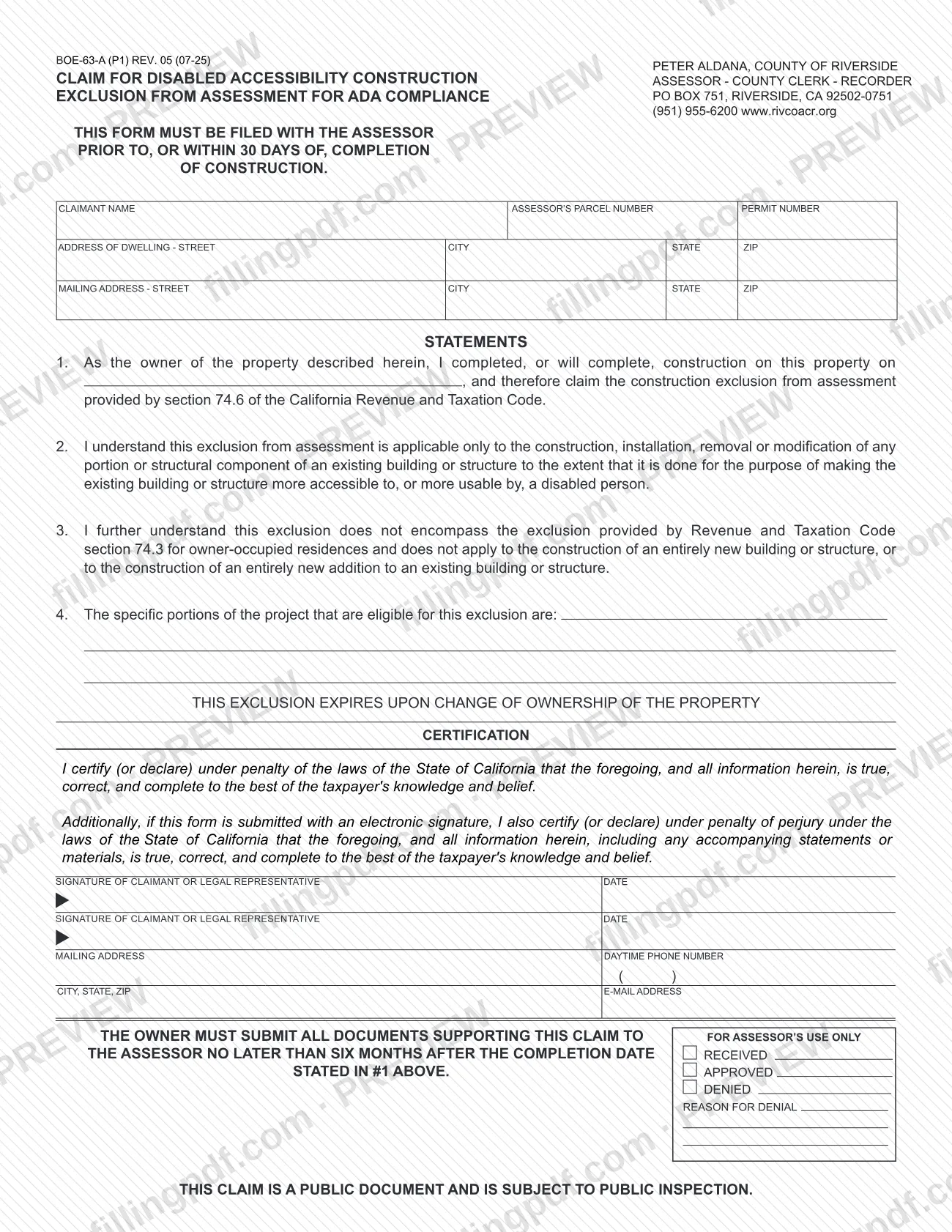
Form BOE-63-A, Claim for Disabled Accessibility Construction Exclusion from Assessment, is the claim a property owner files with the Riverside County Assessor-County Clerk-Recorder to exclude accessibility construction from assessment under section 74.6 of the California Revenue and Taxation Code. It is one of the forms published by the Riverside County Assessor, and it is used when work on an existing building makes it more accessible to, or more usable by, a disabled person. On this page you can fill out the form online on FillingPDF and download or print the completed PDF; the county publishes the original at the source link and does not accept online submission.
Last updated
What is BOE-63-A?
Form BOE-63-A, Claim for Disabled Accessibility Construction Exclusion from Assessment, is the form on which a property owner notifies the Assessor that they claim the construction exclusion that section 74.6 of the California Revenue and Taxation Code provides for accessibility work. The Riverside County Assessor-County Clerk-Recorder publishes this version.
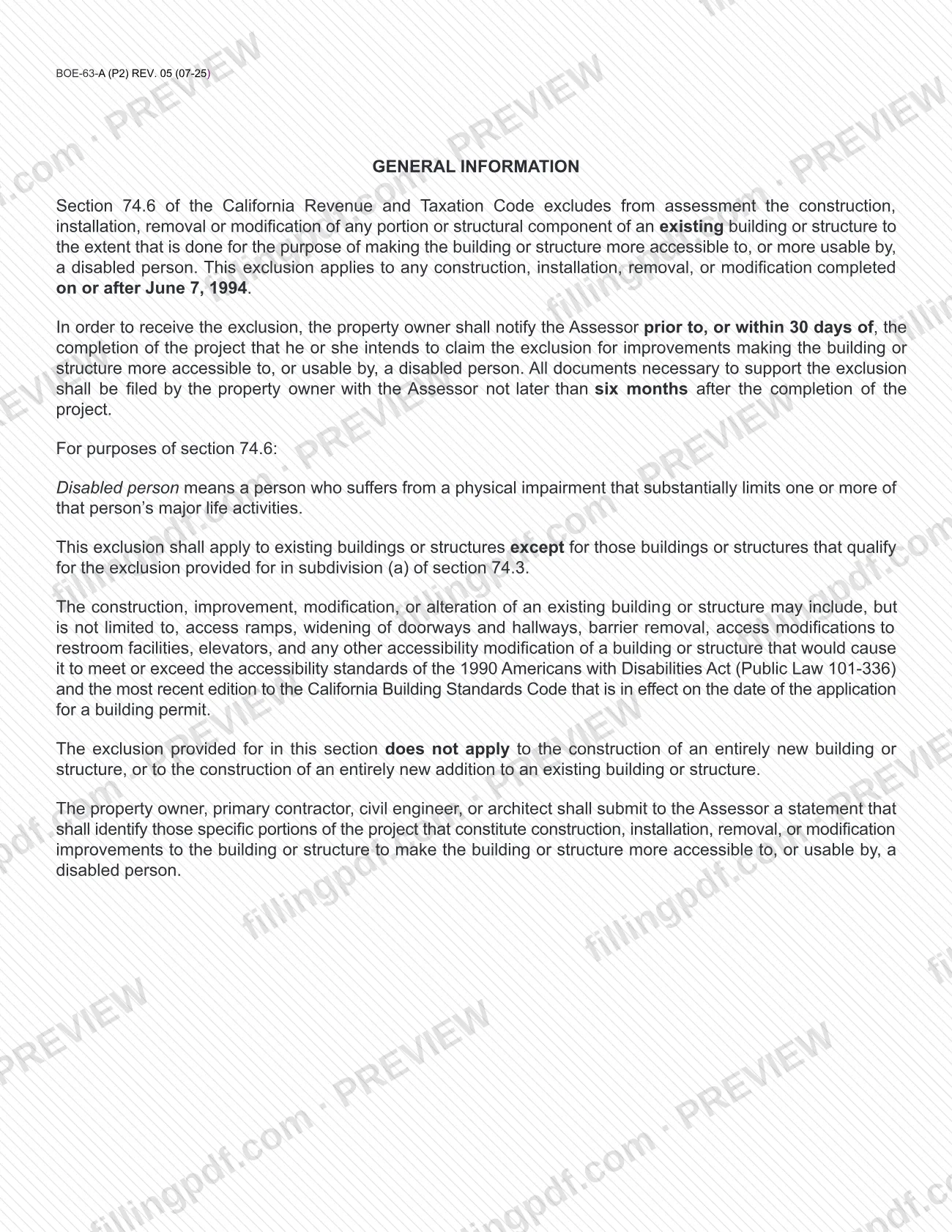
Section 74.6 excludes from assessment the construction, installation, removal or modification of any portion or structural component of an existing building or structure, to the extent it is done to make that building or structure more accessible to, or more usable by, a disabled person. The form's general information says the exclusion applies to work completed on or after June 7, 1994. It defines a disabled person as a person with a physical impairment that substantially limits one or more major life activities.
Examples the form gives include access ramps, widening of doorways and hallways, barrier removal, access modifications to restroom facilities and elevators, and other changes that meet or exceed the accessibility standards of the 1990 Americans with Disabilities Act (Public Law 101-336) and the most recent California Building Standards Code in effect on the date of the building permit application.
The exclusion is not the owner-occupied residence exclusion in section 74.3, and it does not cover an entirely new building, structure or addition. It expires upon change of ownership of the property. The claim is a public document subject to public inspection.
Who needs to file BOE-63-A?
Property owners in Riverside County who have completed, or will complete, accessibility construction on an existing building or structure and want it excluded from assessment use Form BOE-63-A. The form is signed by the claimant or a legal representative.
Conditions that come from the form:
- The work must be done to make an existing building or structure more accessible to, or more usable by, a disabled person.
- The work must have been completed on or after June 7, 1994.
- The exclusion does not cover an entirely new building or structure, or an entirely new addition to an existing building or structure.
- The exclusion is separate from the section 74.3 exclusion for owner-occupied residences, and buildings that qualify under subdivision (a) of section 74.3 are not covered by this one.
Besides the owner, the property owner, primary contractor, civil engineer or architect may submit to the Assessor the statement identifying the specific portions of the project that qualify.
When to file BOE-63-A
File Form BOE-63-A with the Assessor before the construction is completed or within 30 days of its completion. The form states this at the top of page 1, and the general information says the owner must notify the Assessor in that window that they intend to claim the exclusion.
A second deadline applies to the supporting papers. The owner must submit all documents supporting the claim to the Assessor no later than six months after the completion date entered in statement 1 on the form.
The exclusion expires upon change of ownership of the property, so it does not carry over to a new owner.
Documents you need
- All documents supporting the claim, filed with the Assessor no later than six months after the completion date stated in statement 1 of the form.
- A statement identifying the specific portions of the project that are construction, installation, removal or modification work making the building or structure more accessible to, or usable by, a disabled person; the property owner, primary contractor, civil engineer or architect submits it.
How to fill out BOE-63-A
Enter claimant and parcel details
At the top, enter the claimant name, the Assessor's Parcel Number and the permit number.
Enter the dwelling address
Write the street, city, state and ZIP of the dwelling where the work is done.
Enter the mailing address
Give the claimant's mailing address (street, city, state, ZIP) where the Assessor can reach you.
Enter the construction completion date
In statement 1, enter the date you completed, or will complete, the construction. The six-month deadline for supporting documents runs from this date.
Read statements 2 and 3
These state that the exclusion applies only to accessibility work on an existing building or structure and not to the section 74.3 exclusion, a new building or a new addition. Confirm your project fits.
List the eligible project portions
In statement 4, describe the specific portions of the project that are eligible, such as ramps, doorway widening or restroom modifications, if they apply to your work.
Sign and date the certification
The claimant or legal representative signs and dates under the certification. A second signature line and date is provided.
Complete the contact block
Enter the mailing address, daytime phone number, city, state, ZIP and e-mail address in the block beneath the signatures. Leave the For Assessor's Use Only box blank.
Review and download the completed PDF
Check the dates, parcel and permit numbers and your signature. Download or print the completed PDF from FillingPDF in black ink on white 8 1/2" x 11" paper, then deliver it as described under How to submit.
How to submit BOE-63-A
Deliver the completed form to the Riverside County Assessor-County Clerk-Recorder by mail or in person. The county's forms page says its PDF forms do not allow online submission and must be delivered by mail or in person to your local Assessor-County Clerk-Recorder office.
- By mail: the form's header gives the Assessor's address as Assessor - County Clerk - Recorder, PO Box 751, Riverside, CA 92502-0751.
- In person: take it to your local Assessor-County Clerk-Recorder office.
- Questions: call (951) 955-6200 or visit www.rivcoacr.org.
Print the form in black ink on 8 1/2" x 11" white paper, as the county's forms page requires for all its forms. Send or bring the supporting documents within six months after the completion date in statement 1. FillingPDF lets you fill out and download the PDF; submission follows the channels above.
Common mistakes to avoid
- Filing the claim later than 30 days after construction is completed; the form says it must be filed before completion or within 30 days of it.
- Sending the supporting documents more than six months after the completion date entered in statement 1.
- Claiming the exclusion for an entirely new building, structure or addition; the form says it applies only to work on existing buildings or structures.
- Treating the claim as the section 74.3 exclusion for owner-occupied residences; the form says this exclusion does not encompass that one.
- Leaving statement 4 blank instead of naming the specific portions of the project that qualify for the exclusion.
- Expecting the exclusion to continue after a sale; it expires upon change of ownership of the property.
- Leaving the certification unsigned or undated.
- Trying to submit the form online, or printing it on colored paper or in another ink, when the county requires black ink on 8 1/2" x 11" white paper and delivery by mail or in person.
Frequently asked questions
What is Form BOE-63-A used for?
Form BOE-63-A is the claim for the disabled accessibility construction exclusion from assessment under section 74.6 of the California Revenue and Taxation Code. An owner files it with the Assessor to exclude accessibility work on an existing building from assessment.
When do I have to file Form BOE-63-A?
Before the construction is completed or within 30 days of its completion. The form also says the owner must submit all supporting documents to the Assessor no later than six months after the completion date stated in statement 1.
Does the exclusion cover a new addition to my home?
No. The form states that the exclusion does not apply to an entirely new building or structure, or to an entirely new addition to an existing building or structure. It covers modifications to existing buildings that improve access for a disabled person.
Is this the same as the owner-occupied residence exclusion?
No. Statement 3 says the exclusion does not encompass the exclusion in Revenue and Taxation Code section 74.3 for owner-occupied residences, and buildings that qualify under subdivision (a) of section 74.3 are not covered by this claim.
What happens to the exclusion if I sell the property?
It ends. The form states that the exclusion expires upon change of ownership of the property, so a new owner would not inherit it under this claim.
Can I submit Form BOE-63-A online to the Riverside County Assessor?
No. The county says its PDF forms do not allow online submission and must be delivered by mail or in person to your local Assessor-County Clerk-Recorder office. Print the form in black ink on 8 1/2" x 11" white paper.
What kind of work qualifies?
The form lists access ramps, widening of doorways and hallways, barrier removal, restroom access modifications, elevators and other changes that meet or exceed the 1990 Americans with Disabilities Act standards and the current California Building Standards Code edition at the building permit date.
Can I fill out Form BOE-63-A online on FillingPDF?
Yes. You can fill out the PDF online on FillingPDF and download or print it. FillingPDF is an independent service, not connected to the county, and does not file the claim; you deliver it to the Assessor by mail or in person.
Ready to fill out BOE-63-A?
Fill out BOE-63-A now