
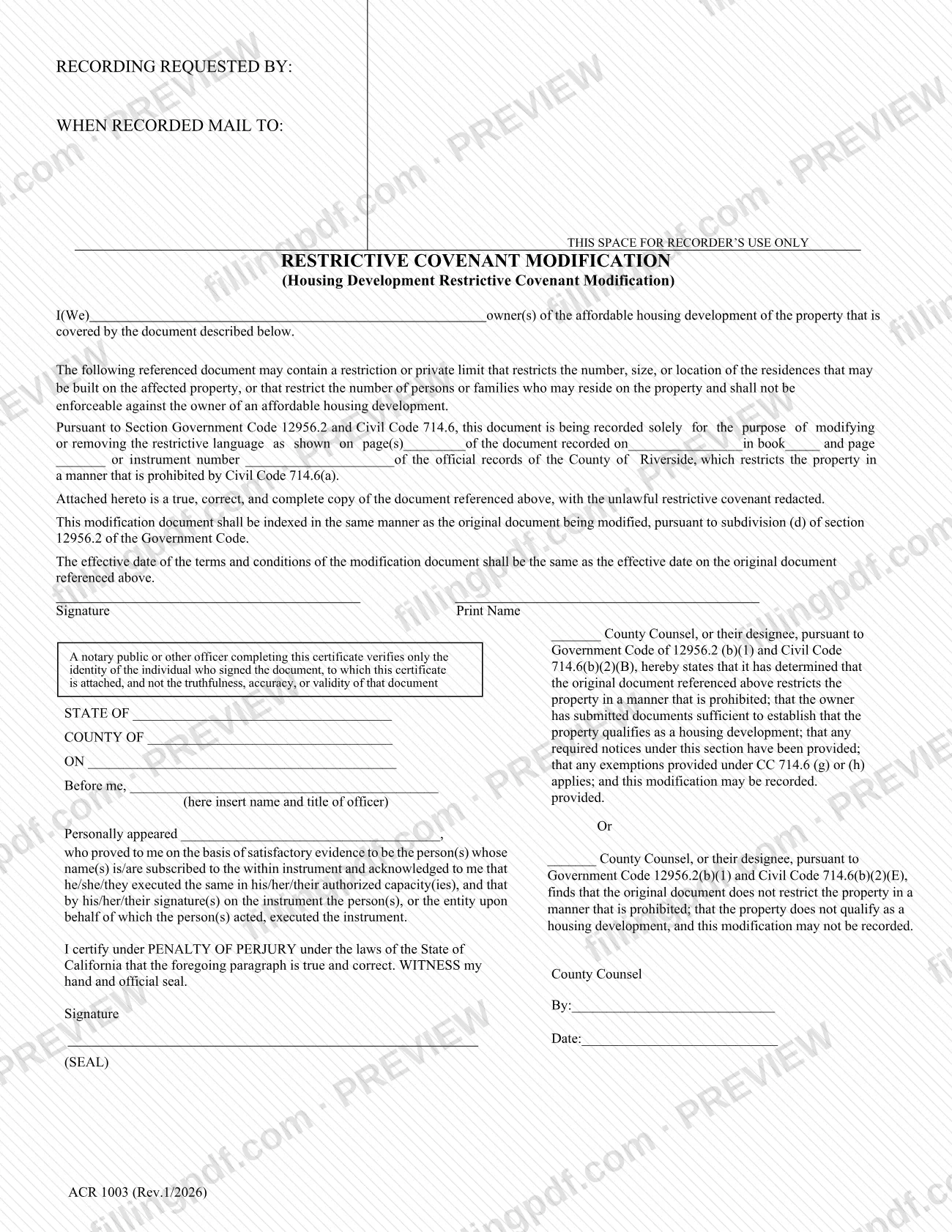
ACR 1003, Restrictive Covenant Modification – Housing Development, is a recordable document issued by the Riverside County Assessor-County Clerk-Recorder (ACR). Owners of an affordable housing development use it to modify or remove restrictive language in a previously recorded document, under Government Code 12956.2 and Civil Code 714.6. On this page you can fill out the form online on FillingPDF and download or print the completed PDF; the form itself and the office's forms page are published by the Riverside County Assessor-County Clerk-Recorder.
Last updated
What is ACR 1003?
Restrictive Covenant Modification – Housing Development (ACR 1003) is the Riverside County Assessor-County Clerk-Recorder form that owners of an affordable housing development record to modify or remove restrictive language in an earlier recorded document.
The form states its purpose: it is recorded solely to modify or remove restrictive language that limits the property in a manner prohibited by Civil Code 714.6(a), citing Government Code 12956.2 and Civil Code 714.6. The language it addresses is a restriction or private limit on the number, size, or location of residences that may be built on the property, or on the number of persons or families who may reside there. The form says such a restriction is not enforceable against the owner of an affordable housing development.
You identify the original document by the page(s) where the language appears and by its recording date, book and page, or instrument number in the official records of the County of Riverside. You attach a true, correct, and complete copy of that document with the unlawful restrictive covenant redacted.
The form also carries a notary acknowledgment and a County Counsel block. In that block, County Counsel, or their designee, either states that the modification may be recorded or finds that it may not be recorded. Once recorded, the modification is indexed in the same manner as the original document, and its effective date is the same as the original's.
Who needs to file ACR 1003?
The owner or owners of an affordable housing development whose property is covered by a recorded document containing a prohibited restrictive covenant use this form. The form is written in the first person ("I(We) owner(s) of the affordable housing development") and is signed by the owner or owners, with a printed name and a notary acknowledgment.
County Counsel, or their designee, completes a separate block on the form. It states one of two outcomes: that the original document restricts the property in a prohibited manner, that the owner submitted documents sufficient to show the property qualifies as a housing development, and that the modification may be recorded; or that the original document does not restrict the property in a prohibited manner, that the property does not qualify as a housing development, and that the modification may not be recorded.
The form applies to restrictions prohibited by Civil Code 714.6(a). It is not a general-purpose recording document. The Assessor-County Clerk-Recorder's forms page says its employees cannot give legal advice or help prepare legal documents, so questions about whether this form fits your transaction go to an attorney or other professional.
When to file ACR 1003
The form has no due date printed on it. You record it when you, as owner of an affordable housing development, want to modify or remove a prohibited restrictive covenant in an earlier recorded document. County Counsel, or their designee, must complete the determination block on the form, and the form states the modification may be recorded only if County Counsel finds that it may be. The modification takes the same effective date as the original document it modifies.
Documents you need
- A true, correct, and complete copy of the previously recorded document, with the unlawful restrictive covenant redacted, attached to the form.
- Documents sufficient to establish that the property qualifies as a housing development: County Counsel's determination refers to documents the owner has submitted; the form does not list them.
How to fill out ACR 1003
Complete the recording request areas
At the top, fill in RECORDING REQUESTED BY and WHEN RECORDED MAIL TO with the name and mailing address for the recorded document. Leave the area marked THIS SPACE FOR RECORDER'S USE ONLY blank.
Identify the owner or owners
In the opening statement ("I(We) owner(s) of the affordable housing development"), enter the owner name or names as the form asks.
Enter the page numbers of the covenant
Write the page(s) of the original document where the restrictive language appears, in the blank after "as shown on page(s)".
Enter the recording information
Enter the date the original document was recorded, and either the book and page or the instrument number, in the official records of the County of Riverside.
Attach the redacted copy
Attach a true, correct, and complete copy of the original document with the unlawful restrictive covenant redacted, as the form states.
Sign and print your name
Each owner signs in the Signature column and prints a name in the Print Name column. Do not sign before you meet the notary or officer completing the acknowledgment.
Complete the notary acknowledgment
The notary or officer enters the state and county, the date, the officer's name and title, and the name of each person who appeared, then signs and affixes the seal. The certificate verifies only the signer's identity, not the truth of the document.
Leave the County Counsel block to County Counsel
County Counsel, or their designee, completes the determination (that the modification may be recorded, or may not be recorded), with signature and date under County Counsel. Do not fill in this block.
Review and download the completed PDF
Check the recording details and the attached copy, then download or print the completed PDF from FillingPDF in black ink on 8 1/2" x 11" white paper. Deliver it as described under How to submit.
How to submit ACR 1003
Form ACR 1003 is delivered by mail or in person to your local Assessor-County Clerk-Recorder office.
- By mail or in person: the Assessor-County Clerk-Recorder's forms page says its PDF forms do not allow online submission and must be delivered by mail or in person to your local office. The form prints no street address or P.O. box; contact the Riverside County Assessor-County Clerk-Recorder for the office location.
- Printing: the forms page says all forms must be printed in black ink on 8 1/2" x 11" white paper.
- Package: include the completed, signed and notarized form and the attached copy of the original document with the unlawful restrictive covenant redacted. Fill in the "Recording requested by" and "When recorded mail to" areas at the top of the form.
The form does not state a fee or a processing time. FillingPDF lets you fill out and download the PDF; submission follows the channels above.
Common mistakes to avoid
- Attaching a copy of the original document that is incomplete or still shows the restrictive covenant; the form says the attached copy must be true, correct, and complete with the unlawful covenant redacted.
- Leaving out the recording details of the original document: the page(s) of the restrictive language, the recording date, and the book and page or instrument number.
- Submitting the form without the notary acknowledgment completed, or with the owner signature missing.
- Filling in the County Counsel block yourself; it is completed by County Counsel or their designee, who either approve or refuse recording.
- Printing the form in a color other than black ink or on paper other than 8 1/2" x 11" white paper.
- Trying to submit the form online; the Assessor-County Clerk-Recorder says its PDF forms must be delivered by mail or in person.
- Using the form for a property that does not qualify as a housing development; the form says County Counsel may find that the modification may not be recorded.
Frequently asked questions
What is Form ACR 1003?
ACR 1003 is the Riverside County Assessor-County Clerk-Recorder's Restrictive Covenant Modification – Housing Development. Owners of an affordable housing development record it to modify or remove restrictive language in a recorded document that restricts the property in a manner prohibited by Civil Code 714.6(a).
Who can use the Restrictive Covenant Modification – Housing Development?
The owner or owners of an affordable housing development covered by a recorded document containing a prohibited restriction. The form is signed by the owner and notarized. County Counsel, or their designee, separately determines whether the modification may be recorded.
Can I fill out ACR 1003 online?
You can fill out the PDF online on FillingPDF and download or print it. Submission is not online: the Assessor-County Clerk-Recorder says its forms must be delivered by mail or in person to your local office. FillingPDF does not file or record the form.
What do I attach to ACR 1003?
Attach a true, correct, and complete copy of the original recorded document with the unlawful restrictive covenant redacted. The form also refers to documents the owner submits to establish that the property qualifies as a housing development, but it does not list them.
Does ACR 1003 need to be notarized?
The form includes a notary acknowledgment block, which the notary or officer completes with the state, county, date and name of the signer. The certificate verifies only the signer's identity, not the truth, accuracy, or validity of the document.
What does County Counsel do on this form?
County Counsel, or their designee, completes a block stating one of two outcomes. Either the original document prohibitedly restricts the property, the property qualifies as a housing development and the modification may be recorded, or the property does not qualify and the modification may not be recorded.
Where do I submit the restrictive covenant modification form?
Deliver it by mail or in person to your local Riverside County Assessor-County Clerk-Recorder office. The agency's forms page says its PDF forms do not allow online submission and must be printed in black ink on 8 1/2" x 11" white paper.
What is the effective date of a recorded modification?
The form says the effective date of the modification is the same as the effective date of the original document. It also says the modification is indexed in the same manner as the original, under subdivision (d) of Government Code section 12956.2.
Ready to fill out ACR 1003?
Fill out ACR 1003 now