
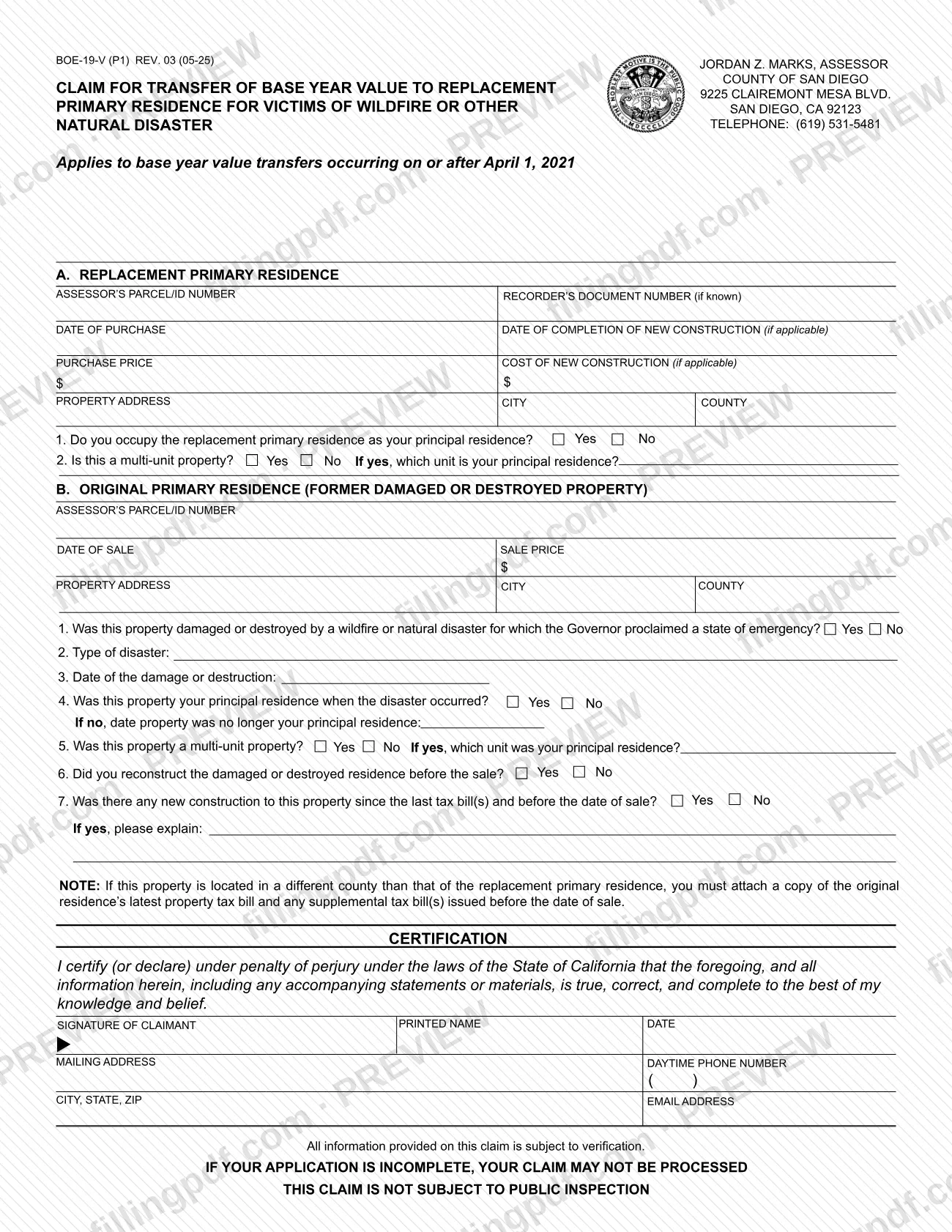
Form BOE-19-V is the claim an owner files with the county Assessor to move the factored base year value of a primary residence damaged or destroyed by a wildfire or other natural disaster to a replacement primary residence in California. This copy is issued by the San Diego County Assessor and is one of the San Diego County property tax forms for people recovering from a Governor-proclaimed disaster. On this page you can fill out the form online on FillingPDF and download or print the completed PDF; the official PDF is published by the San Diego County Assessor/Recorder/County Clerk at sdarcc.gov.
Last updated
What is BOE-19-V?
Form BOE-19-V is the claim a disaster victim files with the county Assessor to transfer the factored base year value of a damaged or destroyed primary residence to a replacement primary residence anywhere in California.
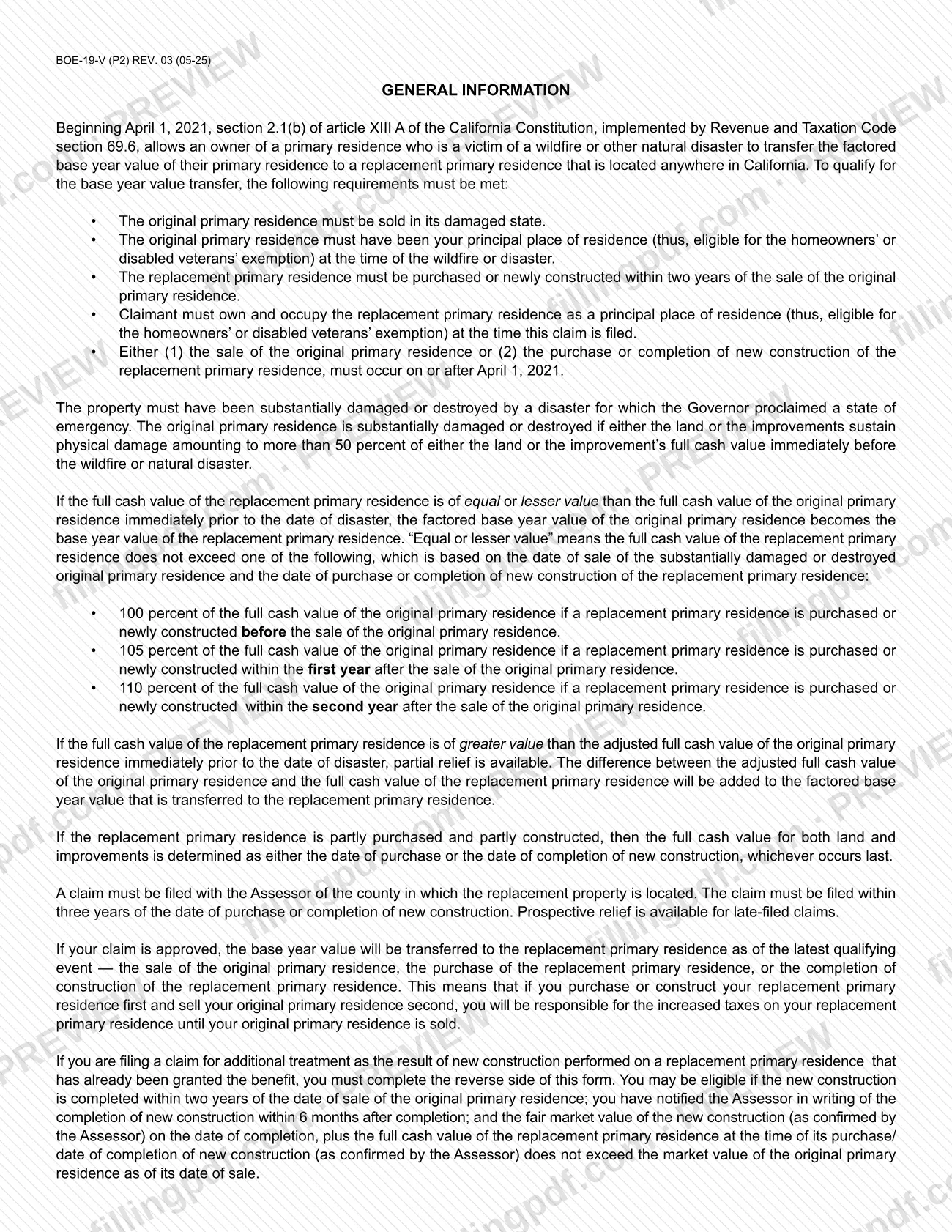
The form applies to base year value transfers occurring on or after April 1, 2021. Its General Information page explains that section 2.1(b) of article XIII A of the California Constitution, implemented by Revenue and Taxation Code section 69.6, allows the transfer. A property counts as substantially damaged or destroyed when the land or the improvements sustain physical damage of more than 50 percent of their full cash value immediately before the disaster, and the Governor must have proclaimed a state of emergency.
How much of the value transfers depends on the replacement's full cash value. If it does not exceed 100 percent of the original residence's full cash value (replacement bought or built before the original is sold), 105 percent (within the first year after the sale) or 110 percent (within the second year), the original factored base year value becomes the replacement's base year value. If the replacement is worth more, partial relief is available: the difference is added to the transferred value.
The Assessor's forms page lists separate applications for transfers before April 1, 2021 (intercounty and intracounty), so this claim is not the form for those. The claim is not subject to public inspection.
Who needs to file BOE-19-V?
Owners of a primary residence who are victims of a wildfire or other natural disaster and want to carry their base year value to a replacement primary residence use this claim. The form lists these requirements:
- The original primary residence was sold in its damaged state.
- It was your principal place of residence at the time of the disaster, so it was eligible for the homeowners' or disabled veterans' exemption.
- The replacement was purchased or newly constructed within two years of the sale of the original.
- You own and occupy the replacement as your principal place of residence, eligible for the homeowners' or disabled veterans' exemption, when you file the claim.
- Either the sale of the original, or the purchase or completion of new construction of the replacement, occurred on or after April 1, 2021.
The disaster must be one for which the Governor proclaimed a state of emergency.
Owners whose replacement residence has already been granted this benefit and who later completed new construction on it may qualify for additional treatment by completing the reverse side of the form. The form does not describe who may sign for a claimant; the certification is signed by the claimant.
When to file BOE-19-V
File the claim within three years of the date of purchase or the date of completion of new construction of the replacement primary residence. Prospective relief is available for late-filed claims.
The replacement must be purchased or newly constructed within two years of the sale of the original primary residence. If the replacement is partly purchased and partly constructed, the full cash value is set as of the later of the purchase date or the completion date.
If the claim is approved, the base year value transfers as of the latest qualifying event: the sale of the original, the purchase of the replacement or the completion of its construction. If you buy or build the replacement first and sell the original second, you pay the increased taxes on the replacement until the original is sold.
For additional treatment for new construction on a replacement that already received the benefit, the form says the construction must be completed within two years of the sale of the original and you must notify the Assessor in writing within 6 months after completion.
Documents you need
- Copy of the original residence's latest property tax bill, only if the original primary residence is in a different county than the replacement primary residence.
- Copy of any supplemental tax bill(s) for the original residence issued before the date of sale, only if the two properties are in different counties.
- Written notice to the Assessor of completion of new construction, within 6 months after completion, only if you seek additional treatment for new construction on a replacement residence that already received the benefit.
How to fill out BOE-19-V
Identify the replacement property
In Section A, enter the Assessor's Parcel/ID Number, the Recorder's Document Number if known, and the property address, city and county.
Enter purchase or construction details
In Section A, enter the date of purchase and purchase price. If applicable, also enter the date of completion of new construction and its cost.
Answer the occupancy questions
Section A, question 1: check Yes or No for whether you occupy the replacement as your principal residence. Question 2: say whether it is a multi-unit property and, if yes, which unit is your principal residence.
Identify the original residence
In Section B, enter the parcel/ID number, date of sale, sale price, and the property address, city and county of the damaged or destroyed property.
Describe the disaster
Section B, questions 1 to 3: confirm the Governor proclaimed a state of emergency, enter the type of disaster and the date of the damage or destruction.
Confirm residence status at disaster
Question 4: check whether it was your principal residence when the disaster occurred; if No, give the date it stopped being your principal residence. Question 5: note any multi-unit status and the unit.
Report reconstruction and new construction
Question 6: check whether you reconstructed the residence before the sale. Question 7: check whether there was new construction since the last tax bill(s) and before the sale, and explain if Yes.
Complete the certification block
Sign, print your name and date the certification. Enter your mailing address, city, state and ZIP, daytime phone number and email address.
Add the reverse-side claim if needed
If you claim additional treatment for new construction on a replacement residence that already received the benefit, complete the reverse side of the form.
Review, sign and download the PDF
Check that every question is answered and the certification is signed, then download or print the completed PDF from FillingPDF. Attach the tax bills if the properties are in different counties and submit as described under How to submit.
How to submit BOE-19-V
File the claim with the Assessor of the county where the replacement primary residence is located. The form prints no portal, e-mail or separate mailing instruction.
- San Diego County Assessor: the header of this version prints the office as 9225 Clairemont Mesa Blvd., San Diego, CA 92123, telephone (619) 531-5481. Call that number to confirm how the office accepts claims.
- Another California county: if the replacement residence is in a different county, file with that county's Assessor, which may use its own version of the form.
If the original residence is in a different county than the replacement, attach a copy of the original residence's latest property tax bill and any supplemental tax bill(s) issued before the date of sale.
The form warns that all information is subject to verification and that an incomplete application may not be processed. The claim is not subject to public inspection. FillingPDF lets you fill out and download the PDF; submission follows the Assessor's channels above.
Common mistakes to avoid
- Filing with the Assessor of the original residence's county when the replacement is elsewhere; the claim goes to the county where the replacement is located.
- Leaving out the latest property tax bill and any supplemental bills when the original and replacement residences are in different counties.
- Filing more than three years after the purchase or completion of new construction; late claims get only prospective relief.
- Buying or building the replacement more than two years after selling the original residence.
- Selling the original residence after reconstructing it; the requirements say it must be sold in its damaged state, so answer Section B question 6 accurately.
- Filing before you occupy the replacement as your principal residence; you must own and occupy it when the claim is filed.
- Submitting an incomplete claim; the form says it may not be processed.
- Leaving the certification unsigned; the claimant signs under penalty of perjury under California law.
- Expecting the transfer to take effect at purchase when the original is sold later; it applies as of the latest qualifying event.
Frequently asked questions
What is Form BOE-19-V used for?
Form BOE-19-V is the claim to transfer the factored base year value of a primary residence damaged or destroyed in a wildfire or other natural disaster to a replacement primary residence anywhere in California. It applies to transfers occurring on or after April 1, 2021.
Who qualifies for the base year value transfer after a disaster?
You qualify if the original residence was your principal residence at the time of a Governor-proclaimed disaster and was sold damaged, you bought or built the replacement within two years of that sale, and you own and occupy it when you file. The sale or purchase must be on or after April 1, 2021.
What is the deadline to file Form BOE-19-V?
File within three years of the date of purchase or completion of new construction of the replacement primary residence. Prospective relief is available for claims filed late, so a late claim is not lost, but it does not reach back.
How much can the replacement home cost and still keep my base year value?
The full cash value of the replacement must not exceed 100 percent of the original's full cash value if bought before the original's sale, 105 percent within the first year after the sale, or 110 percent within the second year. If it exceeds the limit, partial relief applies.
Where do I file the claim?
File with the Assessor of the county where the replacement property is located. This version prints the San Diego County Assessor at 9225 Clairemont Mesa Blvd., San Diego, CA 92123, telephone (619) 531-5481. If the original residence is in another county, attach its latest tax bill and any supplemental bills.
Do I need to attach anything to Form BOE-19-V?
Only if the original and replacement residences are in different counties: attach a copy of the original's latest property tax bill and any supplemental tax bill(s) issued before the date of sale. The form lists no other attachments.
Can I fill out Form BOE-19-V online?
You can fill out the PDF online on FillingPDF and download or print it. FillingPDF is independent of the San Diego County Assessor and does not file claims; you submit the completed form through the Assessor's channels.
Is this the form for disasters before April 1, 2021?
No. Form BOE-19-V applies to transfers occurring on or after April 1, 2021. The San Diego County Assessor's forms page lists separate applications for intercounty and intracounty transfers before April 1, 2021.
Ready to fill out BOE-19-V?
Fill out BOE-19-V now