
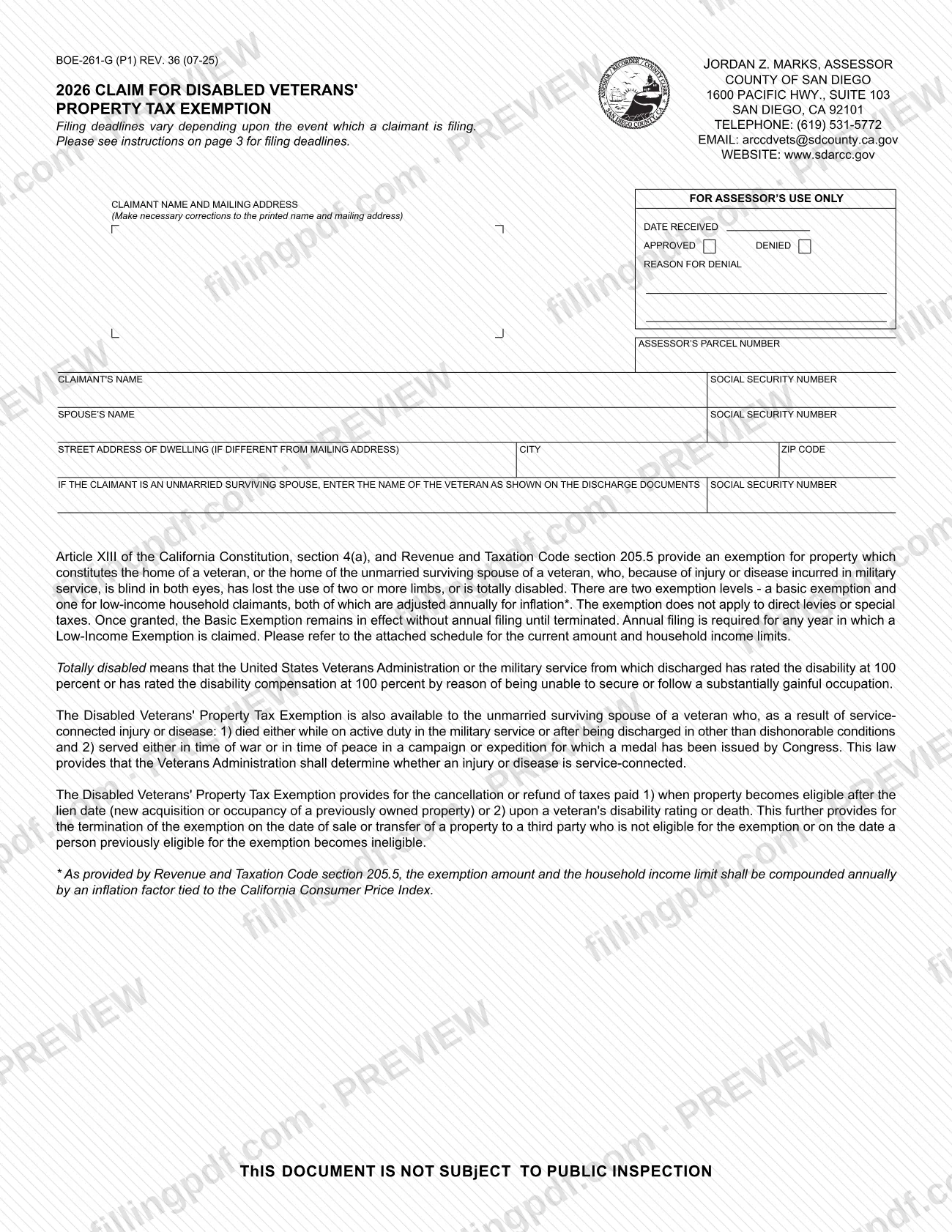
Form BOE-261-G, Basic Disabled Veterans' Exemption Application, is the claim the San Diego County Assessor uses to grant the Disabled Veterans' Property Tax Exemption on the home of a qualifying veteran or unmarried surviving spouse. The printed title is "2026 Claim for Disabled Veterans' Property Tax Exemption". It is one of the San Diego County property tax exemption forms, and it serves first-time claimants and annual Low-Income Exemption claimants. On this page you can fill out the form online on FillingPDF and download or print the completed PDF; the Assessor publishes the original PDF at the official link below.
Last updated
What is BOE-261-G?
Form BOE-261-G, Basic Disabled Veterans' Exemption Application, is the San Diego County Assessor's claim form for the Disabled Veterans' Property Tax Exemption, which exempts part of the value of a home belonging to a qualifying disabled veteran or unmarried surviving spouse from property tax.
The form cites Article XIII of the California Constitution, section 4(a), and Revenue and Taxation Code section 205.5. The exemption covers the home of a veteran who, because of injury or disease incurred in military service, is blind in both eyes, has lost the use of two or more limbs, or is totally disabled. The unmarried surviving spouse of certain veterans may also qualify.
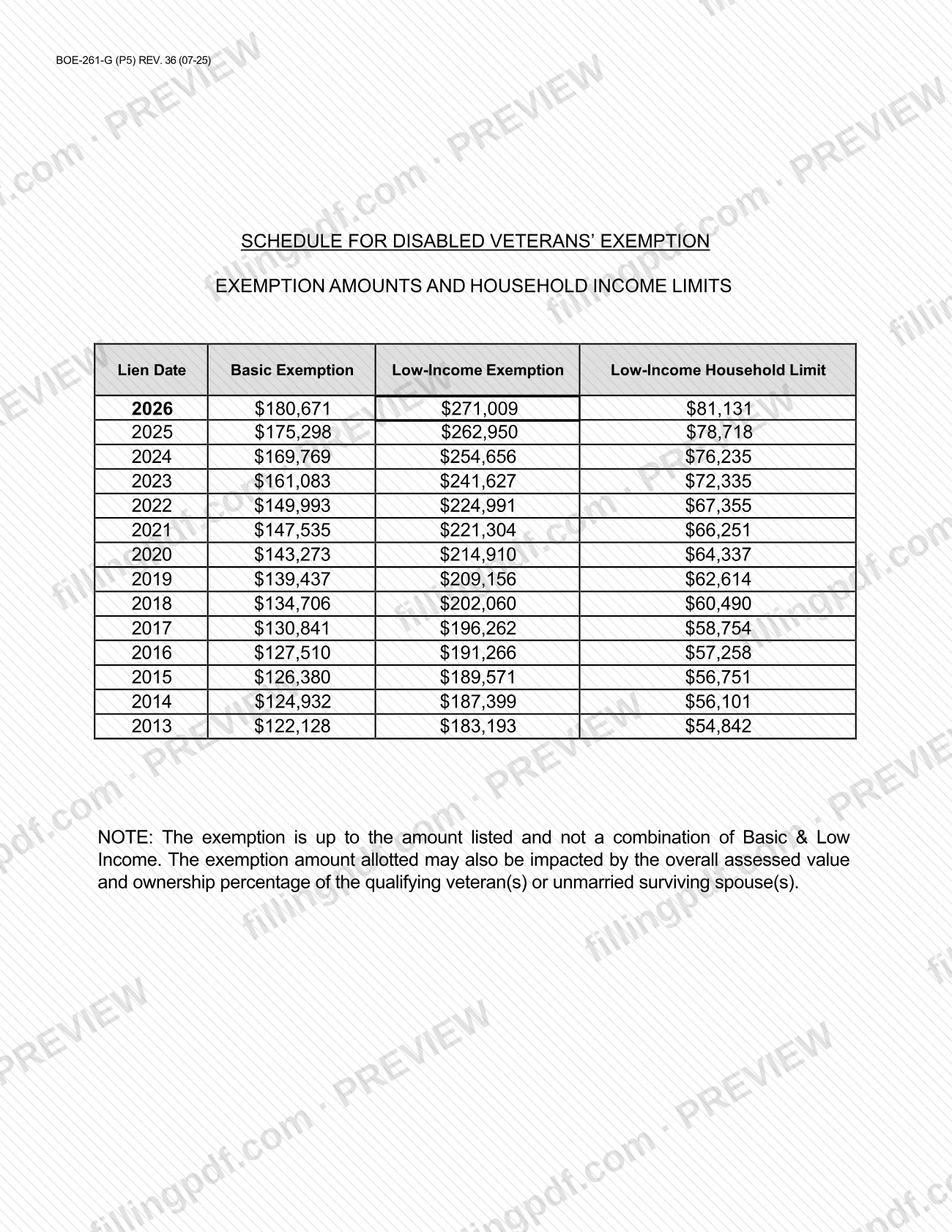
There are two exemption levels: a basic exemption and one for low-income household claimants. Both are adjusted annually for inflation, and the schedule on page 5 of the form lists the current amounts and household income limits. The exemption does not apply to direct levies or special taxes. Once granted, the Basic Exemption stays in effect without annual filing until it is terminated; the Low-Income Exemption must be claimed every year.
The exemption also provides for cancellation or refund of taxes paid when a property becomes eligible after the lien date, or upon a veteran's disability rating or death. It ends on the date of sale or transfer to a third party who is not eligible, or when the person stops being eligible.
Who needs to file BOE-261-G?
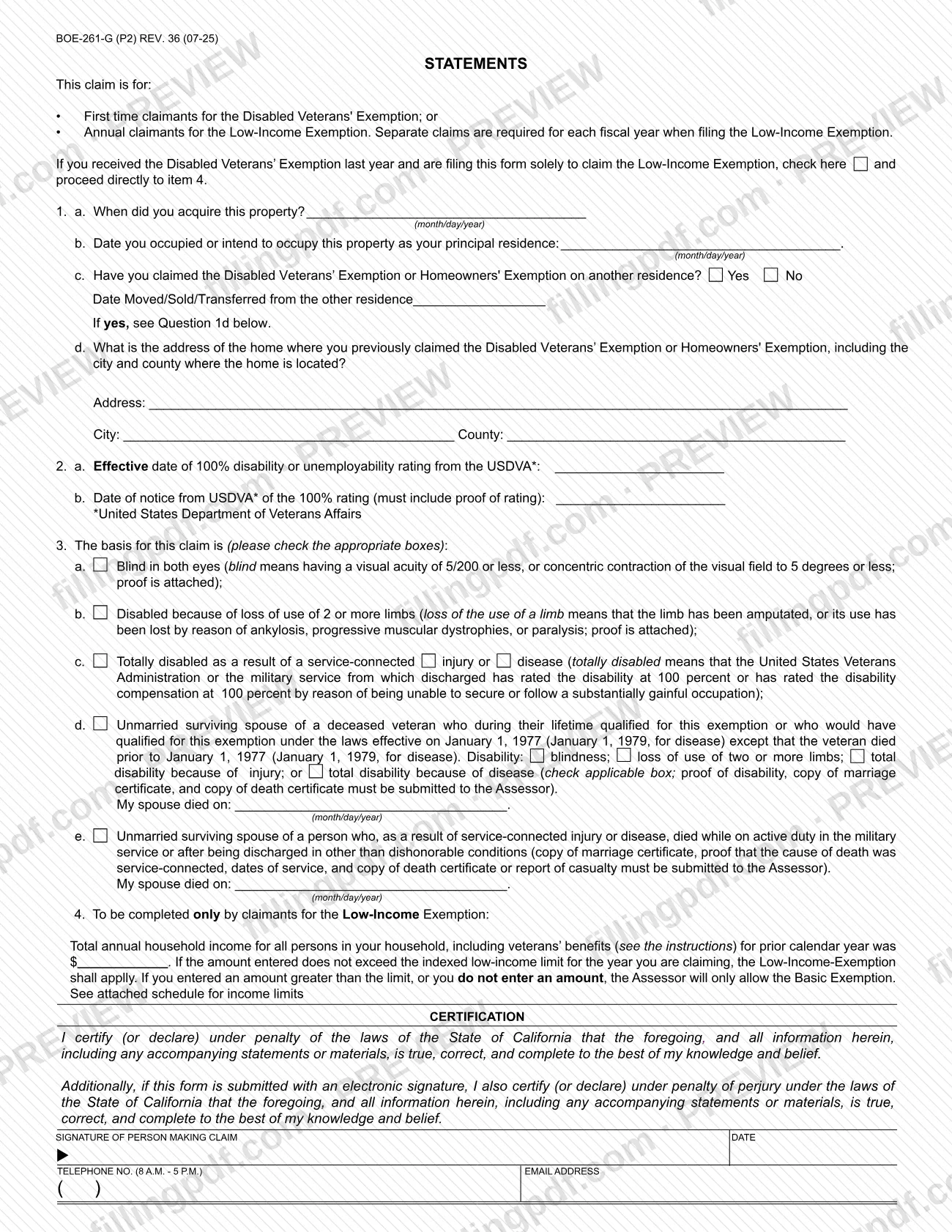
The main group is a veteran who owns and lives in a home and, because of service-connected injury or disease, is blind in both eyes, has lost the use of two or more limbs, or is totally disabled. On this form a veteran checks box 3a, 3b or 3c. Totally disabled means the United States Veterans Administration or the military service of discharge has rated the disability at 100 percent, or has rated the disability compensation at 100 percent because the veteran cannot secure or follow a substantially gainful occupation.
Other groups:
- The unmarried surviving spouse of a veteran who qualified during life, or would have qualified under the laws in effect on January 1, 1977 (January 1, 1979, for disease), checks box 3d.
- The unmarried surviving spouse of a person who died of a service-connected injury or disease while on active duty, or after discharge in other than dishonorable conditions, checks box 3e.
- Claimants must be an owner or co-owner, a veteran spouse of an owner, a purchaser named in a contract of sale, or a shareholder in a corporation whose shares entitle them to possess the home.
The form is for first-time claimants and for annual Low-Income Exemption claimants. A dwelling does not qualify if it is, or is meant to be, rented, vacant and unoccupied, or the claimant's vacation or secondary home.
When to file BOE-261-G
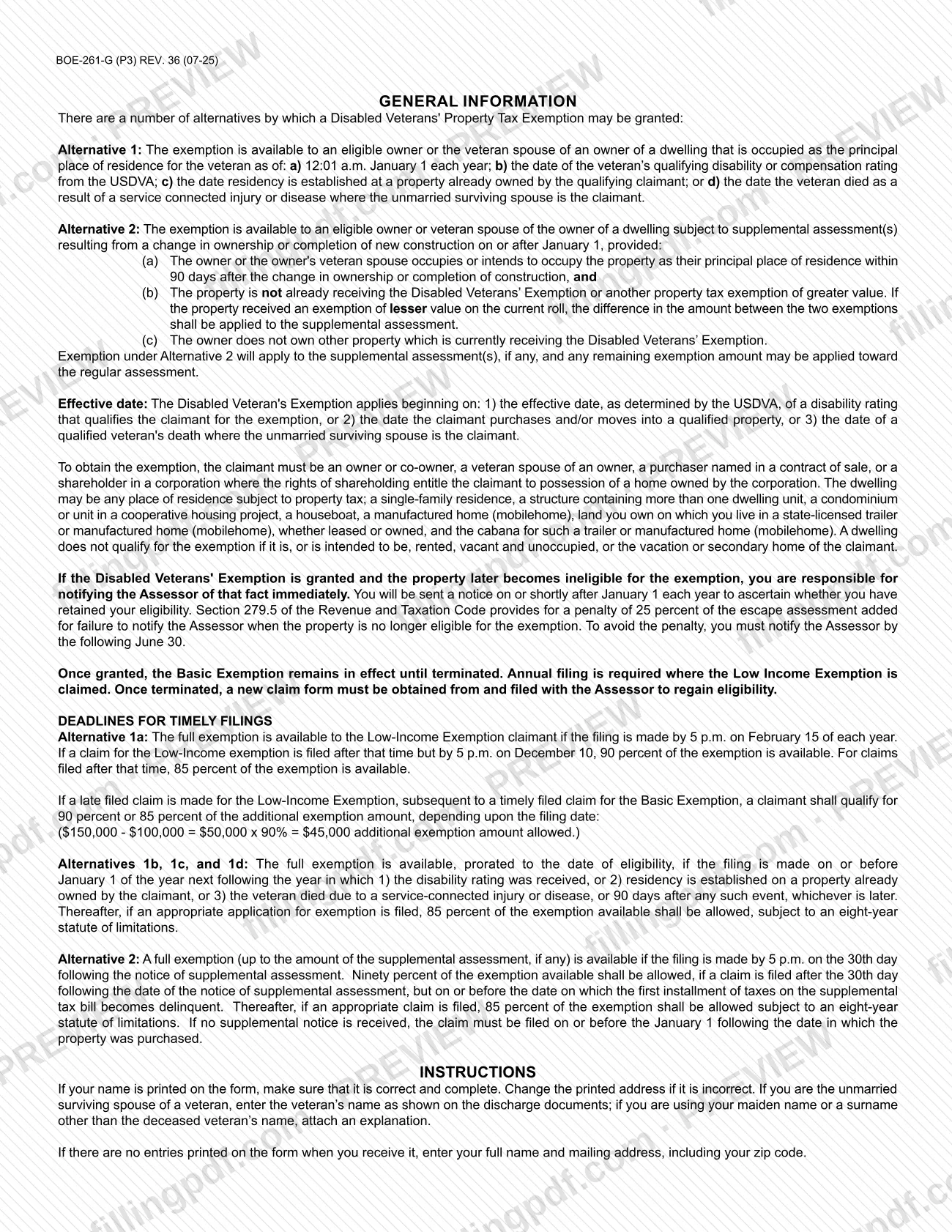
Deadlines depend on the event behind the claim. For the annual Low-Income Exemption, the full exemption is available if you file by 5 p.m. on February 15 of each year; 90 percent is available if you file after that but by 5 p.m. on December 10, and 85 percent after that.
For a new disability rating, a move into a property you already own, or the veteran's death, the full exemption, prorated to the date of eligibility, is available if you file on or before January 1 of the year after the event, or within 90 days of it, whichever is later. After that, 85 percent is allowed, subject to an eight-year statute of limitations.
For a property with a supplemental assessment, the full exemption (up to the supplemental amount) is available if you file by 5 p.m. on the 30th day after the notice. Later claims receive 90 percent until the first installment of the supplemental bill becomes delinquent, then 85 percent. If no notice arrives, file by the January 1 after the purchase.
Documents you need
- Proof of the USDVA 100 percent disability or unemployability rating, with the date of the notice (item 2b): the form says the notice date must come with proof of rating.
- Proof of blindness, if you check box 3a (blind in both eyes): the form says proof is attached.
- Proof of loss of use of two or more limbs, if you check box 3b: the form says proof is attached.
- For an unmarried surviving spouse checking box 3d: proof of the veteran's disability, a copy of the marriage certificate and a copy of the death certificate.
- For an unmarried surviving spouse checking box 3e: copy of the marriage certificate, proof that the cause of death was service-connected, dates of service, and a death certificate or report of casualty.
- An explanation, if you are an unmarried surviving spouse using your maiden name or a surname other than the deceased veteran's name.
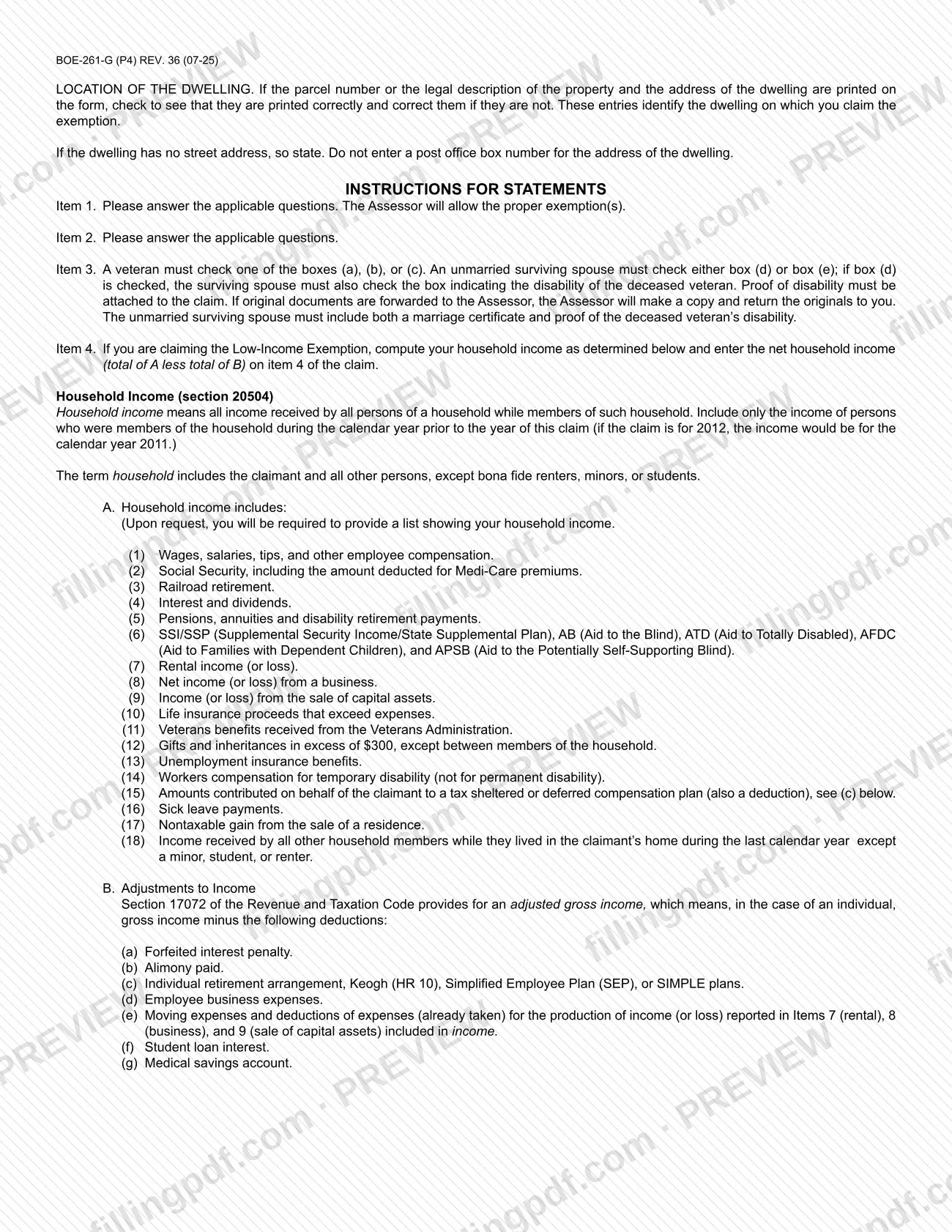
- A list showing your household income, only if the Assessor requests it from a Low-Income Exemption claimant.
How to fill out BOE-261-G
Check the printed name and address
If your name and mailing address are printed on the form, make sure they are correct and fix any errors. If nothing is printed, enter your full name and mailing address with ZIP code.
Enter claimant and spouse details
Fill in CLAIMANT'S NAME and SOCIAL SECURITY NUMBER, then SPOUSE'S NAME and SOCIAL SECURITY NUMBER if you have a spouse.
Describe the dwelling
Enter the STREET ADDRESS OF DWELLING if it differs from the mailing address, with city and ZIP code. Do not use a post office box; if the dwelling has no street address, say so.
Name the veteran if you are a surviving spouse
If you are an unmarried surviving spouse, enter the veteran's name as shown on the discharge documents and the veteran's Social Security number. Attach an explanation if your surname differs from the veteran's.
Mark the Low-Income-only box if it applies
If you received the Disabled Veterans' Exemption last year and are claiming only the Low-Income Exemption, check the box on page 2 and go directly to item 4.
Answer item 1 on the property
Enter the acquisition date (1a), the date you occupied or intend to occupy it as your principal residence (1b), and whether you claimed the exemption elsewhere (1c). If yes, give the previous address, city and county in 1d.
Enter the USDVA rating dates
In item 2a enter the effective date of the 100% disability or unemployability rating, and in 2b the date of the USDVA notice, with proof of the rating.
Check the basis for your claim
In item 3, a veteran checks one of 3a, 3b or 3c. An unmarried surviving spouse checks 3d or 3e, enters the spouse's date of death, and for 3d also checks the veteran's disability.
Complete item 4 for Low-Income claims
Only Low-Income claimants enter total annual household income for the prior calendar year, including veterans' benefits, computed as net household income under the instructions. Compare it with the limit on the schedule.
Sign, date and download the PDF
Sign and date the certification and add a daytime telephone number and email address. Check every entry, then download or print the completed PDF from FillingPDF and gather the proof you must attach.
How to submit BOE-261-G
The form names the Assessor as the office that receives the claim and the supporting proof, and it prints the office's contact details instead of separate filing channels:
- Assessor's office: San Diego County Assessor, 1600 Pacific Hwy., Suite 103, San Diego, CA 92101.
- Telephone: (619) 531-5772.
- Email: [email protected].
- Website: www.sdarcc.gov.
Call or write to the office to confirm how it accepts a signed claim and its attachments. If you send original documents, the Assessor makes a copy and returns the originals to you. The certification block also covers a form submitted with an electronic signature. The claim must arrive by the deadline for your situation, described under When to file. FillingPDF lets you fill out and download the PDF; submission follows the Assessor's channels above.
Common mistakes to avoid
- Missing the filing date for your situation, such as February 15 for the Low-Income Exemption, which lowers the share of the exemption allowed.
- Leaving item 4 blank or entering an income above the limit while expecting the Low-Income Exemption; the Assessor then allows only the Basic Exemption.
- Entering a post office box as the dwelling address; the instructions say not to, and to state that the dwelling has no street address if that is the case.
- Checking only box 3d as a surviving spouse without also checking the box for the deceased veteran's disability.
- Not attaching proof of disability, or for a surviving spouse the marriage certificate and death certificate.
- Claiming a home that is rented, vacant and unoccupied, or a vacation or secondary home, none of which qualifies.
- Not notifying the Assessor when the property stops being eligible; a 25 percent penalty on the escape assessment applies unless you notify by the following June 30.
- Filing again for the Basic Exemption each year; it continues until terminated, and annual filing is required only for the Low-Income Exemption.
Frequently asked questions
What is Form BOE-261-G?
Form BOE-261-G is the San Diego County Assessor's claim for the Disabled Veterans' Property Tax Exemption. A qualifying veteran or unmarried surviving spouse files it to exempt part of the value of the home they own and live in. Its printed title is 2026 Claim for Disabled Veterans' Property Tax Exemption.
Who qualifies for the disabled veterans' exemption in San Diego County?
A veteran who is blind in both eyes, has lost the use of two or more limbs, or is totally disabled from service-connected injury or disease, and who owns and lives in the home. Certain unmarried surviving spouses also qualify. Rented, vacant, vacation or secondary homes do not.
Do I have to file Form BOE-261-G every year?
Not for the Basic Exemption: once granted, it stays in effect until terminated. Annual filing is required for any year in which you claim the Low-Income Exemption, and separate claims are required for each fiscal year. You receive a notice on or shortly after January 1 to confirm eligibility.
What is the deadline for the Low-Income Exemption claim?
File by 5 p.m. on February 15 of each year for the full exemption. A claim filed after that but by 5 p.m. on December 10 gets 90 percent of the exemption, and later claims get 85 percent.
What proof do I attach to the claim?
Proof of the USDVA 100 percent rating if you rely on it, and proof of blindness or loss of use of limbs if you check 3a or 3b. Surviving spouses add a marriage certificate and a death certificate, plus proof of disability or service-connected death. Originals are copied and returned.
What is the difference between the Basic and Low-Income Exemption?
The Low-Income Exemption is a higher exemption level for claimants whose prior-year household income, entered in item 4, does not exceed the indexed limit. If you enter no income or too much, the Assessor allows only the Basic Exemption. The amount is not a combination of the two.
Where do I send the disabled veterans' exemption claim?
To the San Diego County Assessor, 1600 Pacific Hwy., Suite 103, San Diego, CA 92101. The form also prints the telephone number (619) 531-5772 and the email [email protected]; contact the office to confirm how it accepts claims.
What happens if my home stops qualifying?
You must notify the Assessor immediately. Failure to notify can bring a penalty of 25 percent of the escape assessment under Revenue and Taxation Code section 279.5; to avoid it, notify the Assessor by the following June 30. After termination you need a new claim to regain eligibility.
Can I fill out Form BOE-261-G online on FillingPDF?
Yes. You can fill out the PDF online on FillingPDF and download or print it. FillingPDF is an independent service and does not file the claim; you deliver it to the San Diego County Assessor through the office's channels.
Ready to fill out BOE-261-G?
Fill out BOE-261-G now