
Form BOE-265, Cemetery Exemption Claim, is the claim an organization files with the San Diego County Assessor to receive the cemetery property tax exemption for a fiscal year. It is one of the San Diego County property tax forms listed under Institutional Exemptions, and it is signed by an officer or authorized representative of the organization that owns the property. On this page you can fill out the form online on FillingPDF and download or print the completed PDF; the Assessor publishes the original at the official link and receives the claim only through its own channels.
Last updated
What is BOE-265?
Form BOE-265, Cemetery Exemption Claim, is the form on which an organization that owns or operates cemetery property asks the San Diego County Assessor for a property tax exemption for a fiscal year. The claim is made under the cemetery exemption provisions.
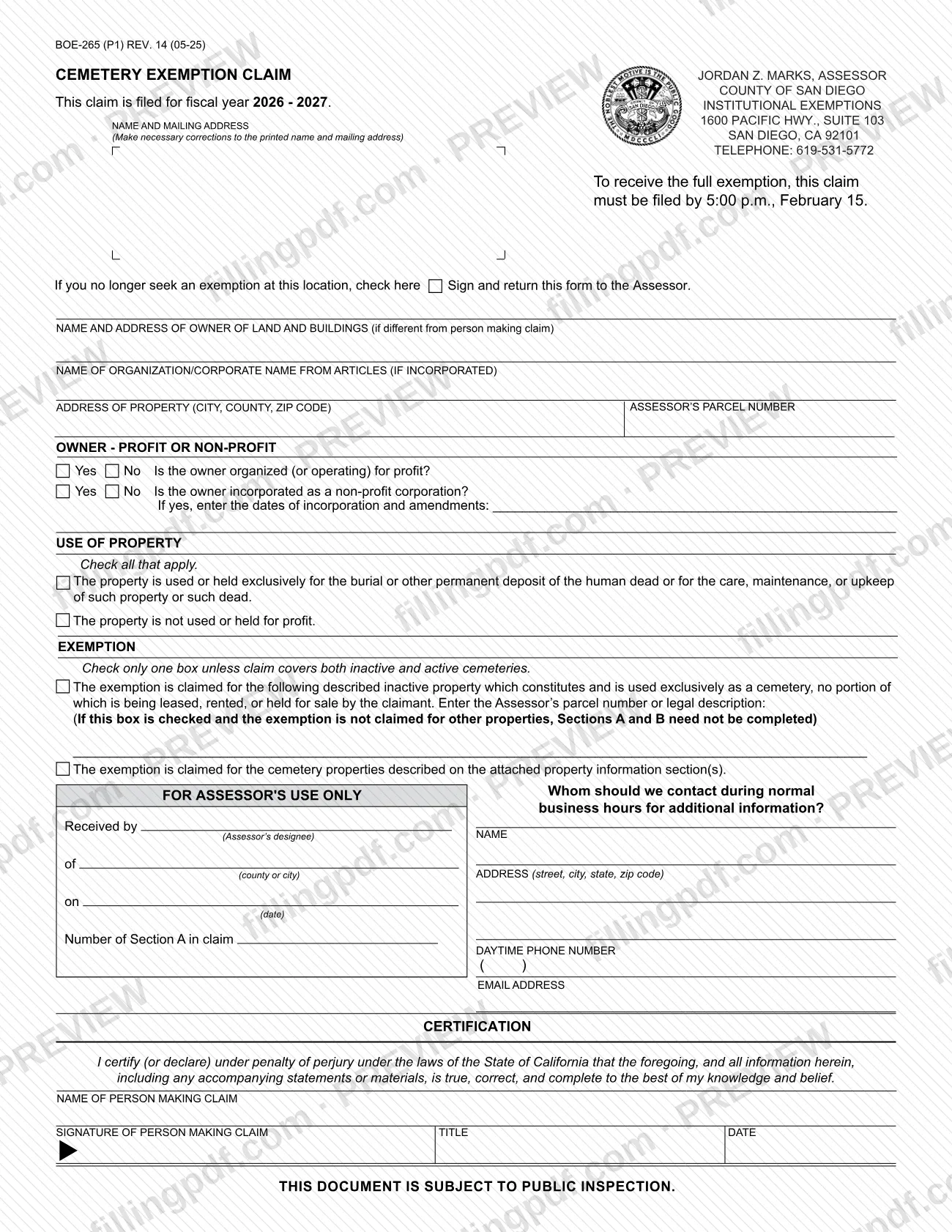
The form certifies, under penalty of perjury under the laws of the State of California, that the property is used or held exclusively for the burial or other permanent deposit of the human dead, or for the care, maintenance or upkeep of that property or those dead, and that it is not used or held for profit. The document is subject to public inspection.
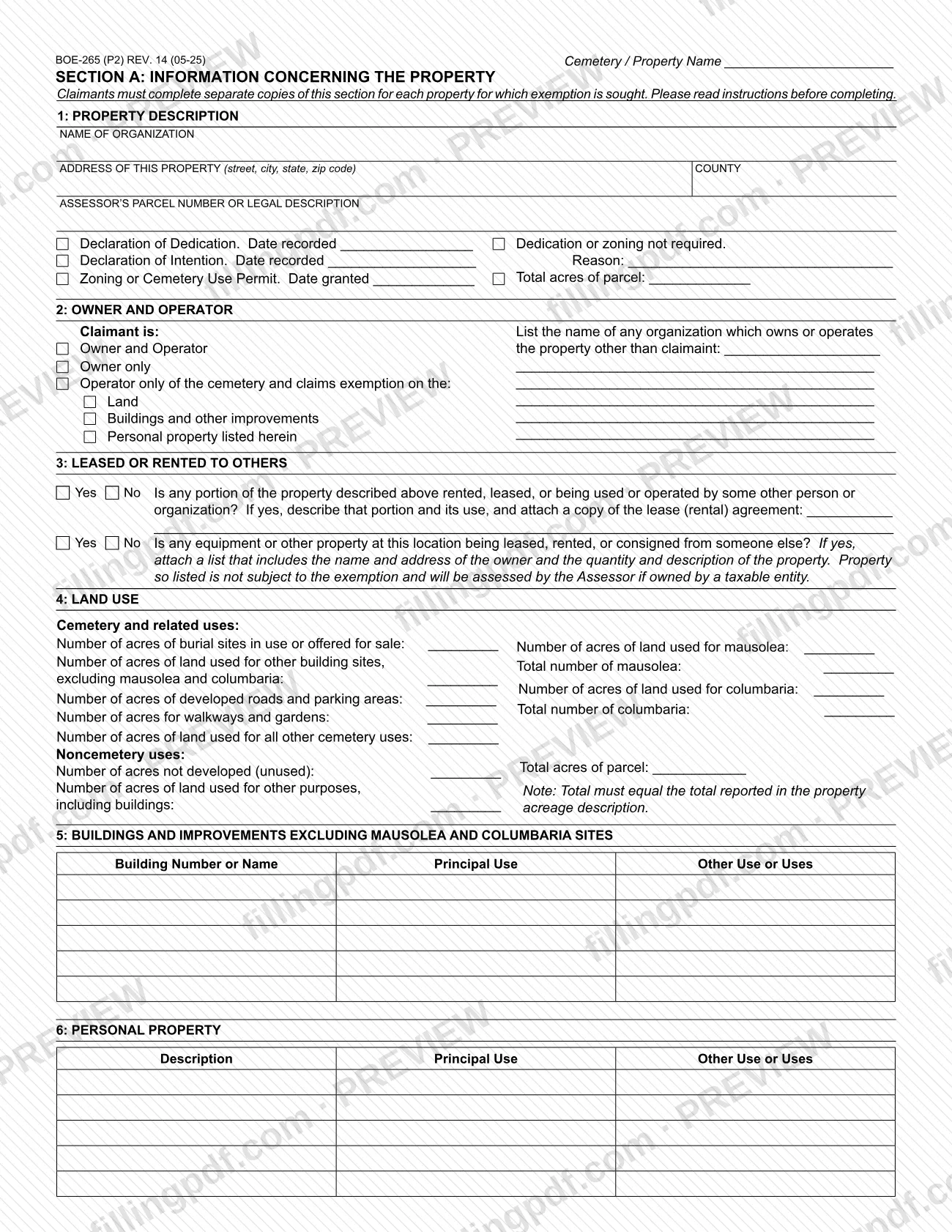
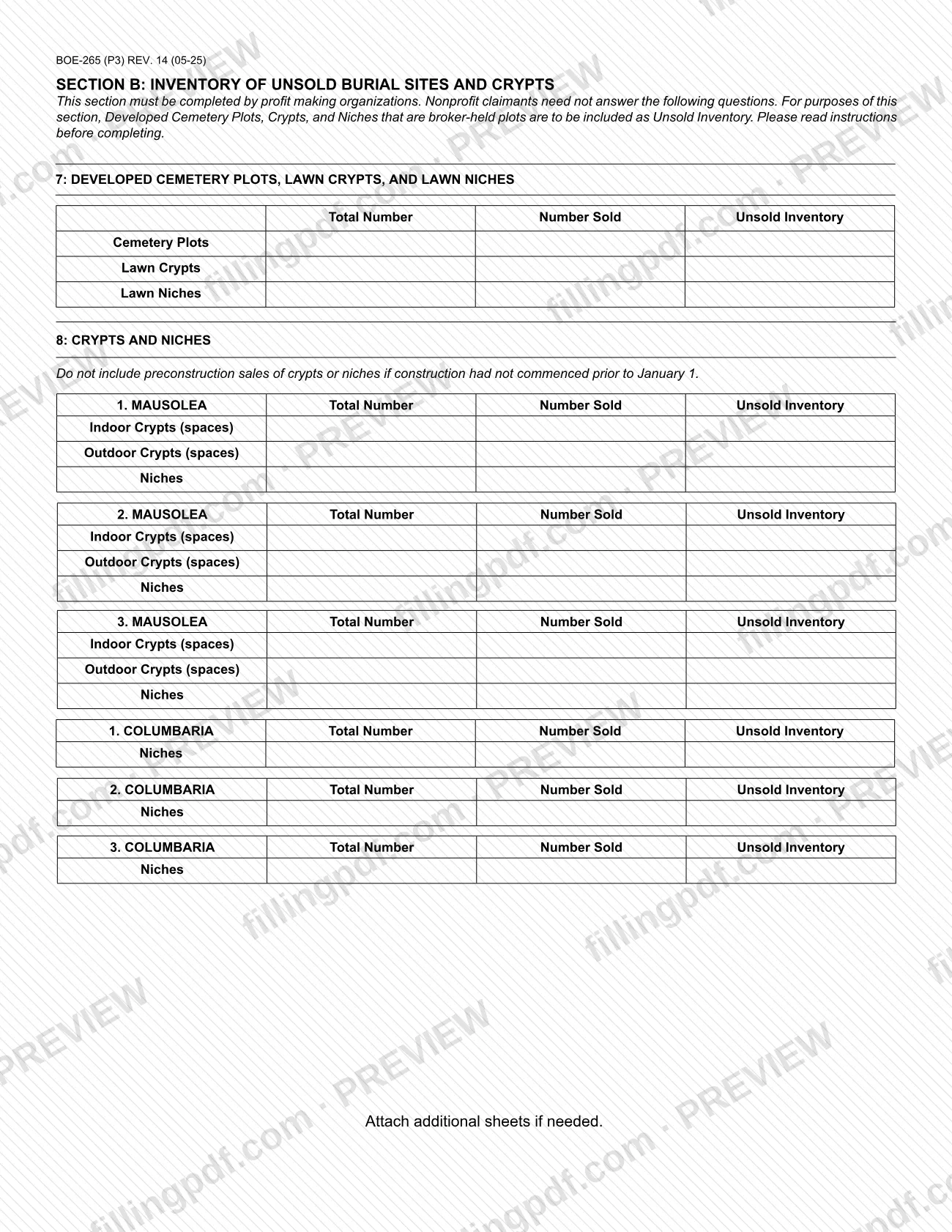
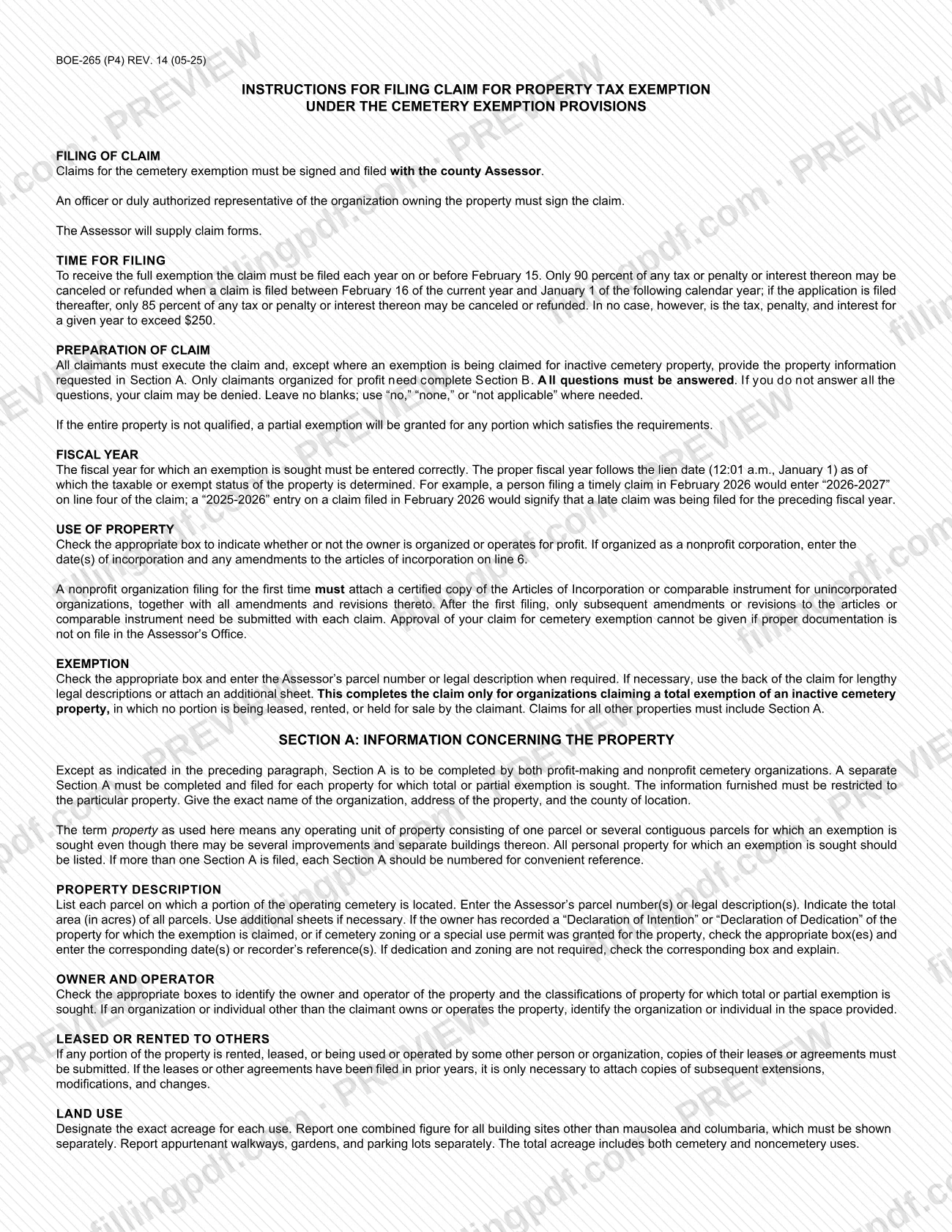
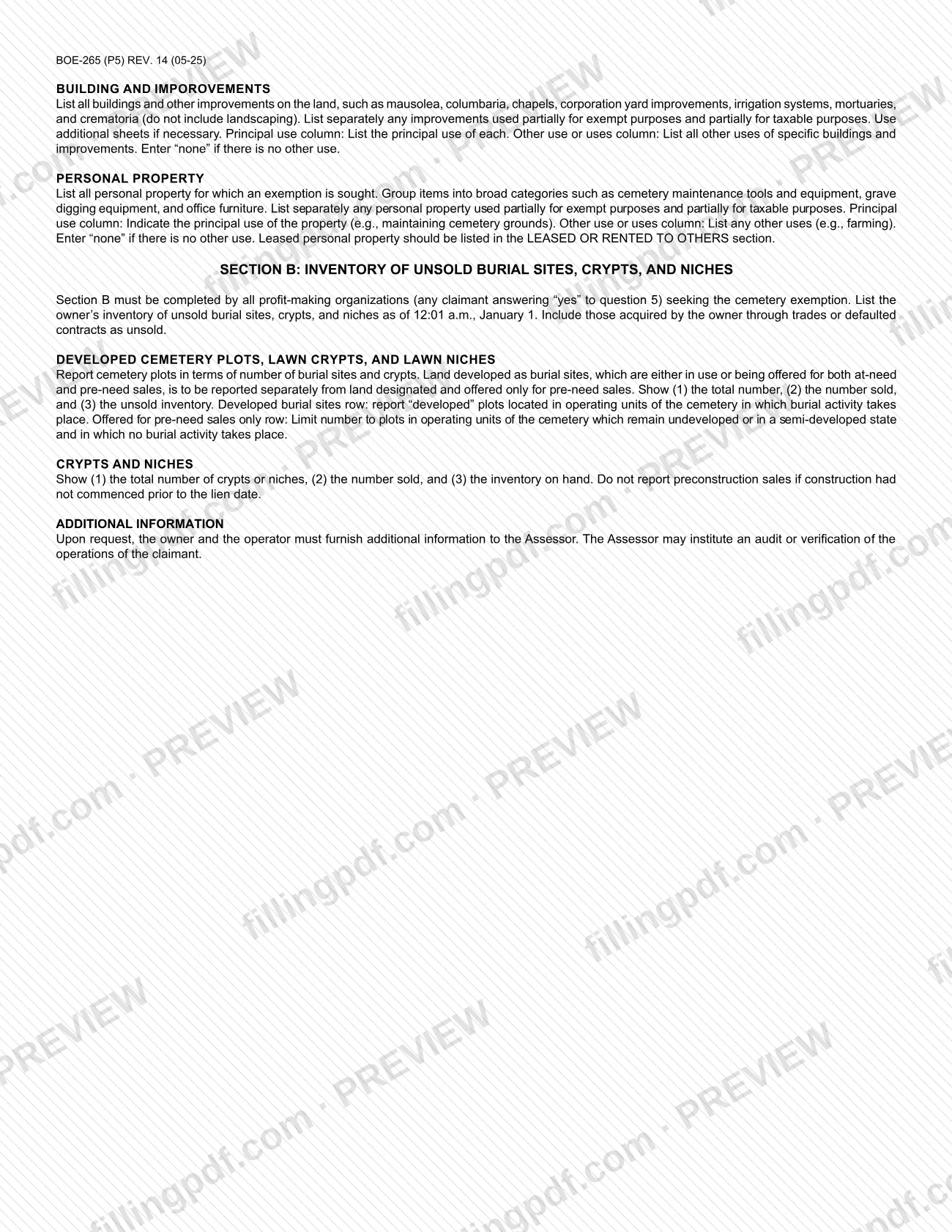
The claim has four printed pages. Page 1 identifies the claimant, the owner, the property, the profit or nonprofit status and the exemption claimed. Section A (page 2) describes each property: its description, owner and operator, any portion leased to others, land use in acres, buildings and personal property. Section B (page 3) is an inventory of unsold burial sites, crypts and niches, completed only by profit-making organizations. Page 4 holds the instructions.
An organization claiming total exemption for an inactive cemetery, with no portion leased, rented or held for sale, completes only page 1. If only part of a property qualifies, the instructions say a partial exemption is granted for the portion that meets the requirements. The Assessor's forms page lists a separate Cemetery Change in Eligibility form among the Institutional Exemptions; BOE-265 is the claim itself.
Who needs to file BOE-265?
Organizations that own cemetery property in San Diego County and want it exempt from property tax file this claim with the Assessor. An officer or duly authorized representative of the organization that owns the property must sign it.
Who completes which part:
- All claimants execute the claim on page 1.
- Claimants with active or partly leased property also complete Section A, with a separate copy for each property for which total or partial exemption is sought.
- Claimants organized for profit (those answering "yes" to the question on whether the owner is organized or operating for profit) also complete Section B. Nonprofit claimants need not answer Section B.
- Claimants for an inactive cemetery with no portion leased, rented or held for sale need only complete the claim itself, entering the Assessor's parcel number or legal description in the Exemption box.
A claimant that no longer seeks an exemption at a location checks the box printed on page 1 for that purpose and returns the signed form to the Assessor. Nonprofit organizations filing for the first time must also attach their organizing documents; see the required documents below.
When to file BOE-265
To receive the full exemption, file the claim every year on or before February 15; the form prints a cutoff of 5:00 p.m. that day. The fiscal year on the claim follows the lien date, 12:01 a.m. on January 1, as of which the property's taxable or exempt status is determined. A timely claim filed in February 2026, for example, is entered as "2026-2027"; a "2025-2026" entry on a claim filed in February 2026 signals a late claim for the preceding fiscal year.
Late claims are accepted for a reduced benefit: when a claim is filed between February 16 and January 1 of the following calendar year, only part of the tax, penalty and interest may be canceled or refunded, and a smaller part if the claim is filed after that. The instructions also cap the tax, penalty and interest for a given year; ask the Assessor for the current figures.
Documents you need
- Certified copy of the Articles of Incorporation, or a comparable instrument for unincorporated organizations, with all amendments and revisions: required when a nonprofit organization files for the first time.
- Later amendments or revisions to the articles or comparable instrument: attach only these with each claim after the first filing.
- Copy of each lease or rental agreement: required when any portion of the property is rented, leased, or used or operated by another person or organization. If filed in prior years, attach only later extensions, modifications and changes.
- List of equipment or other property leased, rented or consigned from someone else at the location, with the owner's name and address and the quantity and description of each item.
- Additional sheet for lengthy legal descriptions, or for more buildings, improvements, personal property or inventory rows than the form has room for, if needed.
- Separate copy of Section A for each property for which exemption is sought, numbered for reference when more than one is filed.
How to fill out BOE-265
Check fiscal year, name and address
Confirm the fiscal year the claim is filed for. Correct the printed name and mailing address, and check the box if you no longer seek an exemption at this location.
Identify the owner and property
Enter the owner of the land and buildings if different from the person making the claim, the organization or corporate name from the articles, the property address and the Assessor's parcel number.
Answer the profit and incorporation questions
Check Yes or No for whether the owner is organized or operating for profit and whether it is incorporated as a non-profit corporation. If yes to the latter, enter the dates of incorporation and amendments.
Check the use of property boxes
Under Use of Property, check all that apply: exclusive use for burial or permanent deposit of the human dead or related care, and not used or held for profit.
Choose the exemption claimed
Check only one box unless the claim covers both inactive and active cemeteries. For inactive property with nothing leased, rented or held for sale, enter the parcel number or legal description; otherwise check the box referring to the attached Section A pages.
Give a contact person
Enter the name, address, daytime phone number and email address of the person the Assessor should contact during business hours.
Sign the certification
Enter the name of the person making the claim, then sign with title and date. An officer or duly authorized representative of the owning organization must sign.
Describe the property in Section A
In item 1, give the organization name, property address, county and parcel number or legal description. Check any declaration of dedication, declaration of intention or zoning or cemetery use permit box with its date, and enter the total acres.
Identify owner, operator and leases
In item 2, check whether the claimant is owner and operator, owner only or operator only, and which property is claimed. In item 3, answer both Yes/No questions and describe any leased portion or leased-in property.
Report land use in acres
In item 4, enter acreage for burial sites, mausolea, columbaria, other building sites, roads and parking, walkways and gardens, other cemetery uses and noncemetery uses. The total must equal the total acres of the parcel.
List buildings and personal property
In items 5 and 6, list each building, improvement and group of personal property with its principal use and other uses, entering "none" when there is no other use. Do not include landscaping.
Complete Section B if profit-making
If the owner is organized for profit, complete items 7 and 8 with the total, sold and unsold counts as of 12:01 a.m., January 1. Nonprofit claimants skip Section B.
Review, sign and download the PDF
Check that no line is blank and that each Section A matches its property. Download or print the completed PDF from FillingPDF and send it with the attachments described under How to submit.
How to submit BOE-265
The claim is signed and filed with the county Assessor; the form says "Sign and return this form to the Assessor." The form names no other channel.
- Where: San Diego County Assessor, Institutional Exemptions, 1600 Pacific Hwy., Suite 103, San Diego, CA 92101, as printed on page 1.
- Telephone: 619-531-5772, the number printed on the form.
- When: on or before 5:00 p.m., February 15 for the full exemption.
- What to include: the signed claim, every completed Section A, Section B if you are a profit-making organization, and the attachments listed under required documents. The instructions warn that approval cannot be given if proper documentation is not on file in the Assessor's Office.
The Assessor supplies claim forms and may ask the owner and operator for additional information, and it may audit or verify the claimant's operations. FillingPDF lets you fill out and download the PDF; submission follows the Assessor's channels above.
Common mistakes to avoid
- Leaving questions blank. The instructions say all questions must be answered, the claim may be denied otherwise, and "no," "none" or "not applicable" should be used where needed.
- Entering the wrong fiscal year. A "2025-2026" entry on a claim filed in February 2026 signals a late claim for the preceding year; a timely February 2026 claim is "2026-2027".
- Filing after February 15 and expecting the full exemption; later claims receive only a part of the cancellation or refund.
- Filing one Section A for several properties. A separate Section A is required for each property, restricted to that property's information.
- Sending a first nonprofit claim without a certified copy of the Articles of Incorporation or comparable instrument, which blocks approval.
- Omitting copies of leases when part of the property is rented or used by someone else.
- Listing leased-in equipment as exempt. Property leased, rented or consigned from someone else is not subject to the exemption.
- Entering land-use acreage that does not add up: the total must equal the total in the property acreage description, and mausolea and columbaria must be shown separately from other building sites.
- Counting preconstruction sales of crypts or niches in Section B when construction had not begun before January 1.
- Having someone sign who is not an officer or duly authorized representative of the owning organization.
Frequently asked questions
What is Form BOE-265?
Form BOE-265 is the Cemetery Exemption Claim filed with the San Diego County Assessor. An organization uses it to claim a property tax exemption for land used or held exclusively for burial or for care of the dead, and not used or held for profit.
When is the cemetery exemption claim due in San Diego County?
On or before February 15 each year, by 5:00 p.m., to receive the full exemption. A claim filed later is accepted only for a reduced share of the tax, penalty and interest that may be canceled or refunded.
Who has to sign the cemetery exemption claim?
An officer or duly authorized representative of the organization that owns the property must sign. The signature block asks for the signer's name, title and date, and certifies the information under penalty of perjury.
Do nonprofit cemeteries have to fill out Section B?
No. Section B, the inventory of unsold burial sites, crypts and niches, is completed only by profit-making organizations. Nonprofit claimants complete the claim and Section A, unless they claim an inactive cemetery.
What do I attach the first time a nonprofit files?
A certified copy of the Articles of Incorporation, or a comparable instrument for unincorporated organizations, with all amendments. After the first filing, attach only later amendments. Add lease copies if any part of the property is rented to others.
Do I need Section A for an inactive cemetery?
Not if the exemption is claimed for inactive property used exclusively as a cemetery with no portion leased, rented or held for sale. Then the claim page, with the parcel number or legal description, completes the claim.
Where do I send Form BOE-265?
Sign and return it to the San Diego County Assessor at 1600 Pacific Hwy., Suite 103, San Diego, CA 92101, as printed on the form. The phone number printed on it is 619-531-5772. The form names no other channel.
Can I fill out Form BOE-265 online on FillingPDF?
Yes. You can fill out the PDF online on FillingPDF and download or print it. FillingPDF is an independent service and does not file the claim; you return it to the Assessor yourself.
Ready to fill out BOE-265?
Fill out BOE-265 now