
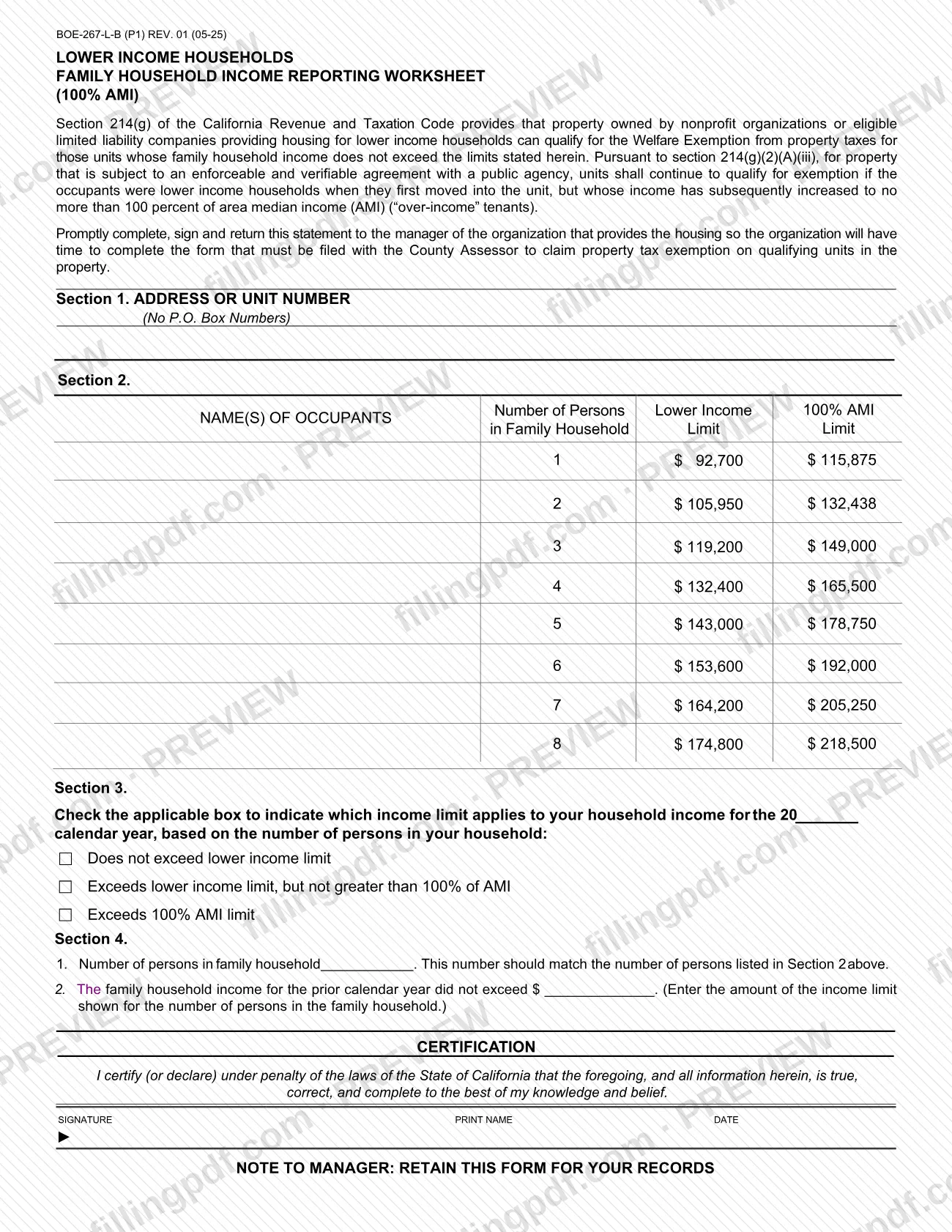
Form BOE-267-L-B, the Family Household Income Reporting Worksheet (Lower Income, 100% AMI), is a statement that a household gives to the organization that manages its housing so the organization can claim the Welfare Exemption from property taxes. It is one of the San Diego County property tax exemption forms published by the County Assessor, and the occupant, not the property owner, completes it. On this page you can fill out the form online on FillingPDF and download or print the completed PDF; the official PDF is published by the San Diego County Assessor.
Last updated
What is BOE-267-L-B?
Form BOE-267-L-B, Family Household Income Reporting Worksheet (Lower Income, 100% AMI) is the statement in which an occupant reports whether the household's income stays within the lower income limit or within 100 percent of area median income (AMI), so the housing organization can support a Welfare Exemption claim.
The form rests on section 214(g) of the California Revenue and Taxation Code. Under that section, property owned by nonprofit organizations or eligible limited liability companies that provide housing for lower income households can qualify for the Welfare Exemption from property taxes for the units whose family household income does not exceed the stated limits. Under section 214(g)(2)(A)(iii), when the property is subject to an enforceable and verifiable agreement with a public agency, a unit keeps qualifying if the occupants were lower income households when they first moved in and their income later rose to no more than 100 percent of AMI. The form calls these "over-income" tenants.
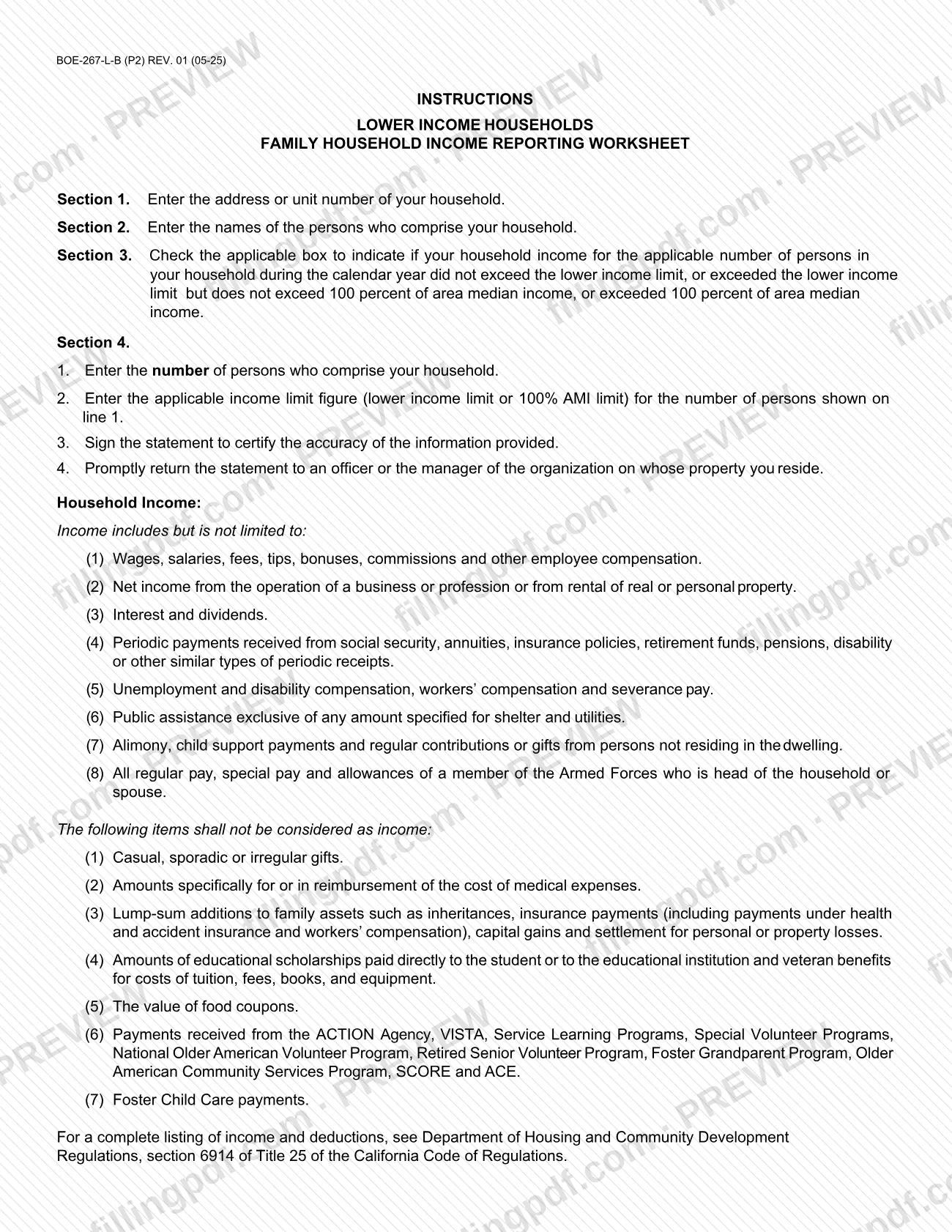
The worksheet prints income limits for households of one to eight persons, in two columns: a lower income limit and a 100% AMI limit. You list the occupants, check the box that matches your income, state the number of persons and the limit that applies, and certify the statement under penalty of the laws of the State of California. The second page contains instructions and the lists of what counts and does not count as income.
The organization uses your answers to complete the form it must file with the County Assessor. The San Diego County Assessor's forms page lists the Welfare Exemption (First Filing) and Welfare Exemption (Annual Filing) forms under Institutional Exemptions.
Who needs to file BOE-267-L-B?
The main group is the occupants of units in property owned by a nonprofit organization or an eligible limited liability company that provides housing for lower income households and that claims the Welfare Exemption for those units. The organization's manager asks each household to complete, sign and return the worksheet.
- Households in lower income units report whether their income did not exceed the lower income limit.
- "Over-income" tenants, who were lower income households when they moved in but whose income has risen to no more than 100 percent of AMI, report that situation on the same worksheet. The form ties this treatment to property subject to an enforceable and verifiable agreement with a public agency.
- A household whose income exceeds the 100% AMI limit checks the third box in Section 3.
The form is completed by the household that lives in the unit. The organization's manager does not fill it in; the manager keeps the signed worksheet for the organization's records. The form names no other person who may sign for the household.
When to file BOE-267-L-B
Complete, sign and return the worksheet promptly after the organization's manager asks for it. The form gives the reason: the organization needs time to complete the form that must be filed with the County Assessor to claim the property tax exemption on qualifying units. No calendar due date is printed on the worksheet, so follow any date the manager sets.
Section 3 asks which income limit applies to your household income for the calendar year you enter on the "20__" line, and Section 4, line 2 refers to the prior calendar year's household income. Have your income figures for the year the organization asks about before you begin.
How to fill out BOE-267-L-B
Enter your address or unit number
In Section 1, write the address or unit number of your household. The form does not accept P.O. box numbers.
List the occupants of the household
In Section 2, enter the names of all the persons who make up your household. Count them, because Section 4 asks for the total.
Find the limits for your household size
Use the table in Section 2 to find the row for your number of persons, from 1 to 8. It shows a Lower Income Limit and a 100% AMI Limit for each size.
Add up your household income
Total the household income the instructions on page 2 list, such as wages, business or rental income, interest and dividends, periodic benefits and alimony. Leave out the excluded items, such as casual gifts, medical reimbursements and lump-sum inheritances.
Check the income box in Section 3
Enter the calendar year on the "20__" line, then check one box: does not exceed the lower income limit, exceeds it but not greater than 100% of AMI, or exceeds the 100% AMI limit.
Enter the number of persons
In Section 4, line 1, enter the number of persons in the family household. It should match the number of persons listed in Section 2.
Enter the income limit amount
In Section 4, line 2, write the amount of the income limit shown for your household size, using the lower income limit or the 100% AMI limit that applies to you.
Sign, print your name and date
In the certification, sign, print your name and enter the date. By signing you certify, under penalty of the laws of the State of California, that the information is true, correct and complete to the best of your knowledge and belief.
Review, download and return the worksheet
Check each section, then download or print the completed PDF from FillingPDF and promptly return it to an officer or the manager of the organization on whose property you live.
How to submit BOE-267-L-B
You return the signed worksheet to the organization that provides your housing, not to the County Assessor.
- Return to the organization: the instructions say to promptly return the statement to an officer or the manager of the organization on whose property you live.
- Organization's filing: the organization then completes the form that must be filed with the County Assessor to claim the property tax exemption. The worksheet itself prints no Assessor address, portal or fee.
- Records: the form carries a note to the manager to retain the worksheet for the organization's records.
The San Diego County Assessor lists its exemption forms at https://arcc.sandiegocounty.gov/content/arcc/home/divisions/assessor/assessor-forms.html. FillingPDF lets you fill out and download the PDF; submission follows the channels above.
Common mistakes to avoid
- Entering a P.O. box in Section 1; the form asks for the address or unit number and says no P.O. box numbers.
- Listing a number of persons in Section 4, line 1 that does not match the occupants named in Section 2.
- Entering a limit on Section 4, line 2 that does not correspond to the number of persons in the household.
- Checking a Section 3 box that does not match your household income for the calendar year, or checking more than one box.
- Counting items the form excludes, such as casual or irregular gifts, medical reimbursements, lump-sum inheritances or insurance payments, or foster child care payments, as income.
- Leaving out income the form lists, such as wages, net business or rental income, interest and dividends, Social Security or pension payments, or alimony and child support.
- Returning the worksheet without a signature, printed name or date in the certification.
- Holding the worksheet instead of returning it promptly to the manager, when the organization needs time to prepare its County Assessor filing.
Frequently asked questions
What is Form BOE-267-L-B used for?
Form BOE-267-L-B is a worksheet in which an occupant reports household income against the lower income and 100% AMI limits. The housing organization uses it to complete the form it files with the County Assessor to claim the Welfare Exemption on qualifying units.
Who fills out the Family Household Income Reporting Worksheet?
The household living in the unit fills it out, signs it and returns it to an officer or manager of the organization that provides the housing. The manager keeps the signed form for the organization's records.
Do I send Form BOE-267-L-B to the San Diego County Assessor?
No. The form says to return it to the manager of the organization that provides your housing. The organization then completes the form that must be filed with the County Assessor. The worksheet prints no Assessor address.
What counts as income on the worksheet?
Income includes wages, tips and bonuses, net business or rental income, interest and dividends, Social Security and pension payments, unemployment and disability compensation, public assistance excluding shelter and utilities, alimony and child support, and Armed Forces pay for a head of household or spouse.
What is an over-income tenant?
An over-income tenant was a lower income household when first moving into the unit, but later had income rise to no more than 100 percent of area median income. Under section 214(g)(2)(A)(iii), the unit can keep qualifying when the property is subject to an enforceable and verifiable public agency agreement.
Which box do I check in Section 3?
Check one box for the calendar year you enter: income that does not exceed the lower income limit, income above that limit but not greater than 100% of AMI, or income above the 100% AMI limit. Use the limits for your number of persons.
Can I fill out Form BOE-267-L-B online?
Yes. You can complete the PDF online on FillingPDF and download or print it. FillingPDF is an independent service and does not send the worksheet to your housing organization or to the Assessor; you return it yourself to the manager.
Ready to fill out BOE-267-L-B?
Fill out BOE-267-L-B now