
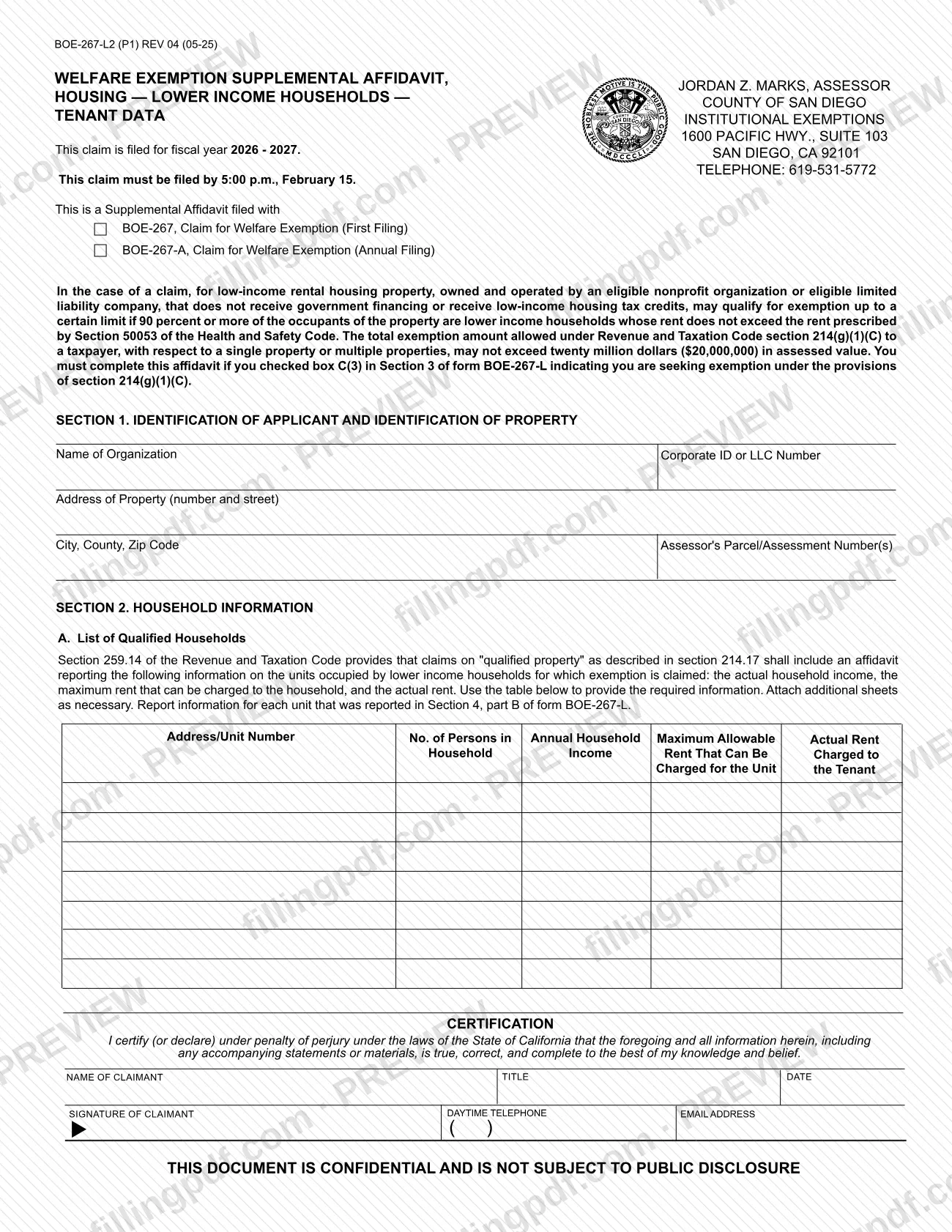
Form BOE-267-L2, the Welfare Exemption Supplemental Affidavit, Housing — Lower Income Households — Tenant Data, is the affidavit on which a nonprofit organization or eligible limited liability company reports household income and rent for each unit of low-income rental housing it wants exempted. It is one of the San Diego County property tax exemption forms handled by the County Assessor, and it travels with the Welfare Exemption claim. On this page you can fill out the form online on FillingPDF and download or print the completed PDF; the agency publishes the original at the San Diego County Assessor's website.
Last updated
What is BOE-267-L2?
Form BOE-267-L2, Welfare Exemption Supplemental Affidavit, Housing — Lower Income Households — Tenant Data, is the affidavit that lists, unit by unit, the household income, the maximum allowable rent and the actual rent of lower income tenants in a property for which a Welfare Exemption is claimed.
The form is filed in the County of San Diego with the Assessor. It is a supplemental affidavit: it is filed with BOE-267, Claim for Welfare Exemption (First Filing), or BOE-267-A, Claim for Welfare Exemption (Annual Filing). The printed text ties it to Revenue and Taxation Code sections 214(g)(1)(C), 214.17 and 259.14.
It applies to low-income rental housing owned and operated by an eligible nonprofit organization or eligible limited liability company that receives no government financing and no low-income housing tax credits. Such property may qualify for exemption up to a limit if 90 percent or more of the occupants are lower income households whose rent does not exceed the rent prescribed by Section 50053 of the Health and Safety Code.
The form is the tenant-data companion of BOE-267-L: you complete BOE-267-L2 when you checked box C(3) in Section 3 of BOE-267-L. The Assessor keeps the information confidential, and the form is marked as not subject to public disclosure. The revision printed on the form is REV 04 (05-25), and it is printed for fiscal year 2026 - 2027.
Who needs to file BOE-267-L2?
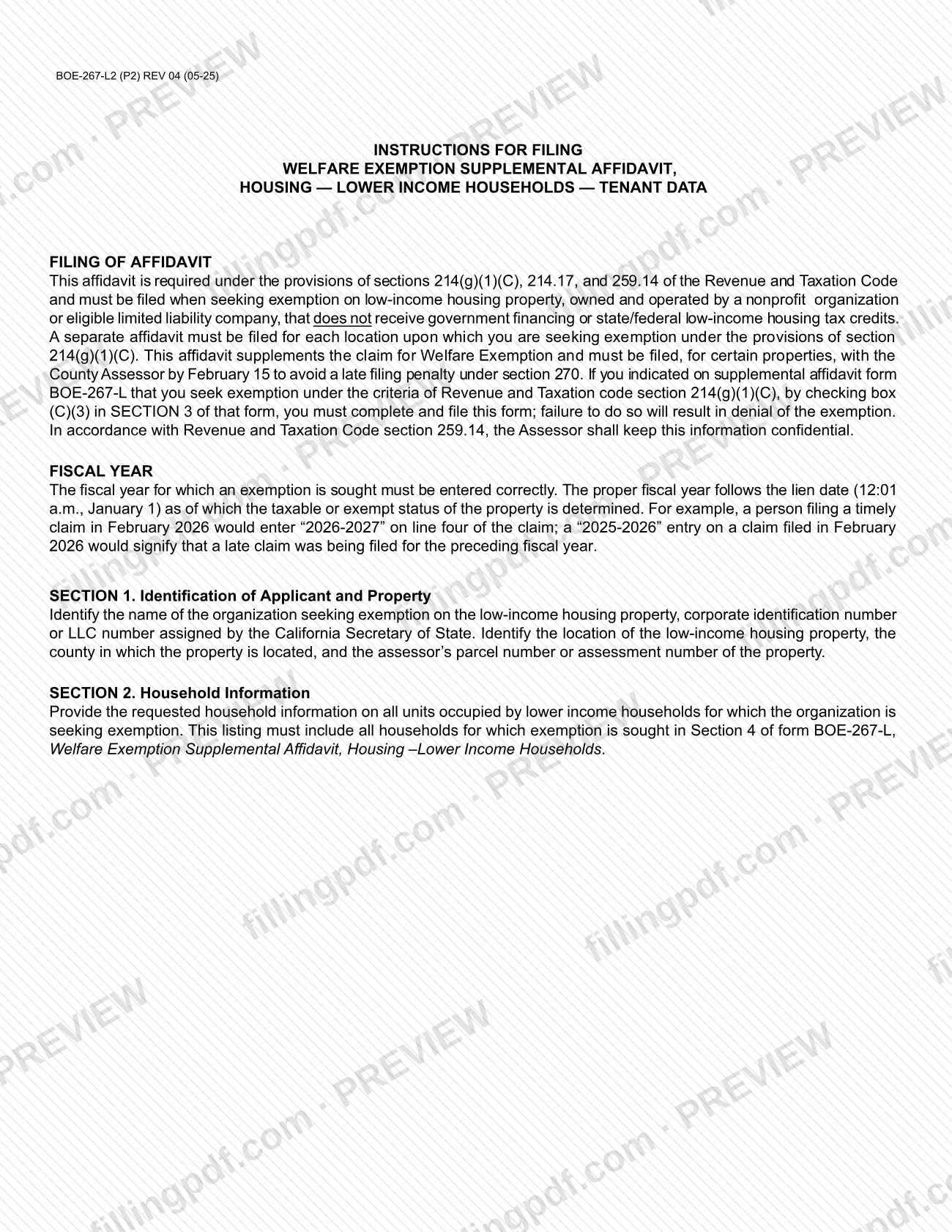
Nonprofit organizations and eligible limited liability companies that own and operate low-income rental housing, receive no government financing or state/federal low-income housing tax credits, and seek exemption under section 214(g)(1)(C) of the Revenue and Taxation Code must file this affidavit.
- Check box C(3): if you checked box C(3) in Section 3 of form BOE-267-L, you must complete and file BOE-267-L2. The instructions say failure to do so will result in denial of the exemption.
- One affidavit per location: a separate affidavit must be filed for each location on which you seek exemption under section 214(g)(1)(C).
- Every unit claimed: the listing must cover each unit reported in Section 4, part B of BOE-267-L, which means all households for which exemption is sought.
The form is not for property that receives government financing or low-income housing tax credits, because the exemption it supports is described for property that does not. The form does not say who may sign for an organization beyond a claimant who gives a name, title and signature under penalty of perjury.
When to file BOE-267-L2
File BOE-267-L2 with the County Assessor by 5:00 p.m. on February 15. The instructions say that filing by February 15 avoids a late filing penalty under section 270. The printed form states that it is filed for fiscal year 2026 - 2027.
The fiscal year follows the lien date (12:01 a.m., January 1) that fixes the taxable or exempt status of the property. A person filing a timely claim in February 2026 enters "2026-2027"; a "2025-2026" entry on a claim filed in February 2026 would signal a late claim for the preceding fiscal year.
The affidavit has no separate cycle of its own: it is filed together with the Welfare Exemption claim, BOE-267 for a first filing or BOE-267-A for an annual filing, whenever that claim requires it.
Documents you need
- Form BOE-267, Claim for Welfare Exemption (First Filing), or BOE-267-A, Claim for Welfare Exemption (Annual Filing): this affidavit is filed with whichever claim applies.
- Form BOE-267-L, if you checked box C(3) in its Section 3: BOE-267-L2 must be completed and filed, and its unit list must match Section 4, part B of BOE-267-L.
- Additional sheets, if the table in Section 2 does not have enough rows for every unit occupied by lower income households for which exemption is claimed.
How to fill out BOE-267-L2
Confirm the fiscal year
The form is printed for fiscal year 2026 - 2027. Check that it matches the lien date (January 1) that applies to your claim.
Enter the organization and ID number
In Section 1, enter the Name of Organization and its Corporate ID or LLC Number, as assigned by the California Secretary of State.
Enter the property address
In Section 1, enter the Address of Property (number and street), then the City, County, Zip Code of the low-income housing property.
Enter the parcel numbers
Enter the Assessor's Parcel/Assessment Number(s) for the property. File a separate affidavit for each location.
List each unit and its household
In Section 2, part A, enter for each unit the Address/Unit Number and the No. of Persons in Household. Report each unit that was reported in Section 4, part B of form BOE-267-L.
Enter income and rent figures
For each unit, enter the Annual Household Income, the Maximum Allowable Rent That Can Be Charged, and the Actual Rent Charged for the Unit to the Tenant.
Add extra sheets if needed
If the table has too few rows, attach additional sheets with the same columns so every qualified household is listed.
Complete the certification
Enter the Name of Claimant, Title and Date. The certification is made under penalty of perjury under the laws of the State of California.
Sign and add contact details
Add the claimant's signature, daytime telephone and email address in the signature row.
Review and download the completed PDF
Check the units against BOE-267-L, then download or print the completed PDF from FillingPDF and file it with the Assessor as described under How to submit.
How to submit BOE-267-L2
The form says the affidavit is filed with the County Assessor. It prints no portal, fax or other channel. The Assessor's office on the form is:
- Address: Jordan Z. Marks, Assessor, County of San Diego, 1600 Pacific Hwy., Suite 103, San Diego, CA 92101.
- Telephone: 619-531-5772.
File it with the Welfare Exemption claim it supplements, BOE-267 or BOE-267-A, and make sure it reaches the Assessor by 5:00 p.m. on February 15. File a separate affidavit for each location. Attach additional sheets if the table in Section 2 needs more rows. Call the Assessor at the printed number to confirm how to deliver it.
FillingPDF lets you fill out and download the PDF; submission follows the Assessor's channels above.
Common mistakes to avoid
- Skipping BOE-267-L2 after checking box C(3) in Section 3 of BOE-267-L; the instructions say failure to file it will result in denial of the exemption.
- Using one affidavit for several locations; a separate affidavit must be filed for each location.
- Filing after 5:00 p.m. on February 15, which exposes the claim to a late filing penalty under section 270.
- Entering the wrong fiscal year; in February 2026 a timely claim shows "2026-2027", and "2025-2026" would signal a late claim.
- Leaving out units that were reported in Section 4, part B of BOE-267-L; the list must include every household for which exemption is sought.
- Omitting the household income, the maximum allowable rent or the actual rent for a unit; Section 259.14 requires all three.
- Signing without the claimant's name, title and date, when the certification is made under penalty of perjury.
- Using the form for property that receives government financing or low-income housing tax credits.
Frequently asked questions
What is Form BOE-267-L2?
Form BOE-267-L2 is the Welfare Exemption Supplemental Affidavit, Housing — Lower Income Households — Tenant Data. It lists the household income, maximum allowable rent and actual rent for each qualified unit in low-income rental housing for which a Welfare Exemption is claimed.
Who has to file the BOE-267-L2 tenant data affidavit?
A nonprofit organization or eligible limited liability company that checked box C(3) in Section 3 of BOE-267-L, seeking exemption under section 214(g)(1)(C) for housing without government financing or low-income housing tax credits. Failure to file it results in denial of the exemption.
When is the BOE-267-L2 due in San Diego County?
By 5:00 p.m. on February 15, filed with the County Assessor. Filing by that date avoids a late filing penalty under section 270. The printed form covers fiscal year 2026 - 2027.
Do I need a separate BOE-267-L2 for each property?
Yes. The instructions require a separate affidavit for each location on which you seek exemption under section 214(g)(1)(C). Within one affidavit, list every unit reported in Section 4, part B of BOE-267-L, using extra sheets if needed.
What forms is the BOE-267-L2 filed with?
It is a supplemental affidavit filed with BOE-267, Claim for Welfare Exemption (First Filing), or BOE-267-A, Claim for Welfare Exemption (Annual Filing). It also relates to BOE-267-L, whose Section 4 part B units it must repeat.
Is the tenant information on BOE-267-L2 public?
No. The form is marked confidential and not subject to public disclosure, and the instructions say that under Revenue and Taxation Code section 259.14 the Assessor shall keep the information confidential.
Where do I file Form BOE-267-L2?
File it with the San Diego County Assessor, 1600 Pacific Hwy., Suite 103, San Diego, CA 92101; the form prints the telephone number 619-531-5772. The form names no other channel, so call that number if you need to confirm how to deliver it.
Can I fill out BOE-267-L2 online on FillingPDF?
Yes. You can fill out the PDF online on FillingPDF and download or print it. FillingPDF is an independent service and does not file the affidavit with the Assessor; you file it through the Assessor's channels.
Ready to fill out BOE-267-L2?
Fill out BOE-267-L2 now