
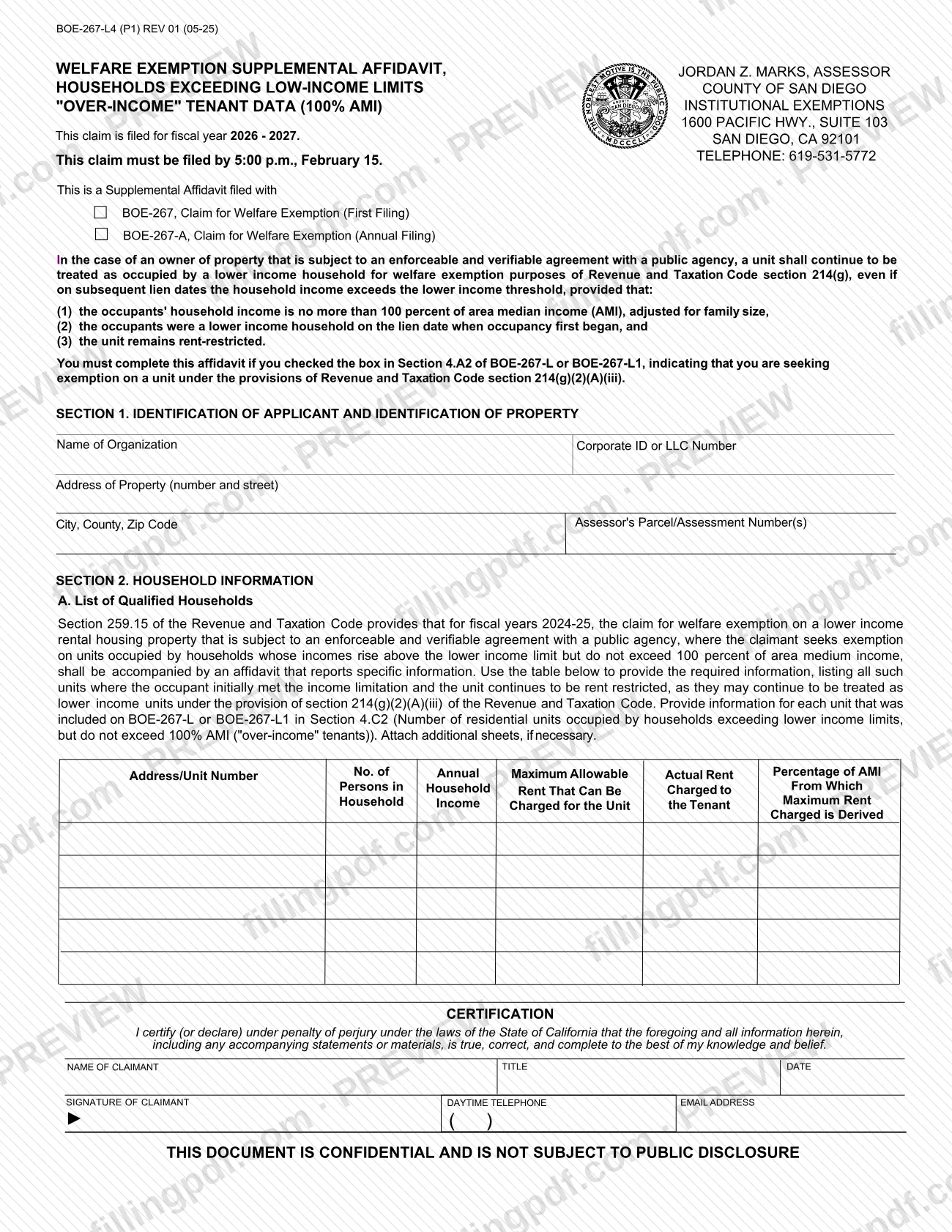
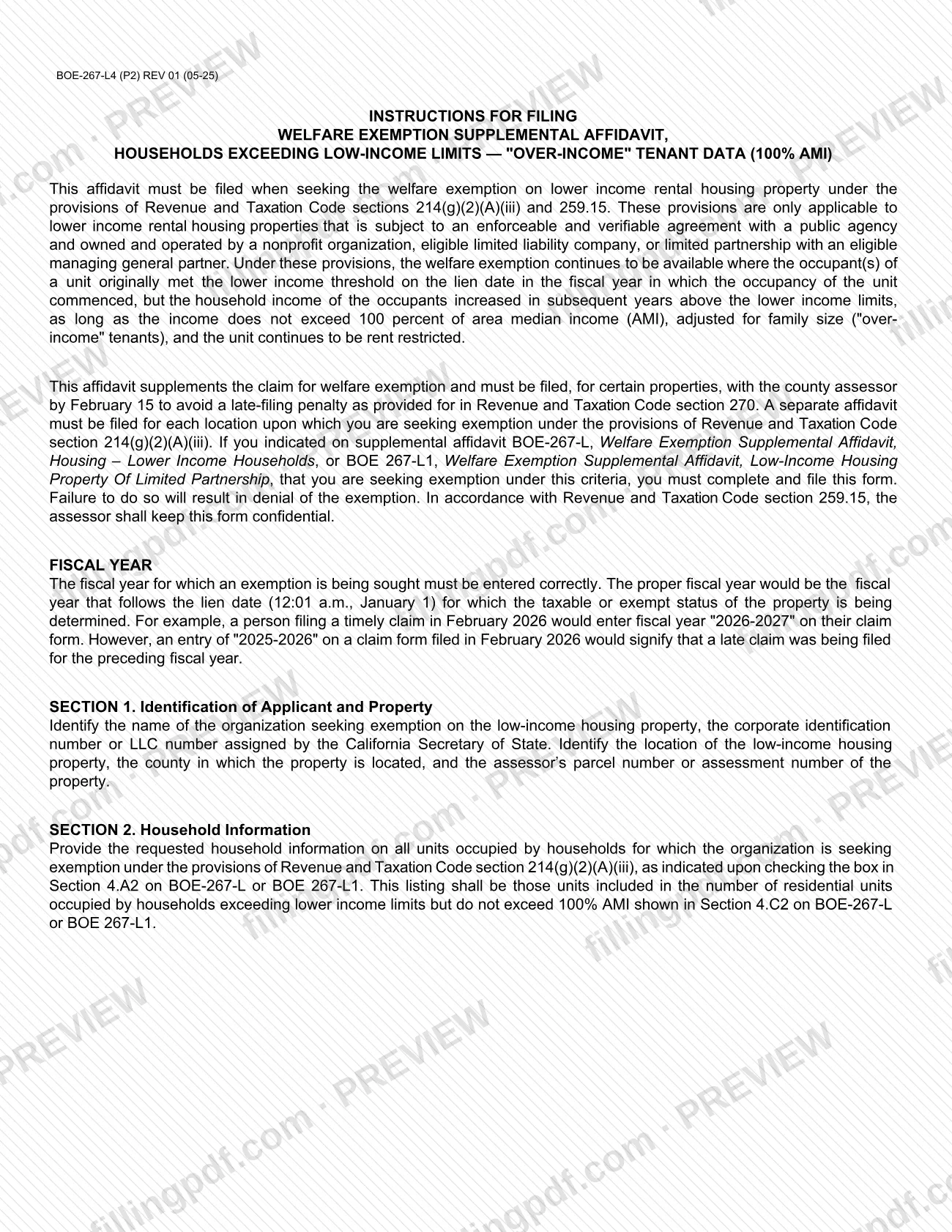
Form BOE-267-L4 is the Welfare Exemption Supplemental Affidavit on which owners of lower income rental housing report “over-income” tenant households, those above the low-income limit but not above 100 percent of area median income (AMI). The San Diego County Assessor receives it, and it is one of the San Diego County property tax exemption forms filed with the welfare exemption claim. On FillingPDF you can fill out the form online and download or print the completed PDF; the form itself is published by the Assessor at the official link on this page.
Last updated
What is BOE-267-L4?
Households Exceeding Low-Income Limits – “Over-Income” Tenant Data (100% AMI), Form BOE-267-L4, is a Welfare Exemption Supplemental Affidavit that lists the units whose households earn more than the lower income limit but no more than 100 percent of area median income (AMI), so the unit can keep its welfare exemption.
The affidavit is filed with the County of San Diego Assessor, Institutional Exemptions. It supplements either BOE-267, Claim for Welfare Exemption (First Filing), or BOE-267-A, Claim for Welfare Exemption (Annual Filing). It applies under Revenue and Taxation Code sections 214(g)(2)(A)(iii) and 259.15.
Under those provisions, a unit in property subject to an enforceable and verifiable agreement with a public agency continues to count as occupied by a lower income household when:
- the occupants' household income is no more than 100 percent of AMI, adjusted for family size;
- the occupants were a lower income household on the lien date when occupancy first began; and
- the unit remains rent-restricted.
Section 1 identifies the organization and the property. Section 2 is a table with one row per unit: address or unit number, number of persons in the household, annual household income, maximum allowable rent, actual rent charged, and the percentage of AMI from which the maximum rent is derived. The form ends with a certification under penalty of perjury. It is marked confidential and not subject to public disclosure.
Who needs to file BOE-267-L4?
The affidavit is filed by the owner claiming the welfare exemption on lower income rental housing when it seeks exemption for units under Revenue and Taxation Code section 214(g)(2)(A)(iii). You must complete it if you checked the box in Section 4.A2 of BOE-267-L or BOE-267-L1.
The instructions limit these provisions to lower income rental housing property that:
- is subject to an enforceable and verifiable agreement with a public agency; and
- is owned and operated by a nonprofit organization, an eligible limited liability company, or a limited partnership with an eligible managing general partner.
List every unit counted in Section 4.C2 of BOE-267-L or BOE-267-L1, meaning units occupied by households that exceed the lower income limits but do not exceed 100% AMI. The occupants must have met the lower income threshold on the lien date in the fiscal year when occupancy began, and the unit must still be rent restricted.
File a separate affidavit for each location for which you seek exemption under this provision. The form does not list who else may sign for the claimant; it asks for the claimant's name, title and signature.
When to file BOE-267-L4
The form must be filed by 5:00 p.m. on February 15. The version provided is for fiscal year 2026-2027. Filing late can bring a late-filing penalty under Revenue and Taxation Code section 270.
The fiscal year you enter is the one that follows the January 1 lien date (12:01 a.m.) being determined. A timely claim filed in February 2026 shows "2026-2027." Entering "2025-2026" on a claim filed in February 2026 signals a late claim for the preceding fiscal year.
The affidavit supplements the welfare exemption claim, so it is filed with BOE-267 or BOE-267-A. The instructions say that failure to file it when you indicated this criterion on BOE-267-L or BOE-267-L1 results in denial of the exemption.
Documents you need
- Form BOE-267, Claim for Welfare Exemption (First Filing), or BOE-267-A, Claim for Welfare Exemption (Annual Filing): this affidavit is filed with whichever claim applies.
- Additional sheets continuing the Section 2 household table, only if the table does not have enough rows for all your units.
How to fill out BOE-267-L4
Confirm the fiscal year
The form is printed for fiscal year 2026-2027 and says it must be filed by 5:00 p.m., February 15. The fiscal year is the one following the January 1 lien date.
Enter the organization's name
In Section 1, write the name of the organization seeking exemption on the low-income housing property and its Corporate ID or LLC Number assigned by the California Secretary of State.
Identify the property
In Section 1, enter the Address of Property (number and street), the City, County and Zip Code, and the Assessor's Parcel/Assessment Number(s).
List each over-income unit
In Section 2.A, enter one row per unit with its Address/Unit Number. Include every unit counted in Section 4.C2 of BOE-267-L or BOE-267-L1.
Enter household and income data
For each unit, give the number of persons in the household and the annual household income.
Enter rent information
For each unit, enter the maximum allowable rent that can be charged to the tenant and the actual rent charged for the unit.
Enter the AMI percentage
For each unit, enter the percentage of AMI from which the maximum rent charged is derived. Attach additional sheets if you need more rows.
Complete the certification
Enter the claimant's name, title and date, the daytime telephone number and the email address. The certification is made under penalty of perjury under California law.
Review, sign and download the PDF
Check each unit against your BOE-267-L or BOE-267-L1, sign as claimant, then download or print the completed PDF from FillingPDF and file it as described under How to submit.
How to submit BOE-267-L4
File the completed affidavit with the county assessor, together with your welfare exemption claim, BOE-267 or BOE-267-A.
- Where: the form header lists County of San Diego, Assessor, Institutional Exemptions, 1600 Pacific Hwy., Suite 103, San Diego, CA 92101.
- Telephone: 619-531-5772.
- Deadline: 5:00 p.m., February 15.
Submit one affidavit per location. Attach additional sheets if the Section 2 table needs more rows. The form prints no separate mailing address, online portal or appointment rule, so call the office if you need to confirm how it accepts filings. The form is confidential, and the instructions say the assessor keeps it confidential under Revenue and Taxation Code section 259.15. FillingPDF lets you fill out and download the PDF; submission follows the channels above.
Common mistakes to avoid
- Missing the 5:00 p.m., February 15 deadline, which can bring a late-filing penalty under Revenue and Taxation Code section 270.
- Not filing the affidavit after checking Section 4.A2 on BOE-267-L or BOE-267-L1; the instructions say failure to file results in denial of the exemption.
- Using one affidavit for several locations; a separate affidavit is required for each location.
- Entering the wrong fiscal year, for example "2025-2026" on a claim filed in February 2026, which signals a late claim for the preceding year.
- Leaving out units that were counted in Section 4.C2 of BOE-267-L or BOE-267-L1; the Section 2 list must match them.
- Listing a unit that is no longer rent restricted, or whose occupants were not a lower income household on the lien date when occupancy began.
- Leaving the certification unsigned or missing the claimant's name, title or date.
- Reporting households above 100% AMI on this form; it covers only households that do not exceed 100% AMI.
Frequently asked questions
What is Form BOE-267-L4?
BOE-267-L4 is the Welfare Exemption Supplemental Affidavit, Households Exceeding Low-Income Limits – “Over-Income” Tenant Data (100% AMI). It lists units whose households now earn above the lower income limit but no more than 100% of AMI, so those units can still be treated as lower income for the welfare exemption.
Who has to file the over-income tenant affidavit?
You must file it if you checked the box in Section 4.A2 of BOE-267-L or BOE-267-L1, seeking exemption under Revenue and Taxation Code section 214(g)(2)(A)(iii). It applies to qualifying lower income rental housing owned and operated by a nonprofit, an eligible LLC, or a limited partnership with an eligible managing general partner.
When is BOE-267-L4 due in San Diego County?
By 5:00 p.m. on February 15. The version provided is for fiscal year 2026-2027. Filing late can mean a late-filing penalty under Revenue and Taxation Code section 270, and the instructions say failing to file it results in denial of the exemption.
Do I file one BOE-267-L4 or one per property?
File a separate affidavit for each location for which you seek exemption under section 214(g)(2)(A)(iii). Within one location, list all qualifying units in the Section 2 table and attach additional sheets if you need more room.
Is BOE-267-L4 filed on its own?
No. It is a supplemental affidavit filed with BOE-267, Claim for Welfare Exemption (First Filing), or BOE-267-A, Claim for Welfare Exemption (Annual Filing). It also depends on the box you checked in Section 4.A2 of BOE-267-L or BOE-267-L1.
Is the information on BOE-267-L4 public?
No. The form states it is confidential and not subject to public disclosure, and the instructions say the assessor keeps it confidential in accordance with Revenue and Taxation Code section 259.15.
Can I fill out BOE-267-L4 online?
Yes, you can fill out the PDF online on FillingPDF and download or print it. FillingPDF is independent of the San Diego County Assessor and does not file the affidavit; you file it with the Assessor yourself.
Ready to fill out BOE-267-L4?
Fill out BOE-267-L4 now