
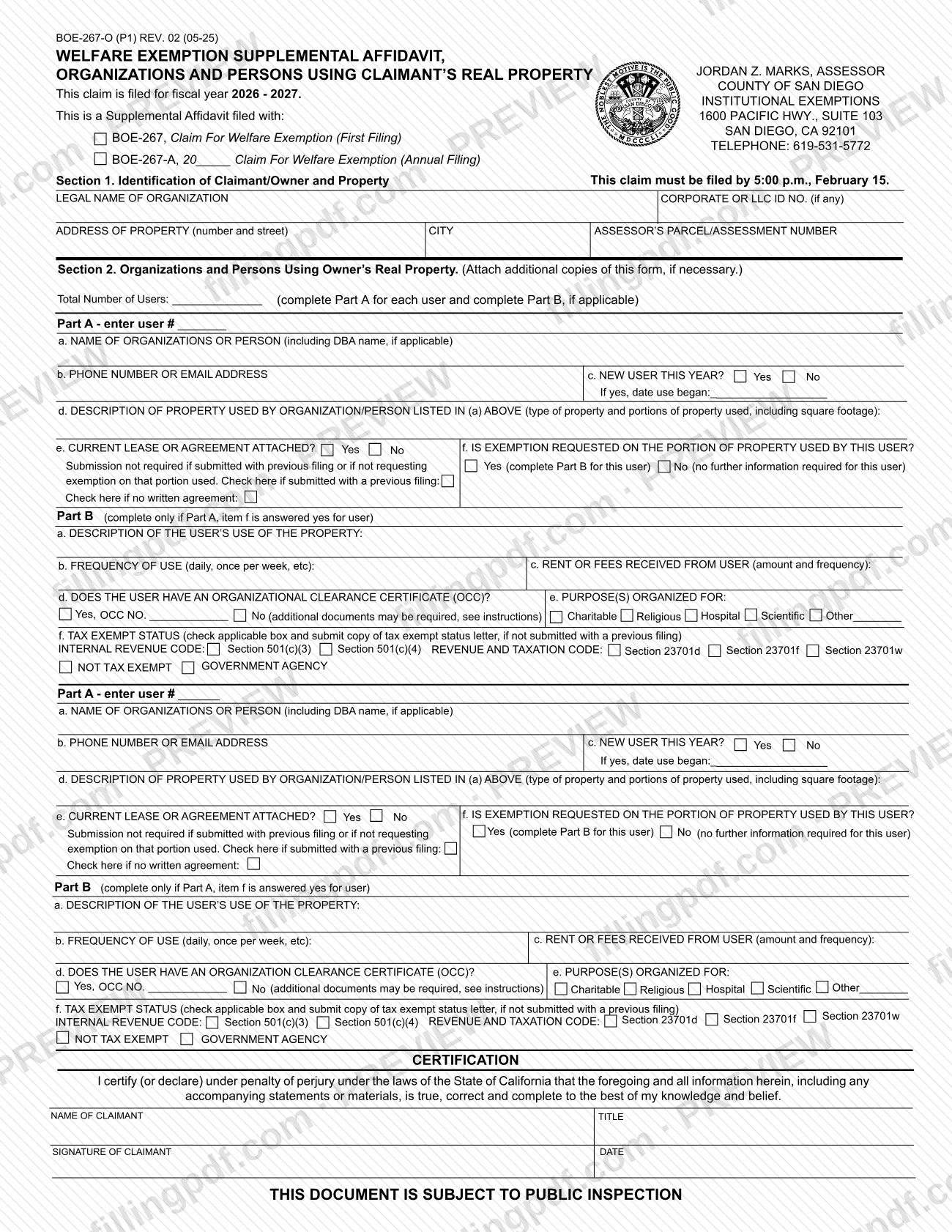
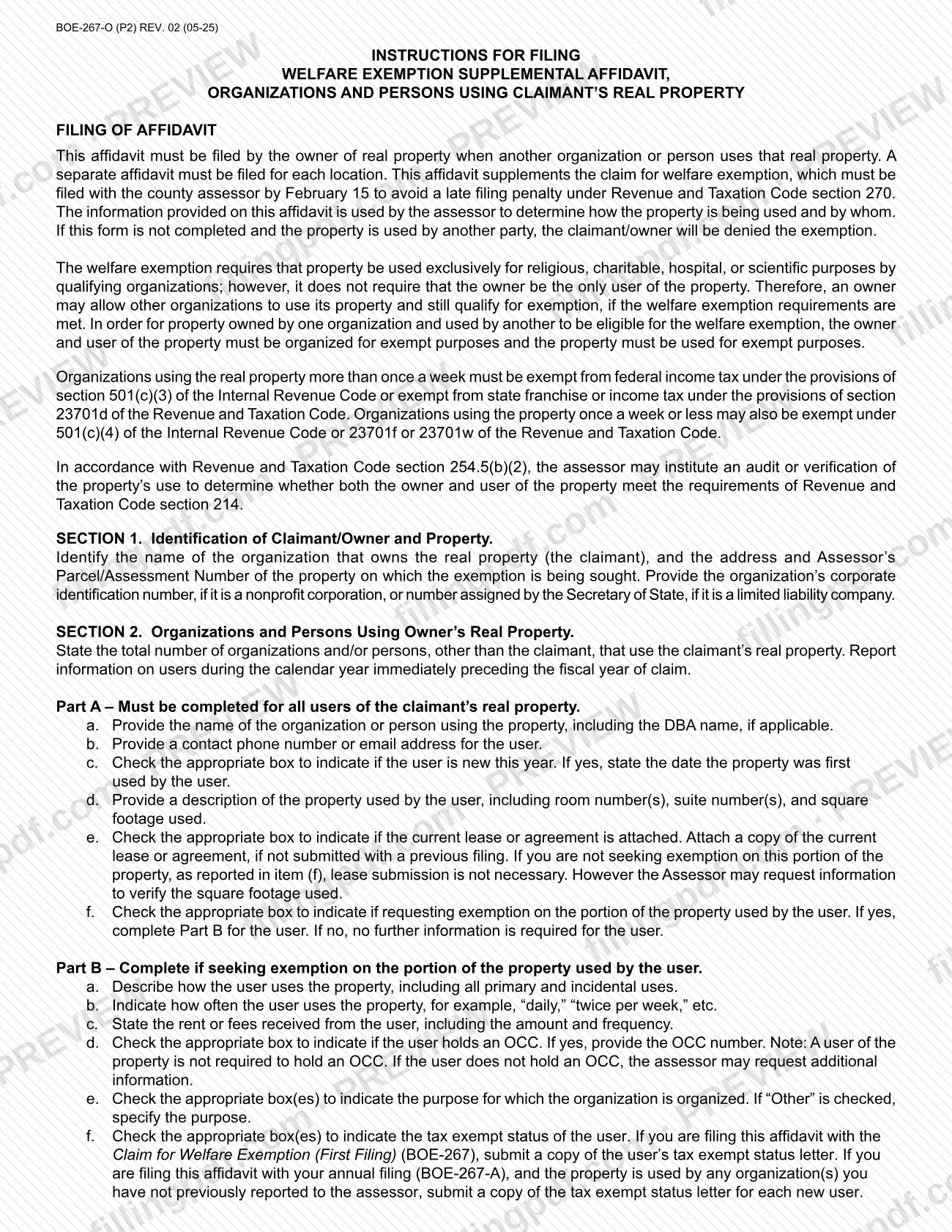
Form BOE-267-O, the Welfare Exemption Supplemental Affidavit for Organizations and Persons Using Claimant's Real Property, is the form on which an owner reports to the San Diego County Assessor every other organization or person that uses its real property. It is one of the San Diego County property tax forms in the Institutional Exemptions group and is filed together with the welfare exemption claim. On this page you can fill out the form online on FillingPDF and download or print the completed PDF; the county publishes the original form and its instructions at the Assessor's website.
Last updated
What is BOE-267-O?
Form BOE-267-O, Welfare Exemption Supplemental Affidavit, Organizations and Persons Using Claimant's Real Property, is the affidavit an owner files with the county assessor to identify every organization or person, other than the owner, that uses the property for which a welfare exemption is claimed.
The assessor uses the answers to decide how the property is being used and by whom. The form is a supplement, not a claim: it is filed with BOE-267, Claim For Welfare Exemption (First Filing) or BOE-267-A, Claim For Welfare Exemption (Annual Filing), and the printed version covers fiscal year 2026 - 2027.
The welfare exemption requires that property be used exclusively for religious, charitable, hospital or scientific purposes by qualifying organizations. It does not require the owner to be the only user, so an owner may let others use the property and still qualify if the requirements are met. For that, the owner and the user must both be organized for exempt purposes and the property must be used for exempt purposes.
Part A of the form identifies each user and the space it occupies. Part B is completed only for users on whose portion exemption is requested. The instructions add that the assessor may audit or verify the property's use under Revenue and Taxation Code section 254.5(b)(2). The form states that it is subject to public inspection.
Who needs to file BOE-267-O?
The owner of real property (the claimant) files this affidavit when another organization or person uses that property. A separate affidavit must be filed for each location.
- Claimants who file BOE-267 (first filing) or BOE-267-A (annual filing) for property that has other users attach this supplement.
- If the property is used by another party and the form is not completed, the claimant/owner will be denied the exemption.
- You report every user other than the claimant. Part A is completed for all users; Part B only for users whose portion of the property is included in the exemption request.
The instructions set tax-status conditions for users in Part B. An organization using the property more than once a week must be exempt under section 501(c)(3) of the Internal Revenue Code or section 23701d of the Revenue and Taxation Code. An organization using it once a week or less may also be exempt under 501(c)(4) of the Internal Revenue Code or section 23701f or 23701w of the Revenue and Taxation Code.
The claimant signs the certification. The form does not name any other person who may sign it.
When to file BOE-267-O
File the affidavit with the welfare exemption claim, which is due by 5:00 p.m. on February 15; the form prints this deadline in Section 1. The instructions say the claim must be filed with the county assessor by February 15 to avoid a late filing penalty under Revenue and Taxation Code section 270.
The form states the fiscal year of the claim (2026 - 2027 on this revision). Report users for the calendar year immediately preceding that fiscal year. The affidavit has no separate due date: it travels with the claim, whether that is the first filing or the annual filing. A new affidavit is needed for each location.
Documents you need
- Copy of the current lease or agreement for each user, if not submitted with a previous filing. It is not needed for a user whose portion of the property is not part of the exemption request.
- Copy of the user's tax exempt status letter for each user in Part B, when this affidavit is filed with BOE-267 (First Filing), unless it was submitted with a previous filing.
- Copy of the tax exempt status letter for each new user not previously reported to the assessor, when this affidavit is filed with BOE-267-A (annual filing).
- Additional documents, which the assessor may request, for a Part B user that has no Organizational Clearance Certificate (OCC); the instructions say the user is not required to hold one.
- Additional copies of this form, if the property has more users than the form has room for.
How to fill out BOE-267-O
Confirm the fiscal year and companion claim
The form states the fiscal year of the claim (2026 - 2027 on this revision). Check whether you are filing it with BOE-267 (First Filing) or BOE-267-A (Annual Filing), as marked at the top.
Identify the claimant and property
In Section 1, enter the legal name of the organization, its corporate or LLC ID number if any, the property address (number and street, city) and the Assessor's Parcel/Assessment Number. Use the corporate ID for a nonprofit corporation, or the Secretary of State number for a limited liability company.
State the total number of users
In Section 2, enter the Total Number of Users: the organizations and persons, other than the claimant, using the property. Report users for the calendar year before the fiscal year of the claim.
Enter the user's name and contact
In Part A, enter the user number, then item a (name, including any DBA name) and item b (phone number or email address).
Mark new users and start date
Item c: check Yes or No for a new user this year. If Yes, enter the date the user first used the property.
Describe the property used
Item d: give the type of property and the portions used, with room numbers, suite numbers and square footage.
Answer the lease question
Item e: check whether the current lease or agreement is attached. Check the box for a previous filing or for no written agreement where either applies.
Say whether exemption is requested
Item f: check Yes if exemption is requested on this user's portion, then complete Part B for that user; check No if no further information is needed.
Complete Part B use details
Items a to c: describe all primary and incidental uses, the frequency of use (for example daily or twice per week) and the rent or fees received, with amount and frequency.
Enter OCC, purpose and tax status
Item d: check Yes and enter the OCC number, or No. Item e: check the purpose organized for. Item f: check the user's tax exempt status, or Not Tax Exempt or Government Agency.
Repeat for each additional user
Use the next Part A and Part B block for each further user, entering its user number, and attach more copies of the form if needed.
Sign, review and download the PDF
Enter the claimant's name and title, sign and date the certification under penalty of perjury. Review every entry, then download or print the completed PDF from FillingPDF and assemble the package described under How to submit.
How to submit BOE-267-O
The form names one filing destination: the San Diego County Assessor. File the completed affidavit together with the welfare exemption claim (BOE-267 or BOE-267-A) that it supplements.
- Assessor's office: County of San Diego, Assessor, 1600 Pacific Hwy., Suite 103, San Diego, CA 92101, as printed on the form.
- Phone: 619-531-5772, the telephone number printed on the form for questions.
Include a copy of each current lease or agreement and each user's tax exempt status letter where the instructions require them (see the required documents). If the property has more users than the form has room for, attach additional copies of the form. The form does not print a fee, a portal or any other channel, so confirm any further details with the Assessor. FillingPDF lets you fill out and download the PDF; submission follows the Assessor's channels above.
Common mistakes to avoid
- Leaving the affidavit out when another party uses the property; the instructions say the claimant/owner will be denied the exemption.
- Filing one affidavit for several locations; a separate affidavit must be filed for each location.
- Missing the 5:00 p.m., February 15 deadline for the claim, which can bring a late filing penalty under Revenue and Taxation Code section 270.
- Listing the claimant itself as a user; Section 2 asks only for organizations and persons other than the claimant.
- Reporting users for the wrong year; the instructions ask for users during the calendar year immediately preceding the fiscal year of claim.
- Describing the space without room or suite numbers and square footage in Part A, item d.
- Leaving out the lease or agreement without checking "submitted with a previous filing" or "no written agreement" in Part A, item e.
- Completing Part B for a user when exemption is not requested on that user's portion, or skipping Part B when item f is answered Yes.
- Omitting the tax exempt status letter for a new user, or checking only a tax status that does not fit the user's frequency of use.
- Submitting the form without the claimant's name, title, signature and date in the certification.
Frequently asked questions
What is Form BOE-267-O used for?
Form BOE-267-O is the Welfare Exemption Supplemental Affidavit that an owner files when another organization or person uses its real property. It tells the San Diego County Assessor who uses the property and how, so the assessor can decide whether the exemption applies.
Do I need BOE-267-O if I am the only user of my property?
The instructions require the affidavit when another organization or person uses the real property. The form asks for users other than the claimant, so it applies when the property has such users and not when the owner is the only one.
What happens if I do not file BOE-267-O?
If the form is not completed and the property is used by another party, the claimant/owner will be denied the exemption, according to the form's instructions.
When is Form BOE-267-O due?
It is filed with the welfare exemption claim, which must be filed by 5:00 p.m. on February 15. The instructions state that a late claim can bring a penalty under Revenue and Taxation Code section 270.
Do I need a separate BOE-267-O for each property?
Yes. The instructions say a separate affidavit must be filed for each location. If one location has more users than the form holds, attach additional copies of the form for that location.
What must I attach to BOE-267-O?
Attach a copy of each current lease or agreement, if not sent with a previous filing and if exemption is requested on that user's portion. Also attach the tax exempt status letter of each user as the instructions require for the first or annual filing.
Does a user need an Organizational Clearance Certificate?
No. The instructions say a user is not required to hold an OCC. If the user has none, check No in Part B, item d; the assessor may then request additional information.
Can I fill out BOE-267-O online on FillingPDF?
Yes. You can fill out the PDF online on FillingPDF and download or print it. FillingPDF is an independent service and does not file the affidavit with the Assessor; you file it through the Assessor's channels.
Ready to fill out BOE-267-O?
Fill out BOE-267-O now