
Form BOE-267-R is the Welfare Exemption Supplemental Affidavit, Rehabilitation — Living Quarters, that an organization files with the San Diego County Assessor when its welfare exemption claim covers property used for rehabilitation or for housing. It is one of the San Diego County property tax forms in the Institutional Exemptions group, and it is never filed alone: it goes with the main claim. On this page you can fill out the form online on FillingPDF and download or print the completed PDF; the county publishes the original PDF at the address shown as the official source.
Last updated
What is BOE-267-R?
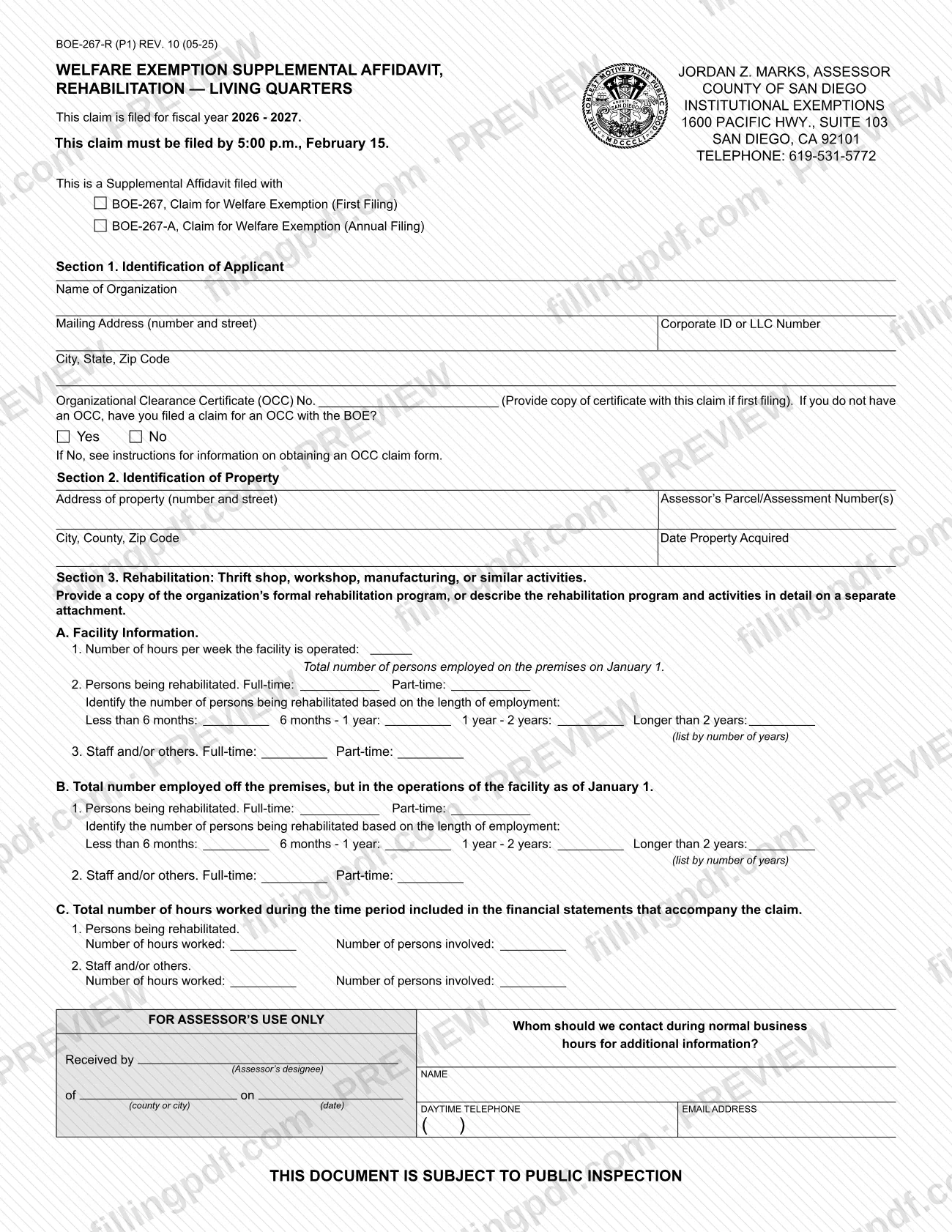
The Welfare Exemption Supplemental Affidavit, Rehabilitation — Living Quarters (Form BOE-267-R) is the supplemental affidavit an organization files with the county assessor when its welfare exemption claim covers property that involves rehabilitating persons, providing living quarters, or both.
The form is issued for the County of San Diego Assessor and is printed for fiscal year 2026 - 2027. It supplements the main claim, either BOE-267, Claim for Welfare Exemption (First Filing) or BOE-267-A, Claim for Welfare Exemption (Annual Filing). The instructions on the form say it is required under sections 251 and 254.5 of the Revenue and Taxation Code.
The affidavit has four parts:
- Section 1: identification of the applicant organization, including its Organizational Clearance Certificate (OCC) number.
- Section 2: identification of the property, with its Assessor's Parcel/Assessment Number(s) and acquisition date.
- Section 3: rehabilitation activities such as a thrift shop, workshop or manufacturing, with counts of persons being rehabilitated and staff, hours worked and wages paid.
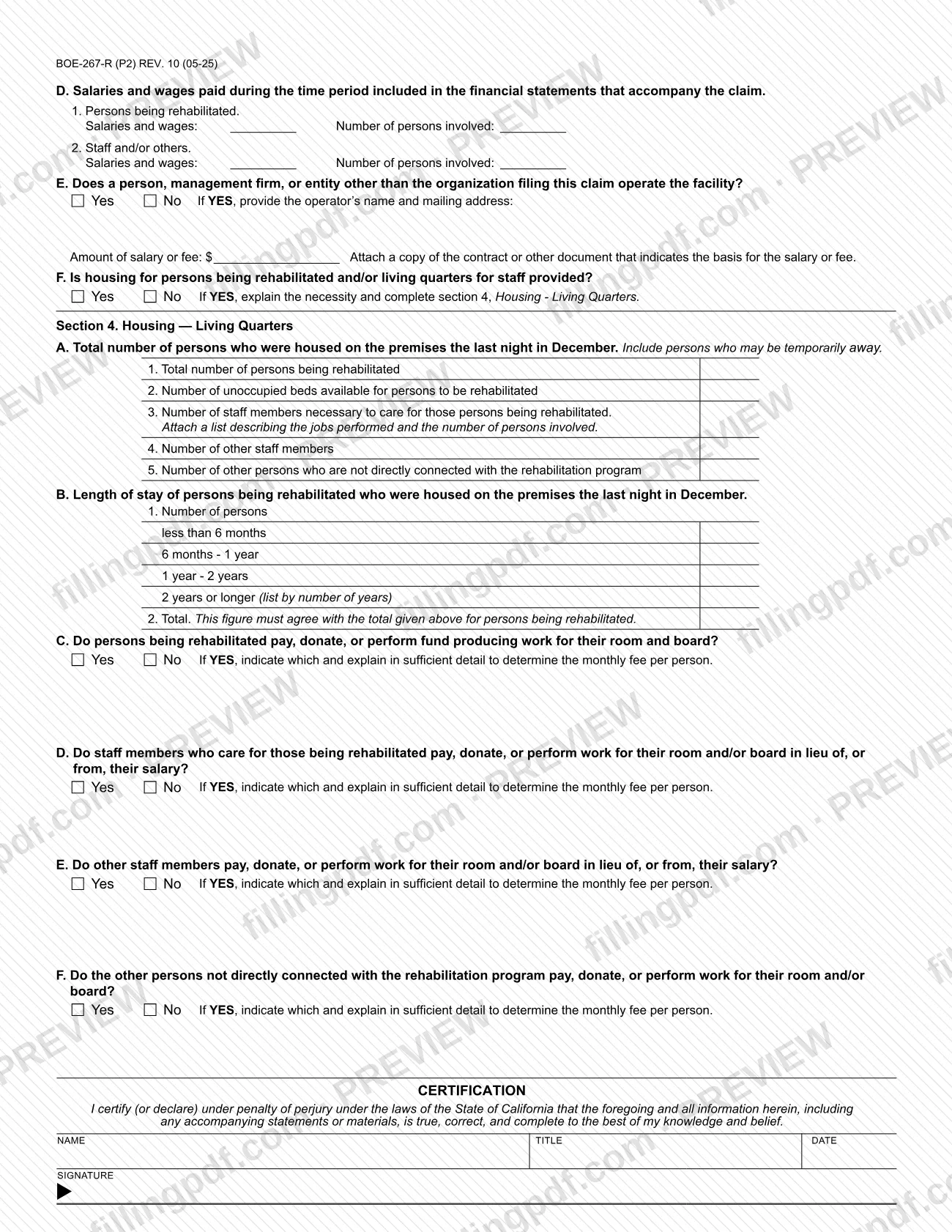
- Section 4: housing and living quarters, with who was housed on the last night in December and whether they pay, donate or work for room and board.
It ends with a certification signed under penalty of perjury under California law. The form states that it is subject to public inspection.
Who needs to file BOE-267-R?
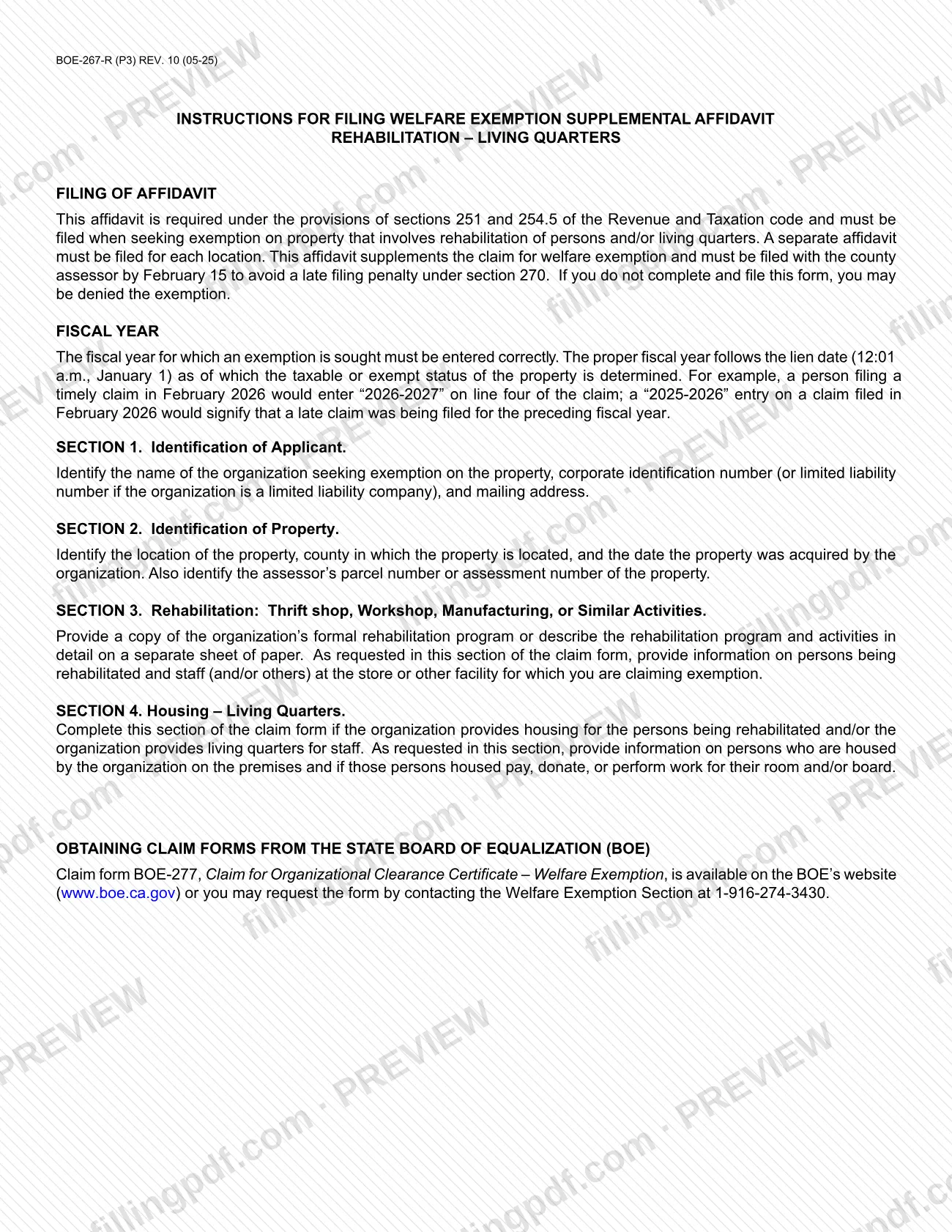
An organization that is seeking a welfare exemption on property that involves rehabilitation of persons, living quarters, or both must file this affidavit with its claim. The form says that if you do not complete and file it, you may be denied the exemption.
- Complete Section 3 when the property is used for rehabilitation through a thrift shop, workshop, manufacturing or similar activities.
- Complete Section 4 only if the organization provides housing for the persons being rehabilitated or living quarters for staff. Question F of Section 3 sends you there when the answer is Yes.
- File a separate affidavit for each location.
The affidavit supplements the claim: it is attached to BOE-267 for a first filing or to BOE-267-A for an annual filing. It is not a stand-alone application. An organization that does not already hold an Organizational Clearance Certificate is asked on the form whether it has filed a claim for one with the BOE; the instructions point to Claim form BOE-277 for that purpose.
When to file BOE-267-R
File the affidavit by 5:00 p.m. on February 15, the deadline printed on the form, together with the welfare exemption claim it supplements. The instructions say it must reach the county assessor by February 15 to avoid a late filing penalty under section 270.
The fiscal year follows the lien date (12:01 a.m., January 1). This revision is printed for fiscal year 2026 - 2027. According to the instructions, a timely claim filed in February 2026 is entered as 2026-2027, while a 2025-2026 entry on a claim filed in February 2026 signals a late claim for the preceding fiscal year.
Several answers are tied to dates: the number of persons employed on the premises on January 1, and the people housed on the last night in December.
Documents you need
- Copy of your Organizational Clearance Certificate (OCC), if this is a first filing.
- A copy of the organization's formal rehabilitation program, or a separate attachment describing the rehabilitation program and activities in detail, for Section 3.
- The financial statements that accompany the claim: the hours and wages you report cover the period they include.
- A copy of the contract or other document showing the basis for the salary or fee, only if a person, management firm or entity other than the organization operates the facility.
- A list describing the jobs performed and the number of persons involved, for staff members necessary to care for persons being rehabilitated (Section 4, item A.3), if housing is provided.
- A written explanation, detailed enough to determine the monthly fee per person, for each Section 4 item C through F answered Yes.
How to fill out BOE-267-R
Enter applicant identification
In Section 1, enter the organization's name, mailing address and Corporate ID or LLC Number. Enter the Organizational Clearance Certificate (OCC) No. and attach a copy if this is a first filing.
Answer the OCC claim question
If you do not have an OCC, check Yes or No to say whether you filed a claim for one with the BOE. If No, the instructions point to Claim form BOE-277.
Identify the property
In Section 2, enter the property address, city, county and ZIP code, the Assessor's Parcel/Assessment Number(s) and the date the property was acquired.
Attach the rehabilitation program
In Section 3, provide a copy of the formal rehabilitation program, or describe the program and activities in detail on a separate attachment.
Complete facility information
In Section 3, part A, enter the hours per week the facility operates and the people employed on the premises on January 1. Break out persons being rehabilitated by length of employment, and staff and/or others, as full-time and part-time.
Report off-premises employees
In part B, enter the total number employed off the premises but in the facility's operations as of January 1, with the same rehabilitated-person and staff breakdowns.
Enter hours and wages
In part C, enter hours worked and number of persons for the period in the accompanying financial statements. In part D, enter salaries and wages and number of persons for the same period.
State who operates the facility
In part E, check Yes or No. If Yes, enter the operator's name, mailing address and the salary or fee, and attach the contract or other supporting document.
Answer the housing question
In part F, check Yes or No for housing or living quarters. If Yes, explain the necessity and complete Section 4.
Complete housing counts
In Section 4, part A, count people housed on the last night in December, including those temporarily away. In part B, give length of stay; the total must agree with the persons being rehabilitated in part A.
Explain room and board payments
For parts C through F, check Yes or No for each group. If Yes, indicate whether they pay, donate or work, and explain in enough detail to determine the monthly fee per person.
Certify, sign and download
Enter the contact person, then the name, title, date and signature in the Certification, made under penalty of perjury. Review every section, then download or print the completed PDF from FillingPDF and file it with the claim.
How to submit BOE-267-R
The form names one channel: filing with the county assessor. The Assessor's office is printed on it as 1600 Pacific Hwy., Suite 103, San Diego, CA 92101, telephone 619-531-5772.
- Where: file the affidavit with the San Diego County Assessor, at the address above, by 5:00 p.m. on February 15.
- With what: file it together with the main claim, BOE-267 (first filing) or BOE-267-A (annual filing), and the attachments the form lists.
- First filing: include a copy of your Organizational Clearance Certificate.
- Questions: call the Assessor at 619-531-5772.
The form does not describe mail, online or drop-off options separately, so confirm any other delivery method with the Assessor before you rely on it. The document is subject to public inspection. FillingPDF lets you fill out and download the PDF; submission follows the channels above.
Common mistakes to avoid
- Filing after 5:00 p.m. on February 15, which can bring a late filing penalty under section 270.
- Not filing the affidavit at all when the property involves rehabilitation or living quarters; the form warns the exemption may be denied.
- Using one affidavit for several locations; a separate affidavit must be filed for each location.
- Entering the wrong fiscal year; a 2025-2026 entry on a claim filed in February 2026 signals a late claim.
- Omitting a copy of the OCC certificate on a first filing.
- Skipping the rehabilitation program copy or detailed description that Section 3 requires.
- Answering Yes to Section 3, question E or F without attaching the operator contract or completing Section 4.
- Giving a length-of-stay total in Section 4, item B.2 that does not match the total number of persons being rehabilitated in item A.1.
- Answering Yes to Section 4, items C through F without explaining enough to determine the monthly fee per person.
Frequently asked questions
What is Form BOE-267-R used for?
Form BOE-267-R is the Welfare Exemption Supplemental Affidavit for Rehabilitation — Living Quarters. An organization files it with its welfare exemption claim when the property involves rehabilitating persons or providing living quarters. It is not a claim on its own.
Is BOE-267-R filed alone or with another form?
With another form. The affidavit is filed with BOE-267, Claim for Welfare Exemption (First Filing), or BOE-267-A, Claim for Welfare Exemption (Annual Filing). It supplements that claim and does not replace it.
What is the deadline for the BOE-267-R affidavit?
The form says it must be filed by 5:00 p.m. on February 15. The instructions add that it must reach the county assessor by that date to avoid a late filing penalty under section 270.
Do I need a separate BOE-267-R for each property?
Yes, for each location. The instructions state that a separate affidavit must be filed for each location, and Section 2 asks for the address and parcel number of that one property.
Do I have to complete Section 4, Housing — Living Quarters?
Only if the organization provides housing for persons being rehabilitated or living quarters for staff. Section 3, question F directs you to Section 4 when the answer is Yes.
What happens if I do not file BOE-267-R?
The form warns that if you do not complete and file it, you may be denied the exemption. A filing after February 15 can also carry a late filing penalty under section 270.
Where do I file BOE-267-R in San Diego County?
File it with the San Diego County Assessor, 1600 Pacific Hwy., Suite 103, San Diego, CA 92101, telephone 619-531-5772. The form names no other delivery channel, so call the Assessor to confirm other methods.
Can I fill out BOE-267-R online on FillingPDF?
Yes. You can fill out the PDF online on FillingPDF and download or print it. FillingPDF is independent of the county and does not file the affidavit; you file it with the Assessor yourself.
Ready to fill out BOE-267-R?
Fill out BOE-267-R now