
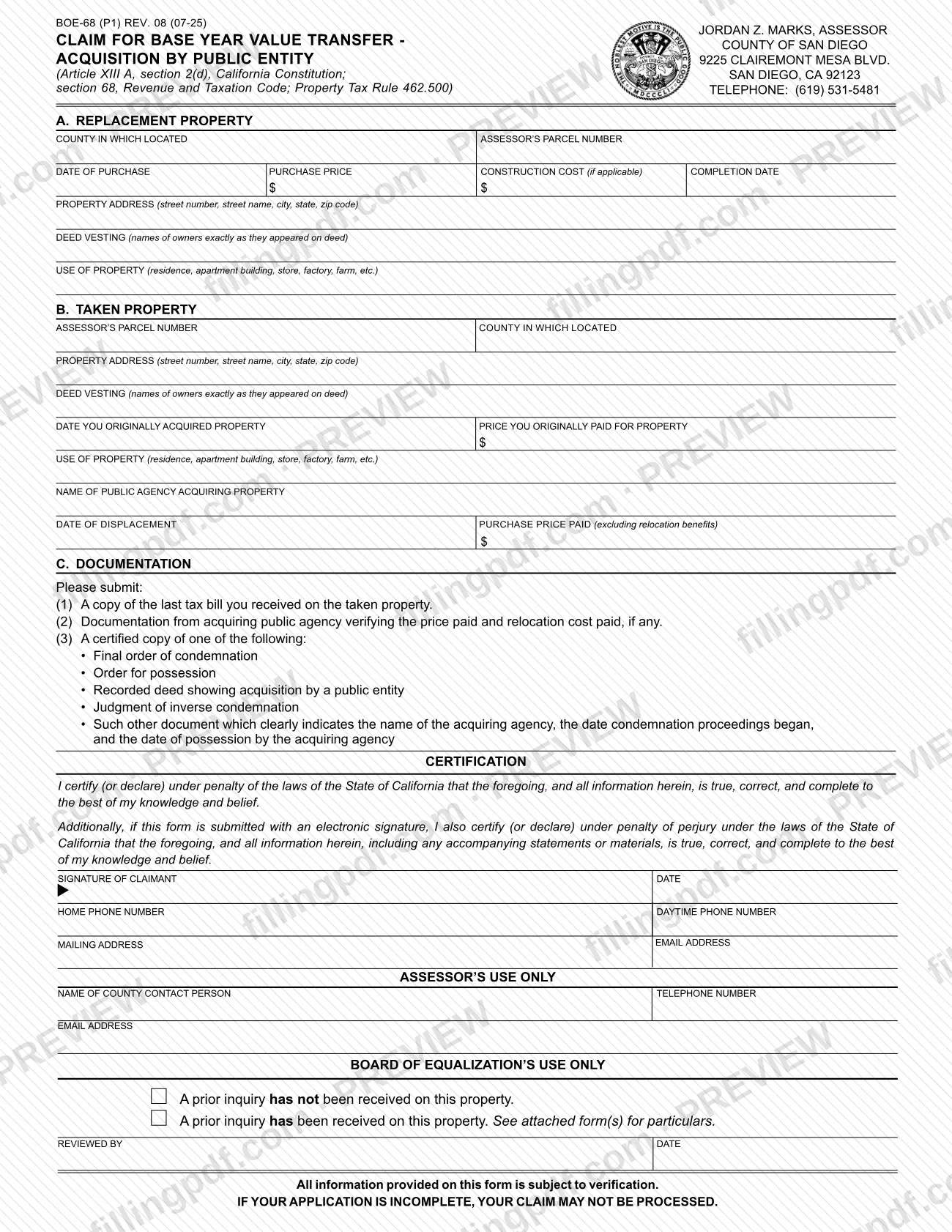
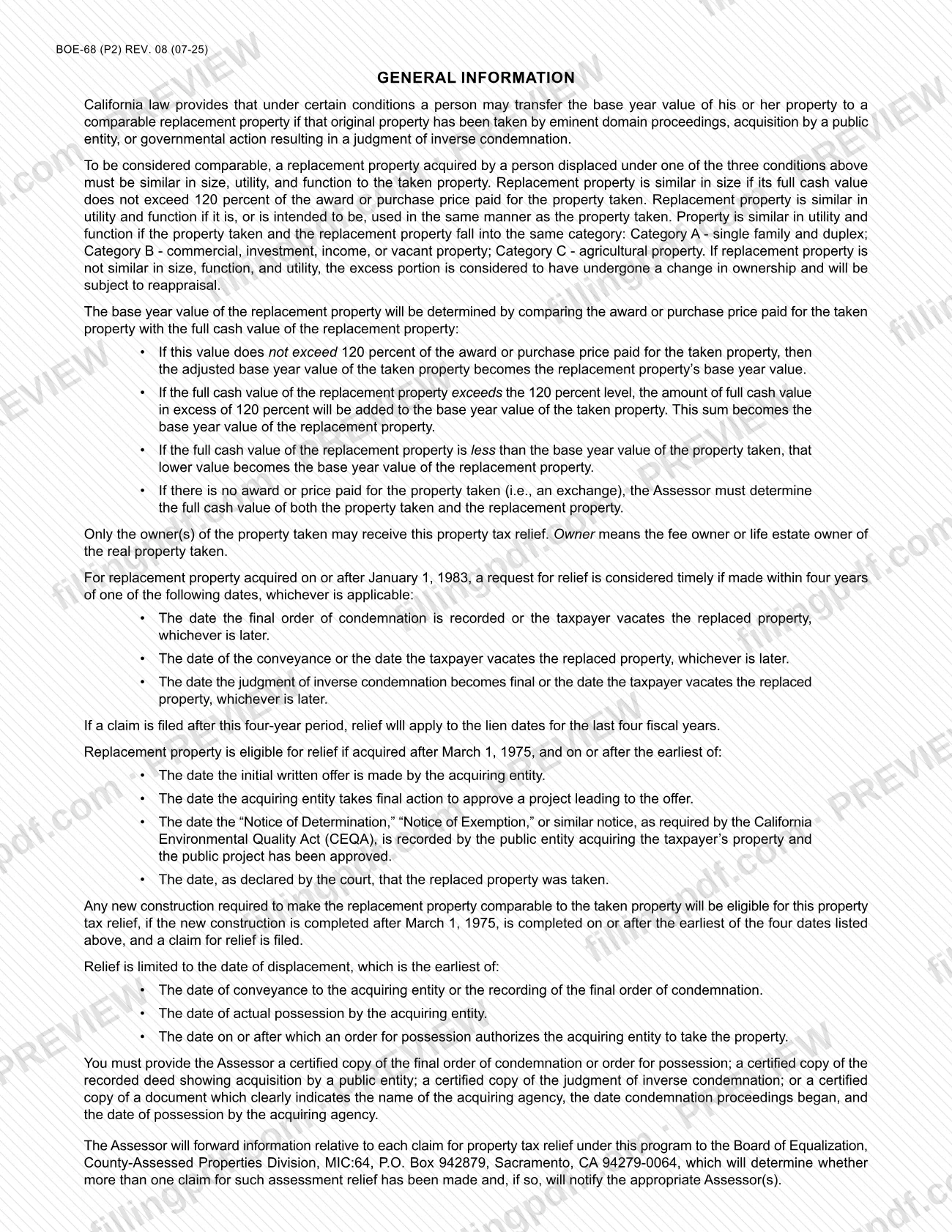
Form BOE-68, Claim for Base Year Value Transfer, Acquisition by Public Entity, is the claim filed with the County of San Diego Assessor so that the base year value of property taken by a public entity can carry over to a comparable replacement property. It is one of the San Diego County property tax forms in the Assessor's exemption and exclusion forms, and the county lists it as Eminent Domain Exclusion (Prop 3). You can fill out the form online on FillingPDF and download or print the completed PDF; the form itself is published by the Assessor at the official URL.
Last updated
What is BOE-68?
Form BOE-68, Claim for Base Year Value Transfer - County of San Diego, Acquisition by Public Entity is the claim an owner files with the San Diego County Assessor to carry the base year value of taken property over to a comparable replacement property.
The form cites Article XIII A, section 2(d) of the California Constitution, section 68 of the Revenue and Taxation Code and Property Tax Rule 462.500. Under that law, a person may transfer the base year value when the original property was taken by eminent domain proceedings, acquisition by a public entity, or governmental action resulting in a judgment of inverse condemnation.
The replacement property must be comparable: similar in size, utility and function. It is similar in size if its full cash value does not exceed 120 percent of the award or purchase price paid for the taken property. It is similar in utility and function if the two fall into the same category:
- Category A: single family and duplex;
- Category B: commercial, investment, income or vacant property;
- Category C: agricultural property.
The excess portion of a property that is not comparable is treated as a change in ownership and is reappraised. If the replacement's full cash value is below the base year value of the taken property, that lower value becomes its base year value.
Page 1 has Section A (replacement property), Section B (taken property), Section C (documentation) and the claimant's certification. Page 2 holds the General Information. The Assessor forwards each claim to the Board of Equalization, which checks whether more than one claim has been made.
Who needs to file BOE-68?
Only the owner or owners of the property taken may receive this relief. The form defines owner as the fee owner or life estate owner of the real property taken. If you are displaced by eminent domain proceedings, acquisition by a public entity, or a judgment of inverse condemnation, and you acquire a comparable replacement property, you file this claim with the Assessor.
Conditions that decide whether the claim works:
- The replacement property must be acquired after March 1, 1975, and on or after the earliest of four dates tied to the taking, such as the initial written offer by the acquiring entity or the date the court declares the property taken.
- Any new construction needed to make the replacement comparable can also qualify if it is completed after March 1, 1975, and on or after the earliest of those dates, and a claim is filed.
- The replacement property should be in the same category as the taken property and should not exceed 120 percent of the award or price paid, or the excess is reappraised.
The form does not describe who may sign for an owner.
When to file BOE-68
For replacement property acquired on or after January 1, 1983, a claim is timely if made within four years of the applicable date, whichever is later in each case:
- the date the final order of condemnation is recorded, or the date you vacate the replaced property;
- the date of the conveyance, or the date you vacate the replaced property;
- the date the judgment of inverse condemnation becomes final, or the date you vacate the replaced property.
If you file after the four-year period, relief applies to the lien dates for the last four fiscal years only. Relief is also limited to the date of displacement, which is the earliest of the conveyance or recording of the final order of condemnation, actual possession by the acquiring entity, or the date an order for possession authorizes the taking. The form sets no other deadline and gives no processing time.
Documents you need
- A copy of the last tax bill you received on the taken property.
- Documentation from the acquiring public agency verifying the price paid and the relocation cost paid, if any.
- A certified copy of the final order of condemnation (one of the Section C options).
- A certified copy of the order for possession (alternative to the other Section C documents).
- A certified copy of the recorded deed showing acquisition by a public entity (alternative option).
- A certified copy of the judgment of inverse condemnation (alternative option).
- A certified copy of another document that clearly shows the name of the acquiring agency, the date condemnation proceedings began and the date of possession by the acquiring agency.
How to fill out BOE-68
Identify the replacement property
In Section A, enter the county in which the replacement property is located and its Assessor's Parcel Number.
Enter purchase and construction details
Enter the date of purchase and the purchase price. If new construction was needed to make the property comparable, also enter the construction cost and the completion date.
Describe the replacement property
Enter the full property address (street number, street name, city, state, zip code), the deed vesting with owners' names exactly as on the deed, and the use of the property, such as residence, store or farm.
Identify the taken property
In Section B, enter the Assessor's Parcel Number, the county, the full address, the deed vesting exactly as on the deed, and the use of the property taken.
Enter your original acquisition
Enter the date you originally acquired the taken property and the price you originally paid for it.
Enter agency and displacement details
Enter the name of the public agency acquiring the property, the date of displacement, and the purchase price paid, excluding relocation benefits.
Prepare the Section C documents
Gather the last tax bill on the taken property, the acquiring agency's documentation of price and relocation cost, and one certified copy from the list in Section C.
Sign, date and add contact details
Under the certification, the claimant signs and dates the form. Enter home and daytime phone numbers, mailing address and email address.
Leave the office-use areas blank
The Assessor's Use Only and Board of Equalization's Use Only boxes are for the county and the Board; the claimant enters nothing there.
Review and download the completed PDF
Check that every field is complete, the names match the deeds and the documents are ready. Download or print the completed PDF from FillingPDF and assemble the package described under How to submit.
How to submit BOE-68
The form names no separate submission channel; page 2 says you must provide the Assessor with the certified documents, and the form header identifies the office to contact.
- Assessor's office: Jordan Z. Marks, Assessor, County of San Diego, 9225 Clairemont Mesa Blvd., San Diego, CA 92123. Telephone: (619) 531-5481. Call to confirm how the office accepts claims before sending originals or certified copies.
- What to include: the completed and signed form plus the documents listed in Section C: the last tax bill on the taken property, the acquiring agency's documentation of the price paid and any relocation cost, and a certified copy of the condemnation, possession, deed or judgment document.
- After filing: the Assessor forwards information on each claim to the Board of Equalization, County-Assessed Properties Division, which checks for other claims on the same property. You do not send the claim to the Board yourself.
The certification includes an added statement that applies if the form is submitted with an electronic signature. The form warns that an incomplete application may not be processed and that all information is subject to verification. FillingPDF lets you fill out and download the PDF; submission follows the channels above.
Common mistakes to avoid
- Submitting an incomplete form: the form warns that an incomplete application may mean the claim is not processed.
- Attaching an uncertified copy of the condemnation order, order for possession, deed or judgment; Section C calls for a certified copy.
- Including relocation benefits in the purchase price paid; the form asks for the price paid excluding relocation benefits.
- Filing more than four years after the applicable date and expecting full relief; late claims get relief only for the lien dates of the last four fiscal years.
- Claiming relief for a replacement property acquired on or before March 1, 1975, or before the earliest of the four eligibility dates.
- Entering deed vesting names differently from how they appear on the deed; the form asks for names exactly as on the deed.
- Filing as someone other than the fee owner or life estate owner of the taken property.
- Leaving out the acquiring agency's documentation of the price paid and any relocation cost paid.
Frequently asked questions
What is Form BOE-68 used for?
Form BOE-68 is the claim to transfer the base year value of property taken by eminent domain, public-entity acquisition or inverse condemnation judgment to a comparable replacement property. It is filed with the San Diego County Assessor, which lists it as Eminent Domain Exclusion (Prop 3).
Who can file a claim for base year value transfer?
Only the owner or owners of the property taken, meaning the fee owner or life estate owner of the real property. Tenants and others without an ownership interest in the taken property do not qualify under the form's General Information.
How long do I have to file Form BOE-68?
A claim is timely if made within four years of the applicable date, such as the recording of the final order of condemnation, the conveyance or the final inverse condemnation judgment, or when you vacate, whichever is later. After four years, relief covers only the last four fiscal years' lien dates.
What is the 120 percent rule on this form?
Replacement property is similar in size if its full cash value is no more than 120 percent of the award or price paid for the taken property. Value above that level is added to the taken property's base year value, so the excess is effectively reappraised.
What documents must I send with Form BOE-68?
You need a copy of the last tax bill on the taken property, the acquiring agency's documentation of price and relocation cost, and a certified copy of one document: final order of condemnation, order for possession, recorded deed, inverse condemnation judgment, or a similar document.
Where do I submit Form BOE-68 in San Diego County?
The form says you provide the documents to the Assessor and prints the office address, 9225 Clairemont Mesa Blvd., San Diego, CA 92123, and telephone (619) 531-5481. It names no delivery method, so call the office to confirm how to submit.
Can I fill out Form BOE-68 online on FillingPDF?
Yes. You can fill out the PDF online on FillingPDF and download or print it. FillingPDF is an independent service, is not affiliated with the Assessor and does not file the claim; you submit it through the Assessor's channels.
What happens to my claim after the Assessor receives it?
The Assessor forwards information on each claim to the Board of Equalization, County-Assessed Properties Division, which determines whether more than one claim for this relief has been made and notifies the appropriate Assessor or Assessors.
Ready to fill out BOE-68?
Fill out BOE-68 now