
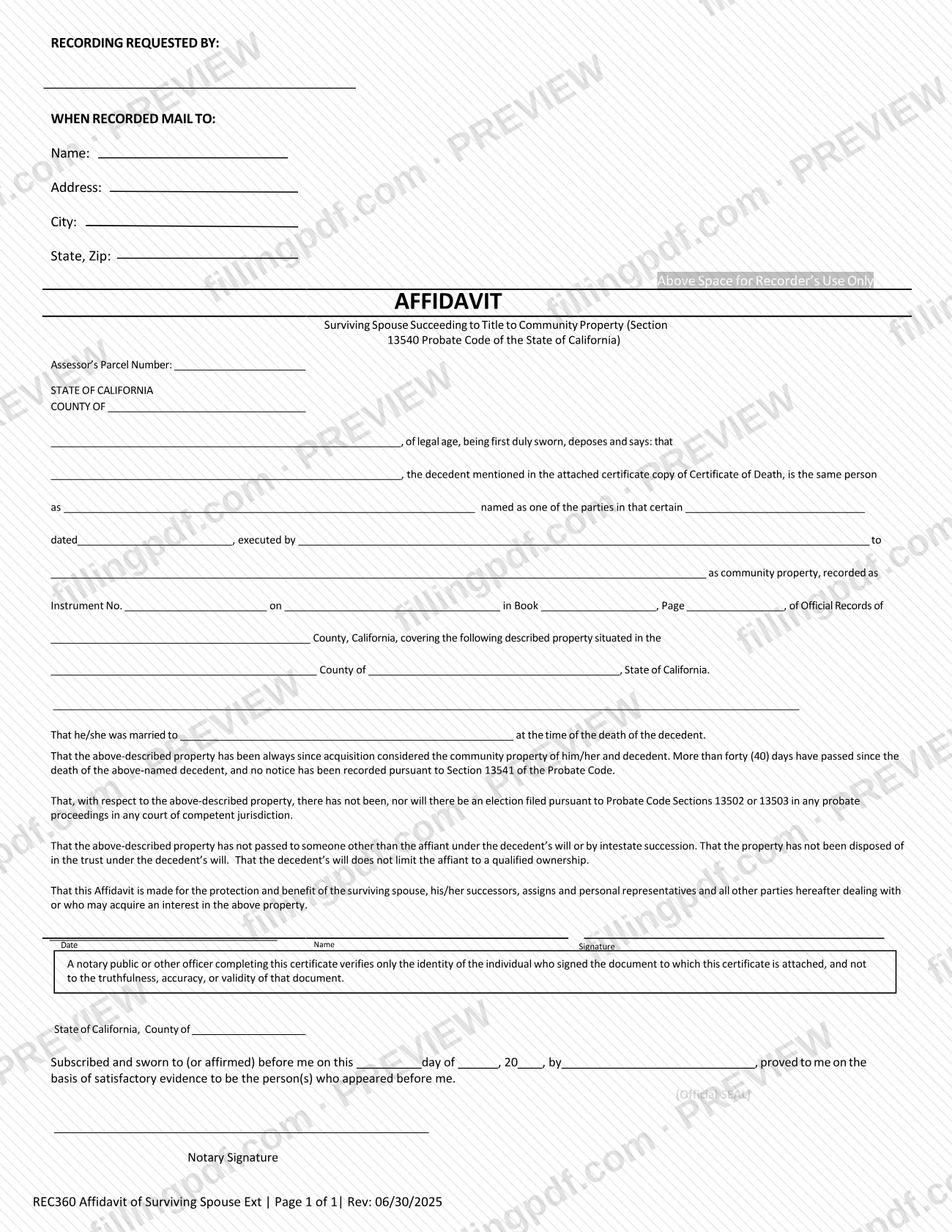
The Affidavit of Surviving Spouse (Form REC360) is a sworn statement, published by the San Diego County Assessor/Recorder/County Clerk, by which a surviving spouse succeeds to title to community property under Section 13540 of the California Probate Code. The form is prepared for recording against a specific parcel, so it carries the Assessor's Parcel Number and the details of the recorded instrument that conveyed the property. On this page you can fill out the form online on FillingPDF and download or print the completed PDF; the original PDF is published by the county at the official URL below, and it must be signed before a notary and recorded with the County Recorder.
Last updated
What is REC360?
The Affidavit of Surviving Spouse is a one-page sworn statement, titled "Surviving Spouse Succeeding to Title to Community Property (Section 13540 Probate Code of the State of California)", that a surviving spouse signs so the property can be recorded as passing to them after the death of their spouse.
The affiant identifies the decedent, who must be the same person named in the attached certificate copy of the Certificate of Death, and the recorded instrument that vested the property as community property: its date, the parties, the Instrument No., recording date, Book and Page of the Official Records, and the county. The affiant then swears to the facts that support succession:
- the affiant was married to the decedent at the time of death;
- the property has always, since acquisition, been considered the community property of the two spouses;
- more than forty (40) days have passed since the death, and no notice has been recorded under Section 13541 of the Probate Code;
- no election under Probate Code Sections 13502 or 13503 has been or will be filed in any probate proceeding;
- the property has not passed to someone else under the decedent's will or by intestate succession, has not been disposed of in a trust under the will, and the will does not limit the affiant to a qualified ownership.
The form states that it is made for the protection and benefit of the surviving spouse, their successors, assigns and personal representatives, and all other parties who later deal with the property. It carries the Assessor's Parcel Number, a space for the Recorder's use, and a notary acknowledgment block. It is a recording document, not a tax return or a county assessment form.
Who needs to file REC360?
A surviving spouse who is succeeding to title to community property in San Diego County after the death of their spouse, and who can truthfully make every statement printed on the form, uses this affidavit. The affiant must be of legal age and must have been married to the decedent at the time of death.
Conditions the form builds in:
- The property must have been considered the community property of the affiant and the decedent since it was acquired.
- More than forty days must have passed since the death, and no notice may have been recorded under Probate Code Section 13541.
- No election under Probate Code Sections 13502 or 13503 may have been or be filed in a probate proceeding.
- The property must not have passed to someone other than the affiant under the will or by intestate succession, must not have been disposed of in a trust under the will, and the will must not limit the affiant to a qualified ownership.
If any of these statements is not true, the affidavit cannot be signed as written. The form is also limited to property in San Diego County, because the Recorder accepts for recording only property located in the county. The form does not describe signing by an agent or representative; the affiant swears to the statements personally before a notary.
When to file REC360
The affidavit can be signed and recorded only after more than forty (40) days have passed since the decedent's death, because the form states that fact and that no notice has been recorded under Section 13541 of the Probate Code. No later deadline is printed on the form.
You also need the certificate copy of the Certificate of Death to attach, and the recording details (Instrument No., recording date, Book and Page) of the instrument that vested the property. Sign the affidavit in front of a notary, then record it with the County Recorder; the Recorder takes a document that California law says must be recorded, provided the fees and taxes are paid and the document is complete and legible.
Documents you need
- A certificate copy of the Certificate of Death of the decedent, attached to the affidavit; the form refers to it as the document that identifies the decedent.
- The recording details of the instrument that vested the property as community property: its date, the parties, Instrument No., recording date, Book, Page and county of the Official Records.
- A completed notary acknowledgment, with a legible notary seal, on the affidavit; the county requires documents to be properly acknowledged unless exempt.
- The Assessor's Parcel Number of the property, written on the form.
How to fill out REC360
Complete the recording request block
In the top-left block under RECORDING REQUESTED BY and WHEN RECORDED MAIL TO, enter your name, address, city, state and ZIP code. Leave the space above it, marked for the Recorder's use only, empty.
Enter the Assessor's Parcel Number
Write the Assessor's Parcel Number of the property on the line provided under the title. The County Recorder asks for the parcel number on property documents.
Enter state and county of the oath
Complete the venue lines for the State of California and the county where you swear to the affidavit.
Identify yourself and the decedent
Enter your name as the affiant, who must be of legal age, and the name of the decedent shown on the attached certificate copy of the Certificate of Death.
Describe the recorded instrument
Enter the type and date of the instrument, who executed it and to whom, the Instrument No., recording date, Book and Page of the Official Records and the county where it was recorded.
Describe the property
Enter the legal description of the property and the county in which it is situated, then the name of your spouse, the decedent, in the sentence stating that you were married at the time of death.
Review the sworn statements
Read the statements about community property, the forty days and Section 13541, the absence of an election under Sections 13502 or 13503, and the will and trust. Sign only if each one is true.
Date, print and sign the affidavit
Fill in the Date, Name and Signature line. Sign in front of the notary, because the Recorder requires original signatures.
Have the notary complete the acknowledgment
The notary fills in the county, the date, your name and the Official SEAL and signature. The notary verifies only your identity, not the truth of the document.
Review, download and attach the death certificate
Check names, parcel number and recording details, then download or print the completed PDF from FillingPDF, attach the certificate copy of the Certificate of Death and submit it as described under How to submit.
How to submit REC360
The signed and notarized original is recorded with the San Diego Recorder/County Clerk in person or by mail.
- In person: record at the downtown San Diego, Chula Vista, Santee or San Marcos office. The county page says this service is not available at the Kearny Mesa office, and appointments are not required.
- By standard U.S. mail: send the original document with a check or money order to San Diego Recorder/County Clerk, P.O. Box 121750, San Diego, CA 92112-1750.
- By overnight or express mail: San Diego Recorder/County Clerk, 590 3rd Avenue, Suite 204, Chula Vista, CA 91910.
Recording fees must be paid at the time of recording. Payment is by cash, credit or debit card (in person only), check or money order; card payments carry a surcharge, and checks or money orders are payable to San Diego Recorder/County Clerk. For amounts, see the county's fee schedule. Signatures must be original, the Recorder's staff can be reached at (619) 238-8158 (Se habla español), and the county reviews each document against state law. FillingPDF lets you fill out and download the PDF; submission follows the channels above.
Common mistakes to avoid
- Signing the affidavit before more than forty (40) days have passed since the death, or when a notice has been recorded under Probate Code Section 13541.
- Submitting a photocopied signature; the Recorder requires original signatures unless the document is a certified copy from the custodian of the record.
- Leaving the Assessor's Parcel Number blank or incomplete in the box above the title.
- Omitting the certificate copy of the Certificate of Death that the form says is attached.
- Using a notary seal that is not legible; the notary seal must be legible for microfilm reproduction.
- Printing on paper that is not exactly 8½" by 11
- which adds a charge per page, or leaving the top 2½ inches of the first page unavailable for the Recorder's stamp, which can add a cover page charge.
- Attaching pages with fasteners such as seals, rivets or ribbons, which the county does not accept.
- Swearing to the community property statement when the property passed to someone else under the will or by intestate succession, or when the will limits the affiant to a qualified ownership.
Frequently asked questions
What is an Affidavit of Surviving Spouse in San Diego County?
It is a sworn statement, Form REC360, that a surviving spouse signs before a notary to succeed to title to community property under Probate Code Section 13540. It is then recorded with the San Diego Recorder/County Clerk against the parcel.
How long do I have to wait before signing the affidavit?
More than forty (40) days must have passed since the decedent's death. The form also states that no notice has been recorded under Probate Code Section 13541, so check that before you sign.
Does the affidavit need to be notarized?
Yes, the form includes a notary acknowledgment block, and the County Recorder requires documents to be properly acknowledged unless exempt. The notary verifies only your identity, not the truth of the statements, and the seal must be legible.
Where do I record the Affidavit of Surviving Spouse?
At the San Diego Recorder/County Clerk offices in downtown San Diego, Chula Vista, Santee or San Marcos, or by mail to P.O. Box 121750, San Diego, CA 92112-1750. The Kearny Mesa office does not offer this service, and appointments are not required.
What do I attach to the affidavit?
A certificate copy of the Certificate of Death of the decedent. The form says the decedent is the person named in that attached certificate, so it must go with the original affidavit when you record.
Is there a fee to record the form?
Yes. The county says all applicable fees must be paid at the time of recording, by cash, card in person, check or money order, with a surcharge on cards. Ask the Recorder at (619) 238-8158 or see its fee schedule for the amount.
Can I fill out the Affidavit of Surviving Spouse online on FillingPDF?
Yes. You can fill out the PDF online on FillingPDF and download or print it. FillingPDF does not record the document; you must sign before a notary and submit the original through the County Recorder's channels.
Ready to fill out REC360?
Fill out REC360 now