
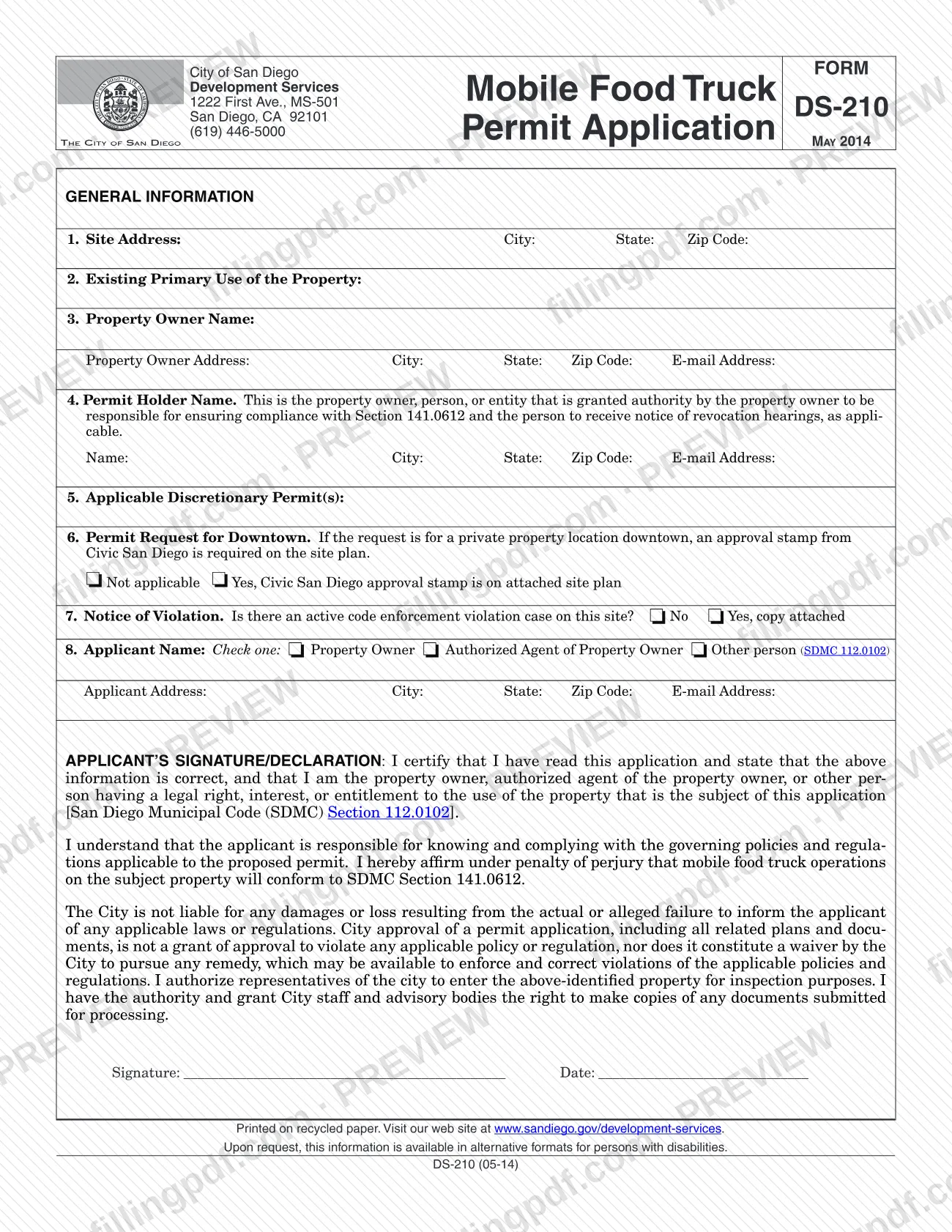
The Mobile Food Truck Permit Application (DS-210) is the form the City of San Diego Development Services Department (DSD) uses to permit mobile food truck operations on private property in the areas where a city permit is required. It sits alongside other approvals a food truck operator needs, such as the County Public Health Permit and the Business Tax Certificate from the City Treasurer, so it is not a San Diego business license by itself. On FillingPDF you can fill out the form online and download or print the completed PDF; the form and City Information Bulletin 148 are published by the City.
Last updated
What is DS-210?
The Mobile Food Truck Permit Application (DS-210) is the City of San Diego Development Services Department (DSD) form used to request a Mobile Food Truck Permit for food truck operations on private property in areas where the City requires one.
City Information Bulletin 148, How to Obtain a Permit for a Mobile Food Truck, treats mobile food trucks as motorized vehicles that sell or serve food or drink to the public. They are retail food facilities and health-regulated businesses under San Diego Municipal Code (SDMC) §42.0101 and Land Development Code (LDC) §141.0612. The bulletin tells applicants to provide one copy of DS-210 together with a vicinity map and a site plan.
One Mobile Food Truck Permit can cover multiple trucks on a single property. The permit is only one of several approvals. The bulletin also lists a Public Health Permit from the County of San Diego, a valid Business Tax Certificate issued by the City Treasurer (non-profits are exempt), and, for operations that would gather 75 people or more on public property, a Special Events Permit from the Special Events Director.
DS-210 is not the form for a Temporary Use Permit, which the bulletin describes as an option for a seasonal or limited-time event (a maximum of two events per year), or for a Neighborhood Use Permit, which is the option for deviating from SDMC §141.0612.
Who needs to file DS-210?
Operators who want to run a mobile food truck on private property in an area where the City requires a permit use DS-210 to apply for a Mobile Food Truck Permit. One permit can cover multiple trucks on a single property.
Information Bulletin 148 says most operations are exempt from a City permit under SDMC §141.0612 (f). You do not need this permit for:
- operations within the public right of way in accordance with SDMC §141.0612;
- operations in industrial zones or commercial office zones;
- operations on the property of a school, university, hospital or religious facility, with the written consent of the property owner or authorized school official;
- operations in RM-3, RM-4 and RM-5 zones tied to a multiple-unit development with 16 or more dwelling units, with the written consent of the property owner or authorized leasing office;
- operations serving an active construction site;
- catering of a private event as an offsite delivery service or within the limits of SDMC §141.0612(d).
Even when no permit is required, property owner authorization is required for any mobile food truck activity on private property. The bulletin also says mobile food trucks are not permitted in the public right of way within the Parking Impact Overlay Zone, and that daily operations are not permitted in the Gaslamp Quarter and Little Italy Neighborhood Center special character districts unless authorized as part of a special event.
When to file DS-210
Apply when you plan to operate a mobile food truck on private property in an area where a Mobile Food Truck Permit is required, which means before the truck starts operating there. Information Bulletin 148 sets no separate filing deadline for DS-210.
The fees for the permit are required to be paid annually. The bulletin adds that DSD cannot store submitted plans while they await fee payment, so plan to pay when you submit.
Other approvals follow their own timing. A Special Events Permit is required for operations that would assemble 75 people or more on public property, and a Temporary Use Permit may be requested for a seasonal or limited-time event, with a maximum of two events per year.
Documents you need
- A vicinity map showing the location of the proposed site relative to major streets: at least two major cross streets, all other roadways leading to the site and a north arrow. It need not be to scale but should be proportional.
- A dimensioned site plan drawn to scale, on a sheet not smaller than 11” x 17” (the vicinity map goes on the same size sheet), showing the general layout and dimensions of the mobile food truck area.
- On the site plan: street, curb, sidewalk and property lines with dimensions, and building footprints with tenant space labeled with square footage and use type.
- On the site plan: where the food truck or trucks will be parked, and a level, paved area of at least 35 feet by 15 feet for each truck operating at the same time on the property.
- On the site plan: enough detail to show that vehicle and pedestrian circulation in parking areas is not blocked, diminished or altered by the truck operation.
- On the site plan: the property owner's name, address and phone number, the street address of the site, a north arrow and the drawing scale.
- The legal description of the site and its Assessor’s Parcel Number (APN), shown on the site plan. The County Assessor’s Office (619-236-3771) can provide them.
How to fill out DS-210
Confirm that a permit is required
Check the list of exempt operations in Information Bulletin 148. A DS-210 permit applies to private-property operations in certain areas, except where SDMC §141.0612 (f) exempts them.
Complete the application information
Enter the applicant and site details the form requests, using the same property owner name, address, phone number and site street address that you will show on the site plan.
Find the legal description and APN
Get the legal description of the site and its Assessor’s Parcel Number (APN) from the County Assessor’s Office at 619-236-3771. You will show both on the site plan.
Prepare the vicinity map
Show the site in relation to at least two major cross streets and the other roadways leading to it, with a north arrow. It need not be to scale but should be proportional.
Draw the site plan
Draw a dimensioned plan to scale showing street, curb, sidewalk and property lines, building footprints with tenant space labeled, and the drawing scale. Use a sheet not smaller than 11” x 17”.
Show the truck parking area
Mark where the truck or trucks will park on a level, paved area of at least 35 feet by 15 feet per truck, and show that parking-area circulation is not blocked or altered.
Check the operating limits
Operations must be self-contained in the vehicle, with no alcohol sales or service. Plan to post the County certification sticker and the violation-reporting notice.
Review and download the completed PDF
Check the application against the vicinity map and site plan, then download or print the completed PDF from FillingPDF. Assemble the package and submit it through the channels described under How to submit.
How to submit DS-210
Submit one copy of DS-210 to the Development Services Department (DSD) with the vicinity map and site plan, and pay the fees online or in person.
- Application package: one copy of DS-210, a vicinity map and a site plan on a sheet not smaller than 11” x 17”. Information Bulletin 148 lists no mailing address or portal for the application itself, so confirm the intake method with DSD.
- Online payment: DSD offers online payments.
- In person: pay by cash, check, debit card, Visa or MasterCard. Checks must be for the exact amount, drawn on a U.S. bank and made payable to the “City Treasurer.”
Fees vary with the complexity of the site and the review time, and they follow the adopted fee schedule as amended. Information Bulletin 148 lists them; ask DSD for the current amounts. Plan check fees and some administrative fees are non-refundable; the Refund Policy is in Refund Application Form DS-721. For sites in the Downtown area, the bulletin points you to the Urban Division. FillingPDF lets you fill out and download the PDF; submission follows the channels above.
Common mistakes to avoid
- Applying for a Mobile Food Truck Permit for an operation the bulletin exempts, such as one in the public right of way or on an industrial or commercial office zone, when no City permit is required.
- Submitting a site plan that is not drawn to scale, is illegible, or is on a sheet smaller than 11” x 17”.
- Leaving the north arrow, two major cross streets or the roadways leading to the site off the vicinity map.
- Showing a truck area smaller than 35 feet by 15 feet, not level and paved, or counting parking spaces reserved or required for another business operating at the same time.
- Drawing a layout that blocks, reduces or alters vehicle or pedestrian circulation within the parking areas.
- Omitting the legal description, Assessor’s Parcel Number or the property owner's name, address and phone number from the site plan.
- Leaving out the three-inch minimum notice, “To report a violation, call City of San Diego Code Enforcement at 619-236-5500,” or the County certification sticker on the truck.
- Putting furniture, umbrellas, generators or other objects outside the truck, or selling or serving alcohol; neither is allowed.
- Paying by check that is not for the exact amount, not drawn on a U.S. bank or not payable to the “City Treasurer.”
Frequently asked questions
What is the Mobile Food Truck Permit Application (DS-210)?
DS-210 is the City of San Diego Development Services Department form for requesting a Mobile Food Truck Permit. It applies to food truck operations on private property in areas where a City permit is required, and it is submitted with a vicinity map and a site plan.
Do I need a DS-210 permit for my food truck in San Diego?
Not always. Most operations are exempt from a City permit, including those in the public right of way, in industrial or commercial office zones, and at active construction sites. Property owner authorization is still required on private property. Check the full exemption list in Information Bulletin 148.
Does DS-210 replace a Business Tax Certificate or County health permit?
No. Information Bulletin 148 lists those as separate approvals: a Public Health Permit from the County of San Diego and a valid Business Tax Certificate from the City Treasurer (non-profits are exempt). DS-210 only covers the City's Mobile Food Truck Permit.
Can one DS-210 permit cover more than one food truck?
Yes. The bulletin says one permit can cover multiple trucks on a single property. The site plan must then show a level, paved area of at least 35 feet by 15 feet for each truck that will operate at the same time.
Is there a fee for the Mobile Food Truck Permit, and how do I pay?
Yes. The fees are paid annually and vary with the site and the review time. Pay online through DSD, or in person by cash, check, debit card, Visa or MasterCard; checks go to the “City Treasurer.” Ask DSD for current amounts, and note that plan check fees are non-refundable.
Can I sell alcohol or set up tables from my food truck?
No alcohol may be sold or served by mobile food trucks. Operations must be self-contained in the vehicle, so no furniture, umbrellas, generators or structures outside it, except where no permit is required or a Neighborhood Development Permit provides for them.
Where can food trucks not operate in San Diego?
Mobile food trucks are not permitted in the public right of way within the Parking Impact Overlay Zone. Daily operations are also not permitted in the Gaslamp Quarter and Little Italy Neighborhood Center, unless authorized as part of a special event.
Can I fill out DS-210 online on FillingPDF?
Yes. You can fill out the PDF online on FillingPDF and download or print it. FillingPDF is an independent service and does not submit the application to the City; you submit it to DSD through the City's channels.
Ready to fill out DS-210?
Fill out DS-210 now