
A qualitative assessment of wild bee habitat features on Boulder County open spaces is a research report by Dr. Adrian L. Carper, a postdoctoral research associate at the University of Colorado Boulder. It describes bee nesting and foraging habitat along St. Vrain Creek on Boulder County Parks and Open Space properties. It is a report, not a government form, and it is listed among the research reports that Boulder County publishes. Land managers, researchers and anyone interested in native bee conservation can use it. On FillingPDF you can view and download the official PDF, which Boulder County hosts at the address linked on this page.
Last updated
What is A qualitative assessment of wild bee habitat features on Boulder County open spaces?
A qualitative assessment of wild bee habitat features on Boulder County open spaces is a research report by Dr. Adrian L. Carper, submitted 23 January 2019, that revisits riparian bee habitats along St. Vrain Creek on Boulder County Parks and Open Space properties.
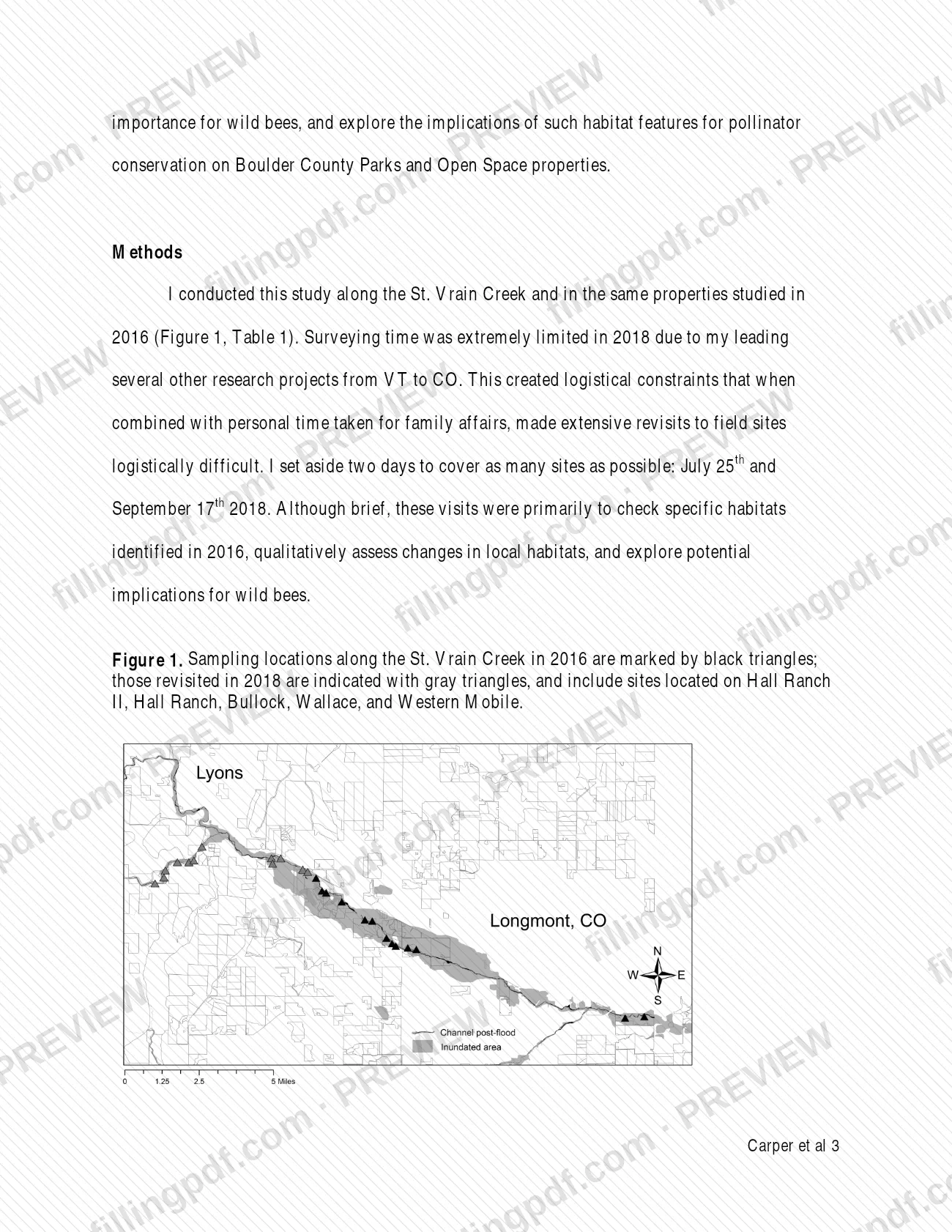
The report builds on a 2016 pollinator survey of 25 sites. In 2016 the author found that where Open Space reported removing woody debris, there was 50% less woody debris than at unmanaged sites and 40% fewer bees overall. In 2018 he spent two days, July 25 and September 17, revisiting sites on Hall Ranch II, Hall Ranch, Bullock, Wallace and Western Mobile to record floral and nesting resources and changes since 2016.
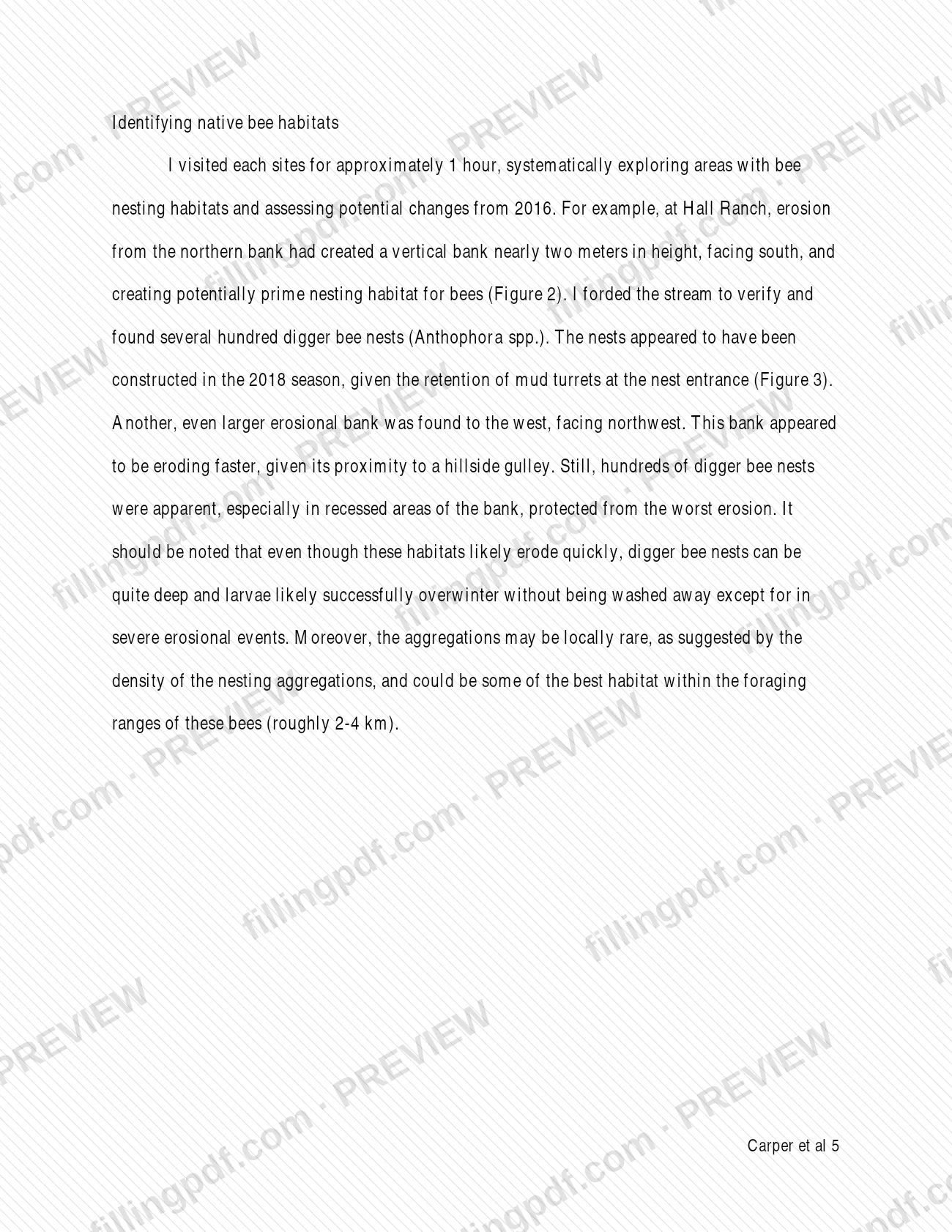
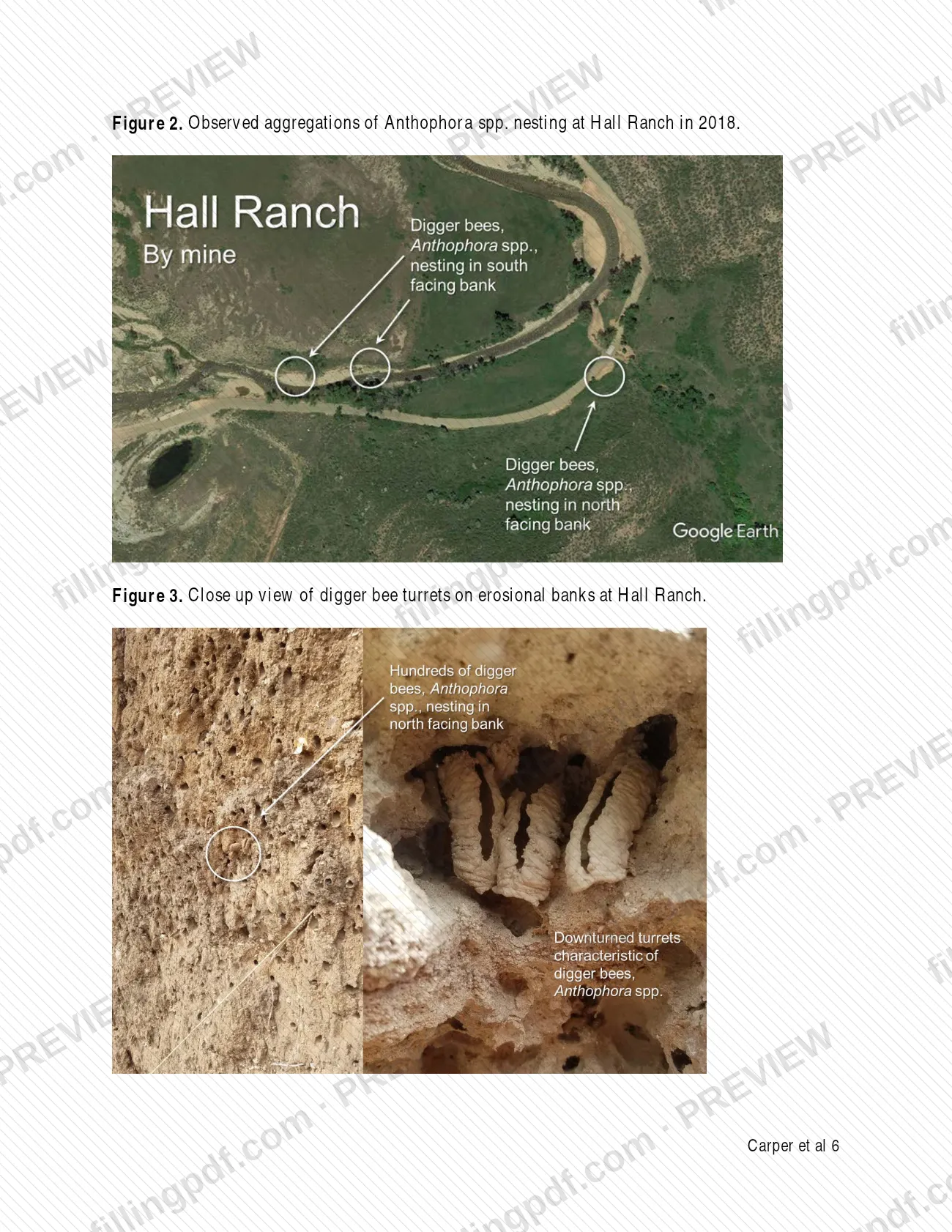
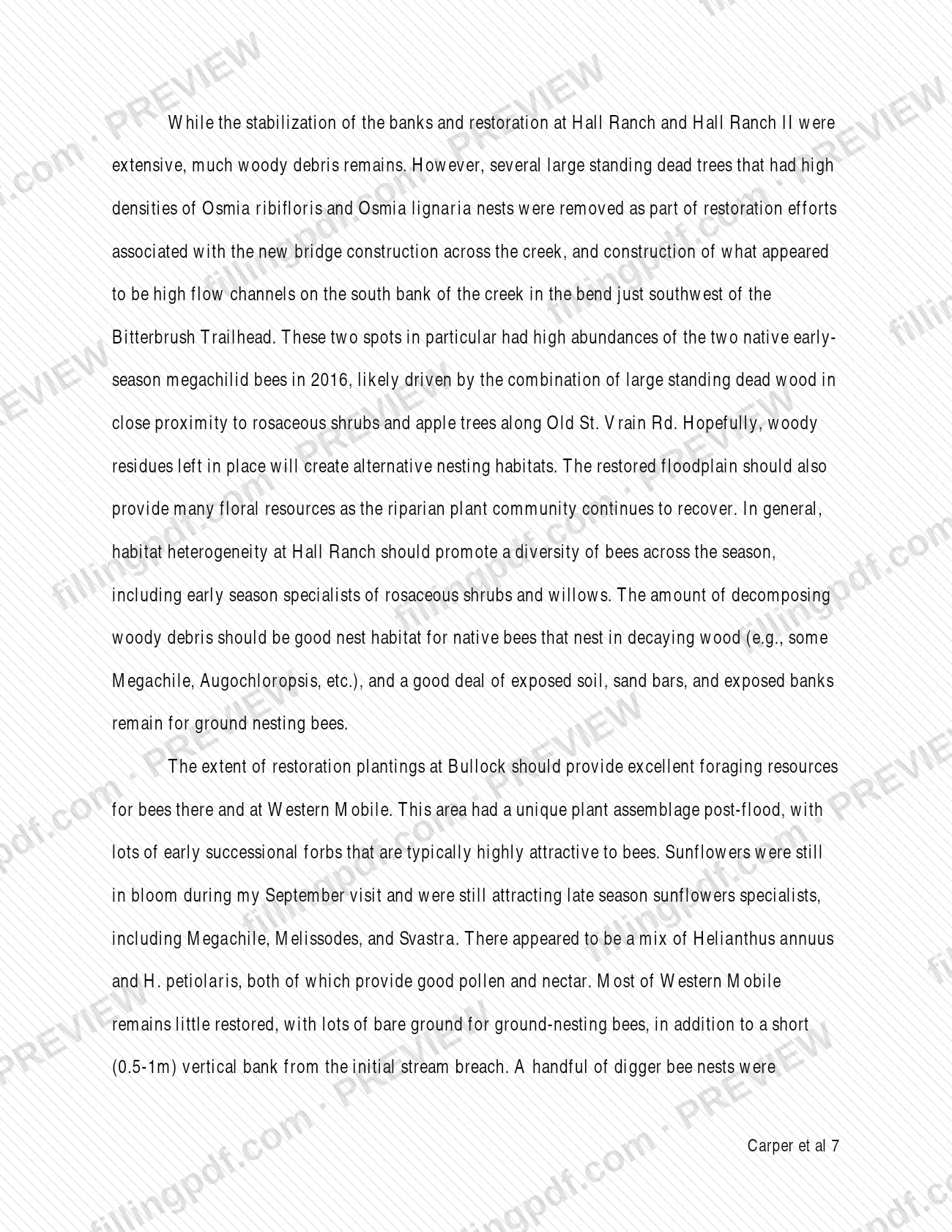
Its main observations concern erosional habitats. At Hall Ranch, a south-facing vertical bank nearly two meters high held several hundred digger bee (Anthophora spp.) nests, and a larger bank to the west held hundreds more. The report also notes that restoration work removed some standing dead trees that had many nests of Osmia ribifloris and Osmia lignaria, while restoration plantings at Bullock should provide good foraging resources.
The author describes the visits as brief and qualitative. The report has a table of the 25 survey sites with coordinates, six figures and a conclusion. A separate slideshow on erosional habitats for ground-nesting bees is linked from the conclusion. It is not a form, application or permit.
Who needs to file A qualitative assessment of wild bee habitat features on Boulder County open spaces?
The report is written for land managers interested in native bee conservation, who the author says should be concerned about how common erosional and other nesting habitats are across the landscape. It also serves Boulder County Parks and Open Space staff and researchers who need a record of where specific bee nesting features were found along St. Vrain Creek in 2016 and 2018.
Educators and outreach staff are another audience: the author calls digger bees a good target for outreach and education and invites readers to explore or distribute the linked slideshow to interested parties.
Nobody has to file or sign this document. It is not a property assessment, a tax record or a permit application, so it is not what residents need when dealing with the county assessor. People who want to conduct their own research on Boulder County open space should know that the county's research page says a permit is required for research activities or for collecting any biological resource elements, and that a more detailed research proposal may be requested after the application.
When to file A qualitative assessment of wild bee habitat features on Boulder County open spaces
Nothing has to be filed by readers: the report is a finished study, and no due date applies to it. The author submitted it on 23 January 2019, after field visits on July 25 and September 17, 2018. Those visits followed a 2016 survey of sites along St. Vrain Creek. The report was written in response to restoration and other habitat changes during the two years after that survey, and it suggests further revisits to downstream sites such as the lower stretches of Western Mobile and Keyes.
How to fill out A qualitative assessment of wild bee habitat features on Boulder County open spaces
Open the official PDF
Use the Boulder County link on this page to view or download the report. It has no form lines to complete.
Read the abstract and introduction
They explain the 2016 riparian pollinator survey on St. Vrain Creek and why the author revisited sites in 2018.
Check the methods and Table 1
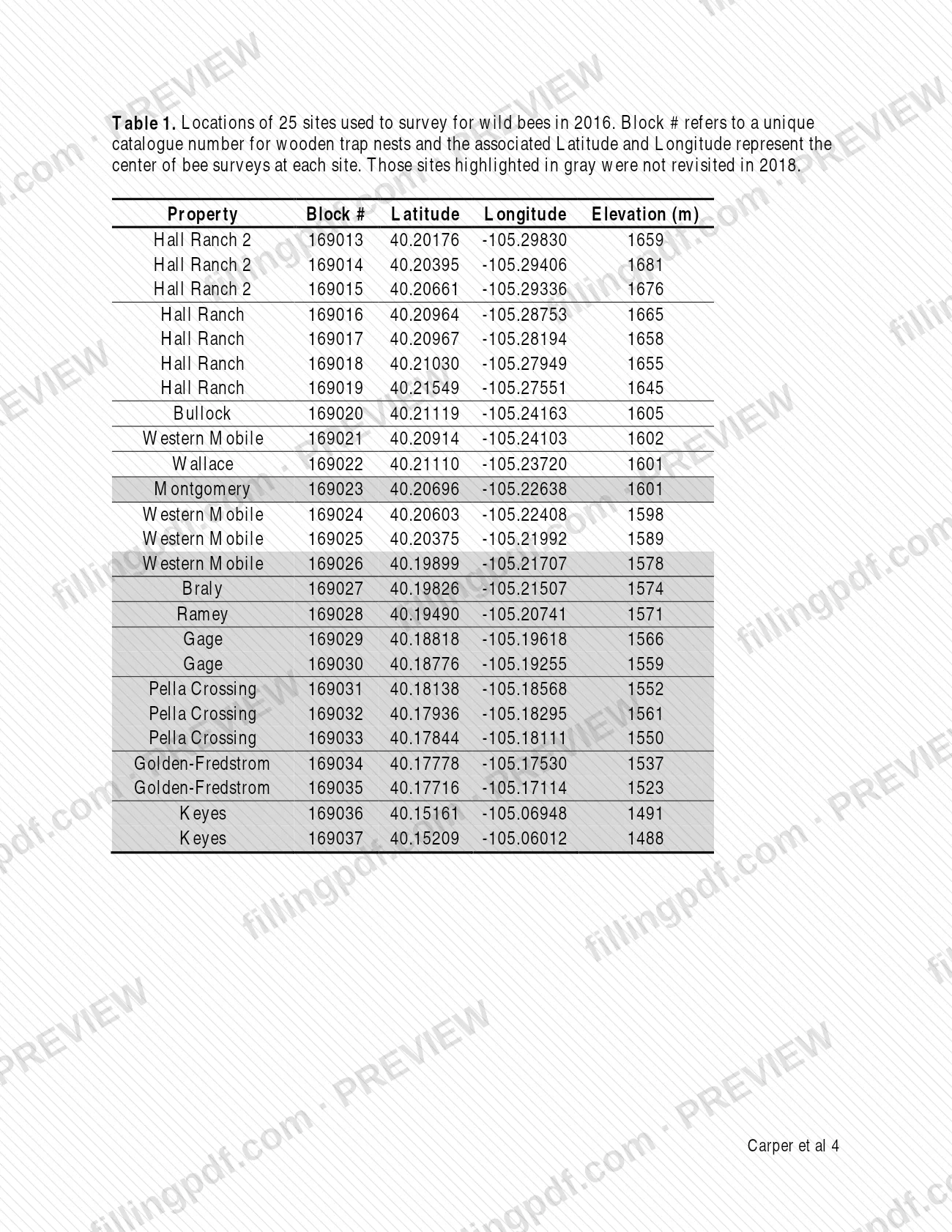
Figure 1 shows the sites revisited in 2018. Table 1 lists 25 sites with block numbers, latitude, longitude and elevation, and highlights those not revisited.
Review the habitat observations
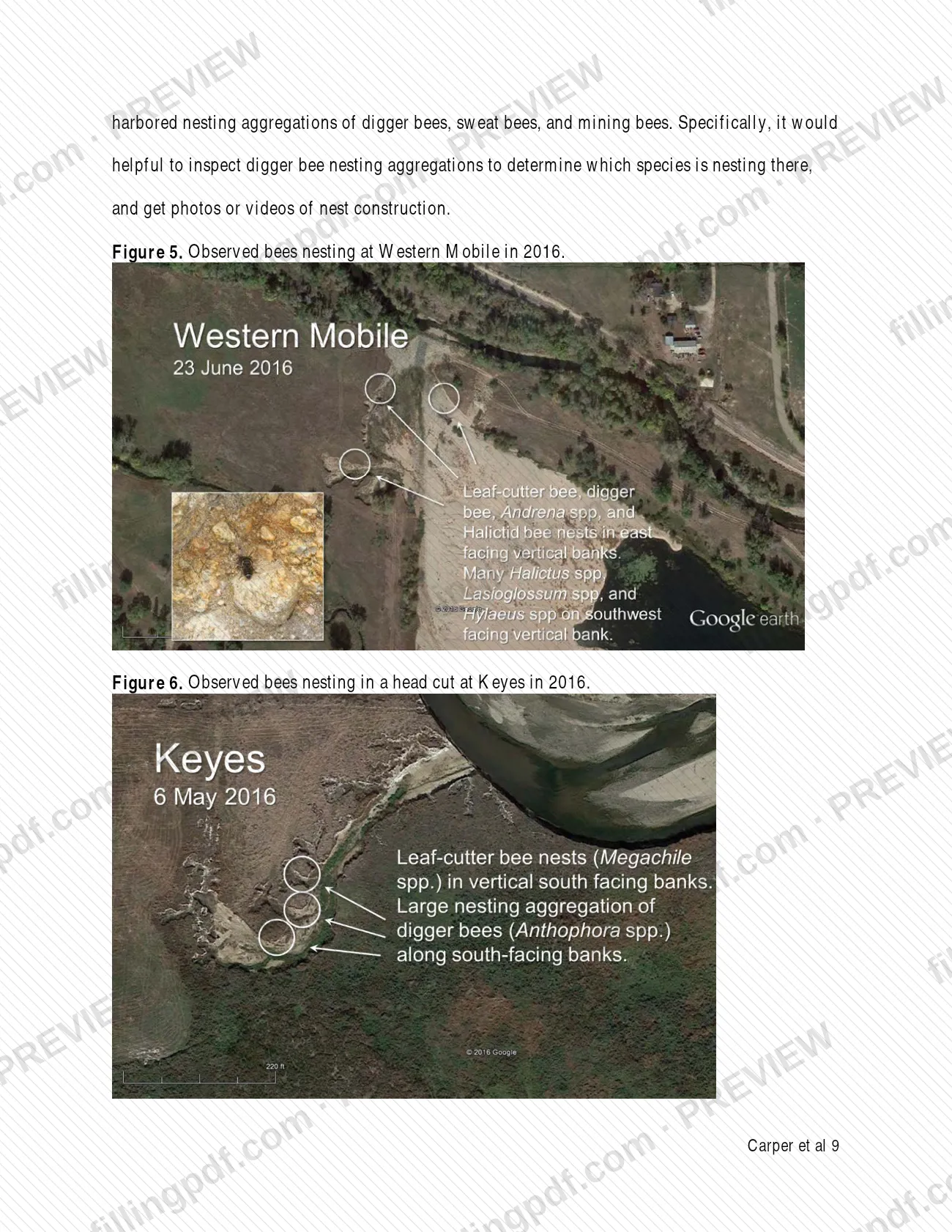
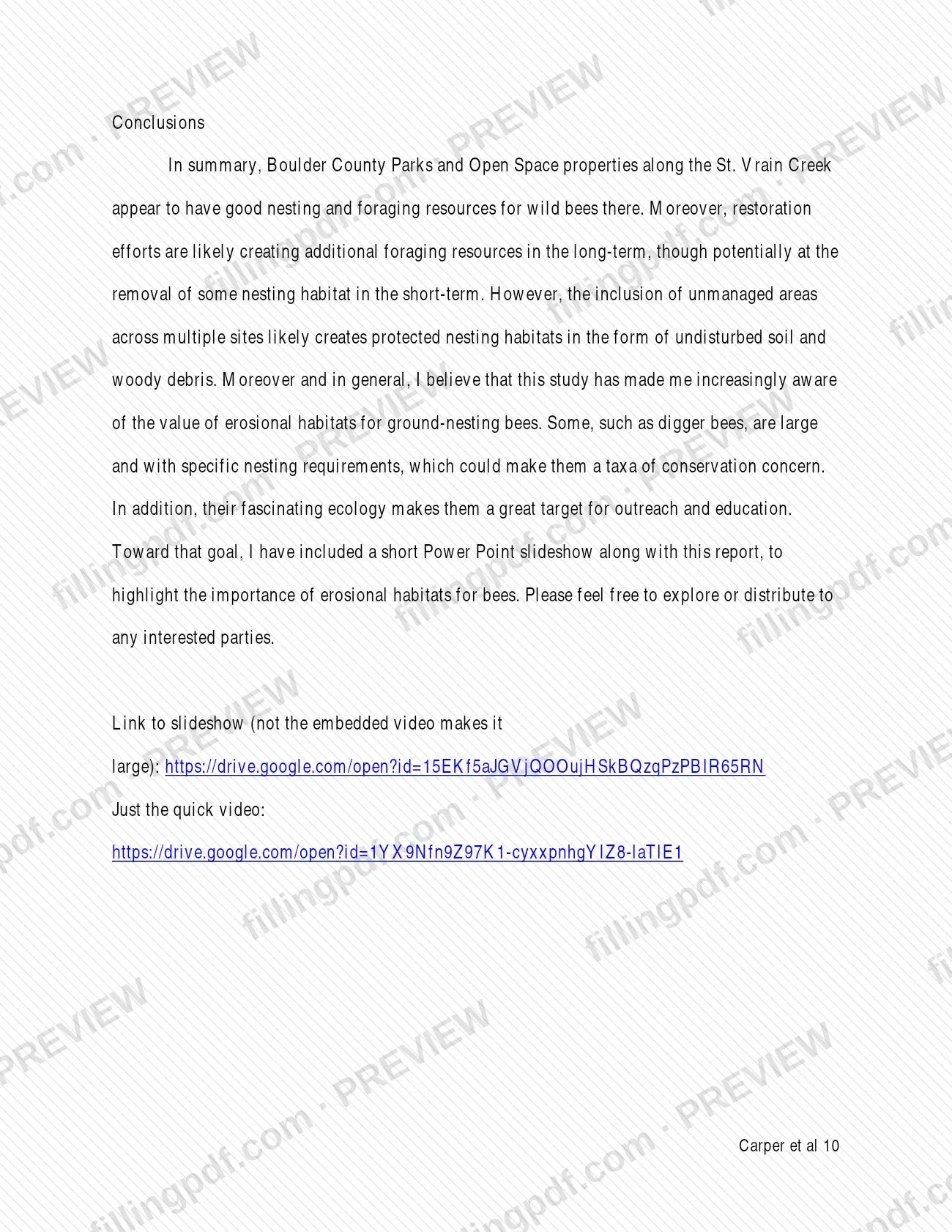
The section on identifying native bee habitats covers Hall Ranch, Bullock, Western Mobile and Wallace, with Figures 2 to 6.
Read the conclusions and slideshow link
The conclusions summarize nesting and foraging resources and point to a separate slideshow on erosional habitats for ground-nesting bees.
How to submit A qualitative assessment of wild bee habitat features on Boulder County open spaces
Readers do not submit this report anywhere; it is a published PDF that Boulder County hosts online. It is listed among the research reports on the Boulder County Parks & Open Space page "Research on Open Space" at https://bouldercounty.gov/open-space/education/research/.
- Read or download: the official PDF is at https://assets.bouldercounty.gov/wp-content/uploads/2019/03/assessment-wild-bee-habitat.pdf.
- Questions about open space research: the county page names Mac Kobza of Parks & Open Space, [email protected], 303-678-6203.
- Accessibility: many reports on the research page come from external parties and may not be fully accessible. To request an ADA accommodation, email [email protected] or call 303-441-1386.
- Conducting your own research: the county page says a permit is required, with an application and possibly a more detailed proposal afterward.
FillingPDF lets you view and download the official PDF; any contact with the county follows the channels above.
Common mistakes to avoid
- Treating this report as a property assessment or a Boulder County assessor document; it is an ecological study of bee habitat on Parks and Open Space land.
- Reading the results as a full survey. The author calls the 2018 visits brief and qualitative, limited to two days, July 25 and September 17, 2018.
- Assuming all 25 sites from the 2016 survey were revisited in 2018. Table 1 marks the sites that were not, and the report says the author could not revisit all of them.
- Expecting the slideshow to be inside the PDF. The conclusion points to it as a separate linked file.
- Citing the woody debris findings as a published paper. The report describes that work as a manuscript in preparation.
- Starting research or collecting biological material on open space based on this report. The county's research page says a permit is required for those activities.
Frequently asked questions
What is the Boulder County wild bee habitat assessment?
It is a research report by Dr. Adrian L. Carper, submitted 23 January 2019, that revisits bee habitats along St. Vrain Creek on Boulder County Parks and Open Space properties. It records nesting and foraging features and how restoration changed them since a 2016 survey.
Is this a Boulder County assessor form?
No. Despite the word assessment, it is an ecological study of wild bee habitat, not a property assessment, tax record or application. It is listed on the Parks & Open Space research page. Property valuation matters are handled by a different county office.
Where did the author find the most bee nests?
At Hall Ranch, where erosional banks held several hundred digger bee (Anthophora spp.) nests. One south-facing vertical bank was nearly two meters high, and a larger bank to the west held hundreds more, especially in recessed areas.
When were the sites visited?
The author made two visits, July 25 and September 17, 2018, to sites first surveyed in 2016. He describes them as brief, mainly to check habitats identified in 2016 and assess changes qualitatively.
Where can I find other Boulder County open space research reports?
The county's Research on Open Space page lists final reports and studies in PDF format, with more than 200 projects completed since 2000. The table shows subject, title, year, researcher, property and keywords.
Do I need a permit to do research on Boulder County open space?
Yes, according to the county's research page: a permit is required to conduct research activities or to collect any biological resource elements from open space. After the application, the county may request a more detailed research proposal.
Can I fill out this PDF online?
There is nothing to fill out: it is a report. FillingPDF lets you view and download the official PDF but does not host the report, and it is not connected to Boulder County. Contact Parks & Open Space for questions.
Ready to fill out A qualitative assessment of wild bee habitat features on Boulder County open spaces?
Fill out A qualitative assessment of wild bee habitat features on Boulder County open spaces now