
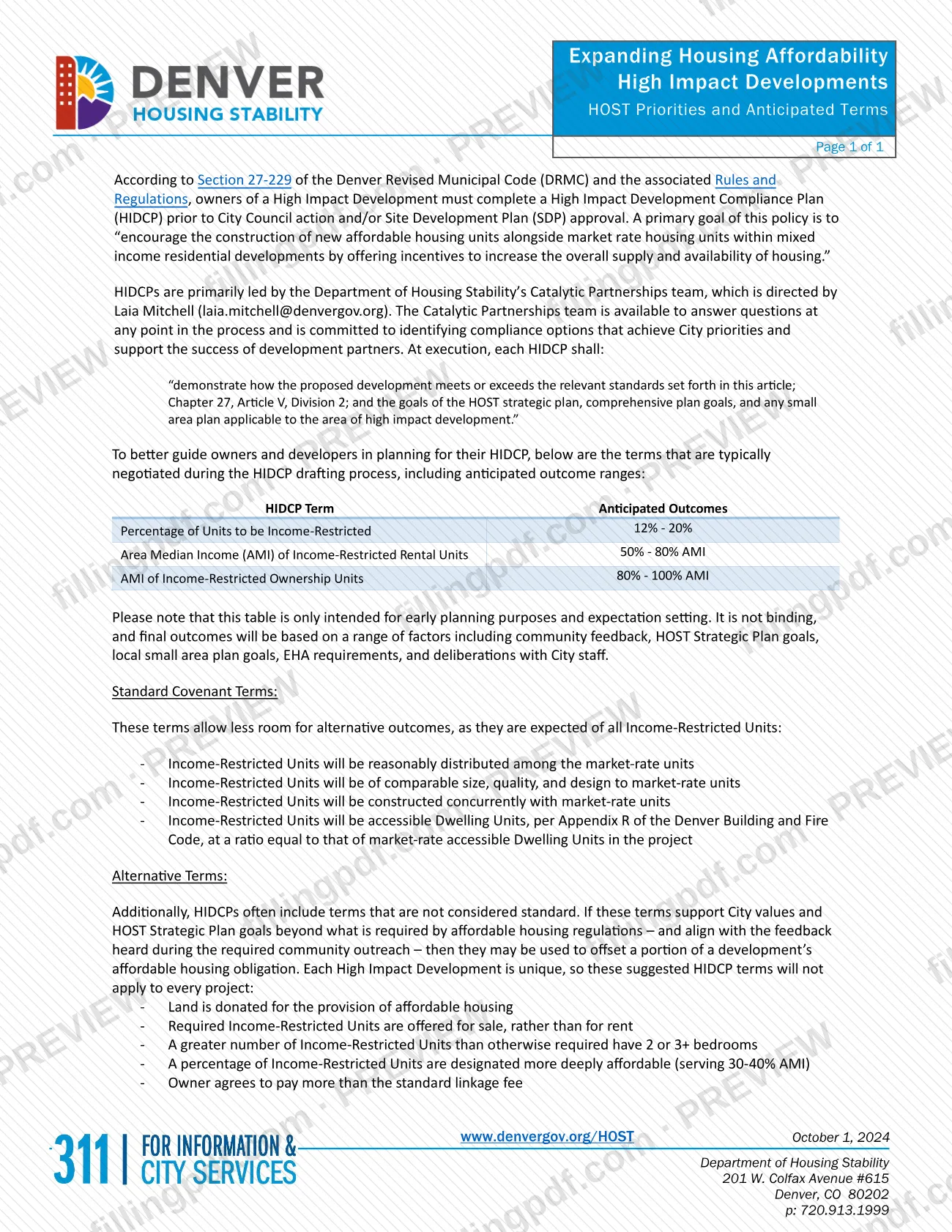
Anticipated Outcomes for High Impact Developments is a one-page City and County of Denver guidance sheet that lists the terms typically negotiated in a High Impact Development Compliance Plan (HIDCP), with the outcome ranges owners can expect. Owners and developers of projects covered by Section 27-229 of the Denver Revised Municipal Code (DRMC) use it for early planning, and it sits among the Denver permit and zoning materials for large residential projects. On FillingPDF you can fill out the form online and download or print the completed PDF; the original sheet is published by the city at denvergov.org.
Last updated
What is Anticipated Outcomes for High Impact Developments – Denver, CO?
Anticipated Outcomes for High Impact Developments, printed under the heading "Expanding Housing Affordability – High Impact Developments – HOST Priorities and Anticipated Terms," is a one-page Denver sheet that tells owners which terms are typically negotiated in a High Impact Development Compliance Plan (HIDCP) and what ranges to expect.
Under DRMC Section 27-229 and the associated Rules and Regulations, owners of a High Impact Development must complete an HIDCP. The sheet explains that each HIDCP must demonstrate how the development meets or exceeds the standards of Chapter 27, Article V, Division 2, the goals of the HOST strategic plan, comprehensive plan goals and any applicable small area plan.
The sheet has three parts:
- A table of anticipated outcomes: 12% - 20% of units income-restricted; 50% - 80% AMI for income-restricted rental units; 80% - 100% AMI for income-restricted ownership units.
- Standard Covenant Terms expected of all Income-Restricted Units, such as reasonable distribution among market-rate units, comparable size, quality and design, concurrent construction and accessible Dwelling Units under Appendix R of the Denver Building and Fire Code.
- Alternative Terms that may offset part of the affordable housing obligation, such as donated land, units offered for sale, more 2 or 3+ bedroom units, units serving 30-40% AMI, or a payment above the standard linkage fee.
The table is for early planning and expectation setting only. It is not binding. Final outcomes depend on community feedback, HOST Strategic Plan goals, local small area plan goals, EHA requirements and deliberations with City staff.
Who needs to file Anticipated Outcomes for High Impact Developments – Denver, CO?
Owners and developers of a High Impact Development use this sheet when planning their HIDCP. The City's Expanding Housing Affordability (EHA) page defines a High Impact Development as development of 10 acres or more, or any development using a public financing tool, such as tax-increment financing or metropolitan districts, regardless of acreage.
- Projects that qualify must select the High-Impact option in their application, unless HOST waives the designation at its discretion.
- Owners who want to ask for that waiver use a separate form, Request for Waiver of High Impact Designation, listed on the city's EHA page.
- HIDCPs are primarily led by the Department of Housing Stability's Catalytic Partnerships team, which answers questions at any point in the process.
The sheet is not for other projects. Residential developments of 10 or more units that are not High Impact Developments follow the other EHA compliance options, and smaller projects pay the linkage fee. The sheet is guidance, not an application, and it does not bind either the owner or the City.
When to file Anticipated Outcomes for High Impact Developments – Denver, CO
The HIDCP that this sheet describes must be completed before City Council action and/or Site Development Plan (SDP) approval. Use the sheet at the start of that process, while you are planning the terms, because it is meant for early planning and expectation setting.
The sheet is not filed and has no deadline of its own. The Catalytic Partnerships team is available to answer questions at any point in the process. The city's EHA page adds that a High Impact Development must finalize and record a compliance plan approved by HOST, unless HOST waives the designation, and that the plan must be informed by a documented community engagement process.
How to fill out Anticipated Outcomes for High Impact Developments – Denver, CO
Confirm your project is High Impact
Check whether the development is 10 acres or more, or uses a public financing tool such as tax-increment financing or metropolitan districts. If so, DRMC Section 27-229 requires an HIDCP.
Read the policy basis
Review the opening paragraphs: the HIDCP is completed before City Council action and/or SDP approval and must show how the project meets the Chapter 27, Article V, Division 2 standards.
Review the anticipated outcome ranges
In the HIDCP Term table, note 12% - 20% of units income-restricted, 50% - 80% AMI for rental units and 80% - 100% AMI for ownership units. Treat these as planning ranges, not commitments.
Check the Standard Covenant Terms
Confirm your plan can meet the four terms expected of all Income-Restricted Units: distribution, comparable size, quality and design, concurrent construction and accessible Dwelling Units per Appendix R.
Consider the Alternative Terms
Decide which of the listed terms, such as donated land, units for sale, more 2 or 3+ bedroom units, units at 30-40% AMI or a higher linkage fee, support City values and could offset part of your obligation.
Contact the Catalytic Partnerships team
Use the contact details printed on the sheet to discuss compliance options with the Department of Housing Stability before drafting your HIDCP.
Review and download the PDF
Check any information you add, then download or print the completed PDF from FillingPDF. The sheet itself is not submitted; see How to submit for the HIDCP process.
How to submit Anticipated Outcomes for High Impact Developments – Denver, CO
This sheet is not submitted to the city. It is a planning guide, and the document you finalize with the city is the HIDCP.
- Application: projects that qualify as High Impact Developments must select that option in their application. The EHA page says projects are prompted in e-permits to show how they meet EHA requirements.
- Department of Housing Stability (HOST): 201 W. Colfax Avenue #615, Denver, CO 80202, phone 720.913.1999, www.denvergov.org/HOST. HOST must approve the compliance plan, which is then recorded.
- Catalytic Partnerships team: it leads most HIDCPs. The sheet gives the director's email as [email protected].
The city page does not list a fee for this sheet. FillingPDF lets you fill out and download the PDF; submission follows the channels above.
Common mistakes to avoid
- Treating the outcome ranges as binding. The sheet says the table is for early planning only and that final outcomes depend on community feedback, HOST goals, small area plans, EHA requirements and talks with City staff.
- Starting the HIDCP after City Council action or SDP approval; the sheet says the plan must be completed before either.
- Assuming every Alternative Term applies to your project. The sheet says each High Impact Development is unique and the suggested terms will not apply to every project.
- Expecting an Alternative Term to offset the obligation when it does not support City values and HOST Strategic Plan goals beyond what regulations require, or does not match community outreach feedback.
- Applying the rental AMI range (50% - 80%) to ownership units; the sheet lists 80% - 100% AMI for income-restricted ownership units.
- Not selecting the High-Impact option in the application when the project is 10 acres or more or uses a public financing tool, unless HOST waives the designation.
- Treating the standard covenant terms as negotiable extras; the sheet says they allow less room for alternative outcomes and are expected of all Income-Restricted Units.
Frequently asked questions
What is the Anticipated Outcomes for High Impact Developments sheet?
It is a one-page Denver sheet showing the terms typically negotiated in a High Impact Development Compliance Plan (HIDCP) and the ranges owners can expect. It helps owners and developers plan early. It is not an application and does not bind the owner or the City.
What counts as a High Impact Development in Denver?
According to the city's EHA page, a High Impact Development is development of 10 acres or more, or any development using a public financing tool, such as tax-increment financing or metropolitan districts, regardless of acreage. HOST may waive the designation at its discretion.
What percentage of units must be income-restricted in an HIDCP?
The sheet gives an anticipated range of 12% - 20% of units, with 50% - 80% AMI for rental units and 80% - 100% AMI for ownership units. The ranges are not binding; final outcomes are set through the HIDCP process with City staff.
When must the HIDCP be completed?
Before City Council action and/or Site Development Plan (SDP) approval, as DRMC Section 27-229 and the associated Rules and Regulations require. This sheet has no deadline of its own; it supports planning of the HIDCP.
What are the Alternative Terms on the sheet?
They are non-standard terms that may offset part of the affordable housing obligation if they support City values and HOST goals and fit community feedback. Examples are donated land, units for sale, more 2 or 3+ bedroom units, units at 30-40% AMI and paying more than the standard linkage fee.
Who do I contact with questions about an HIDCP?
The Department of Housing Stability's Catalytic Partnerships team, which leads most HIDCPs. The sheet lists the Department at 201 W. Colfax Avenue #615, Denver, CO 80202, phone 720.913.1999, and gives the team director's email as [email protected].
Can I fill out this document online on FillingPDF?
You can open the PDF on FillingPDF, fill it out online and download or print it. FillingPDF is an independent service, not affiliated with the City and County of Denver, and does not file anything or complete an HIDCP for you.
Ready to fill out Anticipated Outcomes for High Impact Developments – Denver, CO?
Fill out Anticipated Outcomes for High Impact Developments – Denver, CO now