
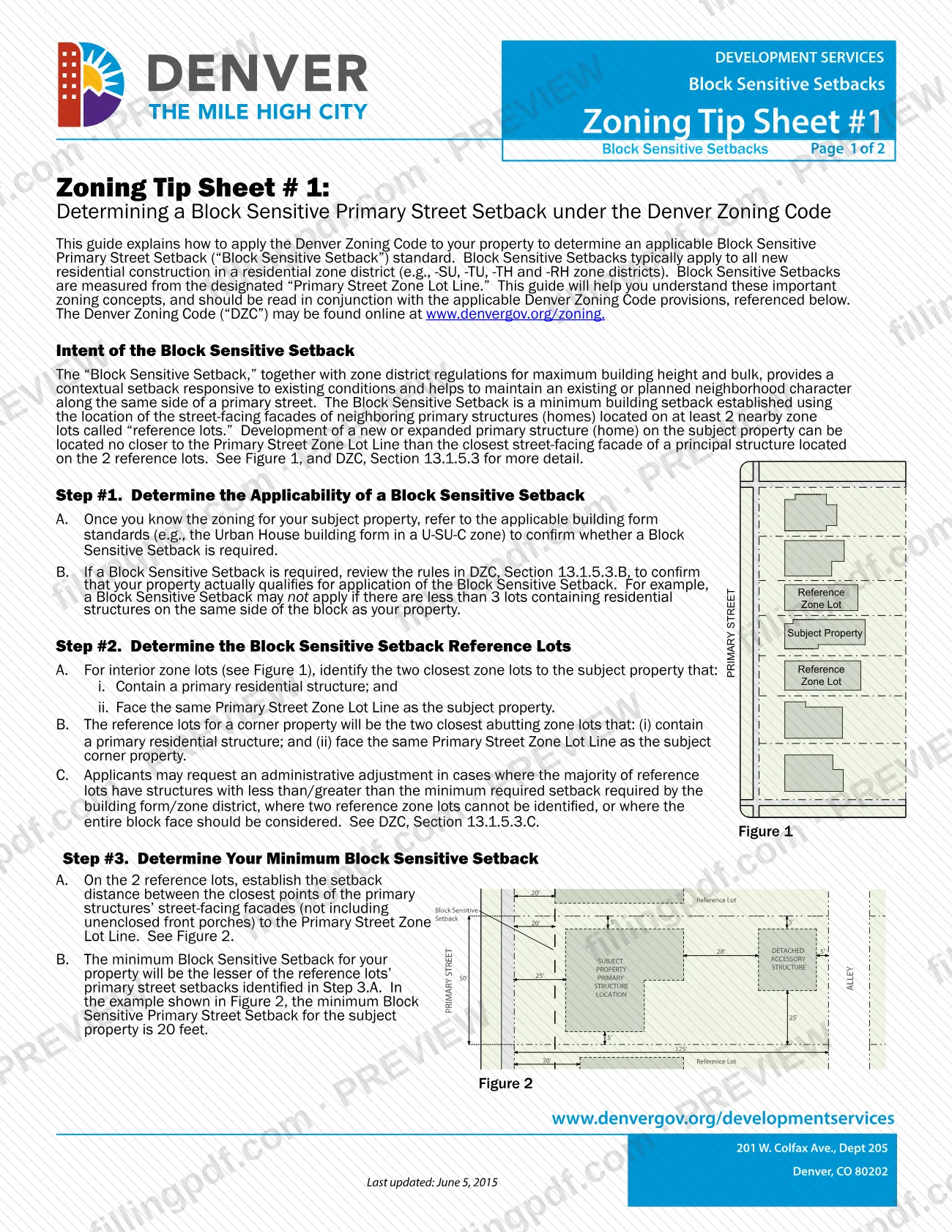
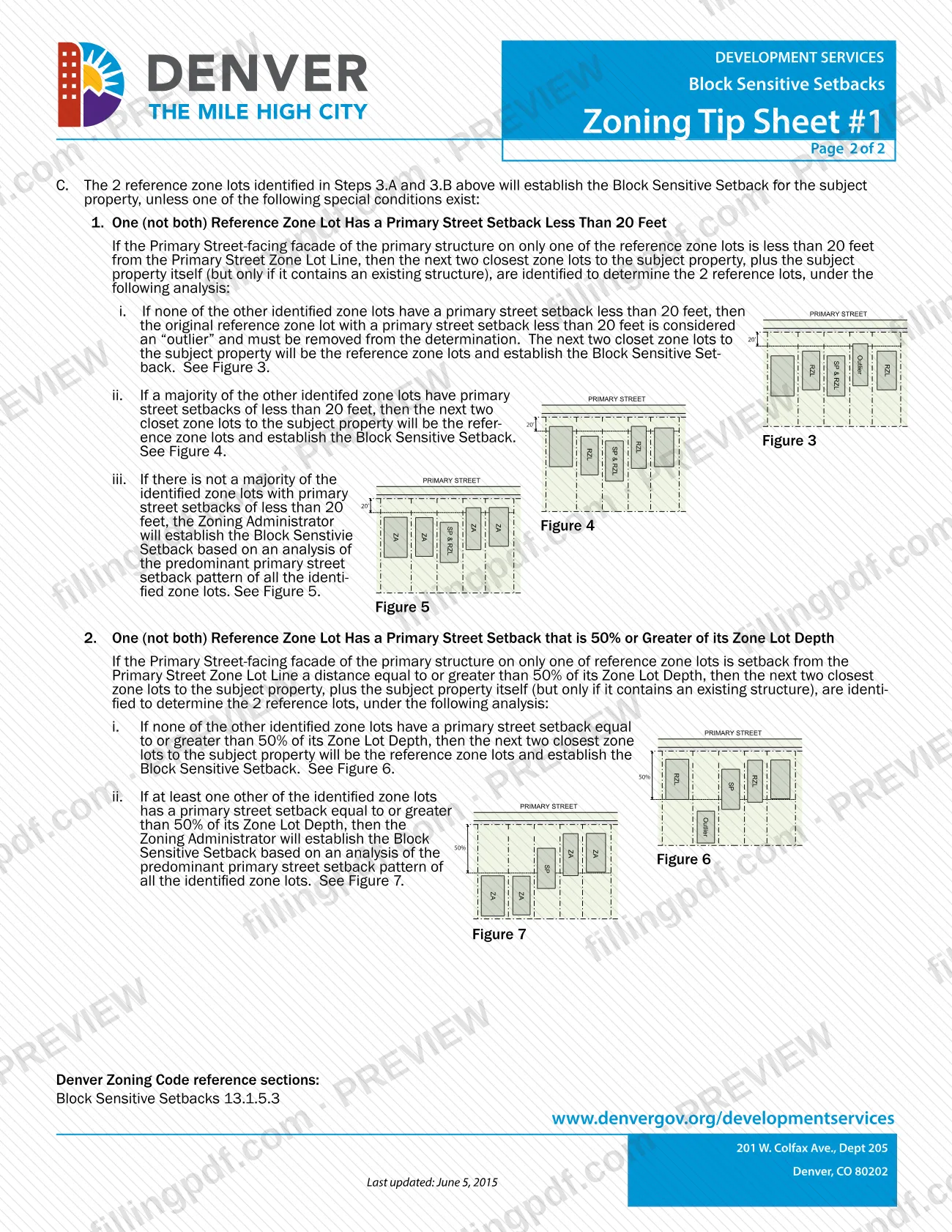
Zoning Tip Sheet #1, Determining a Block Sensitive Primary Street Setback under the Denver Zoning Code, is a two-page guide from Denver Development Services that shows how to work out the minimum setback of a new or expanded home from its Primary Street Zone Lot Line. It is one of the zoning tip sheets that sit alongside a Denver permit application for a new home or addition. The tip sheet is a guide with figures, not an application. On FillingPDF you can fill out the PDF online and download or print it; the original is published by the City and County of Denver.
Last updated
What is Zoning Tip Sheet #1?
Zoning Tip Sheet #1 is a guide published by Denver Development Services that explains how to apply the Denver Zoning Code to a property to determine its Block Sensitive Primary Street Setback, the minimum distance from the Primary Street Zone Lot Line.
The setback is a contextual standard. Together with the zone district's rules on maximum building height and bulk, it responds to existing conditions and helps keep the character of the neighborhood along the same side of a primary street. It is set by the street-facing facades of neighboring homes on at least 2 nearby zone lots, called "reference lots": a new or expanded primary structure can be no closer to the Primary Street Zone Lot Line than the closest street-facing facade of a principal structure on those 2 reference lots.
Block Sensitive Setbacks typically apply to all new residential construction in a residential zone district, for example the -SU, -TU, -TH and -RH zone districts. The tip sheet works in three steps: determine whether a Block Sensitive Setback applies, identify the reference lots, and determine the minimum setback, including two special conditions in which the reference lots change. It is read together with Section 13.1.5.3 of the Denver Zoning Code (DZC), which is available at www.denvergov.org/zoning. It does not grant approval; it is an explanation of the rule.
Who needs to file Zoning Tip Sheet #1?
Anyone planning a new or expanded primary structure (home) on a property in a Denver residential zone district should read this tip sheet. Block Sensitive Setbacks typically apply to all new residential construction in residential zone districts such as -SU, -TU, -TH and -RH. Whether a setback is actually required depends on the building form standards for your zone district, for example the Urban House building form in a U-SU-C zone.
Conditions and exclusions the tip sheet states:
- A Block Sensitive Setback may not apply if fewer than 3 lots containing residential structures are on the same side of the block as your property. The rules are in DZC, Section 13.1.5.3.B.
- Corner properties use their own rule for choosing reference lots: the two closest abutting zone lots.
- Applicants may request an administrative adjustment where most reference lots have structures with less or more than the minimum setback required by the building form or zone district, where two reference zone lots cannot be identified, or where the entire block face should be considered (DZC, Section 13.1.5.3.C).
The City's page on permits for new homes and additions notes that new homes and additions may be built by a homeowner or a licensed contractor.
When to file Zoning Tip Sheet #1
Use this tip sheet when you are planning where a new or expanded home can sit on its lot and need to know the Block Sensitive Setback that governs it. The tip sheet sets no deadline and has no filing date of its own.
Denver's page on permits for new homes and additions asks you to review its information before applying, and states that all new homes and additions need zoning, building, and sewer use and drainage permits (SUDP). Projects that upload all the information required for these three permit types with their initial online application can receive a simultaneous review.
Two special conditions in the tip sheet can change the outcome. When only one reference lot has a setback under 20 feet, or only one has a setback equal to or greater than 50% of its zone lot depth, the analysis moves to the next two closest lots, and in some cases the Zoning Administrator establishes the setback.
How to fill out Zoning Tip Sheet #1
Confirm your zone and building form
Once you know the zoning for your subject property, check the applicable building form standards to see whether a Block Sensitive Setback is required (Step #1.A).
Check that the setback can apply
If a setback is required, review DZC, Section 13.1.5.3.B. It may not apply if fewer than 3 lots with residential structures are on the same side of the block (Step #1.B).
Identify reference lots for an interior lot
Find the two closest zone lots that contain a primary residential structure and face the same Primary Street Zone Lot Line as your property (Step #2.A).
Identify reference lots for a corner lot
For a corner property, use the two closest abutting zone lots that contain a primary residential structure and face the same Primary Street Zone Lot Line (Step #2.B).
Consider an administrative adjustment
You may request one if most reference lots have less or more than the required setback, if two reference lots cannot be identified, or if the whole block face should be considered. See DZC, Section 13.1.5.3.C (Step #2.C).
Measure each reference lot's setback
On each of the 2 reference lots, measure from the closest point of the primary structure's street-facing facade to the Primary Street Zone Lot Line, leaving out unenclosed front porches (Step #3.A).
Take the lesser of the two setbacks
Your minimum Block Sensitive Setback is the lesser of the two reference-lot setbacks. In the tip sheet's Figure 2 example, it is 20 feet (Step #3.B).
Test the under-20-feet condition
If only one reference lot is less than 20 feet from the line, look at the next two closest lots plus your property if it has a structure. An outlier is dropped, a majority under 20 feet sets the reference lots, and with no majority the Zoning Administrator decides (Step #3.C.1).
Test the 50% of lot depth condition
If only one reference lot is set back 50% or more of its zone lot depth, review the next two closest lots. If none of them is, they become the reference lots; if at least one other is, the Zoning Administrator sets the setback (Step #3.C.2).
Review and download the PDF
Check your result against DZC, Section 13.1.5.3, then download or print the PDF from FillingPDF and keep it with your project notes.
How to submit Zoning Tip Sheet #1
The tip sheet is not submitted to anyone. The setback you work out is used in a permit application, which Denver takes through its online e-permits system.
- Online (e-permits): first-time users create an online account. Once signed in, go to "Apply for a Permit" under "Development Services". For zoning, building and SUDP permits, select "building log", then choose Project Classification Single Family/Duplex Residential and Project Scope New Home or Addition.
- Questions to the agency: the tip sheet gives Development Services at 201 W. Colfax Ave., Dept 205, Denver, CO 80202, and www.denvergov.org/developmentservices.
The tip sheet names no separate channel for an administrative adjustment request; it refers you to DZC, Section 13.1.5.3.C. FillingPDF lets you fill out and download the PDF; any permit application follows the City's channels above.
Common mistakes to avoid
- Assuming a Block Sensitive Setback applies without first checking the building form standards for your zone district (for example, the Urban House form in a U-SU-C zone).
- Applying the setback when fewer than 3 lots with residential structures are on the same side of the block; DZC, Section 13.1.5.3.B says it may not apply.
- Choosing reference lots that lack a primary residential structure or that do not face the same Primary Street Zone Lot Line as the subject property.
- Measuring to an unenclosed front porch; the tip sheet measures the street-facing facades of the primary structures and excludes unenclosed front porches.
- Using the greater of the two reference setbacks; the minimum Block Sensitive Setback is the lesser of the two.
- Skipping the special conditions when only one reference lot is under 20 feet, or sits at 50% or more of its zone lot depth.
- Counting the subject property as a reference lot when it has no existing structure; it is included only if it contains one.
- Treating the tip sheet as a replacement for the Denver Zoning Code; it is meant to be read with the DZC provisions it cites.
Frequently asked questions
What is a block sensitive setback in Denver?
It is a minimum building setback from the Primary Street Zone Lot Line, set by the street-facing facades of neighboring homes on at least 2 reference lots. It keeps new or expanded homes in line with the existing or planned character of the same side of the street.
How do I find my block sensitive primary street setback?
Confirm it applies to your zone district and lot, identify the 2 reference lots, measure each primary structure's street-facing facade to the Primary Street Zone Lot Line (excluding unenclosed front porches), and use the lesser distance. The tip sheet's Steps 1 to 3 walk through it.
Which lots are the reference lots for a corner property?
For a corner property, the reference lots are the two closest abutting zone lots that contain a primary residential structure and face the same Primary Street Zone Lot Line as the subject corner property. Interior lots use the two closest zone lots meeting the same two conditions.
What if only one reference lot is under 20 feet from the street?
The tip sheet then looks at the next two closest lots, plus your property if it has a structure. If none of those is under 20 feet, the outlier is removed. If most are, the next two closest become the reference lots. If there is no majority, the Zoning Administrator decides.
Can I request an adjustment to the block sensitive setback?
Yes. The tip sheet says applicants may request an administrative adjustment where most reference lots have less or more than the required setback, where two reference lots cannot be identified, or where the entire block face should be considered. See DZC, Section 13.1.5.3.C.
Do I need a Denver permit for a new home or addition?
Yes. Denver states that all new homes and additions need zoning, building, and sewer use and drainage permits. You apply through the City's e-permits system, choosing "building log" and the Single Family/Duplex Residential classification.
Does a block sensitive setback always apply?
No. Check your zone district's building form standards first. Even where a setback is required, DZC, Section 13.1.5.3.B says it may not apply if fewer than 3 lots with residential structures are on the same side of the block as your property.
Can I fill out Zoning Tip Sheet #1 online on FillingPDF?
You can fill out the PDF online on FillingPDF and download or print it. The tip sheet is a guide, not an application. FillingPDF is independent of the City and County of Denver and does not file permits; Denver permit applications go through the City's e-permits.
Ready to fill out Zoning Tip Sheet #1?
Fill out Zoning Tip Sheet #1 now