
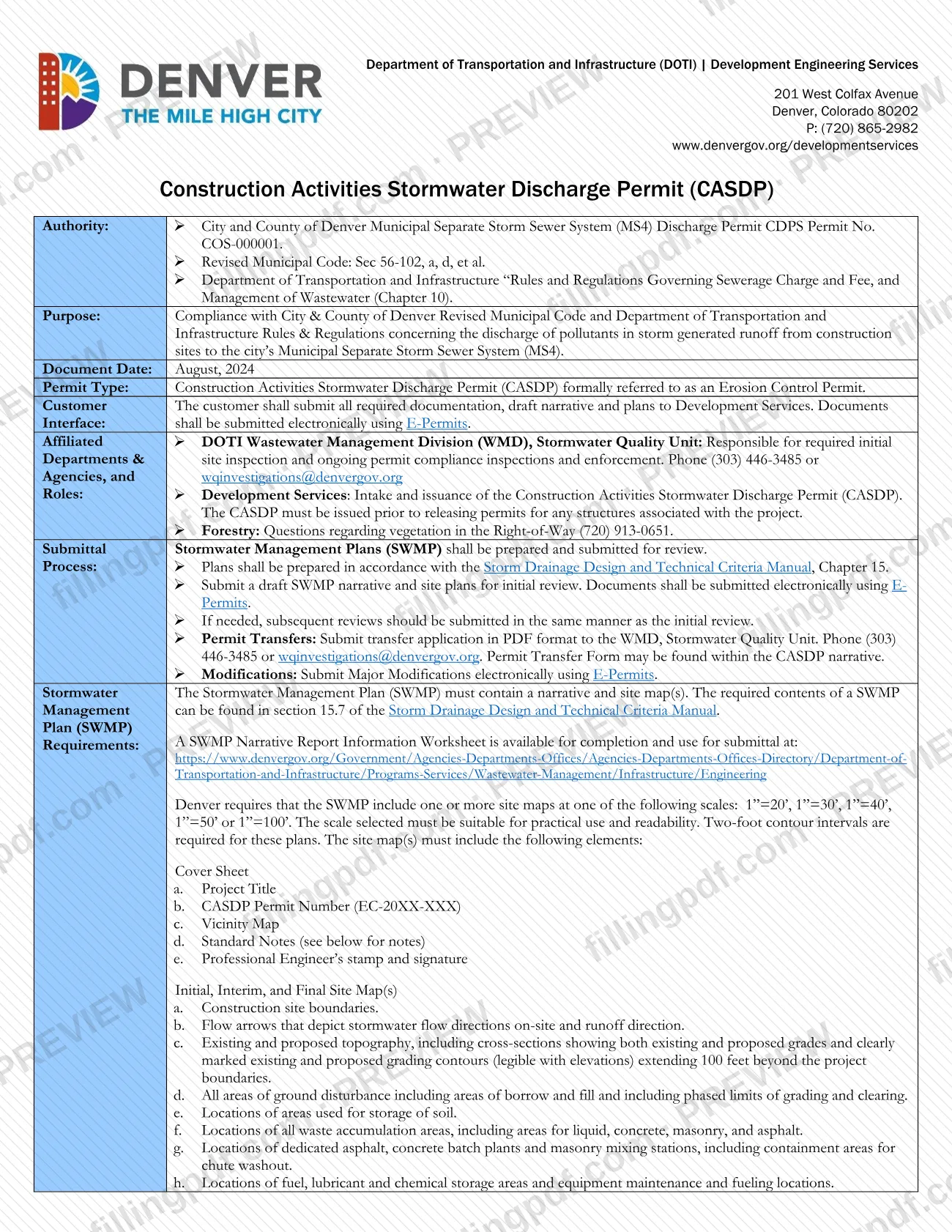
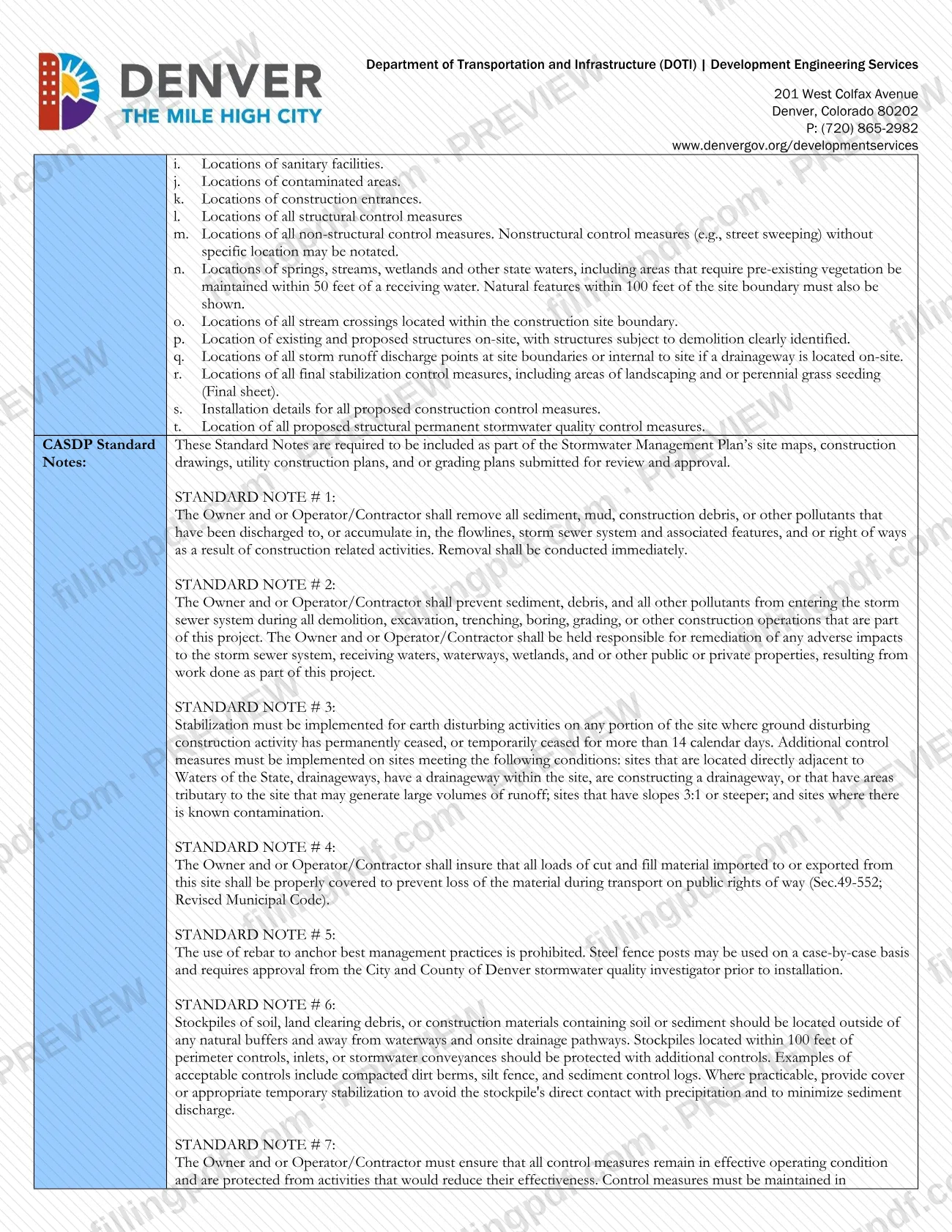
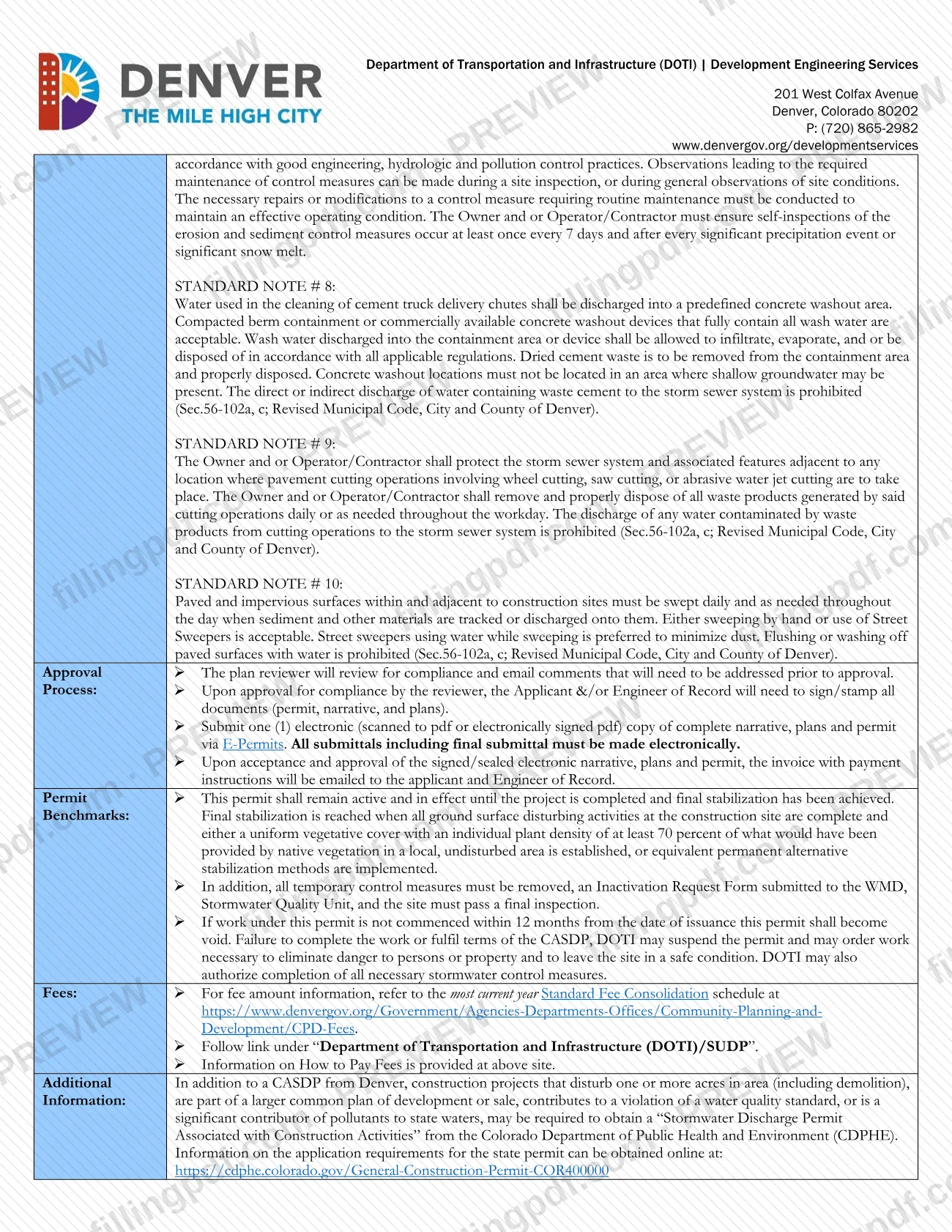
The Construction Activities Stormwater Discharge Permit (CASDP), formally referred to as an Erosion Control Permit, is a Denver permit that requires a Stormwater Management Plan (SWMP) before construction disturbs soil, so that pollutants in runoff do not reach the city's Municipal Separate Storm Sewer System (MS4). Development Services handles intake and issuance, and the Department of Transportation and Infrastructure (DOTI) publishes the permit document. Owners, operators and engineers of record use it for projects that meet the city's thresholds. On this page you can fill out the form online on FillingPDF and download or print the completed PDF; the official PDF is published by the city at denvergov.org.
Last updated
What is Construction Activities Stormwater Discharge Permit (CASDP) – Denver, CO?
The Construction Activities Stormwater Discharge Permit (CASDP), formally referred to as an Erosion Control Permit, is the City and County of Denver permit that governs pollutants in storm runoff from construction sites to the city's Municipal Separate Storm Sewer System (MS4).
The permit document states its authority as the City and County of Denver MS4 Discharge Permit CDPS Permit No. COS-000001, Revised Municipal Code Sec 56-102, a, d, et al., and the DOTI "Rules and Regulations Governing Sewerage Charge and Fee, and Management of Wastewater (Chapter 10)". Its purpose is compliance with the Revised Municipal Code and those rules on the discharge of pollutants from construction sites.
Applying for the CASDP means preparing a Stormwater Management Plan (SWMP): a narrative plus site maps that follow the Storm Drainage Design and Technical Criteria Manual, Chapter 15. The document lists the required map elements and ten Standard Notes that must appear on the plans.
Two city units share the work. Development Services takes in and issues the CASDP, and it must be issued before permits are released for any structures associated with the project. The DOTI Wastewater Management Division (WMD), Stormwater Quality Unit, performs the initial site inspection, ongoing compliance inspections and enforcement.
The CASDP is a city permit. A project may also need the state "Stormwater Discharge Permit Associated with Construction Activities" from the Colorado Department of Public Health and Environment (CDPHE), which is a separate application. Significant changes to an active CASDP use a different application, the Erosion Control Amendment.
Who needs to file Construction Activities Stormwater Discharge Permit (CASDP) – Denver, CO?
Owners, operators and contractors of construction projects in Denver, and the engineers of record who prepare their plans, use the CASDP. The city's E-permits application guide says the permit is required for:
- projects disturbing one acre or more;
- projects that are part of a larger common plan of development that will disturb one acre or more;
- projects adjacent to Waters of the State;
- projects with significant erosion potential;
- other projects identified during the Site Development Plan process.
The permit document adds that the CASDP must be issued before permits are released for any structures associated with the project.
A Denver CASDP does not replace state requirements. Projects that disturb one or more acres (including demolition), are part of a larger common plan of development or sale, contribute to a violation of a water quality standard, or are a significant contributor of pollutants to state waters may also be required to obtain a state permit from CDPHE.
Holders of an active CASDP whose project changes significantly (expanding or reducing the project area, changing drainage design, adjusting phases or replacing the SWMP) apply for an Erosion Control Amendment instead of a new permit. The original permit holder or their contractor applies for it.
When to file Construction Activities Stormwater Discharge Permit (CASDP) – Denver, CO
Apply for the CASDP before construction that disturbs soil begins: the permit exists to make sure a Stormwater Management Plan is in place first, and it must be issued before Development Services releases permits for any structures on the project.
Once issued, the permit stays active until the project is completed and final stabilization is achieved. If work under the permit is not started within 12 months of the date of issuance, the permit becomes void.
At closeout, all temporary control measures must be removed, an Inactivation Request Form submitted to the WMD, Stormwater Quality Unit, and the site must pass a final inspection. If the work is not completed or the terms are not met, DOTI may suspend the permit and may order work needed to leave the site safe. The document gives no review turnaround time.
Documents you need
- Stormwater Management Plan (SWMP) narrative, prepared under the Storm Drainage Design and Technical Criteria Manual, Chapter 15; required contents are in section 15.7.
- SWMP Narrative Report Information Worksheet, available from the DOTI Wastewater Management engineering page named in the permit document, for use in the submittal.
- SWMP site map(s) at 1"=20', 1"=30', 1"=40', 1"=50' or 1"=100' with two-foot contour intervals, showing the listed elements for the Initial, Interim and Final stages.
- Cover sheet with project title, CASDP Permit Number (EC-20XX-XXX), vicinity map, the Standard Notes and the Professional Engineer's stamp and signature.
- Permit, narrative and plans signed and stamped by the Applicant and/or Engineer of Record after the reviewer approves them, as one electronic copy (scanned PDF or electronically signed PDF).
- Permit Transfer Form, found within the CASDP narrative, only when the permit is transferred; send it as a PDF to the WMD, Stormwater Quality Unit.
- Inactivation Request Form, submitted to the WMD, Stormwater Quality Unit, at closeout once final stabilization is reached and temporary controls are removed.
How to fill out Construction Activities Stormwater Discharge Permit (CASDP) – Denver, CO
Confirm the permit applies
Check that your project meets one of the CASDP triggers, such as disturbing one acre or more, and that the Erosion Control application in E-Permits is the one you need.
Prepare the SWMP narrative
Write the narrative following the Storm Drainage Design and Technical Criteria Manual, Chapter 15; section 15.7 lists the required contents. Complete the SWMP Narrative Report Information Worksheet for the submittal.
Set the site map scale
Draw one or more site maps at 1"=20', 1"=30', 1"=40', 1"=50' or 1"=100', whichever is practical and readable. Use two-foot contour intervals.
Complete the cover sheet
Enter the project title, the CASDP Permit Number in the format EC-20XX-XXX, a vicinity map and the Standard Notes. Add the Professional Engineer's stamp and signature.
Show site elements on each map
On the Initial, Interim and Final site maps, mark boundaries, flow arrows, existing and proposed topography extending 100 feet beyond the site, disturbed areas, soil storage, waste, washout, fuel and chemical areas, sanitary facilities, entrances and discharge points.
Show control measures and water features
Locate structural and non-structural control measures, springs, streams, wetlands and other state waters, and stream crossings, with installation details. On the Final sheet, show final stabilization measures such as landscaping or perennial grass seeding.
Add the ten Standard Notes
Include Standard Notes 1 through 10 as written in the permit document on the site maps, construction drawings, utility construction plans or grading plans.
Submit the draft for review
Upload the draft SWMP narrative and site plans through E-Permits. If another review round is needed, submit it in the same way.
Address reviewer comments
The plan reviewer emails comments that must be addressed before approval. Revise the narrative and plans accordingly.
Sign, stamp and download the PDF
After approval, the Applicant and/or Engineer of Record signs and stamps the permit, narrative and plans. Check every entry, then download or print the completed PDF from FillingPDF and upload one electronic copy through E-Permits.
How to submit Construction Activities Stormwater Discharge Permit (CASDP) – Denver, CO
The CASDP is submitted electronically through the city's E-Permits system; the permit document says all submittals, including the final one, must be made electronically.
- E-Permits (initial review): Submit the draft SWMP narrative and site plans to Development Services. Later reviews go in the same way. See the E-permits application guide, where the application is called Erosion Control.
- E-Permits (approval): After the reviewer emails comments and you address them, the Applicant and/or Engineer of Record signs and stamps the permit, narrative and plans. Submit one electronic copy (scanned PDF or electronically signed PDF) of the complete set.
- E-Permits (major modifications): Submit them electronically.
- Permit transfers: Email or send the transfer application in PDF format to the WMD, Stormwater Quality Unit, at (303) 446-3485 or [email protected]. The Permit Transfer Form is within the CASDP narrative.
After approval, an invoice with payment instructions is emailed to the applicant and the Engineer of Record. A fee applies; for the amount, see the current Standard Fee Consolidation schedule under "Department of Transportation and Infrastructure (DOTI)/SUDP" at https://www.denvergov.org/Government/Agencies-Departments-Offices/Community-Planning-and-Development/CPD-Fees. Development Engineering Services: 201 West Colfax Avenue, Denver, Colorado 80202, (720) 865-2982. FillingPDF lets you fill out and download the PDF; submission follows the channels above.
Common mistakes to avoid
- Submitting documents by any method other than E-Permits; the permit document requires every submittal, including the final one, to be electronic.
- Drawing the site map at a scale other than 1"=20', 1"=30', 1"=40', 1"=50' or 1"=100', or without two-foot contour intervals.
- Showing topography only within the site: existing and proposed grading contours must extend 100 feet beyond the project boundaries.
- Leaving the Professional Engineer's stamp and signature, the CASDP Permit Number or the vicinity map off the cover sheet.
- Omitting the ten CASDP Standard Notes from the site maps, construction drawings, utility plans or grading plans submitted for review.
- Specifying rebar to anchor best management practices; Standard Note 5 prohibits it, and steel fence posts need prior approval of the Denver stormwater quality investigator.
- Assuming the Denver CASDP replaces the state permit; projects disturbing one or more acres may also need CDPHE's "Stormwater Discharge Permit Associated with Construction Activities".
- Starting work more than 12 months after issuance; the permit becomes void if work has not commenced within that time.
- Treating the project as closed without removing temporary controls, submitting the Inactivation Request Form and passing the final inspection.
Frequently asked questions
What is the Construction Activities Stormwater Discharge Permit (CASDP)?
The CASDP is the City and County of Denver permit, formally referred to as an Erosion Control Permit, that controls pollutants in runoff from construction sites to the city's MS4. It is built around a Stormwater Management Plan (SWMP) with a narrative and site maps.
Do I need a CASDP for my Denver project?
Likely, if the project disturbs one acre or more, is part of a larger plan that will disturb one acre or more, is adjacent to Waters of the State, has significant erosion potential, or is identified during the Site Development Plan process. The permit must be issued before permits for structures are released.
Is the CASDP the same as the state construction stormwater permit?
No. The CASDP is issued by Denver. Projects that disturb one or more acres, belong to a larger common plan, or significantly contribute pollutants to state waters may also need the CDPHE "Stormwater Discharge Permit Associated with Construction Activities", which is applied for separately.
How do I submit the CASDP to Denver?
Electronically through E-Permits. Submit the draft SWMP narrative and site plans first, then one signed and stamped electronic copy (scanned PDF or electronically signed PDF) of the narrative, plans and permit after approval. Paper is not offered as a channel.
How long is a CASDP valid?
It stays active until the project is completed and final stabilization is achieved. It becomes void if work does not begin within 12 months of issuance. Closeout requires removing temporary controls, an Inactivation Request Form and a passed final inspection.
Is there a fee for the CASDP, and how do I pay?
Yes. After the signed and sealed electronic documents are accepted, an invoice with payment instructions is emailed to the applicant and Engineer of Record. The amount is in the current Standard Fee Consolidation schedule on the Denver CPD Fees page.
How do I transfer a CASDP to a new owner?
Send the transfer application in PDF format to the DOTI Wastewater Management Division, Stormwater Quality Unit, at (303) 446-3485 or [email protected]. The Permit Transfer Form is found within the CASDP narrative.
Is this Denver permit the same as a building permit?
No. The CASDP covers erosion and stormwater controls, and it must be issued before permits are released for structures on the project. Building permits are applied for separately, for example through the Building Log application in E-Permits.
Can I fill out the CASDP online on FillingPDF?
Yes. You can fill out the PDF online on FillingPDF and download or print it. FillingPDF does not submit it to Denver: you upload the signed and stamped documents through E-Permits.
Ready to fill out Construction Activities Stormwater Discharge Permit (CASDP) – Denver, CO?
Fill out Construction Activities Stormwater Discharge Permit (CASDP) – Denver, CO now