
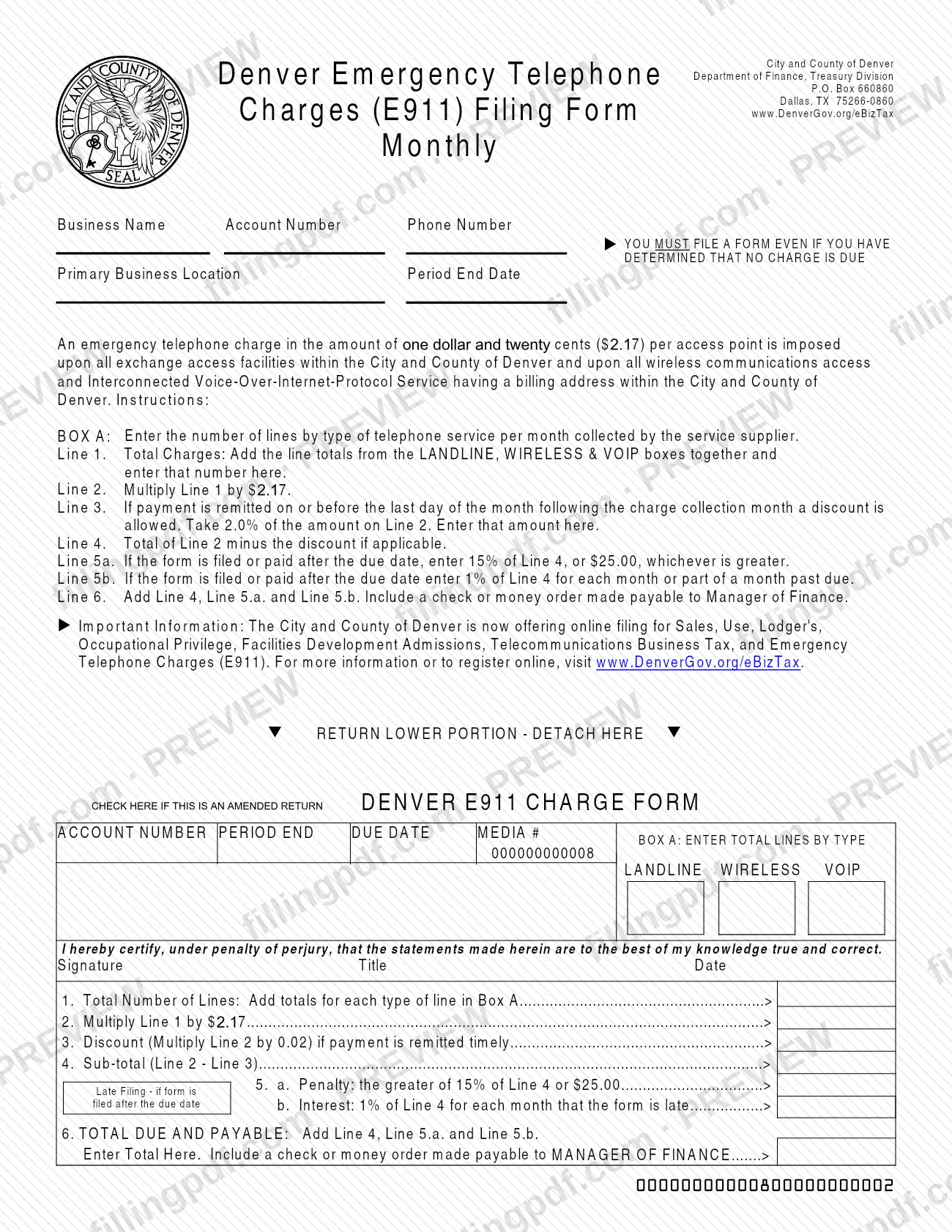
The Emergency Telephone Charges Remittance Form is the filing form the City and County of Denver Treasurer uses for Emergency Telephone Charges (E911), the charge imposed on each phone number or service user within the City and County of Denver. Service suppliers use it to report and remit the charges they collect, including for months in which no charges are due. On this page you can fill out the form online on FillingPDF and download or print the completed PDF; the official PDF is published by the Treasurer at denvergov.org.
Last updated
What is Emergency Telephone Charges Remittance Form – Denver, CO?
The Emergency Telephone Charges Remittance Form is the City and County of Denver form on which a service supplier reports and remits the Emergency Telephone Charges (E911) it collects for each landline, wireless and interconnected VoIP line in Denver.
The Denver Treasurer's business tax FAQ describes the E911 charge as a charge imposed on each phone number or service user within the City and County of Denver. Every service supplier collects the monthly charge per exchange access facility, per wireless communications access and per interconnected voice-over-internet-protocol access, and remits it to the city. The FAQ calls this document the "E911 filing form". The charge is covered by Chapter 16 of the Denver Revised Municipal Code.
The form is separate from the other Denver business taxes the Treasurer administers, such as sales and use tax, Occupational Privilege Tax, Lodger's Tax, Facilities Development Admission (FDA) tax and the Telecommunications Business Tax. It is also not a property tax document: Denver's FAQ says property tax is a different tax payable to the County Treasurer every year on the valuation of the property.
The Treasurer also publishes an E911 Guide (Emergency Telephone Charges) and an E911 Surcharge Increase Notification Letter alongside the form. A supplier that files and pays on time may deduct and retain a percentage of the charges it collected, the vendor's timely filing discount.
Who needs to file Emergency Telephone Charges Remittance Form – Denver, CO?
Service suppliers that collect Emergency Telephone Charges (E911) in the City and County of Denver use this form to report and remit them. The Denver Treasurer's FAQ says every service supplier must collect and remit the charge for each exchange access facility (landline or wireline), each wireless communications access (wireless line) and each interconnected voice-over-internet-protocol access (VoIP line).
- A supplier with no E911 charges due in a particular month still has to file the form for that month.
- The charge is imposed on each phone number or service user within Denver, but it is the supplier that collects it and files the remittance.
Do not use this form for other Denver taxes. Sales and use tax, Occupational Privilege Tax, Lodger's Tax, Facilities Development Admission tax and the Telecommunications Business Tax are described separately by the Treasurer, and property tax is paid to the County Treasurer and is not reported on this form.
When to file Emergency Telephone Charges Remittance Form – Denver, CO
The E911 filing form is due on the last day of the month following the period in which the liability was incurred. A form is required even if no E911 charges are due in a particular month.
If the form is filed and all E911 charges due are remitted on or before that date, the supplier may deduct and retain a percentage of the charges collected, the vendor's timely filing discount.
Late filing has consequences. A penalty is charged on the E911 charges paid late, with a minimum penalty, and interest is charged for each month or fraction of a month between the due date and the payment date. When the payment is mailed, the payment date is determined by its postmark. Ask the Treasurer's audit support office for the current penalty and interest figures.
How to fill out Emergency Telephone Charges Remittance Form – Denver, CO
Open the remittance form
Open the Emergency Telephone Charges Remittance Form on FillingPDF and complete the fields online. Have your records of E911 charges collected for the reporting period at hand.
Identify the reporting period
Report the period in which the liability was incurred; the form's due date is the last day of the following month.
Count lines by type
The charge applies per exchange access facility (landline or wireline), per wireless communications access and per interconnected VoIP access. Sort your Denver lines by these types before entering totals.
Enter the charges due
Enter the E911 charges you collected or owe for the period in the amounts the form's lines ask for. Confirm the per-line amount with the Treasurer's E911 Guide or by calling 720-913-9955.
Apply the timely filing discount
If you file and remit all charges on or before the last day of the month following the period, you may deduct and retain the vendor's timely filing discount from the charges collected, as the form directs.
Complete the form even with no liability
If no E911 charges are due this period, still complete and file the form; the Treasurer requires a form every month.
Review and download the completed PDF
Check each entry against your records, then download or print the completed PDF from FillingPDF and file it as described under How to submit.
How to submit Emergency Telephone Charges Remittance Form – Denver, CO
The Denver Treasurer's FAQ does not give an E911-specific address or portal. For how to file and pay, it refers filers to the Payment Options section on the main business tax page of the City and County of Denver Treasury website.
- Payment Options page: follow the filing and payment instructions in the Payment Options section of the main business tax page.
- Mail: when a payment is mailed, its postmark date is treated as the payment date for penalty and interest purposes.
- Questions: call the Treasurer's office at 720-913-9955 or email [email protected]. The Treasurer also lists the E911 Guide (Emergency Telephone Charges) and Chapter 16 of the Denver Revised Municipal Code as references.
Remit the charges and file the form on or before the last day of the month following the period to keep the timely filing discount. FillingPDF lets you fill out and download the PDF; submission follows the Treasurer's channels above.
Common mistakes to avoid
- Skipping the form for a month in which no E911 charges are due; the Treasurer says a form is still required.
- Filing or remitting after the last day of the month following the period, which loses the timely filing discount and brings a penalty and interest.
- Counting the postmark date as irrelevant: for a mailed payment, the postmark date decides whether it was paid on time.
- Reporting only one kind of line when the supplier has several; the charge applies to landline or wireline, wireless and VoIP lines.
- Paying less than the minimum penalty on a late form; the minimum penalty applies when the calculated penalty is lower.
- Treating the E911 remittance as a Denver property tax payment; property tax is a separate tax payable to the County Treasurer.
Frequently asked questions
What is the Emergency Telephone Charges Remittance Form?
It is the City and County of Denver form that service suppliers use to report and remit the Emergency Telephone Charges (E911) they collect. The Treasurer's FAQ refers to it as the E911 filing form, and the charge is imposed on each phone number or service user within Denver.
Is this form for Denver property tax?
No. This form reports E911 charges only. For Denver property tax, the Treasurer's FAQ says it is a different tax payable to the County Treasurer every year on the valuation of the property, so paying other Denver taxes does not satisfy it.
When is the Denver E911 filing form due?
It is due on the last day of the month following the period in which the liability was incurred. Filing and remitting by that date also keeps the supplier's timely filing discount, which lets it deduct and retain a percentage of the charges collected.
Do I have to file the E911 form if I owe nothing this month?
Yes. The Treasurer's FAQ says a form is still required even if no E911 charges are due in a particular month, so file a form for every period.
What happens if I file the Denver E911 form late?
A penalty applies to the E911 charges paid late, with a minimum penalty, and interest accrues for each month or fraction of a month from the due date to the payment date. A mailed payment is dated by its postmark. Call 720-913-9955 for current figures.
Who has to collect and remit Denver E911 charges?
Every service supplier must collect and remit the charge for each landline or wireline, wireless line and interconnected VoIP line in Denver, according to the Treasurer. Customers pay the charge through the supplier rather than filing this form.
Can I fill out the Denver E911 remittance form online?
You can fill out the PDF online on FillingPDF and download or print it. FillingPDF is independent of the City and County of Denver and does not file the form or accept payment; you file it through the Treasurer's channels.
Where can I get help with Denver E911 charges?
Call the Treasurer's office at 720-913-9955 or email [email protected]. The Treasurer also publishes an E911 Guide (Emergency Telephone Charges), and Chapter 16 of the Denver Revised Municipal Code governs the charge.
Ready to fill out Emergency Telephone Charges Remittance Form – Denver, CO?
Fill out Emergency Telephone Charges Remittance Form – Denver, CO now