
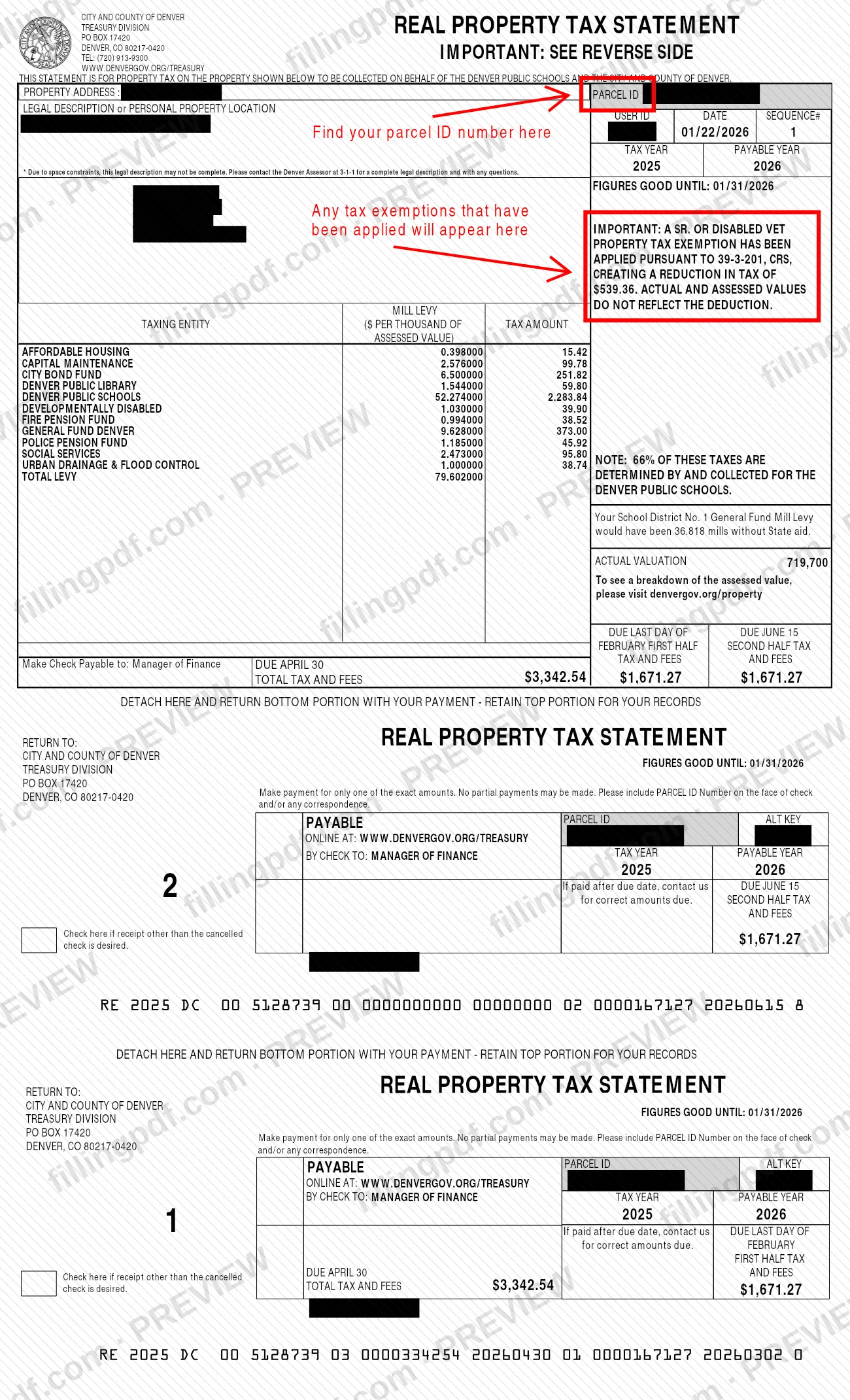
Find your Parcel ID Number and Exemption Information is a sample Real Property Tax Statement published by the City and County of Denver Treasurer, with callouts that show where the parcel ID number and any applied tax exemptions are printed. It is one of the Denver property tax documents that owners use to read their statement and to prepare a payment. On this page you can fill out the form online on FillingPDF and download or print the completed PDF; the original PDF and the Treasury's property tax page stay with the City and County of Denver.
Last updated
What is Find your Parcel ID Number and Exemption Information – Denver, CO?
Find your Parcel ID Number and Exemption Information is the PDF the City and County of Denver Treasurer lists under "Where to Find Information on Your Statement": a sample Real Property Tax Statement that points to the parcel ID number and to the place where applied tax exemptions appear.
The sample is a two-page Real Property Tax Statement from the Treasury Division. It is for property tax collected on behalf of the Denver Public Schools and the City and County of Denver. It is dated 01/22/2026 and shows tax year 2025, payable year 2026.
What the sample lets you locate:
- Parcel ID: printed beside the property address. The statement calls it a unique number identifying the property.
- Exemptions: the callout says any exemption that has been applied appears in a box on the statement. In the sample, a Sr. or disabled vet property tax exemption has been applied under 39-3-201, CRS, and the statement says actual and assessed values do not reflect the deduction.
- Taxing entities: each entity's mill levy and tax amount, the total levy, the actual valuation and the amounts due for the first half, second half or full payment.
- Payment coupons: detachable portions to return with a payment.
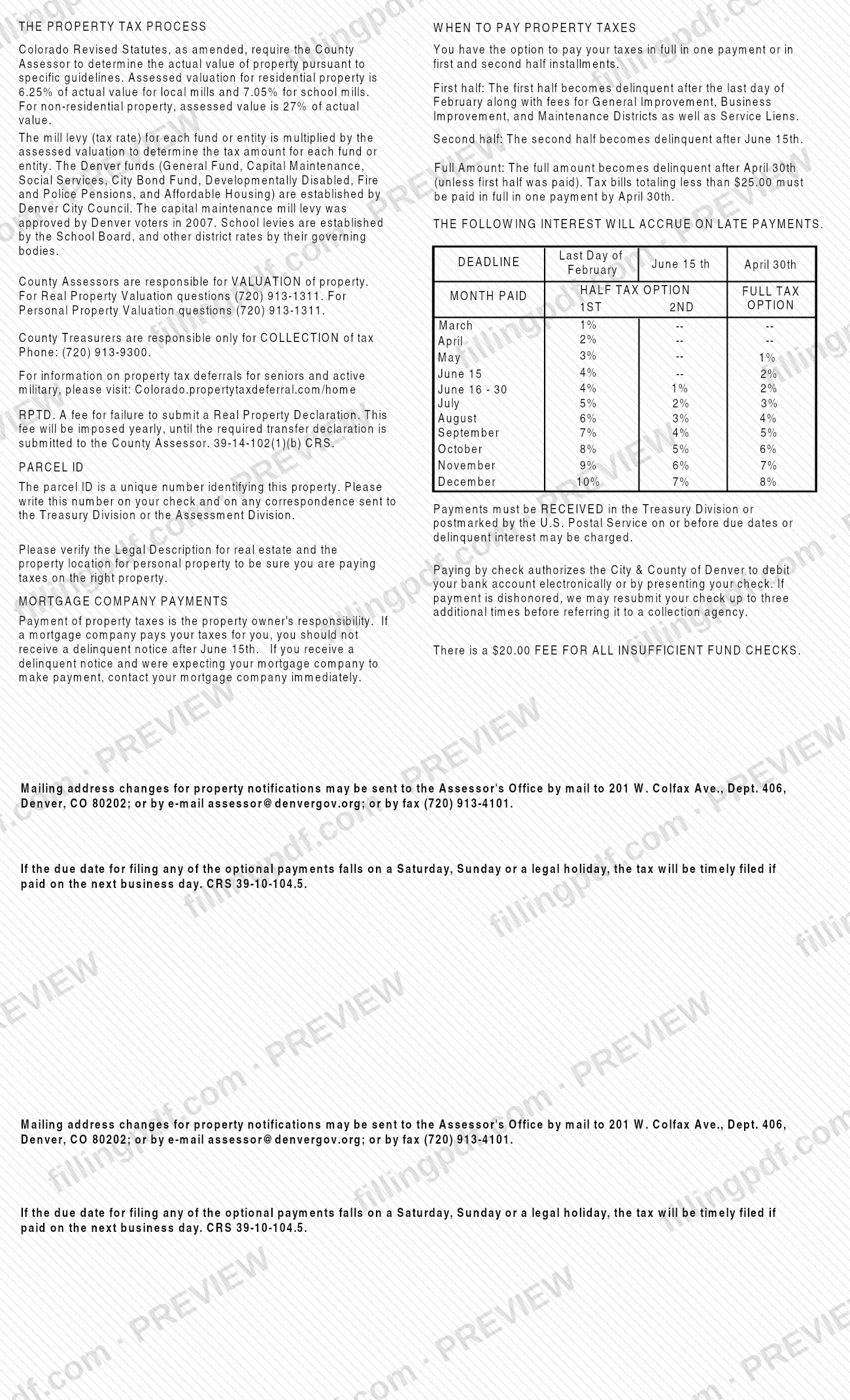
The reverse side explains the property tax process, when to pay, and the interest that accrues on late payments. Real property statements are issued online; Business Personal Property statements are still printed and mailed.
Who needs to file Find your Parcel ID Number and Exemption Information – Denver, CO?
Property owners in the City and County of Denver use this document to read their Real Property Tax Statement, find the parcel ID number and check whether an exemption has been applied. The parcel ID is the number to write on a check and on any correspondence sent to the Treasury Division or the Assessment Division.
- Owners paying by check: the coupon asks you to include the parcel ID on the face of the check.
- Owners with several properties: the Treasurer's page says to repeat the online lookup for every property you own.
- Owners whose mortgage company pays the taxes: payment is still the owner's responsibility. If you get a delinquent notice you did not expect, the statement tells you to contact your mortgage company immediately.
- Owners with a Sr. or disabled vet exemption: the exemption notice appears on the statement. Actual and assessed values do not reflect the deduction.
Business Personal Property tax statements are not covered by the online statements; the Treasurer says they continue to be printed and mailed and are not available online. Questions about the value of a property go to the Assessor, not the Treasurer.
When to file Find your Parcel ID Number and Exemption Information – Denver, CO
Use the statement when your property tax comes due. You can pay in full or in two installments. The first half is due the last day of February and the second half on June 15. Paying the full amount is due April 30. If a due date falls on a Saturday, Sunday or legal holiday, the tax is timely if paid on the next business day.
If you pay everything by April 30, no delinquent interest is charged on the first half. Once a payment is past due, interest accrues; the table on the reverse of the statement lists it by month and by payment option. If you do not pay, you will receive a delinquency notice in July, and unpaid taxes can be advertised and sold at the public tax lien auction, which is usually held in November.
The sample's "figures good until" date applies to the amounts printed on that statement. Payments must be received by the Treasury Division, or postmarked by the U.S. Postal Service, on or before the due dates.
Documents you need
- The payment coupon for the deadline you are paying (first half, second half or full amount), cut along the detach line, if you pay by mail.
- A check payable to Manager of Finance for one of the exact amounts printed on the coupon, with the parcel ID written on its face, if you pay by mail.
How to fill out Find your Parcel ID Number and Exemption Information – Denver, CO
Get your property tax statement
Enter your property address in Denver's property search tool, go to Tax Documents at the bottom of the page and download the statement for the tax year you need.
Find the property address and parcel ID
Locate PARCEL ID beside the property address at the top of the statement; the sample marks it with "Find your parcel ID number here". Copy it exactly for your check and correspondence.
Check the legal description
Compare the legal description with your property to confirm you are paying tax on the right property. It may be incomplete, so contact the Denver Assessor at 3-1-1 if needed.
Confirm tax year and payable year
Read TAX YEAR and PAYABLE YEAR (2025 and 2026 on the sample) and the "figures good until" date to be sure you have the right statement.
Look for the exemption notice
Find the box where applied exemptions appear. If one applies, such as the Sr. or disabled vet exemption on the sample, note that actual and assessed values do not reflect the deduction.
Review levies and actual valuation
Read each taxing entity's mill levy and tax amount, the total levy and the actual valuation; the assessed value breakdown is at denvergov.org/property.
Choose your payment option
Decide between the first half (due the last day of February), second half (June 15) or full amount (April 30). Pay only one of the exact amounts printed.
Prepare the payment coupon
For a mailed payment, cut the coupon for your deadline, write the parcel ID on a check payable to Manager of Finance and mark the receipt box if you want a receipt other than the cancelled check.
Review and download the PDF
Check the parcel ID, tax year and amount, then download or print the completed PDF from FillingPDF and pay through the channels described under How to submit.
How to submit Find your Parcel ID Number and Exemption Information – Denver, CO
Real property tax statements are viewed and paid online, or paid by mail with the printed coupon.
- Online: enter your property address in Denver's property search tool, scroll to Tax Documents, and download the statement for the tax year you need. To pay, scroll to the top of the page and select Tax Payment. The Treasury's payment site is www.denvergov.org/treasury. A service fee applies to credit or debit card payments, online or in person; electronic check avoids it. Ask the Treasury for details.
- By mail: print your statement and include the coupon for the deadline you are paying. Cut a clean line above the "detach here" message. Make the check payable to Manager of Finance and write the parcel ID on it. Mail to Treasury Division, PO Box 17420, Denver, CO 80217-0420. Payments are honored by postmark date only.
- Library: Denver libraries let you view or print your statement for free.
Pay one of the exact amounts printed on the coupons; no partial payments are accepted. For help call (720) 913-9300. If you received a delinquent statement you believe is an error, email [email protected] with your parcel ID, property address, and payment dates, amounts and check numbers. FillingPDF lets you fill out and download the PDF; submission follows the channels above.
Common mistakes to avoid
- Sending a partial payment; the coupon says to pay only one of the exact amounts printed and no partial payments are allowed.
- Mailing the coupon for the wrong deadline instead of the one for the payment you are making.
- Not cutting a clean line above the "detach here" message, which can delay processing of a mailed payment.
- Leaving the parcel ID off the check and any correspondence to the Treasury Division or Assessment Division.
- Expecting the mortgage company's payment to prevent a delinquent notice without checking; payment remains the owner's responsibility.
- Looking for a Business Personal Property statement online; those statements are printed and mailed and are not available online.
- Treating the legal description as complete; the statement says it may be cut short and to contact the Denver Assessor at 3-1-1.
- Assuming the actual and assessed values already show an applied exemption; the statement says they do not reflect the deduction.
- Mailing a payment that is not postmarked by the due date; mailed payments are honored by postmark date only.
Frequently asked questions
Where do I find my parcel ID number on a Denver property tax statement?
It is printed beside the property address near the top of the Real Property Tax Statement, under PARCEL ID. The statement calls it a unique number identifying your property. Write it on your check and on any correspondence to the Treasury Division or the Assessment Division.
Where does a property tax exemption appear on the Denver statement?
In a box on the statement. On the sample, a Sr. or disabled vet property tax exemption applied under 39-3-201, CRS appears there. The notice says the actual and assessed values do not reflect the deduction.
When is Denver property tax due?
The first half is due the last day of February, the second half June 15, and a full payment April 30. If a date falls on a weekend or holiday, the due date moves to the next business day. Interest accrues once a payment is past due.
How do I get a copy of my Denver property tax statement?
Search your address in Denver's property search tool, find Tax Documents at the bottom of the page and download the statement for the tax year. Denver libraries also let you view or print your statement for free.
Where do I mail my Denver property tax payment?
Mail the coupon for your deadline and a check payable to Manager of Finance to Treasury Division, PO Box 17420, Denver, CO 80217-0420. Include the parcel ID on the check. Payments are honored by postmark date only.
Can I pay Denver property tax by credit card?
Yes, online or in person, but a service fee applies to credit or debit cards. Paying online by electronic check avoids that fee. Contact the Treasury Division at (720) 913-9300 for fee details.
What happens if I do not pay my Denver property taxes?
Delinquent interest accrues and you receive a delinquency notice in July. Unpaid taxes are advertised and can be sold at the public tax lien auction, which is usually held in November. After a sale you owe redemption interest and fees.
Can I fill out this Denver property tax document online on FillingPDF?
You can fill out the PDF online on FillingPDF and download or print it. FillingPDF is an independent service, is not affiliated with the City and County of Denver and does not pay or file anything; you pay through the Treasury's channels.
Ready to fill out Find your Parcel ID Number and Exemption Information – Denver, CO?
Fill out Find your Parcel ID Number and Exemption Information – Denver, CO now