
The For-Sale Form of Covenant is the City and County of Denver's template for the recorded covenant on income-restricted for-sale homes, published on the Expanding Housing Affordability (EHA) pages of Denver Community Planning and Development. It is one of the forms behind the affordable housing questions that Denver permit applications raise under the EHA ordinance, and it is used by developers who build for-sale affordable units on-site. On this page you can fill out the form online on FillingPDF and download or print the completed PDF; the original is published by the City at the official URL below.
Last updated
What is For-Sale Form of Covenant – Denver, CO?
The For-Sale Form of Covenant is Denver's template affordable housing covenant, recorded by a developer against income-restricted for-sale units to set buyer income limits, occupancy rules and a maximum resale price.
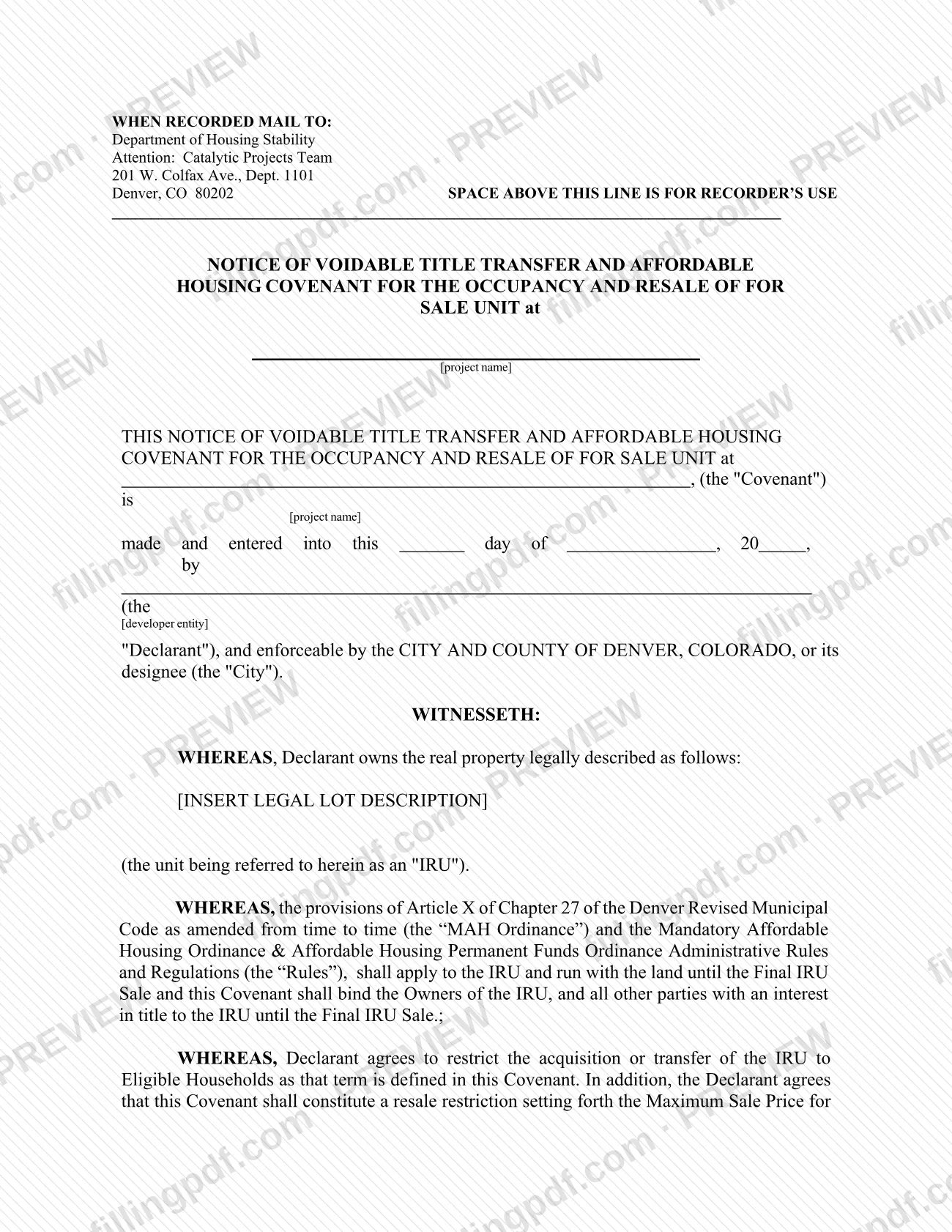
Its printed title is Notice of Voidable Title Transfer and Affordable Housing Covenant for the Occupancy and Resale of For Sale Unit. The developer signs as "Declarant", and the City and County of Denver, Colorado, or its designee, enforces it. Each restricted unit is called an "IRU", and the covenant runs with the land until the Final Sale. It applies the Mandatory Affordable Housing Ordinance (Article X of Chapter 27 of the Denver Revised Municipal Code) and its Administrative Rules and Regulations. The Department of Housing Stability (HOST) administers it.
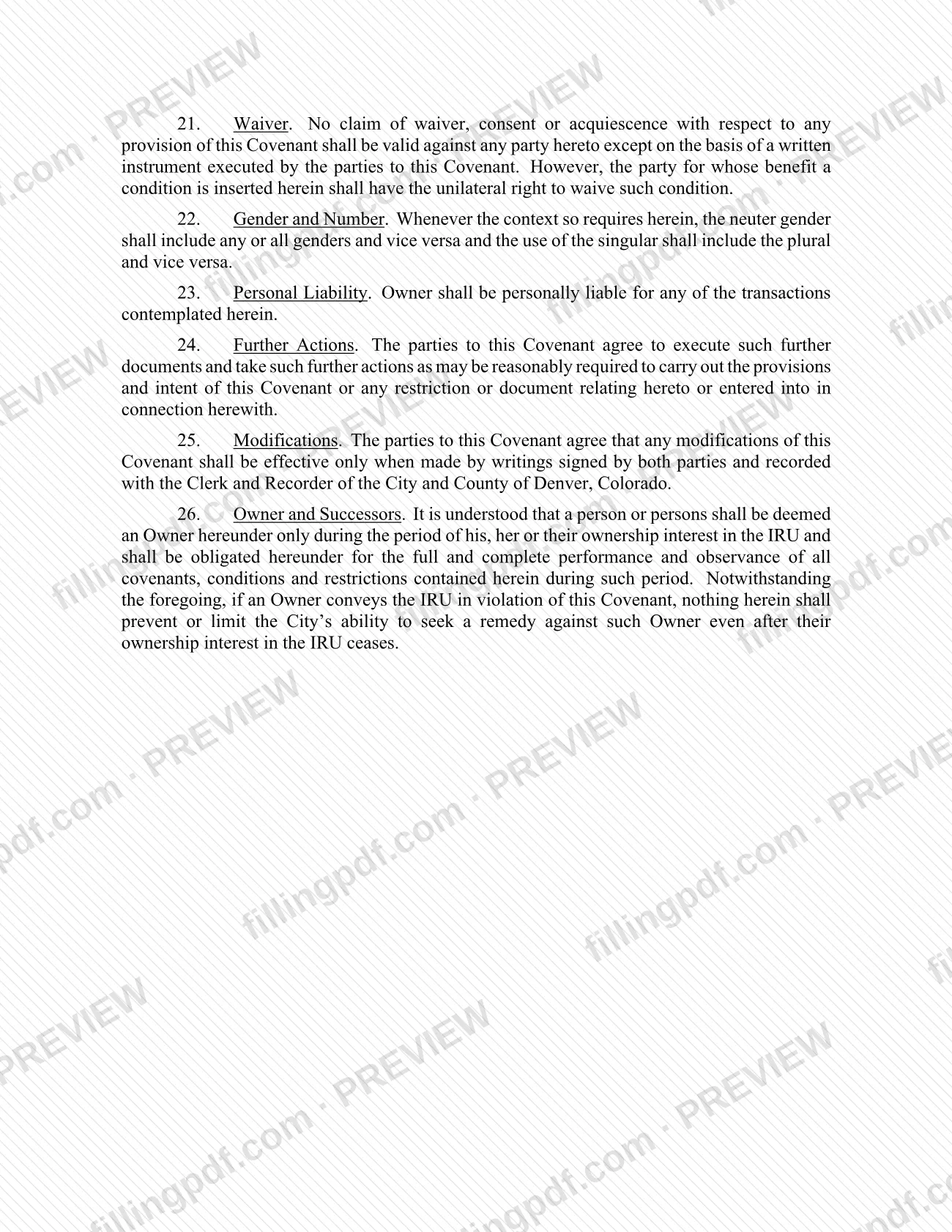
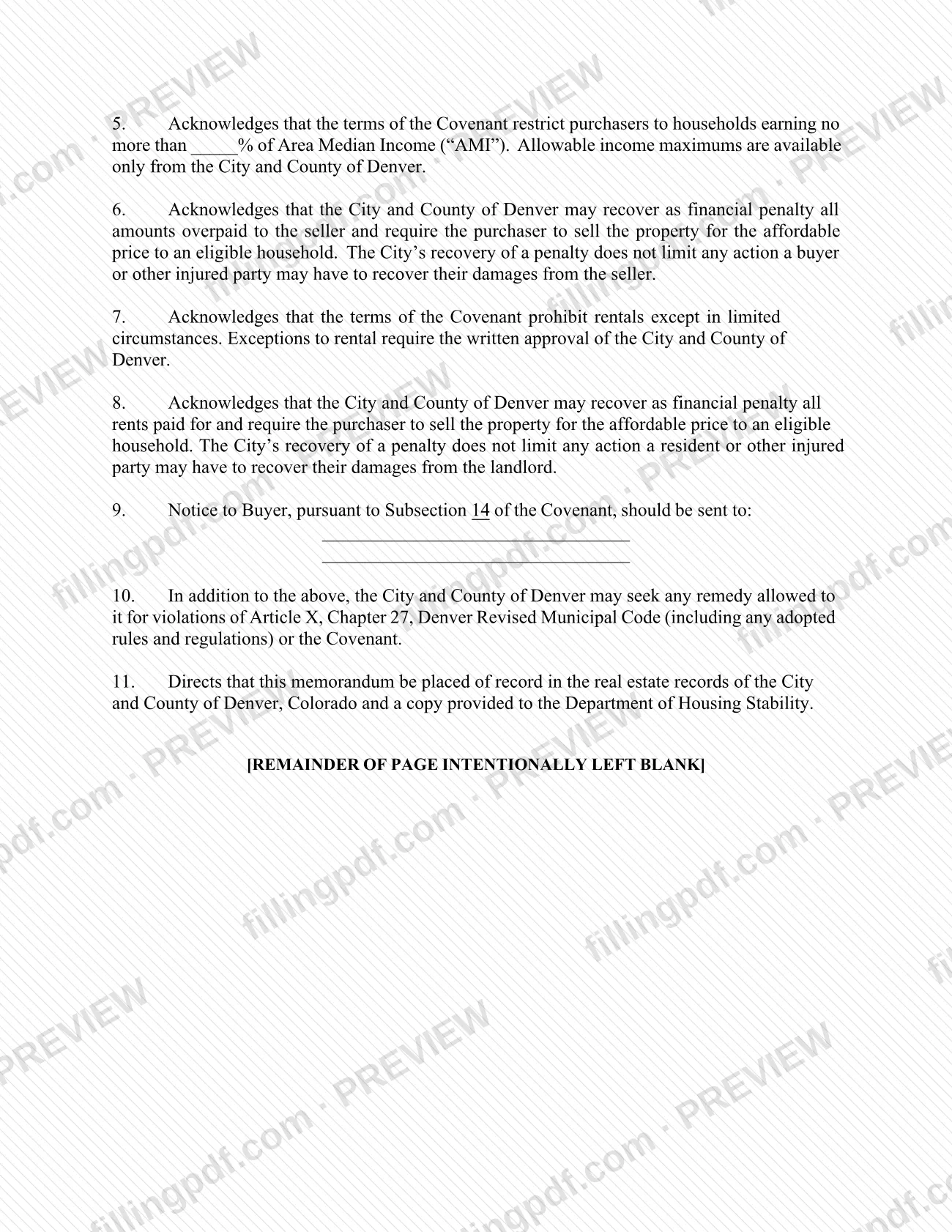
The document covers the Initial Sale, buyer verification by HOST, a Memorandum of Acceptance that every owner records, occupancy duties, the Maximum Sale Price formula, remedies for breach, foreclosure, and the Final Sale. Exhibit A, the Memorandum of Acceptance, is part of the same document.
The City's EHA page lists it under Forms next to the For-Rent Form of Covenant and the Affordable Housing Plan. It says the For-Sale Form of Covenant is to be recorded before the certificate of occupancy. Rental units use the For-Rent form, which is a different document.
Who needs to file For-Sale Form of Covenant – Denver, CO?
Developers (the Declarant) that build income-restricted for-sale units on-site under Denver's Expanding Housing Affordability ordinance use this covenant for those units. The EHA page places it with the build-on-site option, where at least the required share of units must be Income Restricted Units (IRUs).
Other parties named in the document:
- Buyers and later owners sign the Memorandum of Acceptance (Exhibit A) when they buy an IRU. A buyer must be an Eligible Household verified by HOST, meaning a household within the income limit printed in the covenant. Certain nonprofits and governmental bodies designated by the Director may also qualify.
- The City and County of Denver signs the acceptance block, and HOST enforces the covenant.
- Notaries complete the acknowledgment blocks for the Declarant, the City and the buyer.
Rental developments use the separate For-Rent Form of Covenant. The EHA page says incentives are available only when affordable units are built on-site, so a project that pays the fee-in-lieu instead does not use this covenant for incentives.
When to file For-Sale Form of Covenant – Denver, CO
Record the covenant before the certificate of occupancy: the City's EHA page says the For-Sale Form of Covenant is "to be recorded prior to certificate of occupancy."
Later events in the document run on their own clocks:
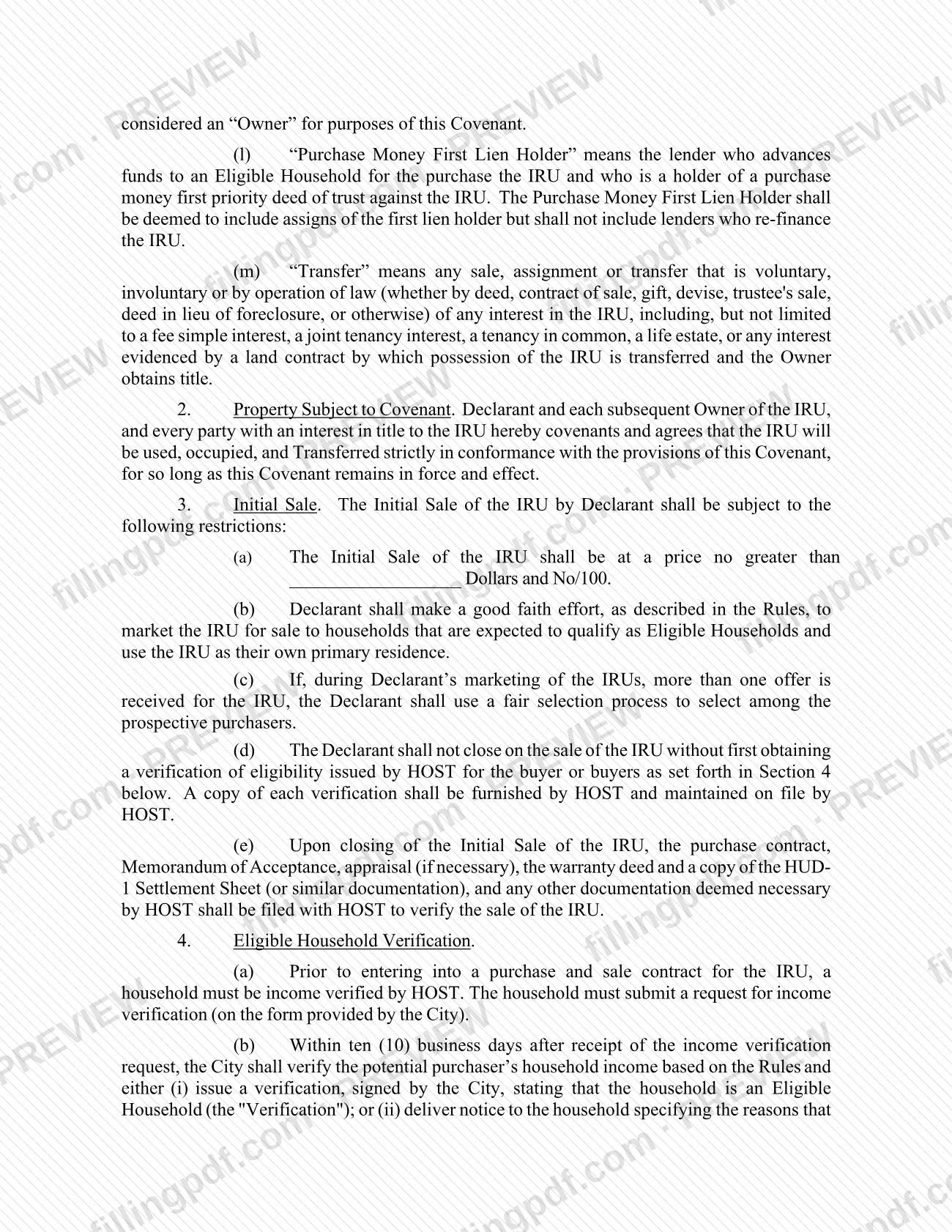
- Before the Initial Sale closes, HOST must issue a verification of eligibility for the buyer. HOST has ten business days after receiving the income verification request to issue it or send reasons.
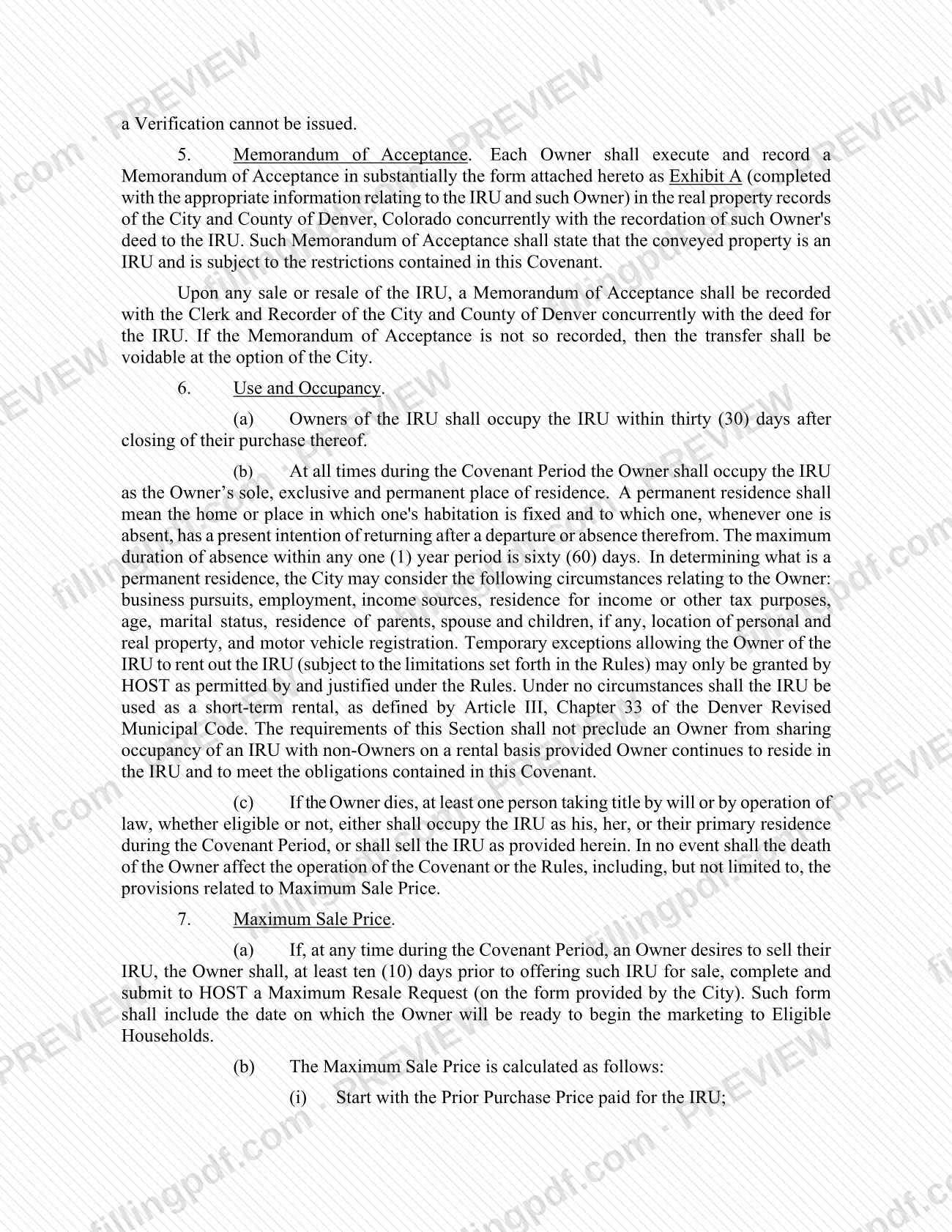
- Each owner records a Memorandum of Acceptance together with the deed on every sale or resale. If it is not recorded, the City may void the transfer.
- An owner who wants to sell submits a Maximum Resale Request to HOST at least ten days before offering the unit for sale.
- Owners must occupy the unit within thirty days after closing.
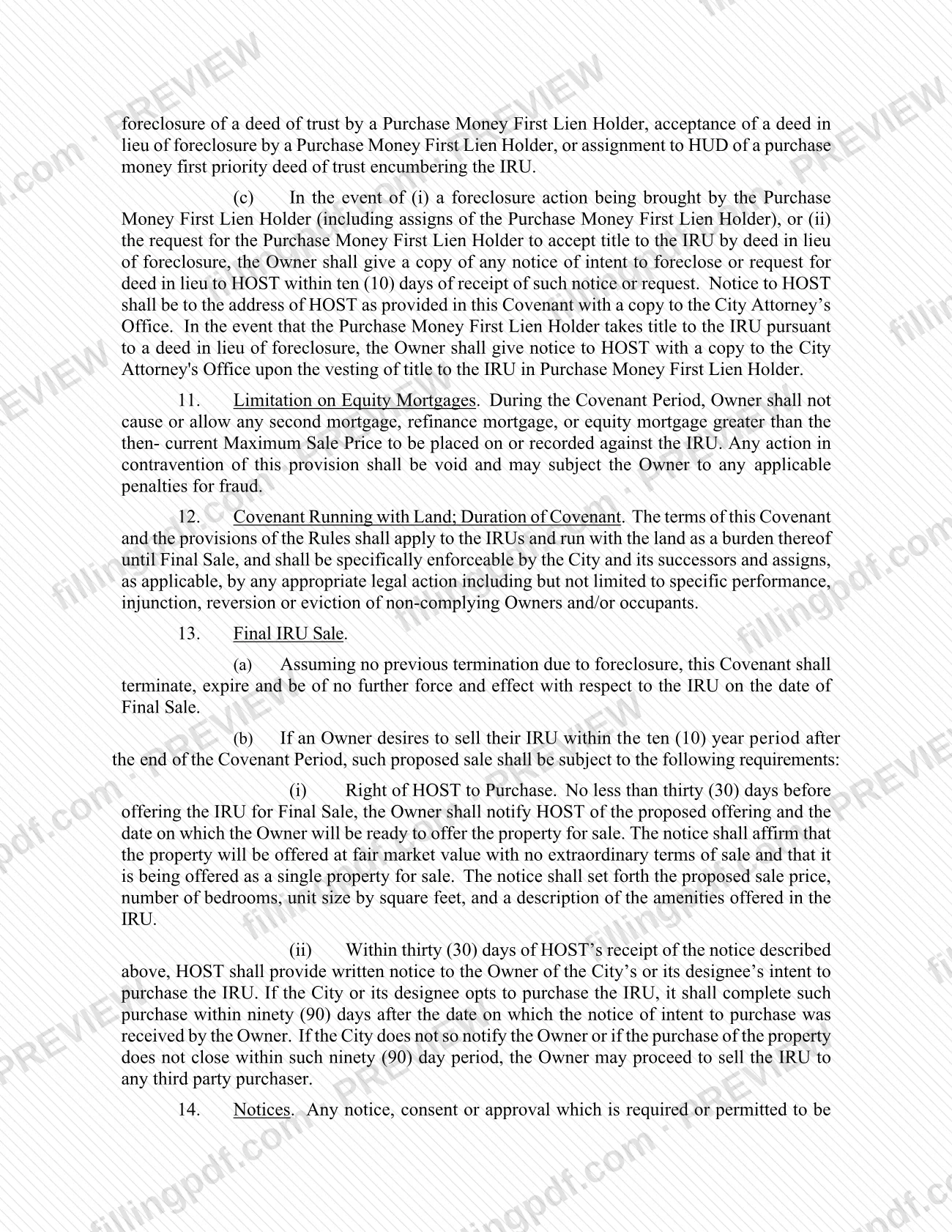
- For a Final Sale during the ten years after the Covenant Period, the owner notifies HOST at least thirty days before offering the unit.
Documents you need
- Legal lot description of the real property, entered in the [INSERT LEGAL LOT DESCRIPTION] space of the covenant.
- HOST verification of eligibility for each buyer, obtained before the Initial Sale closes (the buyer first submits an income verification request on the City's form).
- For the Initial Sale file with HOST: purchase contract, Memorandum of Acceptance, and warranty deed.
- For the Initial Sale file with HOST: appraisal (if necessary), a HUD-1 Settlement Sheet copy or similar documentation, and any other documentation HOST deems necessary.
- Memorandum of Acceptance (Exhibit A), signed and notarized by the buyer and recorded with the deed on every sale or resale.
- Maximum Resale Request, on the City's form, for an owner who wants to sell during the Covenant Period.
How to fill out For-Sale Form of Covenant – Denver, CO
Enter the project name
Write the project name in the title and in the opening paragraph, and enter the developer entity as the Declarant, along with the day, month and year of the covenant.
Insert the legal description
Replace [INSERT LEGAL LOT DESCRIPTION] with the legal description of the real property that contains the unit, which the form calls an "IRU".
Fill in the Covenant Period and AMI
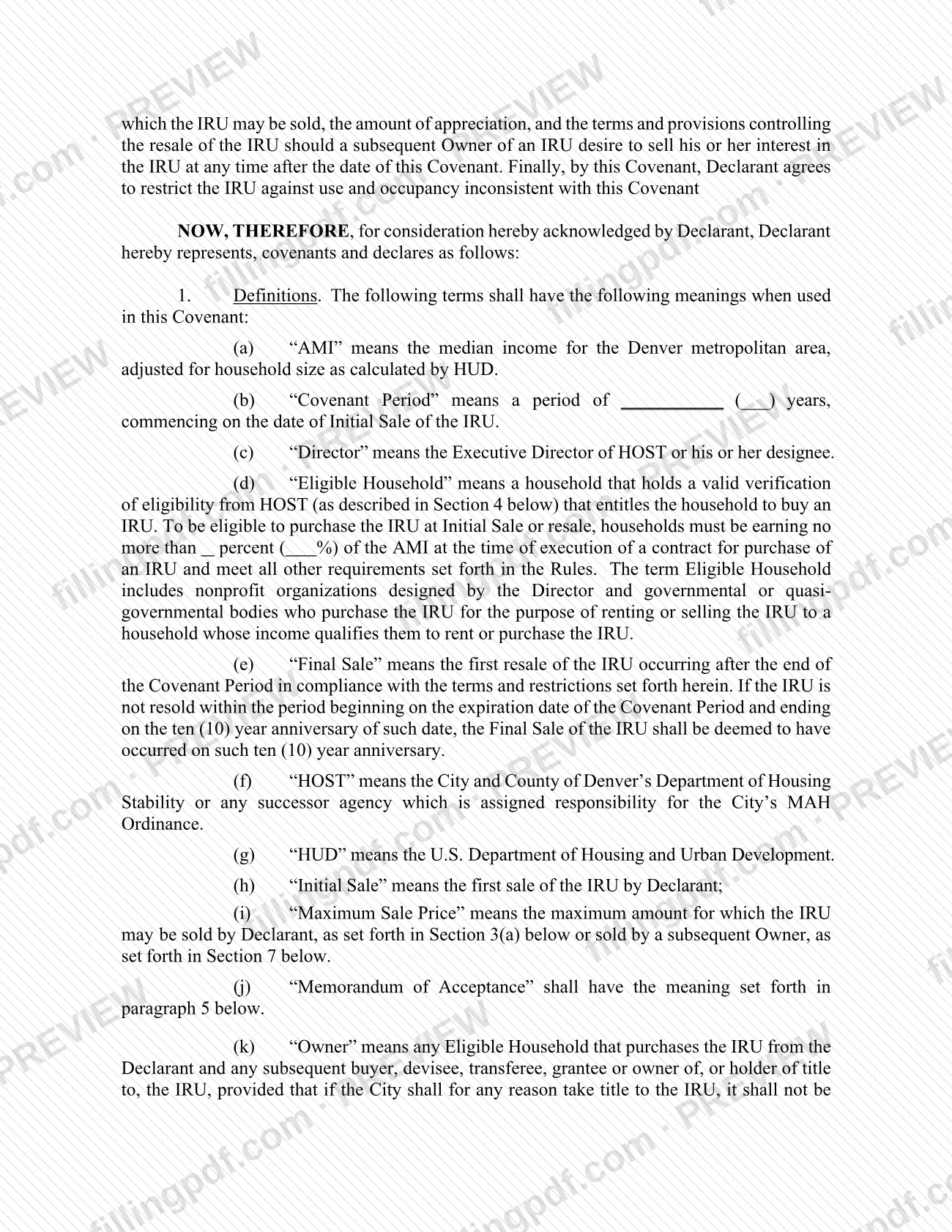
In Section 1(b) enter the length of the Covenant Period in years, in words and numerals. In Section 1(d) enter the percent of AMI that limits Eligible Households.
Enter the Initial Sale price cap
In Section 3(a) write the maximum price for the Initial Sale, in words, on the line before "Dollars and No/100."
Complete the Declarant notice address
In Section 14, under "To Declarant," enter the development entity name, street address, and city, state and ZIP code. The City and City Attorney's addresses are already printed.
Complete the Declarant signature block
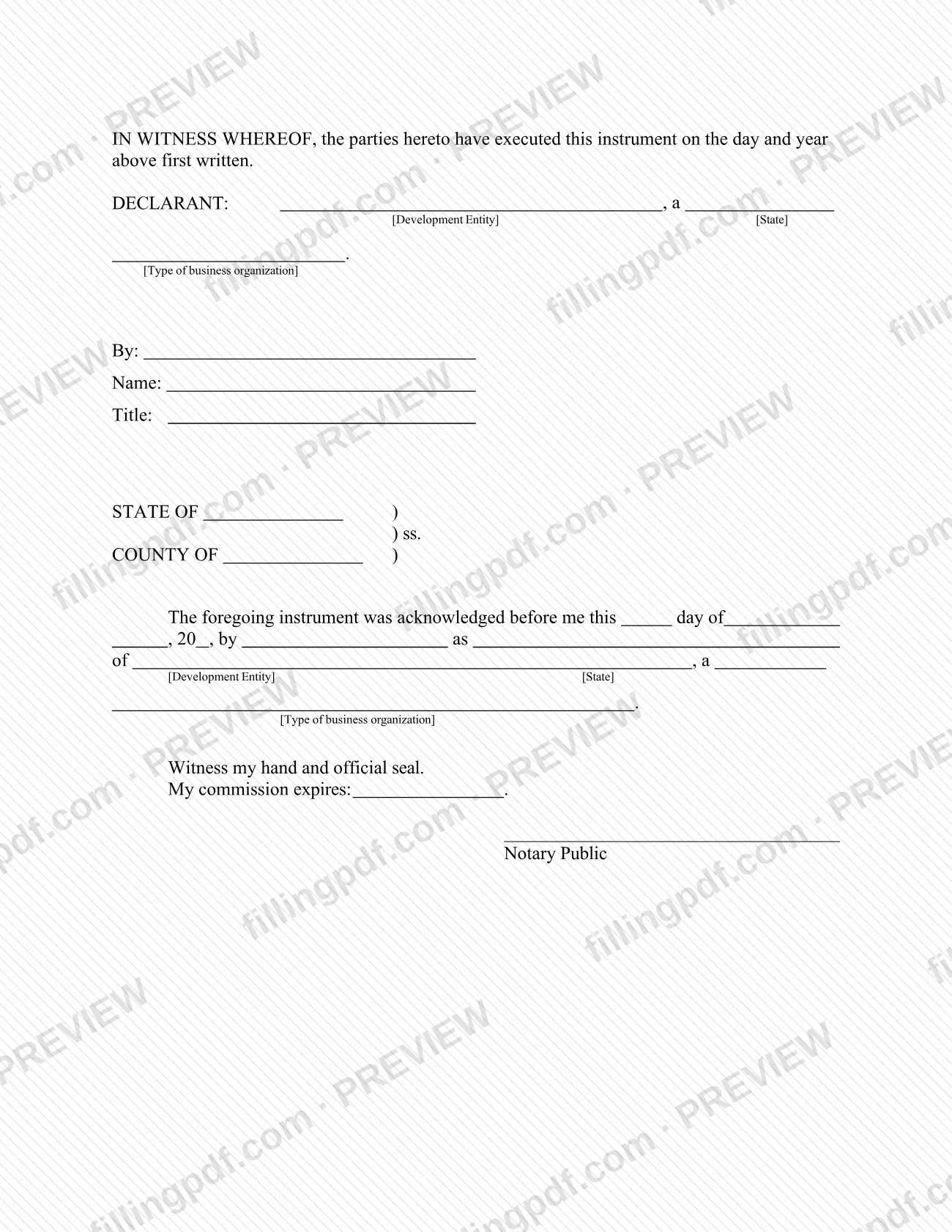
Enter the entity name, state and type of business organization, then the By, Name and Title of the signer.
Complete the notary acknowledgment
Fill in the state, county, date and signer's name and title, and let the notary complete the seal and commission expiration.
Prepare the City acceptance block
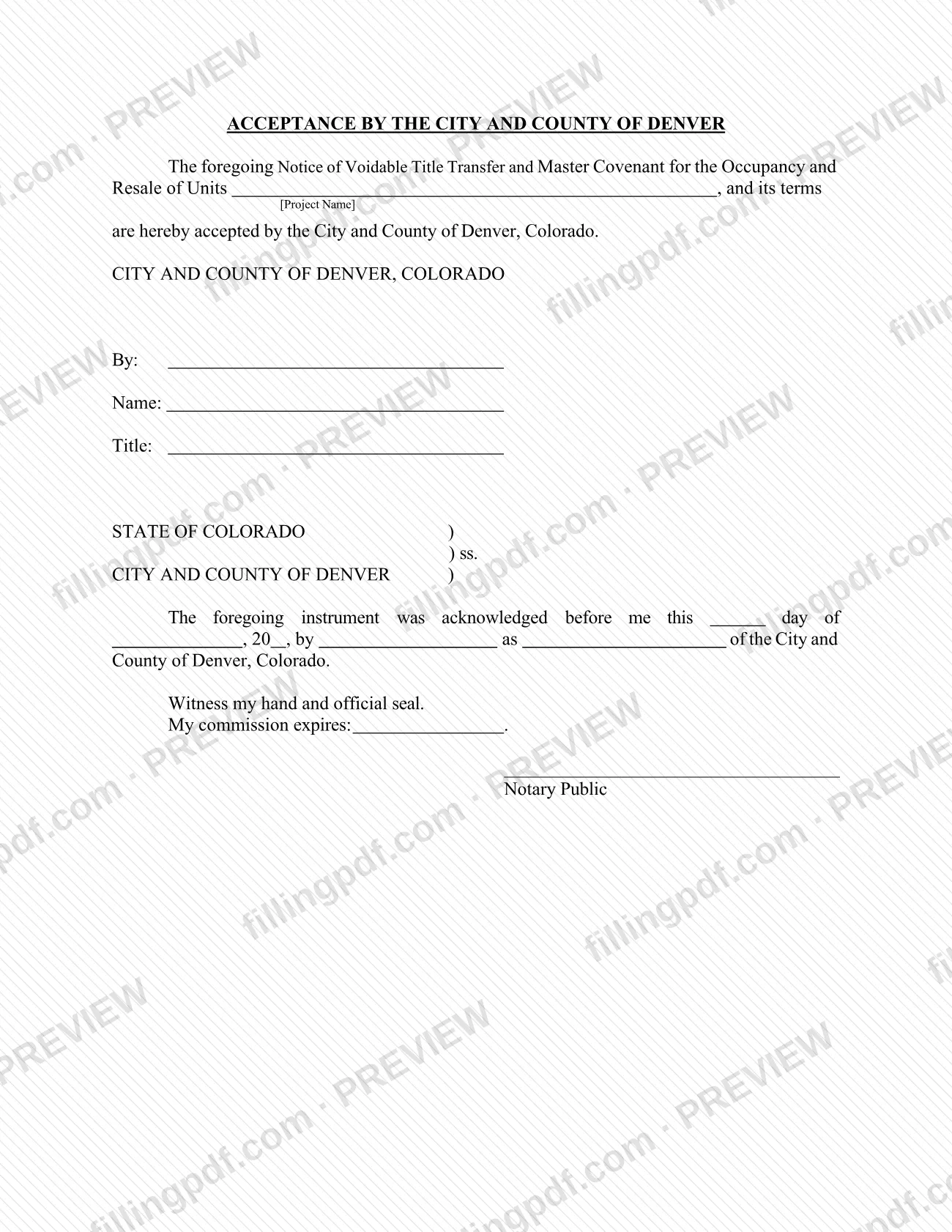
Enter the project name in the Acceptance by the City and County of Denver block. The City's representative signs, and a notary completes the acknowledgment.
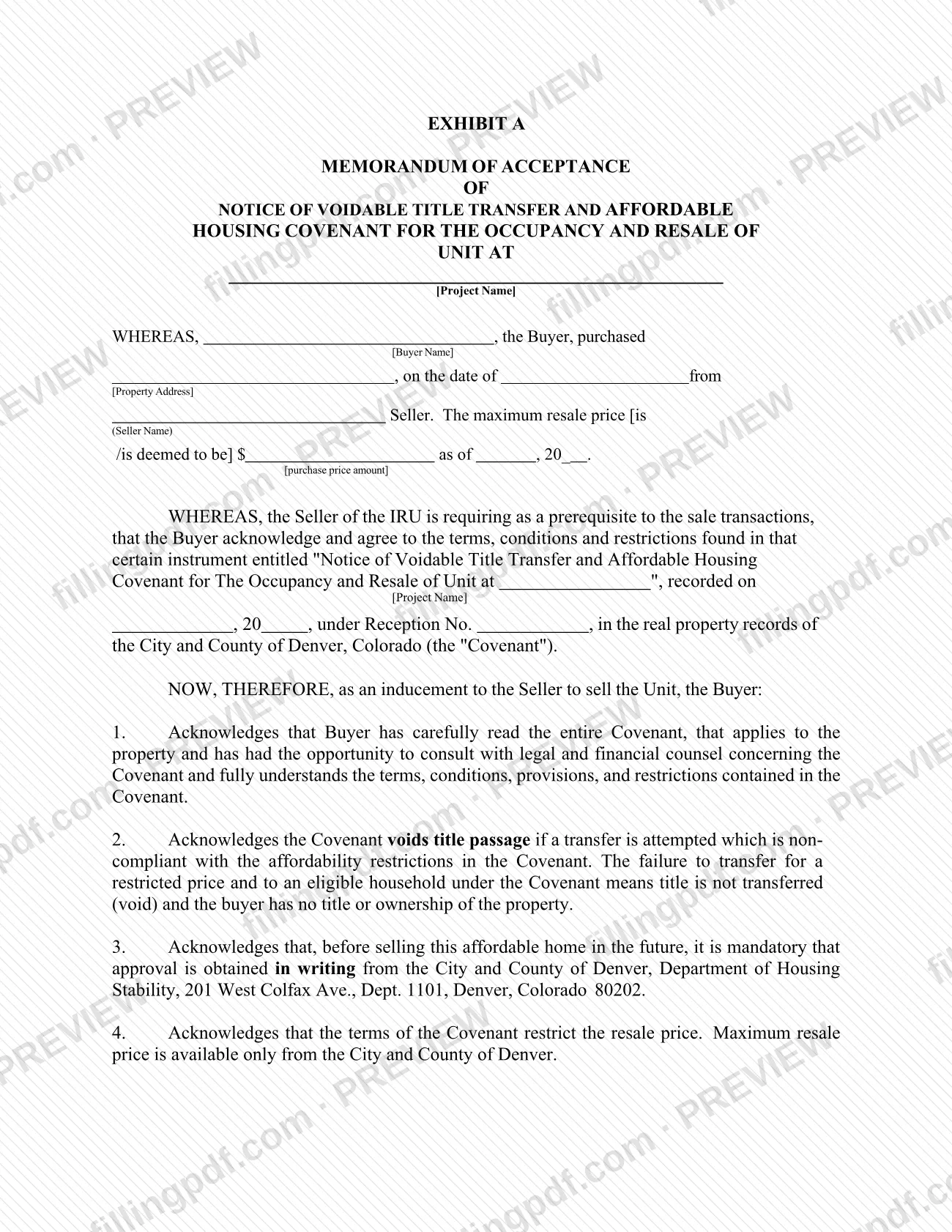
Complete Exhibit A for each buyer
Enter the project name, buyer name, property address, purchase date, seller, whether the maximum resale price "is / is deemed to be" the stated amount, the AMI percentage, the covenant's recording date and Reception No., and the buyer's notice address.
Have buyers sign Exhibit A
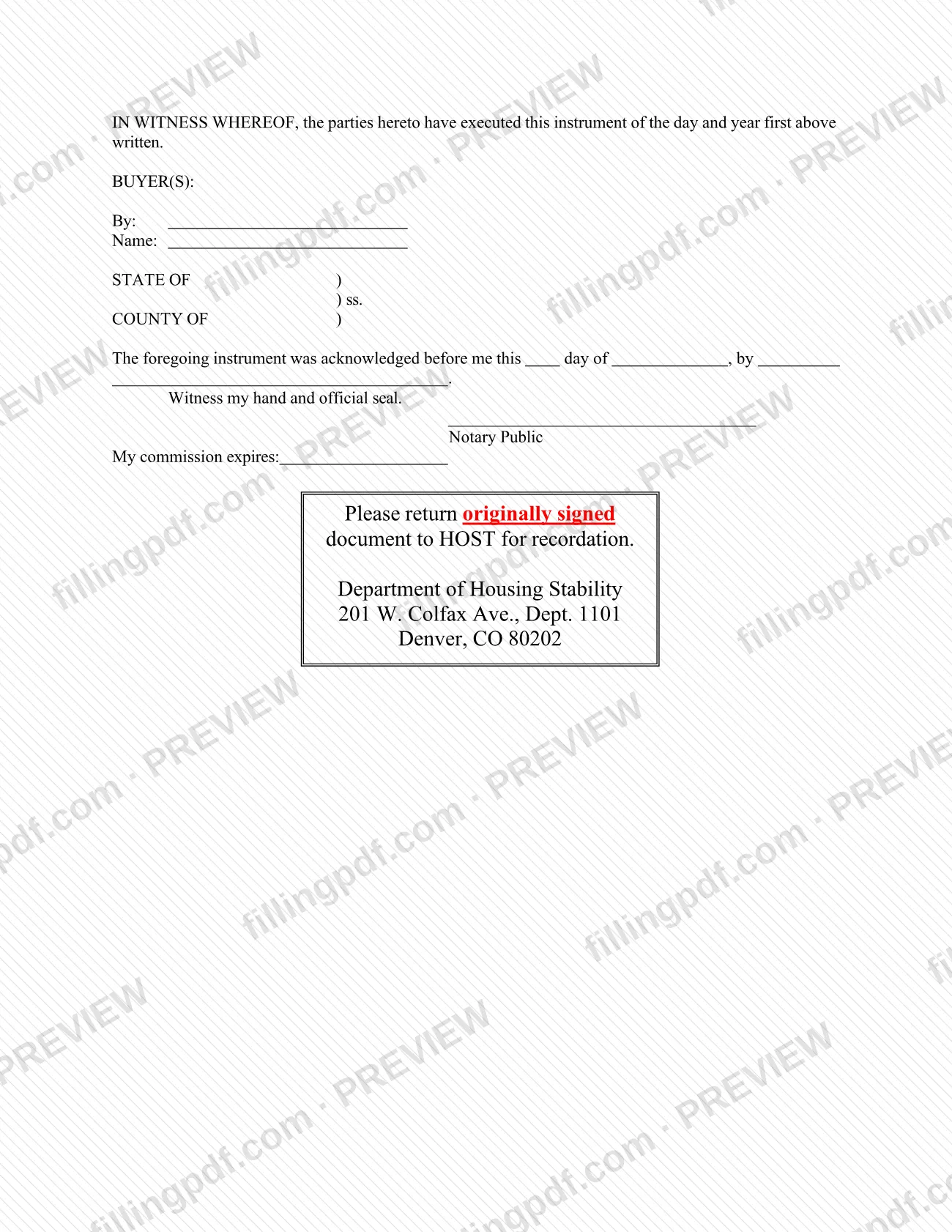
Each buyer signs by name before a notary, who completes the acknowledgment so the Memorandum of Acceptance can be recorded.
Review and download the PDF
Check every blank against your project records, then download or print the completed PDF from FillingPDF and follow the recording and mailing steps under How to submit.
How to submit For-Sale Form of Covenant – Denver, CO
The form names mail and recording as its channels: mail to HOST and recording with the Denver Clerk and Recorder.
- Mail to HOST: the header reads "When recorded mail to" Department of Housing Stability, Attention: Catalytic Projects Team, 201 W. Colfax Ave., Dept. 1101, Denver, CO 80202. Exhibit A asks that the originally signed document be returned to HOST at 201 W. Colfax Ave., Dept. 1101, Denver, CO 80202 for recordation.
- Recording: the covenant is recorded in the real property records of the City and County of Denver. Each Memorandum of Acceptance is recorded with the Clerk and Recorder together with the deed.
- Sale file with HOST: after the Initial Sale closes, the purchase contract, Memorandum of Acceptance, appraisal (if necessary), warranty deed, a HUD-1 Settlement Sheet copy (or similar) and any other documents HOST requires are filed with HOST.
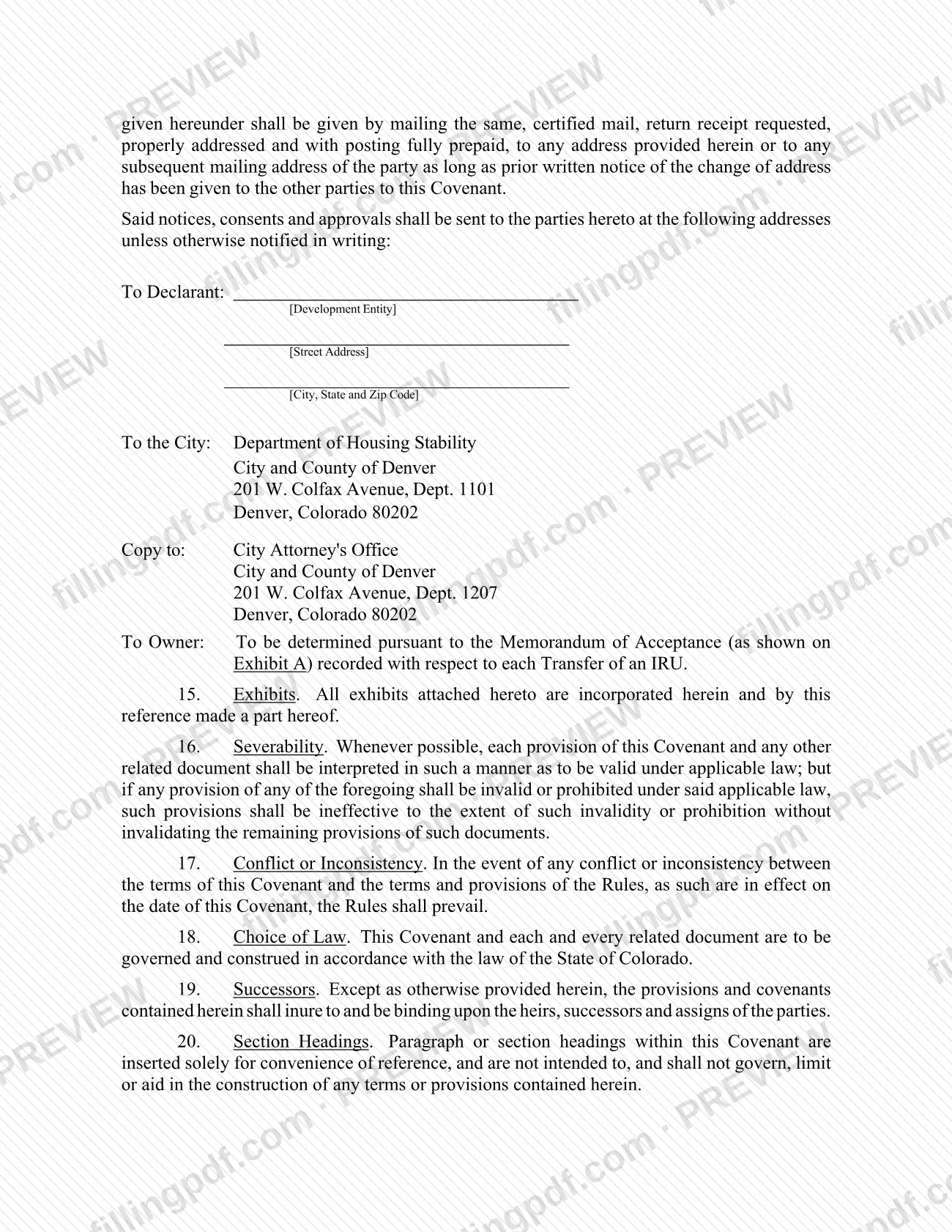
- Formal notices to the City go by certified mail, return receipt requested, to the Department of Housing Stability, 201 W. Colfax Avenue, Dept. 1101, Denver, Colorado 80202, with a copy to the City Attorney's Office, 201 W. Colfax Avenue, Dept. 1207, Denver, Colorado 80202.
FillingPDF lets you fill out and download the PDF; submission follows the channels above.
Common mistakes to avoid
- Closing the Initial Sale before HOST has issued a verification of eligibility for the buyer.
- Not recording the Memorandum of Acceptance with the deed; the covenant makes the transfer voidable at the City's option.
- Listing a unit for sale before receiving HOST's written determination of the Maximum Sale Price, or contracting above that price.
- Submitting the Maximum Resale Request less than ten days before offering the unit for sale.
- Leaving blanks open, such as the Covenant Period years, the AMI percentage, the Initial Sale price or the legal description.
- Using an IRU as a short-term rental, or renting it out without a temporary exception granted by HOST.
- Placing a second, refinance or equity mortgage greater than the current Maximum Sale Price on the unit.
- Not sending HOST a copy of a notice of default or foreclosure within the time the covenant sets.
Frequently asked questions
What is the For-Sale Form of Covenant in Denver?
It is Denver's template affordable housing covenant for income-restricted for-sale units, recorded by the developer. It sets the buyer income limit, owner occupancy rules, the Maximum Sale Price and what happens on breach, foreclosure and final sale.
Who signs the For-Sale Form of Covenant?
The developer signs as Declarant before a notary, and the City and County of Denver signs an acceptance block, also notarized. Each buyer of a unit later signs the Exhibit A Memorandum of Acceptance before a notary.
When does the For-Sale Form of Covenant have to be recorded?
The City's EHA page says it is to be recorded prior to certificate of occupancy. After that, each sale or resale needs a recorded Memorandum of Acceptance together with the deed, or the City may void the transfer.
Where do I send the recorded covenant in Denver?
The header says to mail the recorded document to the Department of Housing Stability, Attention: Catalytic Projects Team, 201 W. Colfax Ave., Dept. 1101, Denver, CO 80202. Exhibit A asks for the originally signed document to go to HOST at the same address.
What is the difference between the For-Sale and For-Rent forms of covenant?
The For-Sale form covers units that are sold to Eligible Households, with resale price limits and a Memorandum of Acceptance for each owner. The City lists a separate For-Rent Form of Covenant for rental units.
Can I fill out the For-Sale Form of Covenant online?
Yes. You can fill out the PDF online on FillingPDF and download or print it. FillingPDF is an independent service and does not record or file the covenant; you record it and mail it to HOST through the channels the form names.
How is the maximum resale price calculated?
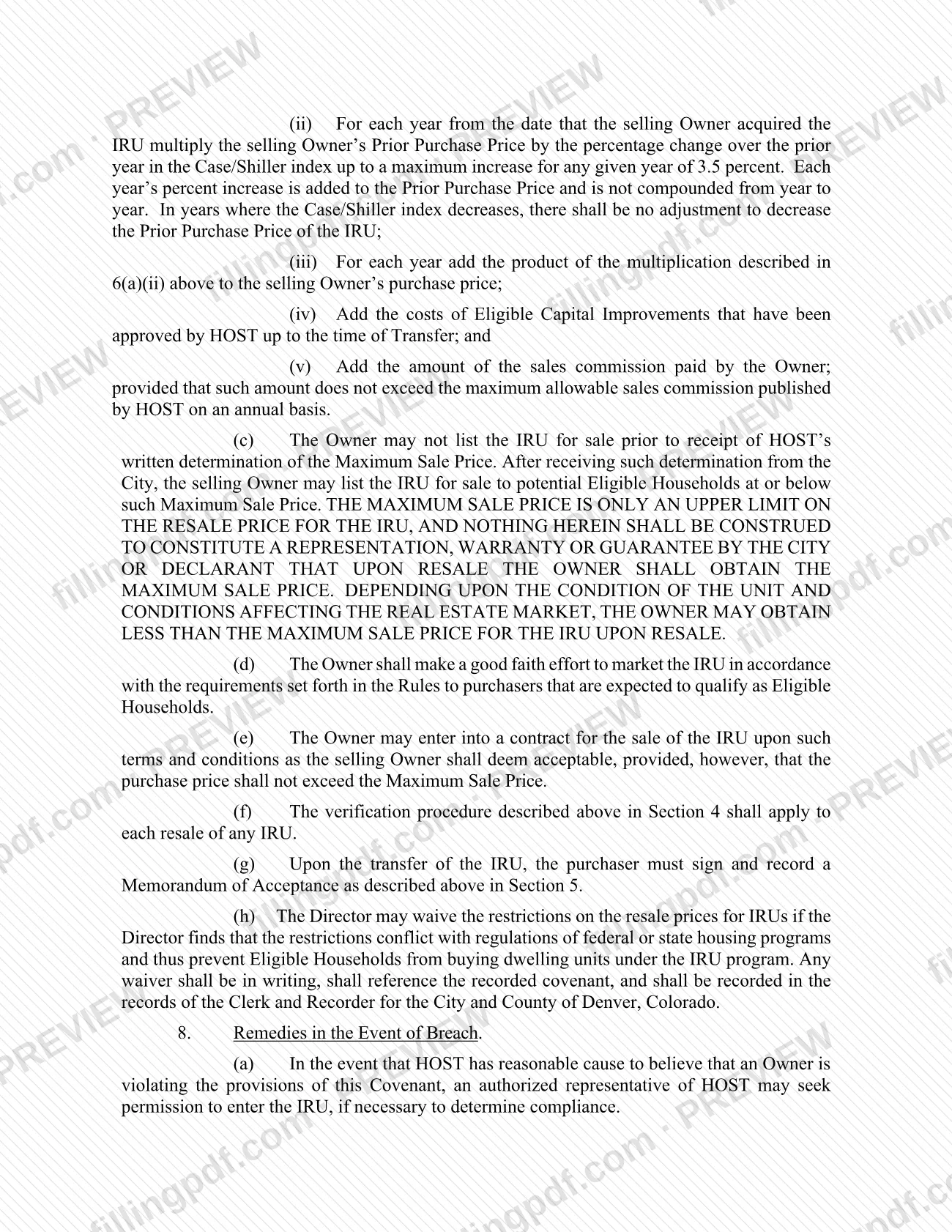
Section 7(b) starts from the owner's prior purchase price. It adds a yearly increase tied to the Case/Shiller index, capped at 3.5 percent and not compounded, then HOST-approved eligible capital improvements and the sales commission paid, up to HOST's published maximum.
Can an owner of a covenant unit rent it out?
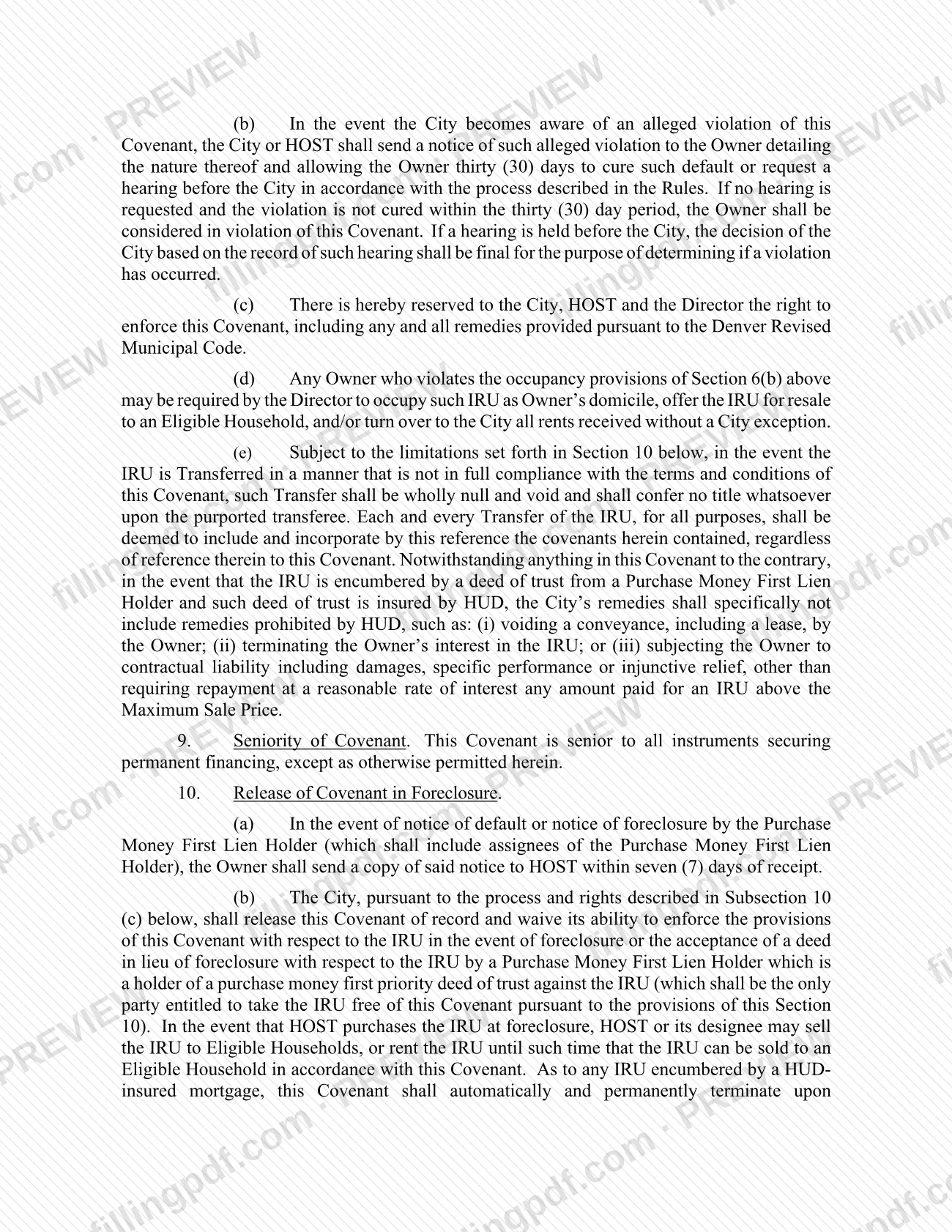
Only with a temporary exception that HOST grants under the Rules. The covenant requires the owner to live in the unit as a permanent residence and never allows short-term rental, though an owner who stays may share the unit with renters.
Ready to fill out For-Sale Form of Covenant – Denver, CO?
Fill out For-Sale Form of Covenant – Denver, CO now