
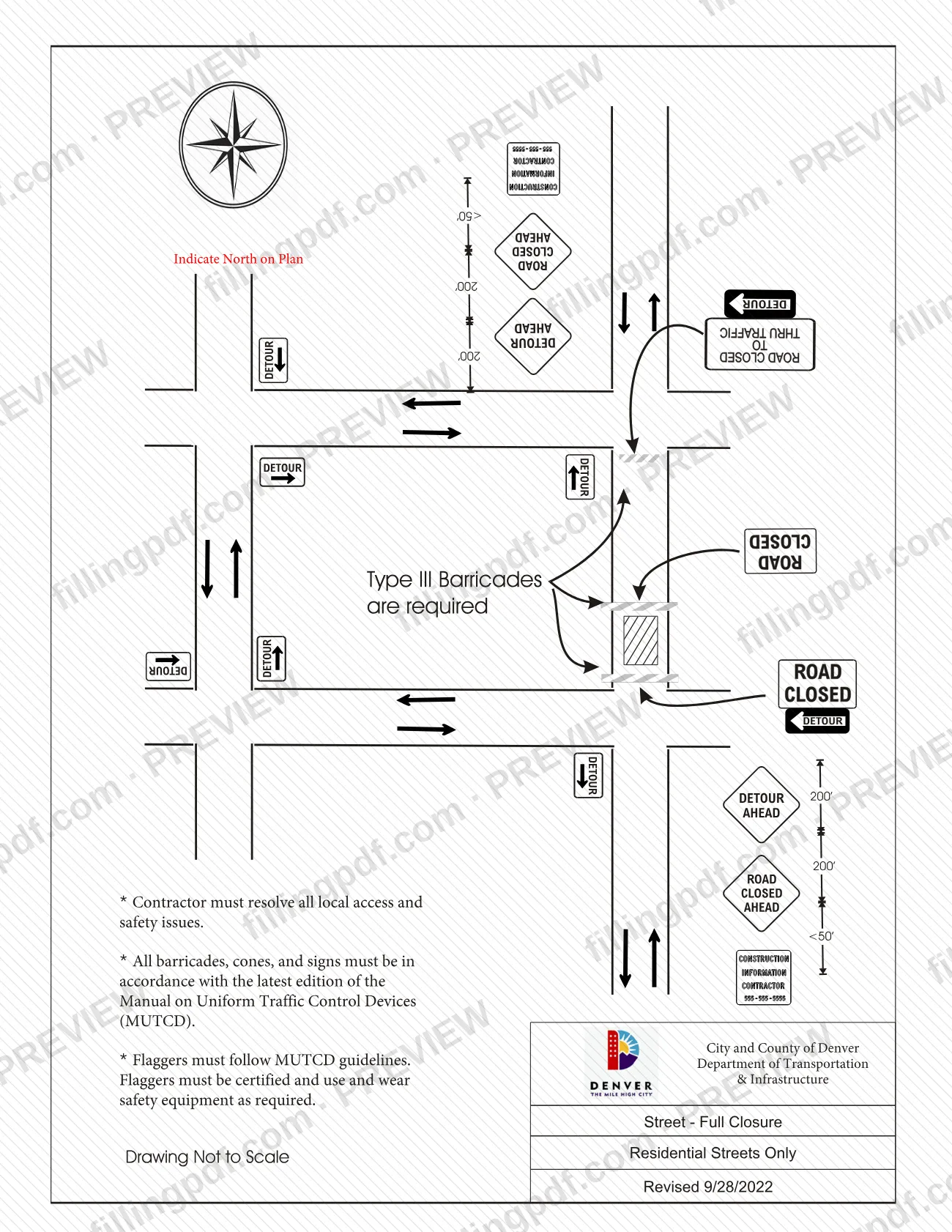
Street - Full Closure is a traffic control drawing published by the City and County of Denver Department of Transportation & Infrastructure (DOTI) for closing a residential street completely and routing through traffic onto a detour. It shows the ROAD CLOSED and DETOUR signs, the Type III barricades and the distances between them, and it carries the contractor's notes on MUTCD signing and flaggers. On this page you can fill out the form online on FillingPDF and download or print the completed PDF; DOTI publishes the original and takes street occupancy submittals through its E-Permits system.
Last updated
What is Street - Full Closure – Denver, CO?
Street - Full Closure is a City and County of Denver Department of Transportation & Infrastructure (DOTI) drawing that lays out the signs, barricades and detour used when a residential street is fully closed to through traffic. It is marked "Residential Streets Only" and "Drawing Not to Scale."
The drawing has placeholders where you enter the street name ("Enter Street Name Here") and a spot to indicate north on the plan. It shows ROAD CLOSED and DETOUR AHEAD signs at 200' spacing, a "THRU TRAFFIC DETOUR TO" sign, detour arrows, and a note that Type III barricades are required. Several distances are marked <50'.
Its printed notes set the rules for the work:
- The contractor must resolve all local access and safety issues.
- All barricades, cones and signs must follow the latest edition of the Manual on Uniform Traffic Control Devices (MUTCD).
- Flaggers must follow MUTCD guidelines, be certified, and use and wear safety equipment as required.
DOTI lists traffic control plans among the resources on its Street Occupancy page, which covers short-term use of the city's right-of-way. The form is a plan drawing, not a permit: the permit requests themselves go through E-Permits. For street or alley closures related to special events rather than construction, DOTI points to Section C of the Special Events Planning Guide.
Who needs to file Street - Full Closure – Denver, CO?
Contractors and applicants who plan to close a residential street completely to through traffic, usually as part of a street occupancy request, use this drawing as their traffic control plan. The form addresses the contractor directly: the contractor must resolve local access and safety issues and see that the signs, barricades and flaggers meet the printed requirements.
Exclusions and limits:
- The drawing is for residential streets only, as printed on it. It is not the plan for other kinds of streets.
- DOTI directs closures related to special events (not construction) to Section C, Events on Denver Streets, of the Special Events Planning Guide.
- A street occupancy permit is a separate requirement. DOTI says a Street Occupancy Permit is always required in addition to a Street Cut or Construction Permit.
The form names no one else who may complete or sign it for the applicant.
When to file Street - Full Closure – Denver, CO
Prepare this drawing when you are requesting to close a residential street fully for work in the public right-of-way. DOTI says all submittals through E-Permits must upload the DOTI Street Occupancy Request Worksheet and traffic plans, so the plan goes in with the request, not afterward. No separate due date is printed on the drawing itself.
If the closure also needs parking meters bagged, DOTI handles that through a separate Online Meter Bagging Permit System. Its page says those requests take up to 72 hours to process and should be submitted at least 1 week before the event.
Documents you need
- DOTI Street Occupancy Request Worksheet: DOTI says to upload it with all requests submitted through E-Permits; it is also the form used to calculate permit costs.
- Traffic plan, such as the completed Street - Full Closure drawing: DOTI says all E-Permits submittals must upload traffic plans along with the worksheet.
How to fill out Street - Full Closure – Denver, CO
Confirm the plan fits your street
The drawing is marked "Residential Streets Only" and "Drawing Not to Scale." Use it only for a full closure of a residential street.
Enter the street names
Replace each "Enter Street Name Here" placeholder with the name of the street shown at that point on the drawing.
Indicate north on the plan
Use the "Indicate North on Plan" spot so the orientation of the closure and detour is clear.
Check the ROAD CLOSED signing
Review the ROAD CLOSED and ROAD CLOSED AHEAD signs and the 200' and <50' distances marked on the drawing for each approach to the closure.
Complete the detour route
Check the DETOUR AHEAD, THRU TRAFFIC and "DETOUR TO" signs and the DETOUR arrows so the route around the closure is shown.
Confirm Type III barricades
The drawing states that Type III barricades are required. Make sure the barricades at the closure match.
Review the contractor notes
The notes require the contractor to resolve all local access and safety issues, and to follow the latest MUTCD for barricades, cones and signs.
Plan for certified flaggers
Flaggers must follow MUTCD guidelines, be certified, and use and wear safety equipment as required.
Review and download the completed PDF
Check the street names and the north indication, then download or print the completed PDF from FillingPDF. Upload it with the DOTI Street Occupancy Request Worksheet as described under How to submit.
How to submit Street - Full Closure – Denver, CO
DOTI takes street occupancy requests online through E-Permits; the drawing has no mailing address or counter instructions of its own.
- E-Permits (online): DOTI says all right-of-way street cut, street occupancy and ROW construction permits must be submitted online through E-Permits. Upload the completed traffic plan together with the DOTI Street Occupancy Request Worksheet, which DOTI requires with every submittal.
- Permit costs: The worksheet is the form DOTI tells applicants to use to calculate permit costs. Check the DOTI Street Occupancy page for current fees, which this page does not list: DOTI Street Occupancy.
FillingPDF lets you fill out and download the PDF; submission follows the DOTI channels above.
Common mistakes to avoid
- Using this drawing for a street that is not residential; it is printed "Residential Streets Only."
- Leaving the "Enter Street Name Here" placeholders unchanged instead of entering the actual street names.
- Not indicating north on the plan where the drawing asks you to.
- Using other barricades when the drawing states that Type III barricades are required.
- Setting up barricades, cones or signs that do not follow the latest edition of the MUTCD, as the notes require.
- Using flaggers who are not certified or who do not follow MUTCD guidelines and wear required safety equipment.
- Uploading the traffic plan to E-Permits without the DOTI Street Occupancy Request Worksheet, which DOTI requires with all submittals.
- Applying only for a Street Cut or Construction Permit; DOTI says a Street Occupancy Permit is always required in addition.
- Using this construction closure plan for a special event closure, which DOTI sends to the Special Events Planning Guide, Section C.
Frequently asked questions
What is the Street - Full Closure form in Denver?
It is a City and County of Denver DOTI traffic control drawing showing the signs, Type III barricades and detour for fully closing a residential street. It is printed "Residential Streets Only," with contractor notes on MUTCD signing and flaggers.
Can I use the Street - Full Closure plan on any street?
No. The drawing is marked "Residential Streets Only." For other situations, such as closures tied to a special event, DOTI refers applicants to Section C of the Special Events Planning Guide.
Where do I submit a Denver street closure traffic plan?
Through DOTI's E-Permits system. DOTI says all right-of-way street cut, street occupancy and ROW construction permits must be submitted online there, and that each submittal must upload the DOTI Street Occupancy Request Worksheet and traffic plans.
Do I need a street occupancy permit as well?
DOTI says a Street Occupancy Permit is always required in addition to a Street Cut or Construction Permit. The traffic plan supports the street occupancy request submitted through E-Permits; the drawing itself is not a permit.
What are the flagger requirements on the drawing?
Flaggers must follow MUTCD guidelines, must be certified, and must use and wear safety equipment as required. The same notes say barricades, cones and signs must follow the latest edition of the MUTCD.
Is there a fee for a street occupancy request?
Permit costs apply to street occupancy requests. DOTI provides the Street Occupancy Request Worksheet to calculate them and asks for it with every E-Permits submittal. This page does not list amounts; check DOTI's Street Occupancy page.
Can I fill out the Street - Full Closure PDF online?
Yes. You can fill out the PDF online on FillingPDF and download or print it. FillingPDF is an independent service, not affiliated with the City and County of Denver, and does not submit anything to DOTI; you submit through E-Permits.
Ready to fill out Street - Full Closure – Denver, CO?
Fill out Street - Full Closure – Denver, CO now