
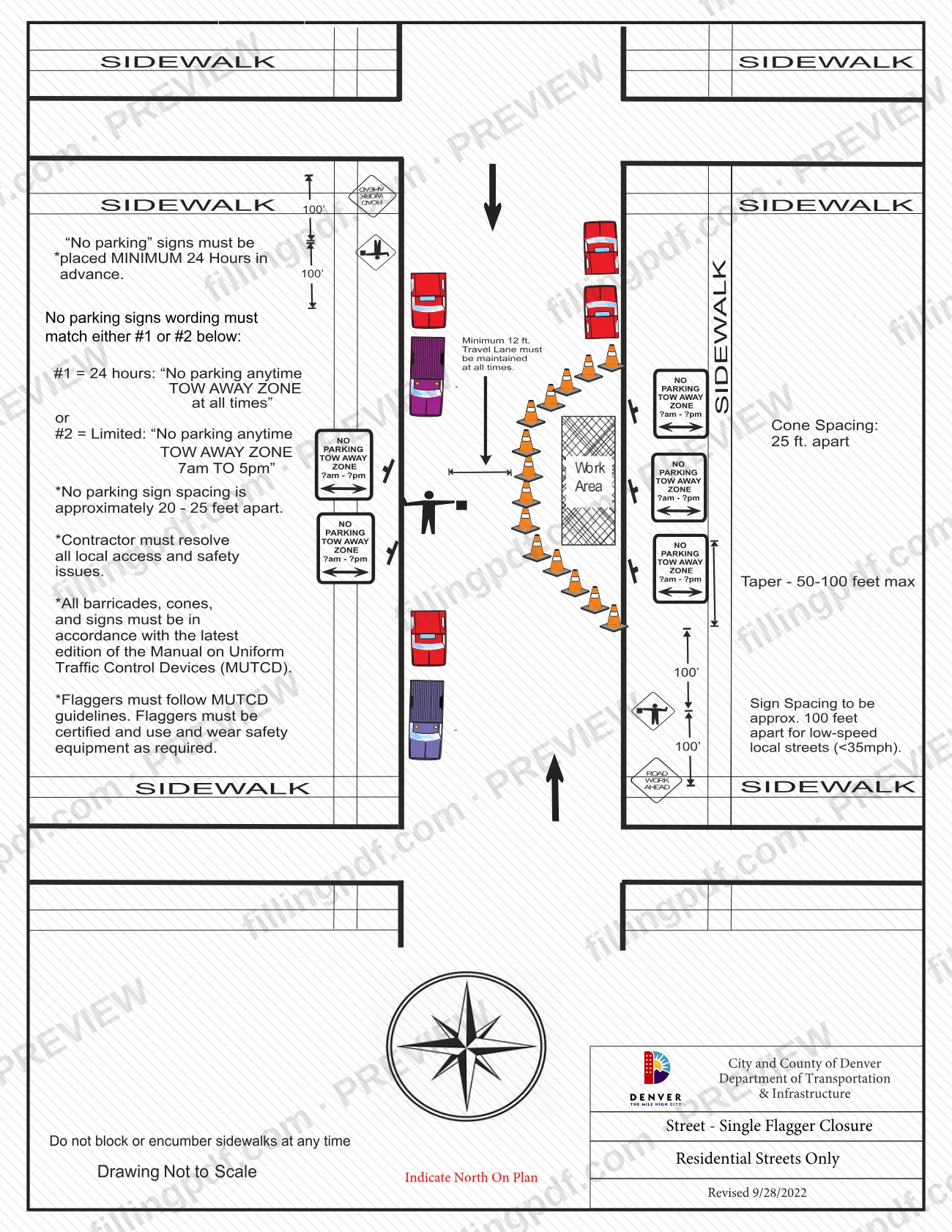
Street - Single Flagger Closure is a traffic control plan drawing published by the City and County of Denver Department of Transportation & Infrastructure (DOTI) for short-term work on a residential street that is managed with one flagger. It shows where the no parking signs, cones, taper and sidewalk warnings go, and it is one of the city-approved plans listed on DOTI's Street Occupancy page. On this page you can fill out the form online on FillingPDF and download or print the completed PDF; the original plan is published by DOTI at denvergov.org.
Last updated
What is Street - Single Flagger Closure – Denver, CO?
Street - Single Flagger Closure is a traffic control plan drawing from the City and County of Denver Department of Transportation & Infrastructure (DOTI) that lays out a street closure managed by a single flagger, with the placement of no parking signs, cones, taper and sidewalk warnings.
The sheet is a diagram of a street with a work zone in the middle. It carries a "Road Work" and "Sidewalk Ahead" sign sequence, tow-away no parking signs, a cone line and a taper. It has three places marked "Enter Street Name Here", a note to indicate north on the plan, and the legend "Drawing Not to Scale". It is marked "Residential Streets Only" and carries the warning "Do not block or encumber sidewalks at any time". The revision printed on it is Revised 9/28/2022.
The printed notes set the layout rules:
- No parking signs go up at least 24 hours in advance, and their wording must match option #1 (24 hours) or option #2 (limited, 7am to 5pm).
- Sign spacing is approximately 20 to 25 feet for no parking signs, and about 100 feet apart on low-speed local streets (under 35 mph).
- Cones are 25 feet apart, the taper is 50 to 100 feet at most, and a travel lane of at least 12 feet is kept open at all times.
- Barricades, cones and signs follow the latest edition of the Manual on Uniform Traffic Control Devices (MUTCD), and flaggers must be certified.
DOTI lists the plan under Traffic Control Plans on its Street Occupancy page, which covers short-term use of the city's right-of-way.
Who needs to file Street - Single Flagger Closure – Denver, CO?
Applicants and contractors who plan short-term work in the right-of-way of a residential street and will control traffic with one flagger use this plan for the traffic control drawing. The sheet is marked "Residential Streets Only", so it is not the plan for other street types.
Conditions printed on the plan:
- The contractor must resolve all local access and safety issues.
- Flaggers must be certified, follow MUTCD guidelines, and use and wear the safety equipment required.
- Sidewalks must not be blocked or encumbered at any time.
DOTI's Street Occupancy page adds that a Street Occupancy Permit is always required in addition to a Street Cut or Construction Permit.
Do not use this plan for a street or alley closure for a special event that is not construction. DOTI directs those requests to Section C, Events on Denver Streets, of the Special Events Planning Guide.
When to file Street - Single Flagger Closure – Denver, CO
The plan has no due date of its own: you prepare it when you apply for a street occupancy permit, because DOTI says every E-Permits submittal must include the DOTI Street Occupancy Request Worksheet and traffic plans.
One timing rule is printed on the plan itself. The no parking signs must be placed at least 24 hours in advance, so the closure schedule has to leave room for that notice. The sign hours are written on the signs as "?am - ?pm" placeholders that you replace with your closure hours.
DOTI's page does not give a review time for street occupancy permits. If you also want parking meters bagged, that is a separate online request; DOTI says it takes up to 72 hours to process and should be submitted at least 1 week before the event.
Documents you need
- DOTI Street Occupancy Request Worksheet (XLS or PDF): upload it with every E-Permits submittal; it is also used to calculate permit costs.
How to fill out Street - Single Flagger Closure – Denver, CO
Confirm the street qualifies
The plan is printed "Residential Streets Only" and is for a single flagger closure. Use a different city-approved plan if the street or the traffic control method differs.
Enter the street names
Replace each "Enter Street Name Here" with the name of the street where the work will take place. The label appears in more than one place on the drawing.
Indicate north on the plan
The sheet says "Indicate North On Plan". Mark the north direction so the layout can be matched to the street.
Set the no parking sign wording
Choose option #1 (24 hours, "No parking anytime at all times") or option #2 (limited, "No parking anytime 7am TO 5pm"). Replace the "?am - ?pm" placeholders on the signs with your hours.
Check cone and taper layout
Keep cones 25 feet apart and the taper to 50-100 feet at most, and keep a travel lane of at least 12 feet open at all times.
Check sign spacing and sidewalks
Space no parking signs approximately 20-25 feet apart. On low-speed local streets (under 35 mph), space the warning signs about 100 feet apart, and do not block the sidewalk.
Review the flagger and MUTCD notes
The printed notes require MUTCD-compliant barricades, cones and signs, certified flaggers using required safety equipment, and contractor resolution of local access and safety issues.
Review and download the completed PDF
Check the street names, north indication and sign hours, then download or print the completed PDF from FillingPDF. Assemble it with the DOTI Street Occupancy Request Worksheet for the channels described under How to submit.
How to submit Street - Single Flagger Closure – Denver, CO
The plan is submitted online through E-Permits as part of a street occupancy request. The sheet prints no mailing address or other channel.
- E-Permits (online): DOTI states that all right-of-way street cut, street occupancy and ROW construction permits must be submitted online through E-Permits. Street Occupancy and construction in the right of way can be applied for and paid online.
- What to upload: DOTI says all submittals must upload the DOTI Street Occupancy Request Worksheet and traffic plans, such as this one.
- Permit costs: DOTI says the worksheet is used to calculate permit costs, so a charge applies; the amount comes from the worksheet and DOTI, not from this plan.
The worksheet, the list of city-approved traffic control plans and the E-Permits information are on DOTI's Street Occupancy page. FillingPDF lets you fill out and download the PDF; submission follows the DOTI channels above.
Common mistakes to avoid
- Using this plan for a street that is not residential; the sheet is marked "Residential Streets Only".
- Placing the no parking signs less than 24 hours before the closure begins.
- Writing no parking sign wording that matches neither option #1 ("No parking anytime at all times") nor option #2 ("No parking anytime 7am TO 5pm").
- Leaving the "?am - ?pm" hours on the signs unchanged instead of entering the closure hours.
- Leaving "Enter Street Name Here" blank, or not indicating north on the plan.
- Planning cones more than 25 feet apart, a taper longer than 100 feet, or a travel lane narrower than 12 feet.
- Blocking or encumbering the sidewalk; the plan says never to do so at any time.
- Submitting the plan through E-Permits without the DOTI Street Occupancy Request Worksheet.
Frequently asked questions
What is the Street - Single Flagger Closure plan?
It is a City and County of Denver DOTI traffic control plan drawing for a residential street closure managed by one flagger. It shows no parking signs, cones, taper and sidewalk warnings, along with the spacing and MUTCD rules printed beside the drawing.
Can I use this plan on any Denver street?
No. The sheet is marked "Residential Streets Only". For closures related to special events rather than construction, DOTI points to Section C, Events on Denver Streets, of the Special Events Planning Guide.
How far in advance must no parking signs be posted?
At least 24 hours. The plan says no parking signs must be placed a minimum of 24 hours in advance, with wording that matches either option #1 (24 hours) or option #2 (limited, 7am to 5pm).
How wide must the travel lane be during a single flagger closure?
A minimum of 12 feet, maintained at all times. The plan also sets cone spacing at 25 feet apart, a taper of 50-100 feet at most, and requires that sidewalks never be blocked or encumbered.
Where do I submit the single flagger closure plan?
Through Denver's E-Permits system with your street occupancy request. DOTI says all submittals must upload the DOTI Street Occupancy Request Worksheet and traffic plans. The plan itself prints no address or other submission channel.
Do I need a street occupancy permit as well?
DOTI says right-of-way street occupancy permits are submitted online through E-Permits, and that a Street Occupancy Permit is always required in addition to a Street Cut or Construction Permit. This plan is the traffic drawing that goes with the request.
Is parking meter bagging part of this plan?
No. Meter bagging is a separate online request. DOTI says it takes up to 72 hours to process, so submit it at least 1 week before your event, and a street occupancy permit is still needed for work in the street.
Can I fill out the single flagger closure plan on FillingPDF?
Yes. You can fill out the PDF online on FillingPDF and download or print it. FillingPDF is an independent service and does not submit the plan or file for a permit; you submit through DOTI's E-Permits system.
Ready to fill out Street - Single Flagger Closure – Denver, CO?
Fill out Street - Single Flagger Closure – Denver, CO now