
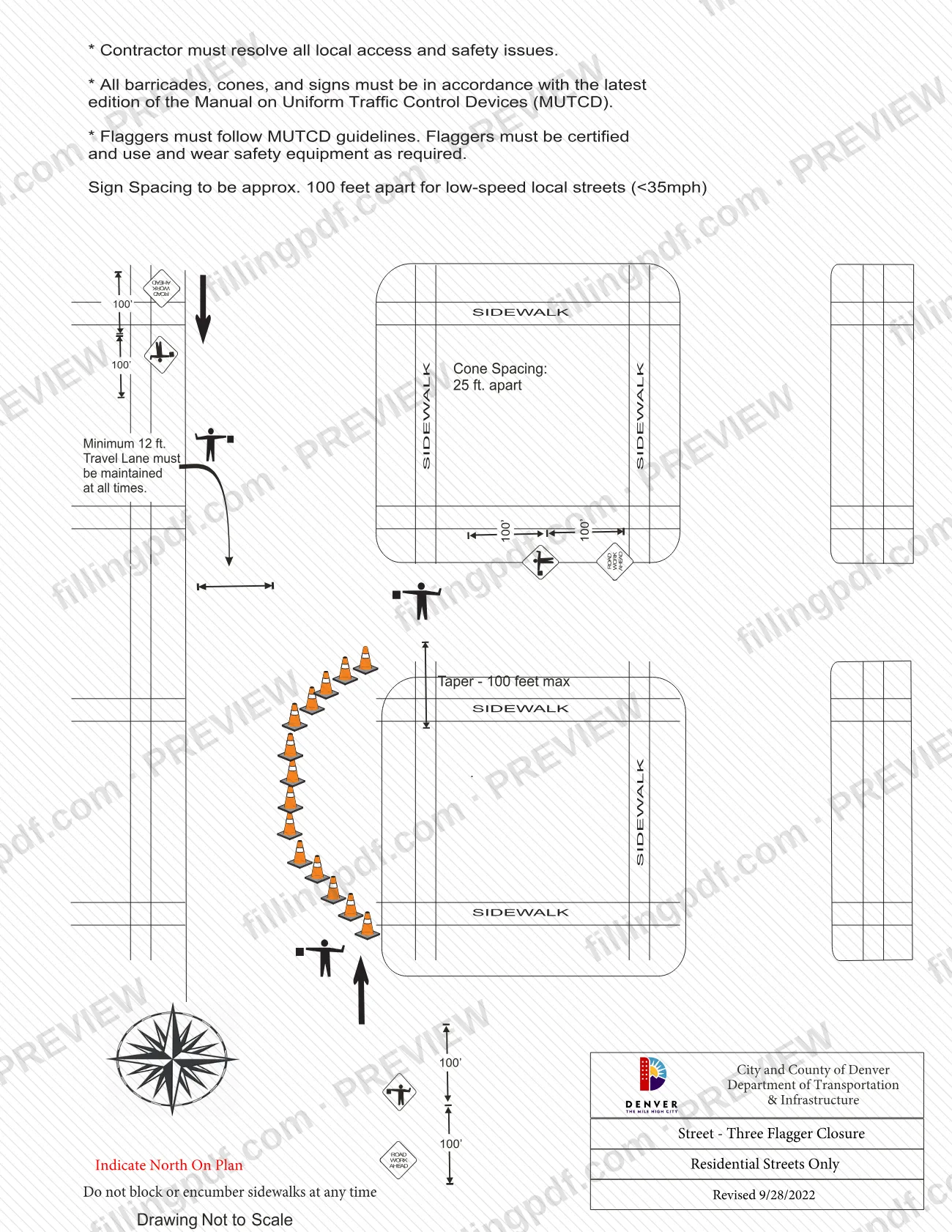
Street - Three Flagger Closure is a traffic control plan drawing published by the City and County of Denver Department of Transportation & Infrastructure (DOTI). It shows how signs, cones and tapers are laid out for a flagger-controlled work zone on a residential street, and it is one of the Denver right-of-way resources that applicants use alongside the city's street occupancy process, where people often start from searches such as denver 311. On this page you can fill out the plan online on FillingPDF and download or print the completed PDF; the original drawing and the permit process are published by the City of Denver.
Last updated
What is Street - Three Flagger Closure – Denver, CO?
Street - Three Flagger Closure is a City and County of Denver Department of Transportation & Infrastructure (DOTI) traffic control plan drawing that shows the sign, cone and taper layout for a flagger-controlled work zone on a residential street.
The drawing is marked "Residential Streets Only" and "Drawing Not to Scale." It shows ROAD WORK AHEAD signs on the approaches to the work area, with placeholders reading "Enter Street Name Here" for the street being worked on and a prompt to "Indicate North On Plan." Its printed dimensions include signs about 100 feet apart on low-speed local streets (under 35 mph), cones 25 feet apart, a taper of 100 feet maximum, and a minimum 12-foot travel lane that must be maintained at all times.
The notes on the sheet set the contractor's responsibilities: resolve all local access and safety issues, place barricades, cones and signs in accordance with the latest edition of the Manual on Uniform Traffic Control Devices (MUTCD), and use certified flaggers who follow MUTCD guidelines and wear the required safety equipment. Sidewalks must not be blocked or encumbered at any time.
DOTI lists this sheet among its City Approved traffic control plans on its Street Occupancy page. The plan is a supporting drawing, not a permit: the permit itself is requested through the city's E-Permits system.
Who needs to file Street - Three Flagger Closure – Denver, CO?
Contractors and other applicants who are requesting a street occupancy permit from DOTI for work on a residential street, and who plan to control traffic with flaggers as shown on this drawing, use this plan. The City of Denver describes street occupancy as the short-term use of the city's right-of-way (ROW).
Conditions printed on the plan:
- It is for residential streets only.
- The sign spacing shown applies to low-speed local streets (under 35 mph).
- The contractor is responsible for resolving local access and safety issues.
- Flaggers must be certified and must follow MUTCD guidelines.
Do not use this drawing for street or alley closures related to special events (not construction); DOTI refers those to the Special Events Planning Guide, Section C: Events on Denver Streets. A Street Cut or Construction Permit does not replace the street occupancy permit: DOTI states that a Street Occupancy Permit is always required in addition to it.
When to file Street - Three Flagger Closure – Denver, CO
Submit the plan when you apply for the street occupancy permit it supports. DOTI states that all submittals through E-Permits must include the DOTI Street Occupancy Request Worksheet and traffic plans, so this drawing goes in with the application, not afterward. The drawing itself prints no separate due date. Because the permit covers short-term use of the right-of-way, complete the plan before you request the permit and check the Special Event Calendar that DOTI links on its Street Occupancy page to see whether your request may conflict with an event.
Documents you need
- DOTI Street Occupancy Request Worksheet: DOTI says all E-Permits submittals must upload it; the worksheet is used to calculate permit costs.
- Traffic plans: DOTI says all E-Permits submittals must upload traffic plans, which is where this completed Street - Three Flagger Closure drawing goes.
How to fill out Street - Three Flagger Closure – Denver, CO
Read the notes on the plan
Review the notes at the top: the contractor must resolve local access and safety issues, follow the latest MUTCD for barricades, cones and signs, and use certified flaggers with required safety equipment.
Enter the street name
Replace each "Enter Street Name Here" placeholder with the name of the residential street where the work will take place.
Indicate north on the plan
Mark the direction of north on the drawing where it says "Indicate North On Plan."
Check sign, cone and taper spacing
Compare your site with the printed dimensions: signs about 100 feet apart on low-speed local streets (under 35 mph), cones 25 feet apart, taper 100 feet maximum. The drawing is not to scale.
Confirm travel lane and sidewalks
Make sure the work zone keeps a minimum 12-foot travel lane open at all times and does not block or encumber sidewalks.
Review and download the completed PDF
Check the street names and north indication, then download or print the completed PDF from FillingPDF and upload it with your E-Permits application as described under How to submit.
How to submit Street - Three Flagger Closure – Denver, CO
DOTI requires right-of-way street cut, street occupancy and ROW construction permits to be submitted online through E-Permits; the drawing is not sent separately.
- E-Permits (online): apply for the street occupancy permit through the city's E-Permits system, listed on the DOTI Street Occupancy page. Street occupancy permits can be applied for and paid online there.
- Upload with the application: DOTI states that all submittals must include the DOTI Street Occupancy Request Worksheet and traffic plans, so upload the completed traffic control plan together with the worksheet. DOTI says the worksheet is used to calculate permit costs; ask DOTI for the current amounts.
Meter bagging is a separate request managed through the Online Meter Bagging Permit System. FillingPDF lets you fill out and download the PDF; submission follows the channels above.
Common mistakes to avoid
- Using this drawing for a street that is not residential; the plan is printed "Residential Streets Only."
- Leaving the "Enter Street Name Here" placeholders unchanged instead of writing in the name of the street being worked on.
- Forgetting to indicate north on the plan, as the drawing prompts.
- Blocking or encumbering a sidewalk; the plan says sidewalks must not be blocked at any time.
- Reducing the travel lane below the minimum 12 feet that must be maintained at all times.
- Using flaggers who are not certified or who lack the required safety equipment and MUTCD guidelines.
- Placing barricades, cones or signs that do not follow the latest edition of the MUTCD.
- Applying for only a Street Cut or Construction Permit; DOTI says a Street Occupancy Permit is always required in addition.
- Submitting the plan without the DOTI Street Occupancy Request Worksheet through E-Permits.
Frequently asked questions
What is the Street - Three Flagger Closure plan?
It is a City and County of Denver DOTI traffic control plan drawing for residential streets. It shows the placement of signs, cones and a taper for a flagger-controlled work zone and lists the contractor's safety and MUTCD requirements.
Is the three flagger closure plan a permit?
No. It is a supporting traffic plan drawing. The street occupancy permit is requested online through DOTI's E-Permits system, and DOTI says all submittals must upload the Street Occupancy Request Worksheet and traffic plans.
Can I use this plan on any street in Denver?
No. The drawing is printed "Residential Streets Only," and its sign spacing of about 100 feet applies to low-speed local streets under 35 mph. Special event closures use a different guide, Section C of the Special Events Planning Guide.
What spacing does the plan require for signs and cones?
The drawing shows signs about 100 feet apart for low-speed local streets (under 35 mph) and cones 25 feet apart. It shows a taper of 100 feet maximum and requires a minimum 12-foot travel lane at all times.
Do I still need a street occupancy permit if I have a street cut permit?
Yes. DOTI states that a Street Occupancy Permit is always required in addition to the Street Cut or Construction Permit. Both are submitted online through E-Permits.
Do flaggers need to be certified?
Yes. The notes on the plan say flaggers must be certified, follow MUTCD guidelines and use and wear safety equipment as required. The contractor must also resolve all local access and safety issues.
Can I fill out the Street - Three Flagger Closure plan online?
You can fill out the PDF online on FillingPDF and download or print it. FillingPDF is an independent service, is not affiliated with the City of Denver and does not submit the plan; you upload it through E-Permits.
Ready to fill out Street - Three Flagger Closure – Denver, CO?
Fill out Street - Three Flagger Closure – Denver, CO now