
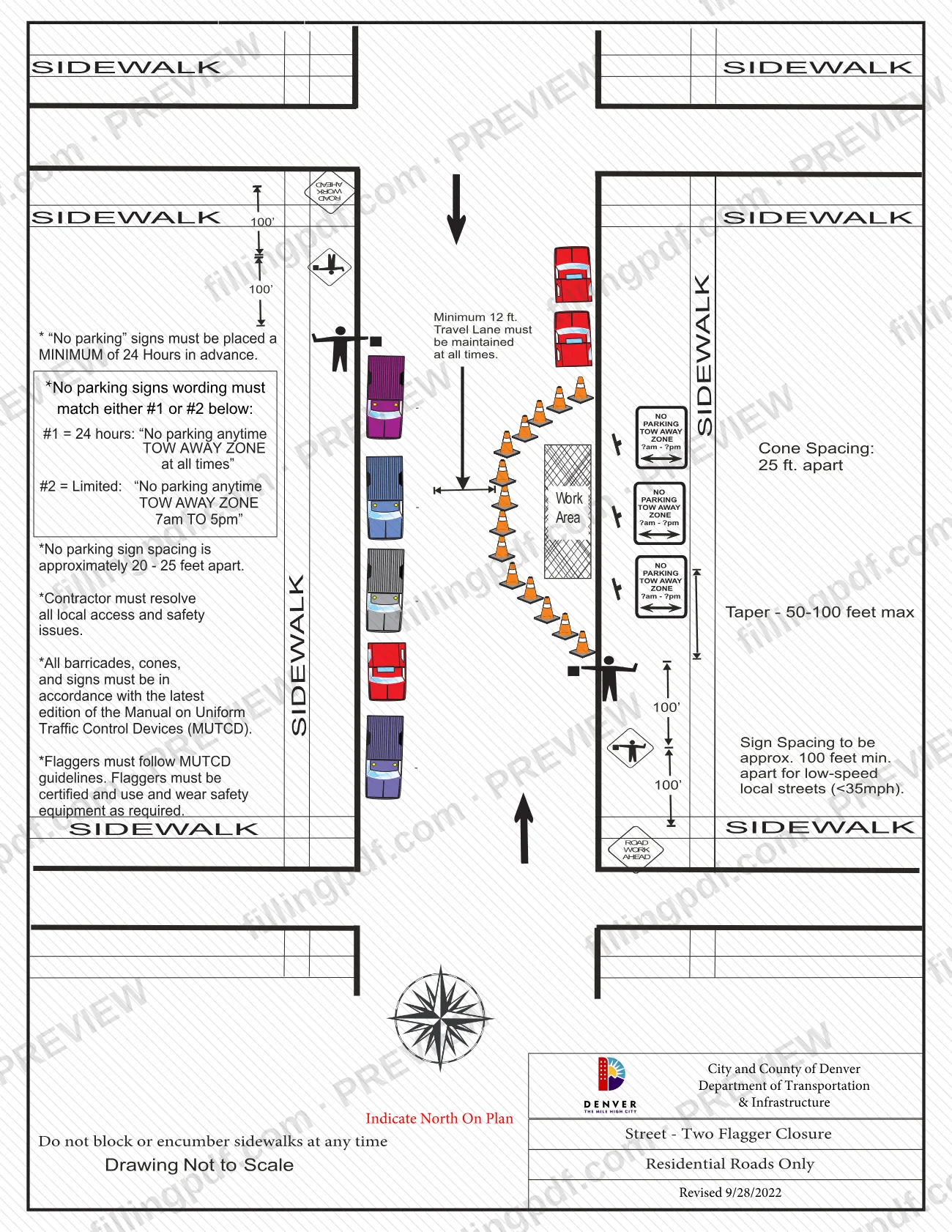
Street - Two Flagger Closure is a traffic control plan drawing published by the City and County of Denver Department of Transportation & Infrastructure (DOTI). It shows how signs, cones, a taper, no-parking signs and two flaggers are laid out for a street closure on a residential road. It is one of the Denver 311 era city resources people look for when planning right-of-way work, but the form itself is a DOTI drawing, not a service request. On this page you can fill out the form online on FillingPDF and download or print the completed PDF; DOTI publishes the original PDF at denvergov.org.
Last updated
What is Street - Two Flagger Closure – Denver, CO?
Street - Two Flagger Closure is a City and County of Denver Department of Transportation & Infrastructure (DOTI) traffic control plan drawing for a two-flagger street closure on a residential road, showing where work-area signs, cones, a taper, no-parking signs and flaggers are placed.
The sheet is a diagram, not a questionnaire. It carries three spaces to enter the street name, a note to indicate north on the plan, and "No parking" sign wording with blank hours (?am - ?pm). Printed notes set the working rules: a minimum 12 ft. travel lane must be maintained at all times, cones are spaced 25 ft. apart, the taper is 50-100 feet maximum, signs are spaced approximately 100 feet minimum apart, and flaggers are 100' apart for low-speed local streets (<35mph).
The sheet also states that all barricades, cones and signs must follow the latest edition of the Manual on Uniform Traffic Control Devices (MUTCD), that flaggers must follow MUTCD guidelines, be certified and use and wear required safety equipment, and that the contractor must resolve all local access and safety issues. It is marked "Drawing Not to Scale" and "Residential Roads Only", and it is not a permit: DOTI's Street Occupancy page says street occupancy permits are applied for through E-Permits, with traffic plans uploaded alongside the request.
Who needs to file Street - Two Flagger Closure – Denver, CO?
The drawing is meant for applicants and contractors who will close part of a residential road in Denver with two flaggers and need a traffic control plan to go with their right-of-way request. The printed notes address the contractor directly: the contractor resolves local access and safety issues, and the flaggers it uses must be certified.
Exclusions and limits printed on the sheet:
- It says "Residential Roads Only", so it is not the plan for other kinds of streets.
- The flagger spacing it shows is for low-speed local streets (<35mph).
- Sidewalks must never be blocked or encumbered.
Street or alley closures for special events (not construction) are handled differently: DOTI's Street Occupancy page refers those requests to the Special Events Planning Guide, Section C: Events on Denver Streets. Parking meter bagging is also a separate application, through the Online Meter Bagging Permit System.
When to file Street - Two Flagger Closure – Denver, CO
Complete the plan when you prepare a street occupancy request for work that uses a two-flagger closure on a residential road, because DOTI asks that traffic plans be uploaded with every E-Permits submittal. The drawing has no due date of its own.
One timing rule is printed on it: "No parking" signs must be placed a minimum of 24 hours in advance of the closure. The wording must match either option #1 (24 hours: "No parking anytime TOW AWAY ZONE at all times") or option #2 (limited: "No parking anytime TOW AWAY ZONE 7am TO 5pm"). DOTI's page adds that a Street Occupancy Permit is always required in addition to a Street Cut or Construction Permit.
Documents you need
- DOTI Street Occupancy Request Worksheet: DOTI says to upload it with every request submitted through E-Permits; it is also used to calculate permit costs.
- Traffic plans: DOTI says every E-Permits submittal must upload them, and this completed Street - Two Flagger Closure drawing is a traffic plan for a two-flagger closure on a residential road.
How to fill out Street - Two Flagger Closure – Denver, CO
Confirm the plan fits your closure
The sheet is for a two-flagger closure on a residential road only. Check that your street and work match before you start.
Enter the street name
Replace each "Enter Street Name" space on the drawing with the name of the street where the closure will take place.
Indicate north on the plan
Use the "Indicate North On Plan" note to show the north direction so the drawing matches your site. The drawing is not to scale.
Choose the no-parking wording
Pick option #1 (24 hours: "No parking anytime TOW AWAY ZONE at all times") or option #2 (limited: "No parking anytime TOW AWAY ZONE 7am TO 5pm"). The wording must match one of the two.
Fill in the sign hours
Replace the "?am - ?pm" placeholders on the no-parking signs with the hours that match the option you chose. Signs are about 20 - 25 feet apart and placed at least 24 hours ahead.
Check cone, taper and flagger spacing
Confirm cones 25 ft. apart, a taper of 50-100 feet maximum, signs approximately 100 feet minimum apart and flaggers 100' apart on low-speed local streets (<35mph).
Keep the travel lane and sidewalks clear
Make sure a minimum 12 ft. travel lane is maintained at all times and that no sidewalk is blocked or encumbered at any time.
Review, then download the completed PDF
Check the street names, north arrow, sign wording and hours. Download or print the completed PDF from FillingPDF and attach it, with the Street Occupancy Request Worksheet, to your E-Permits submittal described under How to submit.
How to submit Street - Two Flagger Closure – Denver, CO
The completed plan is submitted online through E-Permits, DOTI's system for right-of-way street cut, street occupancy and ROW construction permits.
- E-Permits: DOTI states that all right-of-way street cut, street occupancy and ROW construction permits must be submitted online through E-Permits. Every submittal must upload the DOTI Street Occupancy Request Worksheet and the traffic plans. Street Occupancy permits can be applied for and paid online there; the fee is not stated on this form, so use the worksheet and the DOTI page to find costs.
- DOTI page: the Street Occupancy page is at https://denvergov.org/Government/Agencies-Departments-Offices/Agencies-Departments-Offices-Directory/Department-of-Transportation-and-Infrastructure/Programs-Services/Right-of-Way-Services/Street-Occupancy. It also lists the Construction Inspection Area Map for contacting the assigned right-of-way inspector.
The drawing itself prints no mailing address or other channel. FillingPDF lets you fill out and download the PDF; submission follows the DOTI channels above.
Common mistakes to avoid
- Using this plan for a road that is not residential; the sheet is marked "Residential Roads Only".
- Writing no-parking sign wording that matches neither option #1 (24 hours) nor option #2 (limited, 7am TO 5pm).
- Placing "No parking" signs less than 24 hours in advance of the closure.
- Leaving the "Enter Street Name" spaces blank or forgetting to indicate north on the plan.
- Planning a closure that leaves less than the minimum 12 ft. travel lane, which must be maintained at all times.
- Blocking or encumbering a sidewalk; the sheet says not to do so at any time.
- Using flaggers who are not certified or who lack required safety equipment, or devices that do not follow the latest MUTCD.
- Submitting the plan without the DOTI Street Occupancy Request Worksheet when applying through E-Permits.
Frequently asked questions
What is the Street - Two Flagger Closure form?
It is a City and County of Denver DOTI traffic control plan drawing for a two-flagger street closure on a residential road. It shows sign, cone, taper, no-parking and flagger placement, and it is not itself a permit.
Can I use this plan on any street in Denver?
No. The drawing is marked "Residential Roads Only", and the flagger spacing shown is for low-speed local streets (<35mph). Other kinds of streets are not covered by this sheet.
What wording must the no-parking signs use?
Either option #1 for 24 hours: "No parking anytime TOW AWAY ZONE at all times", or option #2 for limited hours: "No parking anytime TOW AWAY ZONE 7am TO 5pm". The signs must be placed a minimum of 24 hours in advance.
How wide must the travel lane be during a two-flagger closure?
The sheet requires a minimum 12 ft. travel lane that must be maintained at all times. It also says sidewalks must not be blocked or encumbered at any time.
Do flaggers on this plan need to be certified?
Yes. The sheet says flaggers must follow MUTCD guidelines, must be certified, and must use and wear safety equipment as required. Barricades, cones and signs must follow the latest edition of the MUTCD.
Where do I submit the Two Flagger Closure plan?
Upload it through DOTI's E-Permits system with your street occupancy request. DOTI says every submittal must include the DOTI Street Occupancy Request Worksheet and traffic plans; the drawing itself lists no mailing address.
Is a street occupancy permit still needed with this plan?
The drawing is a plan, not a permit. DOTI says street occupancy permits are applied for through E-Permits, and a Street Occupancy Permit is always required in addition to a Street Cut or Construction Permit.
Can I fill out Street - Two Flagger Closure online on FillingPDF?
Yes. You can fill out the PDF online on FillingPDF and download or print it. FillingPDF is independent of the City and County of Denver and does not submit the plan; you submit it through DOTI's E-Permits.
Ready to fill out Street - Two Flagger Closure – Denver, CO?
Fill out Street - Two Flagger Closure – Denver, CO now