
The Voluntary Disclosure Agreement for Sales Tax Not Collected, Use Tax and Occupational Privilege Tax is the agreement the City and County of Denver Treasury Division uses when a business comes forward on its own to pay Denver sales, use and occupational privilege tax (OPT) it never reported. It is meant for businesses that owe Denver tax but are not licensed and have not filed returns. On this page you can fill out the form online on FillingPDF and download or print the completed PDF; the form and the Voluntary Disclosure Program rules are published by the Denver Treasury Division at denvergov.org.
Last updated
What is Voluntary Disclosure Agreement for Sales Tax Not Collected, Use Tax and Occupational Privilege Tax – Denver, CO?
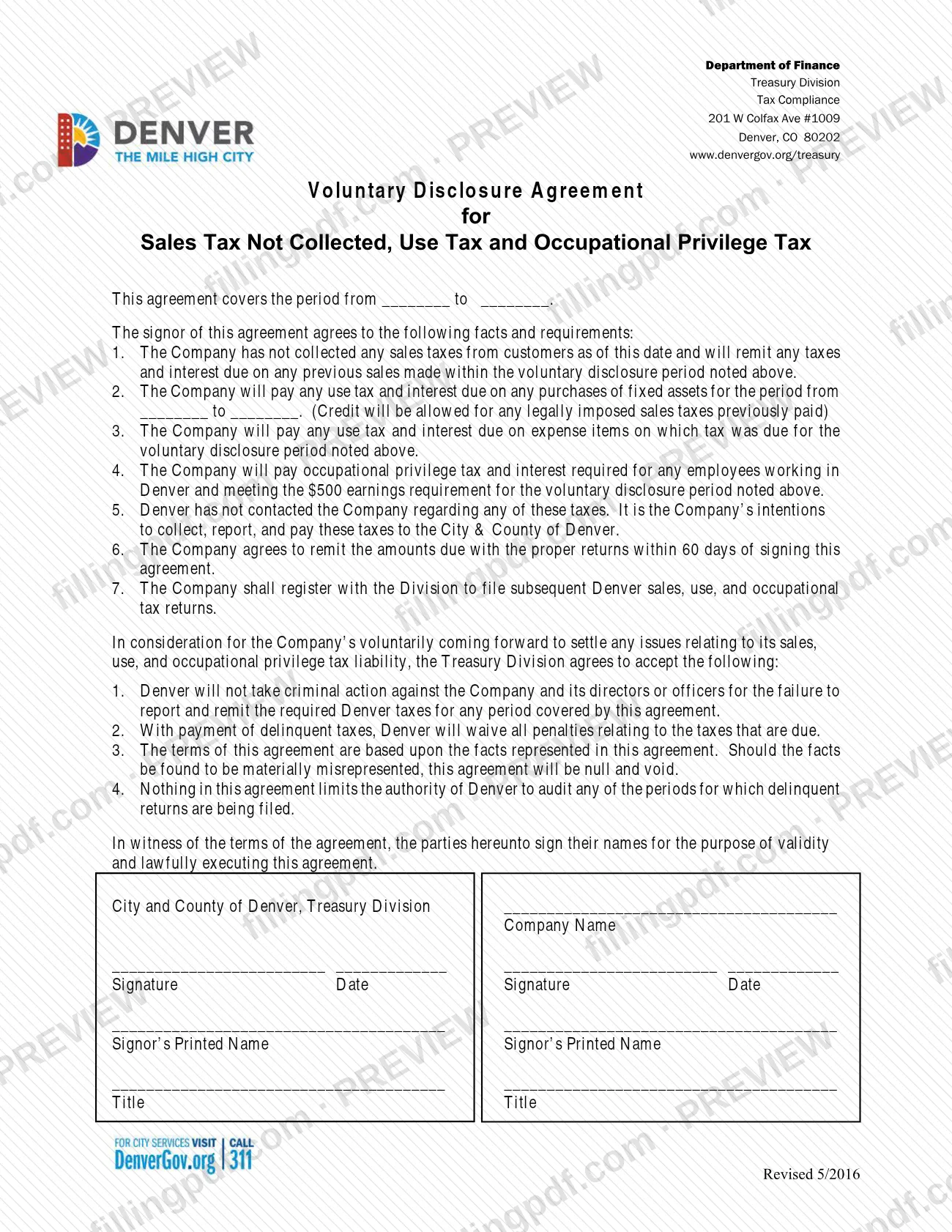
The Voluntary Disclosure Agreement for Sales Tax Not Collected, Use Tax and Occupational Privilege Tax is a City and County of Denver Treasury Division agreement under which a business discloses unpaid Denver taxes and agrees to pay them in exchange for penalty relief.
The company states a disclosure period and agrees to seven points: it has not collected sales tax from customers; it will pay the tax and interest due on prior sales, use tax and interest on fixed-asset purchases and on expense items, and OPT and interest for employees working in Denver who meet the $500 earnings requirement; Denver has not contacted it about these taxes; it will remit the amounts with the proper returns within 60 days of signing; and it will register with the Division to file later Denver sales, use and occupational tax returns.
In return, the Treasury Division agrees that Denver will take no criminal action against the company and its directors or officers for the periods covered, and that it will waive all penalties once the delinquent taxes are paid. The form also says the agreement becomes null and void if the facts are found to be materially misrepresented, and that it does not limit Denver's authority to audit the periods covered.
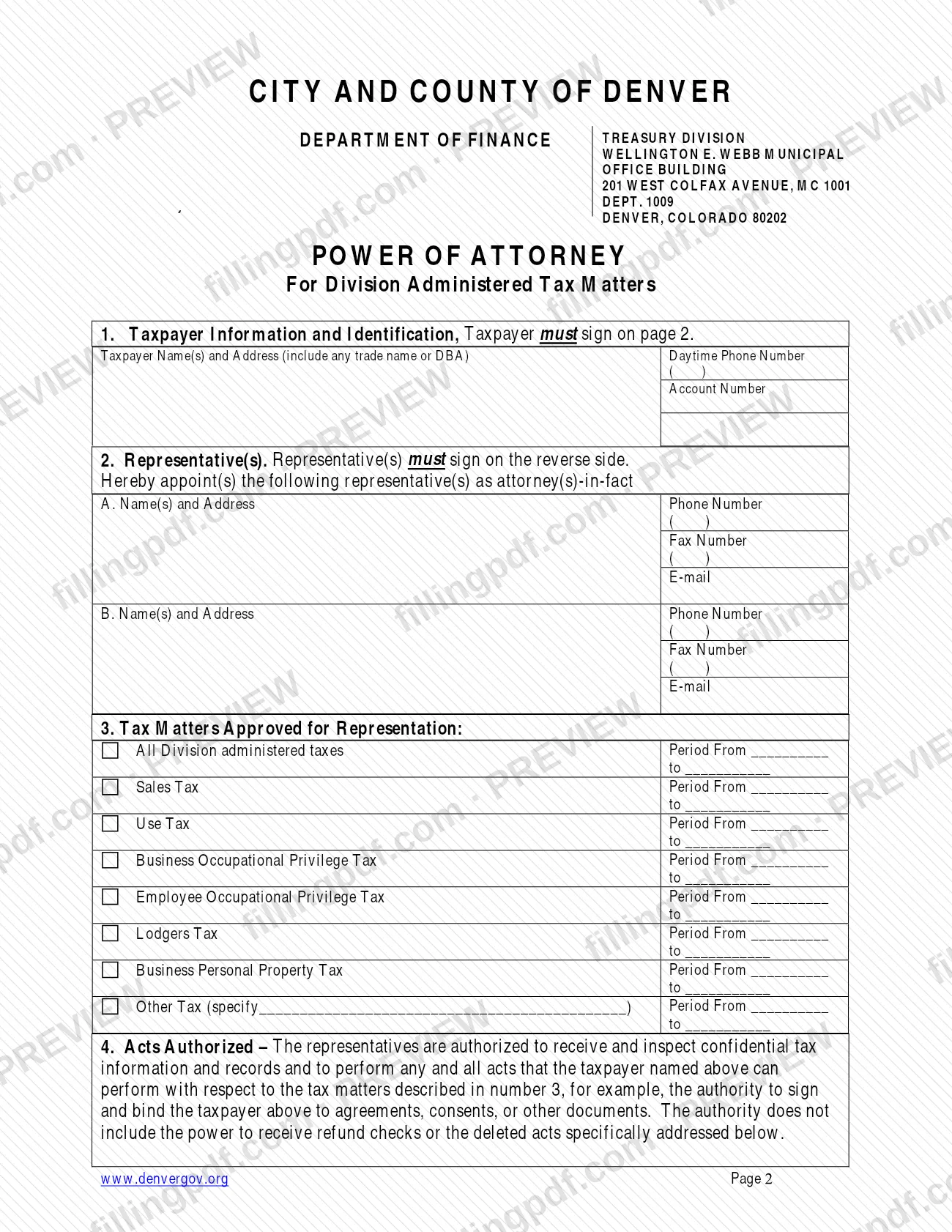
Denver publishes separate agreements for other combinations, such as sales tax that was collected but not remitted, use tax only, or OPT only. The PDF also carries a Power of Attorney for Division Administered Tax Matters, used when a representative acts for the taxpayer. This is a sales, use and OPT agreement, not a property tax document.
Who needs to file Voluntary Disclosure Agreement for Sales Tax Not Collected, Use Tax and Occupational Privilege Tax – Denver, CO?
Business owners who owe Denver sales, use and/or occupational privilege tax, are not licensed with Denver and have not filed returns for those taxes use this agreement, as the Denver Voluntary Disclosure Program describes it. The agreement fits a business that did not collect sales tax from customers and also owes consumer's use tax and OPT.
Your business is not eligible for the program if any of these is true:
- the company is under audit by the City and County of Denver;
- Denver has already contacted the company about any tax delinquency;
- the company is currently licensed and registered for excise tax with Denver.
Item 5 of the agreement has the company state that Denver has not contacted it about these taxes.
Use a different Denver agreement if you collected sales tax from customers and did not remit it, or if you disclose a single tax type such as OPT only. For Telecommunications Business Tax, Lodger's, Facilities Development Admission taxes, E911 charges or another unusual combination, Denver directs you to [email protected].
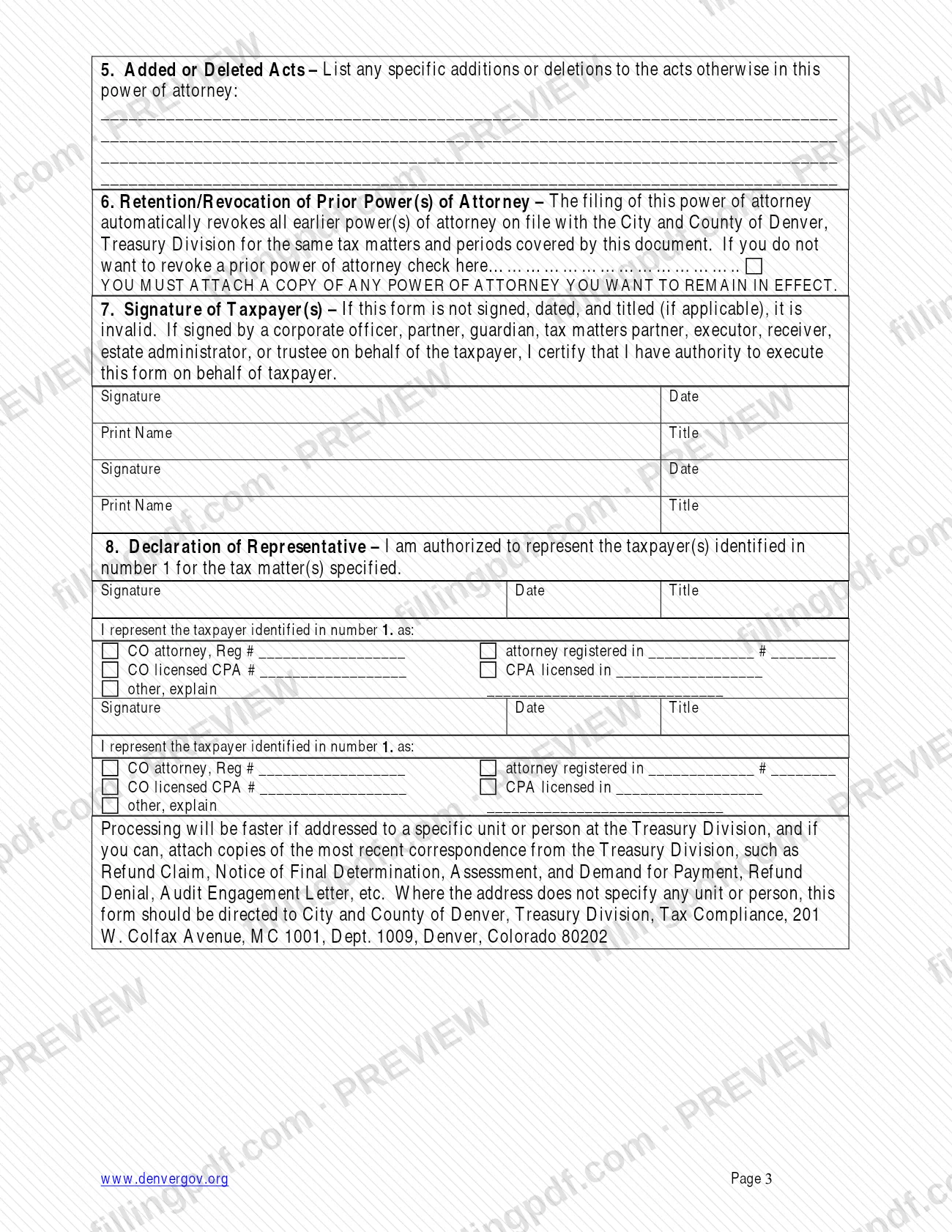
A third-party representative who will make submissions for you needs the Power of Attorney on the second page of the agreement. Corporate officers, partners, guardians, executors, trustees and similar signers certify on that page that they have authority to sign for the taxpayer.
When to file Voluntary Disclosure Agreement for Sales Tax Not Collected, Use Tax and Occupational Privilege Tax – Denver, CO
Submit the agreement once you have confirmed that your business is eligible, which means before Denver has audited or contacted the company about these taxes. The form sets no calendar deadline for submitting it.
The disclosure period is the one you enter on the form. Denver's general look-back periods are three years for sales or retailer's use tax not collected, three years for consumer's use tax on expenses, seven years for consumer's use tax on taxable capital assets, and three years for occupational privilege tax. If tax was collected from customers or employees, it is treated as held in trust, and the look-back can reach back to the date the company began doing business in Denver.
After you sign, the form requires the company to remit the amounts due with the proper returns within 60 days of signing. Denver's program page adds that you may send payment with your completed disclosure packet. The company must also register with the Treasury Division so it can file later returns.
Documents you need
- Power of Attorney for Division Administered Tax Matters, printed on the second and third pages of the agreement PDF: needed only if a third-party representative will make submissions on your behalf.
- Completed disclosure packet with supporting documentation: Denver's program page asks you to submit it, and offers spreadsheet templates to calculate the taxes owed.
- A copy of any earlier power of attorney you want to stay in effect: attach it only if you check the box in item 6, since filing the new power of attorney otherwise revokes earlier ones for the same tax matters and periods.
- Copies of recent Treasury Division correspondence, such as a refund claim or assessment notice: attach them to the power of attorney if you can, because the form says processing is faster with them.
How to fill out Voluntary Disclosure Agreement for Sales Tax Not Collected, Use Tax and Occupational Privilege Tax – Denver, CO
Check eligibility before you start
Confirm the company is not under audit, has not been contacted by Denver about these taxes and is not currently licensed and registered for excise tax. Item 5 of the agreement states that Denver has not contacted the company.
Enter the disclosure period
On the line "This agreement covers the period from ____ to ____", enter the start and end dates of the period you are disclosing. Use Denver's look-back periods as a guide for each tax type.
Enter the fixed-asset period
In item 2, enter the from and to dates for the use tax due on purchases of fixed assets. Credit is allowed for legally imposed sales taxes previously paid.
Review the company's seven agreements
Read items 1 to 7 and the four Treasury Division terms before signing. They cover sales tax not collected, use tax, OPT for employees meeting the $500 earnings requirement, the 60-day payment term and registration for later returns.
Enter the company name and signors
Write the Company Name beside the City and County of Denver, Treasury Division line. In the signature blocks, add the signature, date, Signor's Printed Name and Title for each signor.
Complete the power of attorney sections
If a representative will act for you, fill in item 1 (taxpayer name, address, daytime phone, account number) and item 2 (representative name, address, phone, fax, e-mail). In item 3, check the tax matters and enter each period; the form lists sales, use, business and employee occupational privilege taxes among the choices.
Set acts and prior powers
In item 5, list any acts you add or delete. In item 6, check the box only if you do not want earlier powers of attorney revoked, and attach a copy of any you want to stay in effect.
Sign the taxpayer and representative blocks
The taxpayer signs, dates and titles item 7. The representative completes item 8, stating whether they are a CO attorney, a CO licensed CPA or other, with registration or license numbers.
Assemble the disclosure package
Gather the supporting documentation and tax calculations for your disclosure packet, and decide how you will remit the amounts due within 60 days of signing. Submission is described under How to submit.
Review and download the completed PDF
Check the dates, names, signatures and titles, then download or print the completed PDF from FillingPDF and send it through the channels described under How to submit.
How to submit Voluntary Disclosure Agreement for Sales Tax Not Collected, Use Tax and Occupational Privilege Tax – Denver, CO
Denver's Voluntary Disclosure Program takes the signed agreement by email, and the Treasury Division then signs it and returns it to you.
- Email: send the signed agreement, and the power of attorney if a representative acts for you, to [email protected]. After you submit a signed agreement, Denver signs it and returns it.
- Registration: register for a Denver tax account through the eBiz Tax Center, then tell the VDA team at [email protected] that you have started, so they can check that the account is set up for the voluntary disclosure.
- Disclosure packet: send your completed disclosure packet and supporting documentation. Denver offers spreadsheet templates for calculating the taxes owed; ask [email protected] if you need one for your situation.
- Payment: remit all outstanding taxes within 60 days of signing. After reviewing your packet, Denver confirms the taxes due net of payments already made.
The form lists the Treasury Division's Tax Compliance address as Department of Finance, Treasury Division, Tax Compliance, 201 W Colfax Ave #1009, Denver, CO 80202. The power of attorney page says that, where no unit or person is named, it should go to City and County of Denver, Treasury Division, Tax Compliance, 201 W. Colfax Avenue, MC 1001, Dept. 1009, Denver, Colorado 80202. FillingPDF lets you fill out and download the PDF; submission follows the channels above.
Common mistakes to avoid
- Submitting the agreement when the company is under audit, has already been contacted by Denver about a tax delinquency, or is currently licensed and registered for excise tax; those conditions make a business ineligible.
- Leaving the disclosure period blank, or the separate fixed-asset period in item 2, so the agreement does not say which dates it covers.
- Using this agreement to disclose sales tax that was collected from customers and not remitted; Denver lists a separate agreement for that case.
- Missing the 60-day deadline to remit the amounts due with the proper returns after signing the agreement.
- Not registering with the Treasury Division for later sales, use and occupational tax returns, which item 7 requires.
- Sending the power of attorney unsigned, undated or without a title; the form says it is invalid if not signed, dated and titled.
- Filing a new power of attorney without checking item 6 when an earlier one should stay in force; the new filing automatically revokes earlier ones for the same matters and periods.
- Misstating the facts in the agreement; the form says it is null and void if they are found to be materially misrepresented.
Frequently asked questions
What is the Denver Voluntary Disclosure Agreement for sales tax not collected?
It is a Treasury Division agreement in which a business discloses Denver sales tax it never collected, plus use tax and occupational privilege tax, and agrees to pay the tax and interest. In return Denver agrees to waive penalties and take no criminal action for the periods covered.
Who is eligible for Denver's Voluntary Disclosure Program?
Business owners who owe Denver tax, are not licensed and have not filed sales, use or occupational privilege tax returns. A company is not eligible if it is under audit, has already been contacted by Denver about a tax delinquency, or is currently licensed and registered for excise tax.
Is this a Denver property tax form?
No. This agreement covers sales tax not collected, use tax and occupational privilege tax. Denver's business tax FAQ says property tax is a separate tax payable to the County Treasurer each year on the valuation of the property.
How do I submit the Denver voluntary disclosure agreement?
Email the signed agreement, and the power of attorney if you use a representative, to [email protected]. Denver then signs the agreement and returns it to you. You also register for a tax account through the eBiz Tax Center and tell the VDA team.
How long do I have to pay after signing the agreement?
The form requires the company to remit the amounts due with the proper returns within 60 days of signing. Denver's program page says you may send payment with your completed disclosure packet, after which Denver confirms the taxes due net of payments already made.
Does the agreement waive penalties and interest?
The form says that with payment of delinquent taxes, Denver waives all penalties relating to the taxes due. The company still agrees to pay the taxes and interest due. Denver can still audit the periods covered, and the agreement is void if the facts are materially misrepresented.
How far back must I report under the agreement?
You enter the period on the form. Denver's general look-back is three years for uncollected sales or retailer's use tax, consumer's use tax on expenses and OPT, and seven years for consumer's use tax on taxable capital assets. Tax collected and held in trust can reach back to the start of business in Denver.
Do I need the power of attorney on this form?
Only if a third-party representative will make submissions for you. The power of attorney is included in the PDF; the taxpayer signs item 7 and the representative signs item 8. The form is invalid if the taxpayer's signature is not dated and titled where applicable.
Can I fill out the Denver voluntary disclosure agreement online?
You can fill out the PDF online on FillingPDF and download or print it. FillingPDF is an independent service, not connected to the City and County of Denver, and it does not submit the agreement; you send it to the Treasury Division through its channels.
Ready to fill out Voluntary Disclosure Agreement for Sales Tax Not Collected, Use Tax and Occupational Privilege Tax – Denver, CO?
Fill out Voluntary Disclosure Agreement for Sales Tax Not Collected, Use Tax and Occupational Privilege Tax – Denver, CO now