
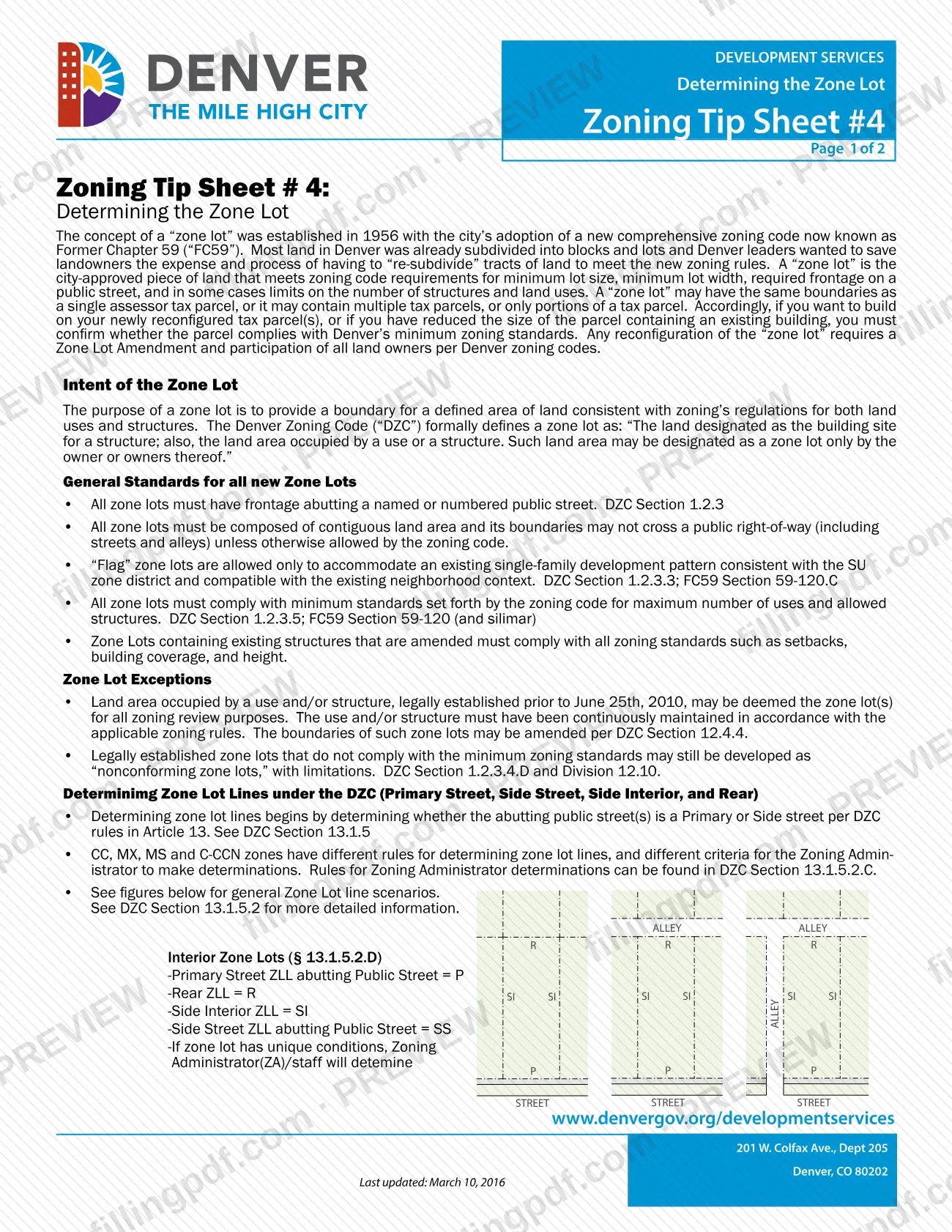
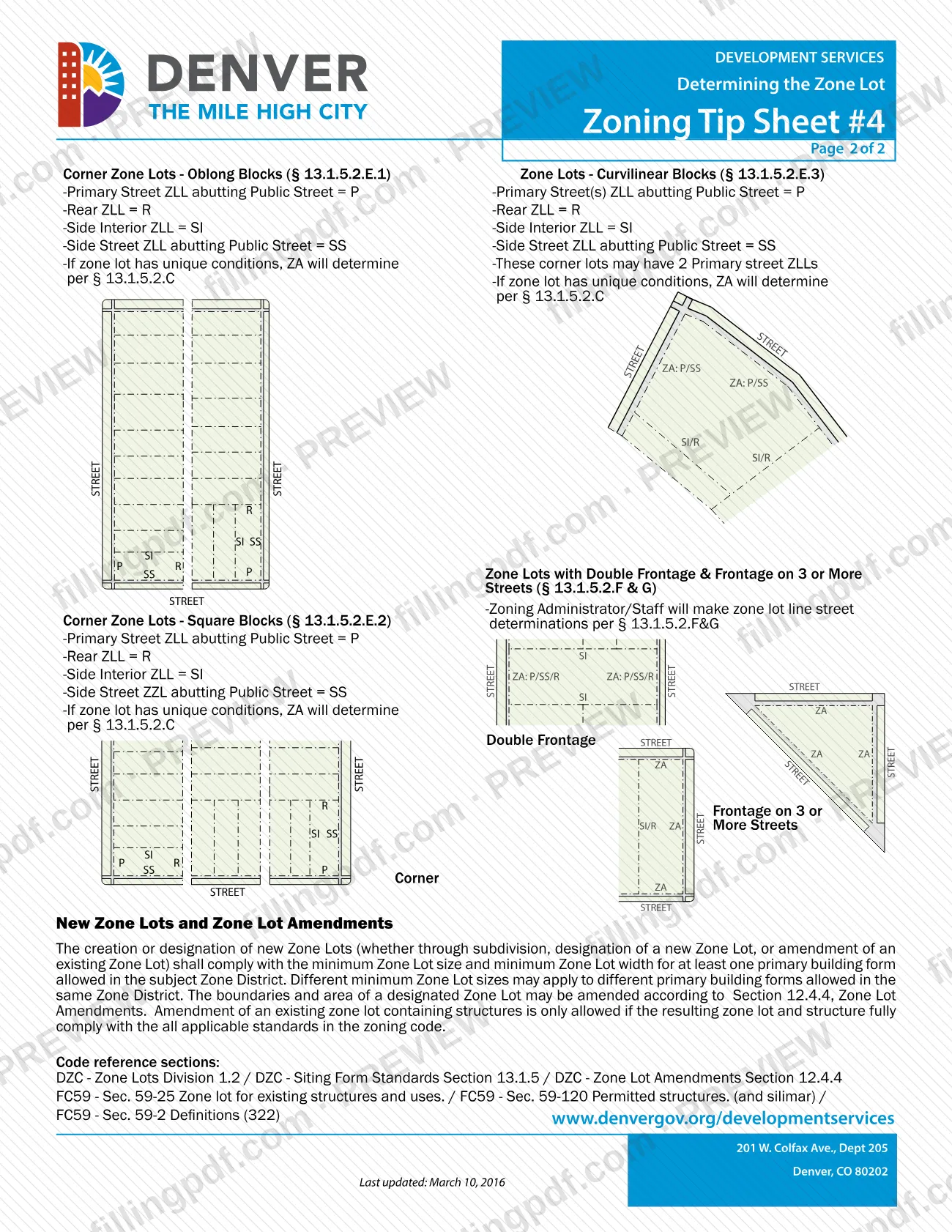
Zoning Tip Sheet #4: Determining the Zone Lot is a two-page guide from Denver Development Services, part of the City and County of Denver Planning and Development, that explains what a zone lot is, which standards apply to new zone lots and how zone lot lines are determined under the Denver Zoning Code (DZC). It is one of the resources to review when preparing a Denver permit application for a project on a reconfigured parcel, because the tip sheet says such a parcel must be checked against Denver's minimum zoning standards. On this page you can view the PDF on FillingPDF and download or print it; the tip sheet itself is published by the City and County of Denver.
Last updated
What is Zoning Tip Sheet #4?
Zoning Tip Sheet #4: Determining the Zone Lot is a Denver Development Services guide that explains the zone lot, the city-approved piece of land that meets zoning code requirements for minimum lot size, minimum lot width and required frontage on a public street, and how its boundaries are determined.
The tip sheet is guidance, not an application. It explains that the zone lot concept dates from 1956, when the city adopted the zoning code now known as Former Chapter 59 (FC59), and that a zone lot may match a single assessor tax parcel, contain several tax parcels or include only part of one. It quotes the Denver Zoning Code (DZC) definition of a zone lot and lists the general standards for new zone lots: frontage on a named or numbered public street, contiguous land, no crossing of a public right-of-way such as a street or alley unless the code allows it, limits on flag zone lots, and compliance with the code's limits on uses and structures.
It also covers two exceptions: land occupied by a use or structure legally established before June 25th, 2010, and nonconforming zone lots. The second page shows diagrams of how Primary Street, Side Street, Side Interior and Rear zone lot lines are labeled for interior, corner, curvilinear, double-frontage and three-street lots.
The document that actually changes a zone lot is a Zone Lot Amendment, which the tip sheet says is required for any reconfiguration of the zone lot (DZC Section 12.4.4). This tip sheet is not that application.
Who needs to file Zoning Tip Sheet #4?
The main readers are landowners and applicants in Denver whose parcel has changed. The tip sheet says that if you want to build on newly reconfigured tax parcels, or you have reduced the size of the parcel containing an existing building, you must confirm that the parcel complies with Denver's minimum zoning standards.
Others who may find it useful:
- Owners considering a change to a zone lot. The tip sheet says any reconfiguration requires a Zone Lot Amendment and the participation of all land owners, and that a zone lot may be designated only by its owner or owners.
- Owners of zone lots that contain existing structures. An amended zone lot must still comply with standards such as setbacks, building coverage and height.
- Owners of property in the CC, MX, MS or C-CCN zones, which have different rules and different criteria for the Zoning Administrator's determinations (DZC Section 13.1.5.2.C).
- Applicants for single-family or duplex construction permits. The city's guide for those projects lists tip sheets on zoning standards among its downloads and says projects subject to a Zone Lot Amendment must finish that process, or get the reviewer's approval, before applying for construction permits.
The tip sheet is general guidance. For unique conditions it says Zoning Administrator staff make the determination.
When to file Zoning Tip Sheet #4
Nothing is filed with this tip sheet: it has no due date and is read when your parcel or zone lot is being reconfigured. The triggering event is a plan to build on a newly reconfigured tax parcel, or a reduction in the size of a parcel that contains an existing building. At that point the tip sheet says you must confirm the parcel meets Denver's minimum zoning standards.
If the project is subject to a Zone Lot Amendment, the city's guide for single-family and duplex projects says the amendment process must be completed, or approval obtained from your Zone Lot Amendment reviewer, before you submit an application for construction permits. The tip sheet shows March 10, 2016 as its last update, so check the DZC sections it cites for current rules.
How to fill out Zoning Tip Sheet #4
Compare your parcel with the zone lot
Read the opening definition and check whether your zone lot matches one tax parcel, spans several, or covers only part of one. If you reconfigured or reduced a parcel, confirm it meets Denver's minimum zoning standards.
Check the general standards
Review the five standards for new zone lots: street frontage, contiguous land, no crossing of a public right-of-way, flag lot limits, and limits on uses and structures. Note the DZC and FC59 sections cited.
Look for an applicable exception
Check whether a use or structure was legally established before June 25th, 2010 and continuously maintained, or whether the lot is a nonconforming zone lot with limitations.
Identify primary and side streets
Determine whether each abutting public street is a Primary or Side street under DZC Article 13 (Section 13.1.5). If your lot is in a CC, MX, MS or C-CCN zone, see DZC Section 13.1.5.2.C.
Match your lot to a figure
Find the scenario on page 2 that fits: interior, corner (oblong, square or curvilinear blocks), double frontage or frontage on 3 or more streets. Label lines P, SS, SI and R as shown; ZA marks lines the Zoning Administrator decides.
Check amendment requirements
If you plan to change the zone lot, review the New Zone Lots and Zone Lot Amendments section: minimum size and width for at least one primary building form, and Section 12.4.4.
Download or print the tip sheet
Download or print the PDF from FillingPDF and keep it with your project notes. Confirm details against the cited code sections and, for permits, the city's guidance.
How to submit Zoning Tip Sheet #4
Zoning Tip Sheet #4 is not submitted anywhere; it is a reference you read and keep. The tip sheet prints the office details of Denver Development Services: www.denvergov.org/developmentservices and 201 W. Colfax Ave., Dept 205, Denver, CO 80202.
If your project needs permits, the city's guide for single-family and duplex projects describes the channel:
- Online (e-permits): first-time users create an online account, then choose "Apply for a Permit" under "Development Services." For zoning, building and sewer use and drainage permits, select the "building log" permit type.
- Zone Lot Amendment: where required, complete the Zone Lot Amendment application process, or obtain approval from your reviewer, before applying for construction permits.
The city's guide gives [email protected] and 720-865-3002 for assigning an address, which must be done before construction permits are submitted. FillingPDF lets you view and download the PDF; any permit application follows the City and County of Denver's channels above.
Common mistakes to avoid
- Assuming a zone lot is always the same as one assessor tax parcel; the tip sheet says it may contain several parcels or only portions of one.
- Building on a newly reconfigured tax parcel, or a reduced parcel with an existing building, without confirming it meets Denver's minimum zoning standards.
- Reconfiguring a zone lot without a Zone Lot Amendment and without the participation of all land owners.
- Drawing a zone lot whose boundaries cross a public right-of-way, including streets and alleys, when the zoning code does not allow it.
- Proposing a flag zone lot outside the case the tip sheet allows: an existing single-family pattern consistent with the SU zone district.
- Applying the general lot-line rules to the CC, MX, MS or C-CCN zones, which have different rules and Zoning Administrator criteria.
- Amending a zone lot that contains structures so that setbacks, building coverage or height no longer comply with zoning standards.
- Submitting construction permit applications before finishing a required Zone Lot Amendment process or getting the reviewer's approval.
Frequently asked questions
What is a zone lot in Denver?
A zone lot is the city-approved piece of land that meets zoning code requirements for minimum lot size, minimum lot width, required frontage on a public street and, in some cases, limits on structures and uses. Zoning Tip Sheet #4 also quotes the DZC definition: the land designated as the building site for a structure.
Is a zone lot the same as a tax parcel?
Not always. According to Zoning Tip Sheet #4, a zone lot may have the same boundaries as one assessor tax parcel, may contain multiple tax parcels, or may include only portions of a tax parcel.
Do I need a Zone Lot Amendment to change my zone lot?
Yes. The tip sheet says any reconfiguration of the zone lot requires a Zone Lot Amendment and the participation of all land owners under the Denver zoning codes. Section 12.4.4 of the DZC covers Zone Lot Amendments.
Can a Denver zone lot cross an alley or street?
Generally no. Zone lots must be contiguous and their boundaries may not cross a public right-of-way, including streets and alleys, unless the zoning code otherwise allows it. All zone lots must also front a named or numbered public street.
What is a nonconforming zone lot?
It is a legally established zone lot that does not meet the minimum zoning standards. The tip sheet says it may still be developed, with limitations, and cites DZC Section 1.2.3.4.D and Division 12.10.
Who decides zone lot lines in unusual cases?
The Zoning Administrator (ZA) or staff. The tip sheet says they determine lines when a lot has unique conditions, for double frontage and frontage on 3 or more streets, and under different criteria in the CC, MX, MS and C-CCN zones.
Do I need a permit to build a new home in Denver?
Yes. The city's guide for single-family and duplex projects says all new homes and additions need zoning, building, and sewer use and drainage permits. Zoning Tip Sheet #4 helps you check the zone lot; it is not a permit application.
Can I fill out Zoning Tip Sheet #4 on FillingPDF?
It is an informational guide, not an application. FillingPDF lets you view the PDF and download or print it, but it is independent of the City and County of Denver, does not file anything and does not process permits.
Ready to fill out Zoning Tip Sheet #4?
Fill out Zoning Tip Sheet #4 now