

The 2024 Combined Reporting Instructions are the District of Columbia Office of Tax and Revenue (OTR) publication that explains how a unitary business files one combined report for franchise tax, with the Combined Group Members' Schedule and Schedules 1A, 1B, 2A and 2B. They are used by the designated agent of a combined group that files Form D-20 or Form D-30 for the group. On this page you can fill out the form online on FillingPDF and download or print the completed PDF; the official publication and the fill-in schedules are published by OTR at otr.cfo.dc.gov.
Last updated
What is 2024 Combined Reporting Instructions – Washington, DC?
The 2024 Combined Reporting Instructions are the Office of Tax and Revenue (OTR) publication that explains how members of a unitary business file one DC combined report for franchise tax, and that contains the schedules used to prepare it.
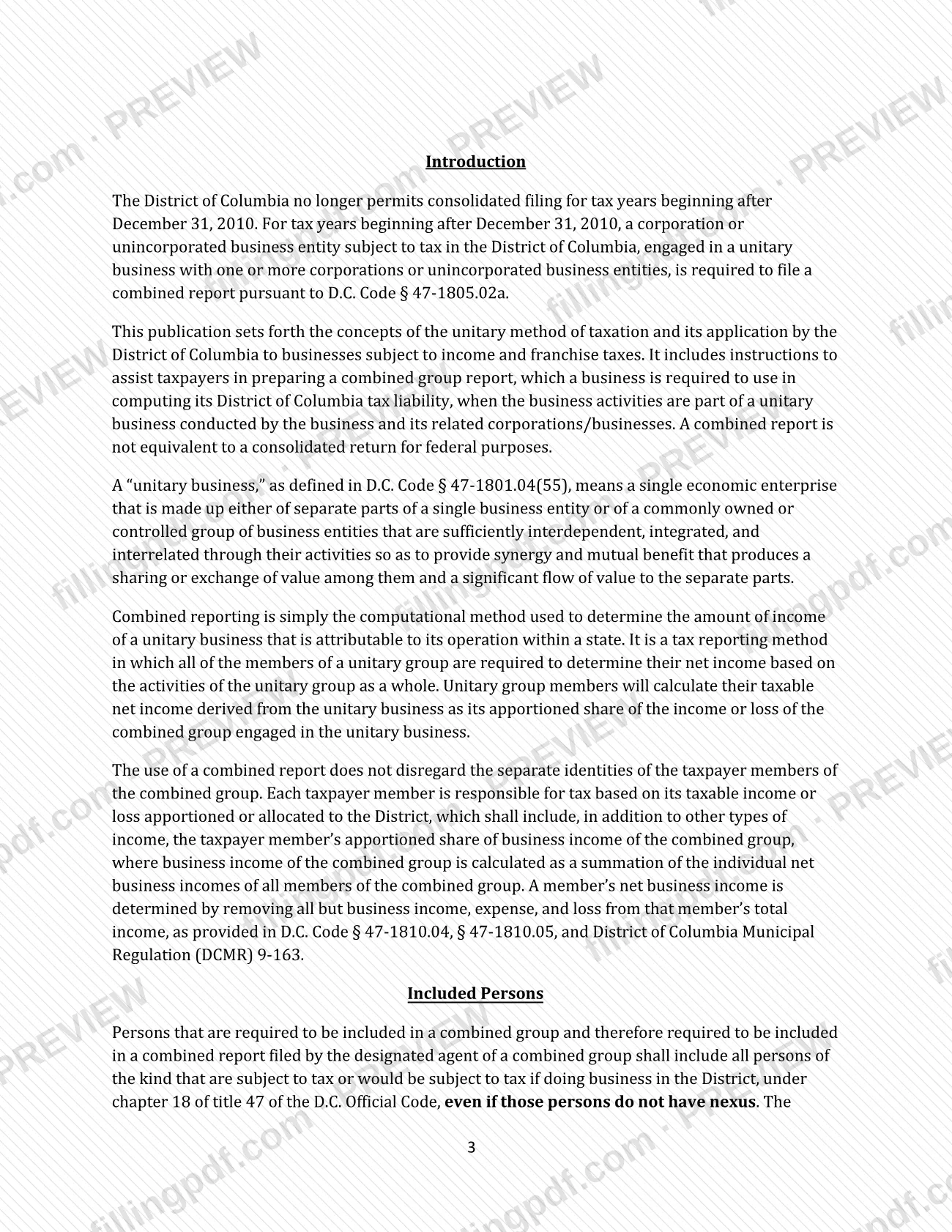
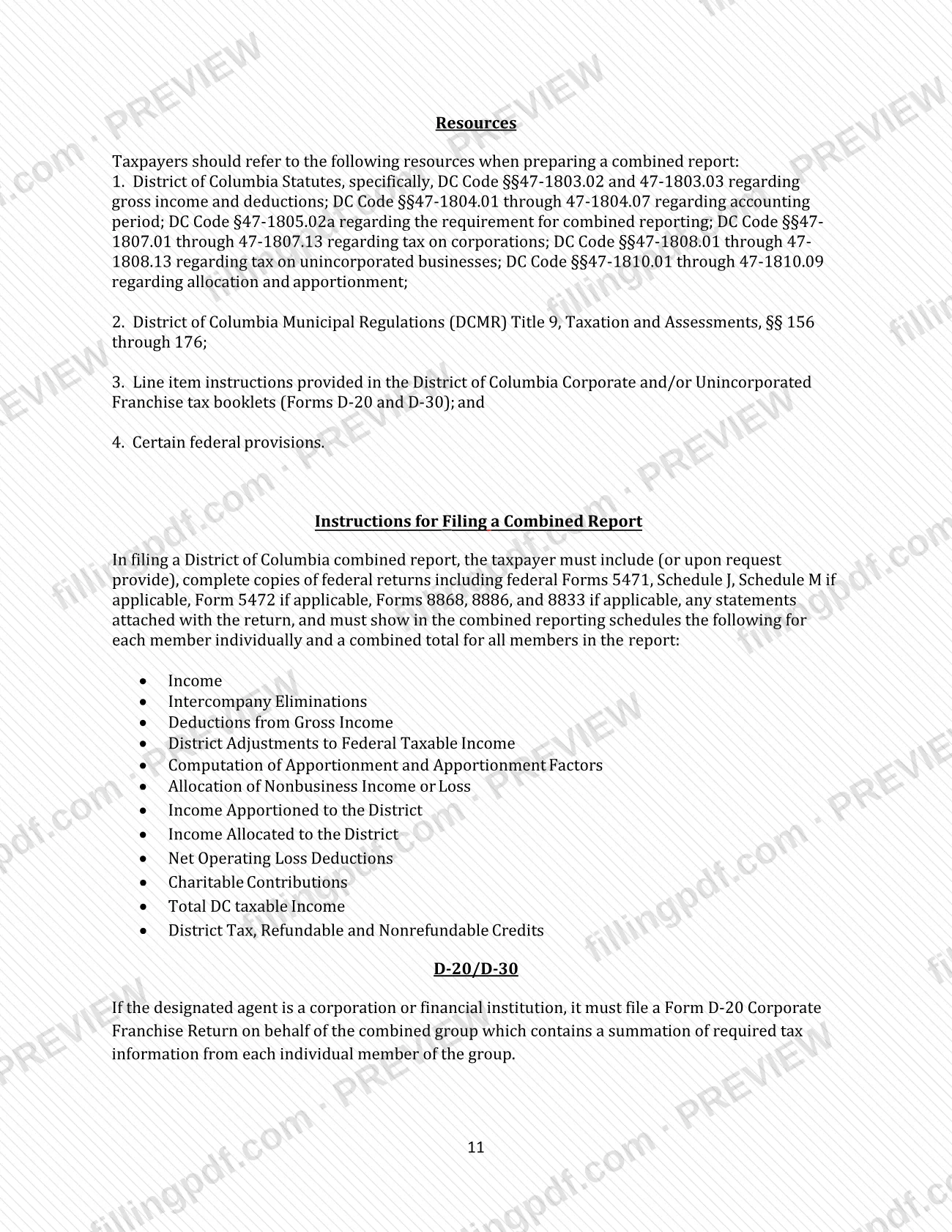
OTR prints the full title as "2024 Instructions and Schedules for Completing the DC Combined Report for Franchise Tax Returns." The District no longer permits consolidated filing for tax years beginning after December 31, 2010. Since then, a corporation or unincorporated business entity subject to DC tax that is engaged in a unitary business with other corporations or unincorporated business entities must file a combined report under D.C. Code § 47-1805.02a. The instructions state that a combined report is not equivalent to a federal consolidated return, and that each taxpayer member keeps its separate identity and is responsible for tax on its own apportioned or allocated income.
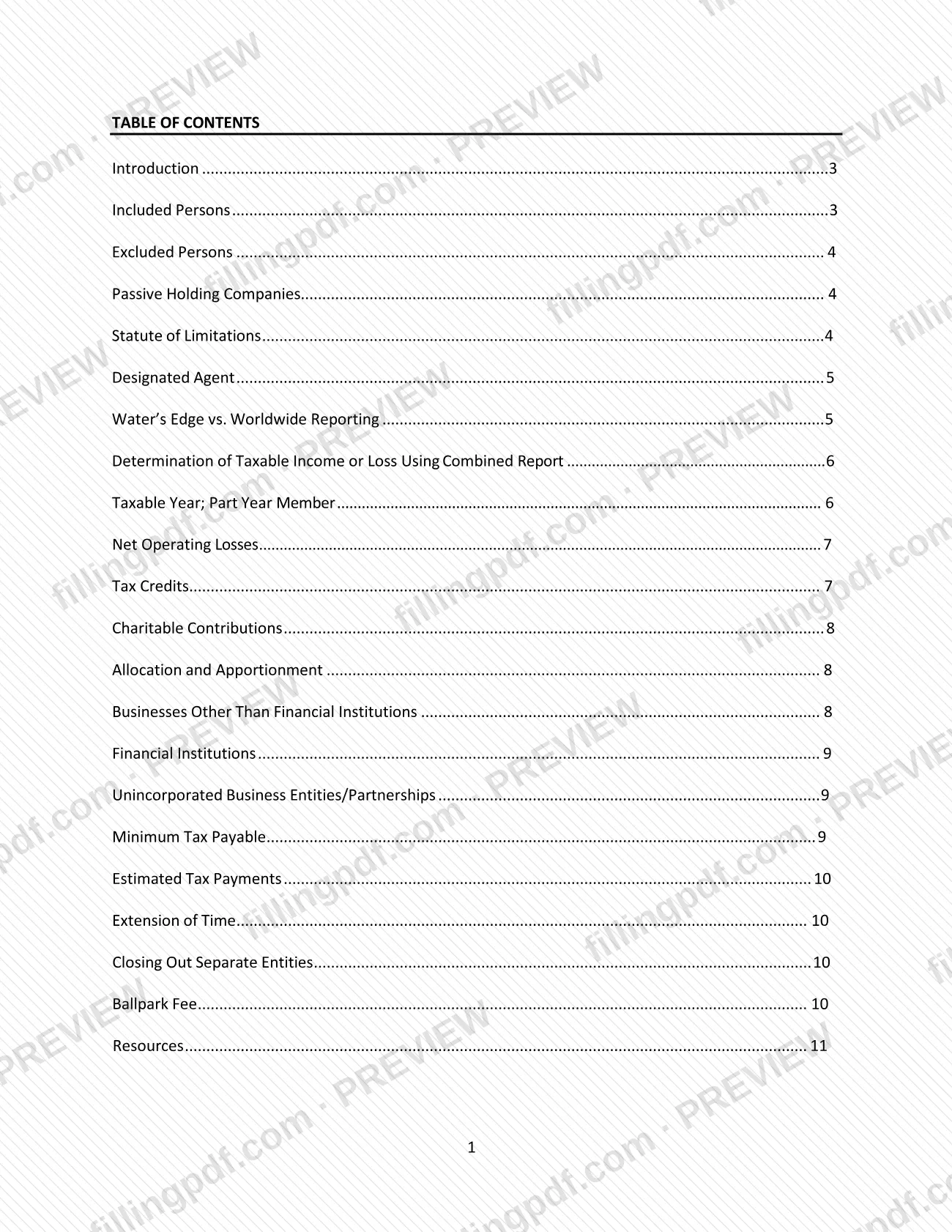
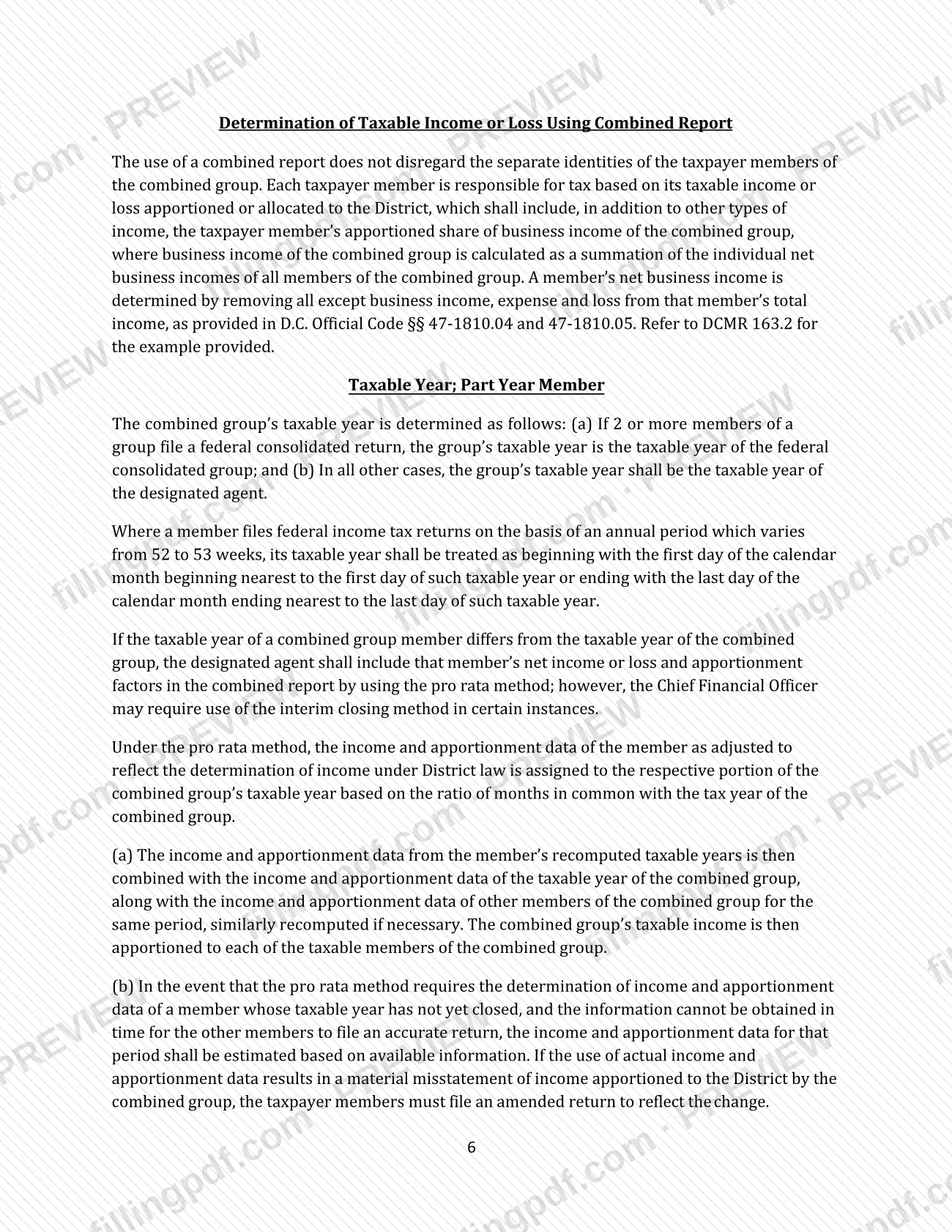
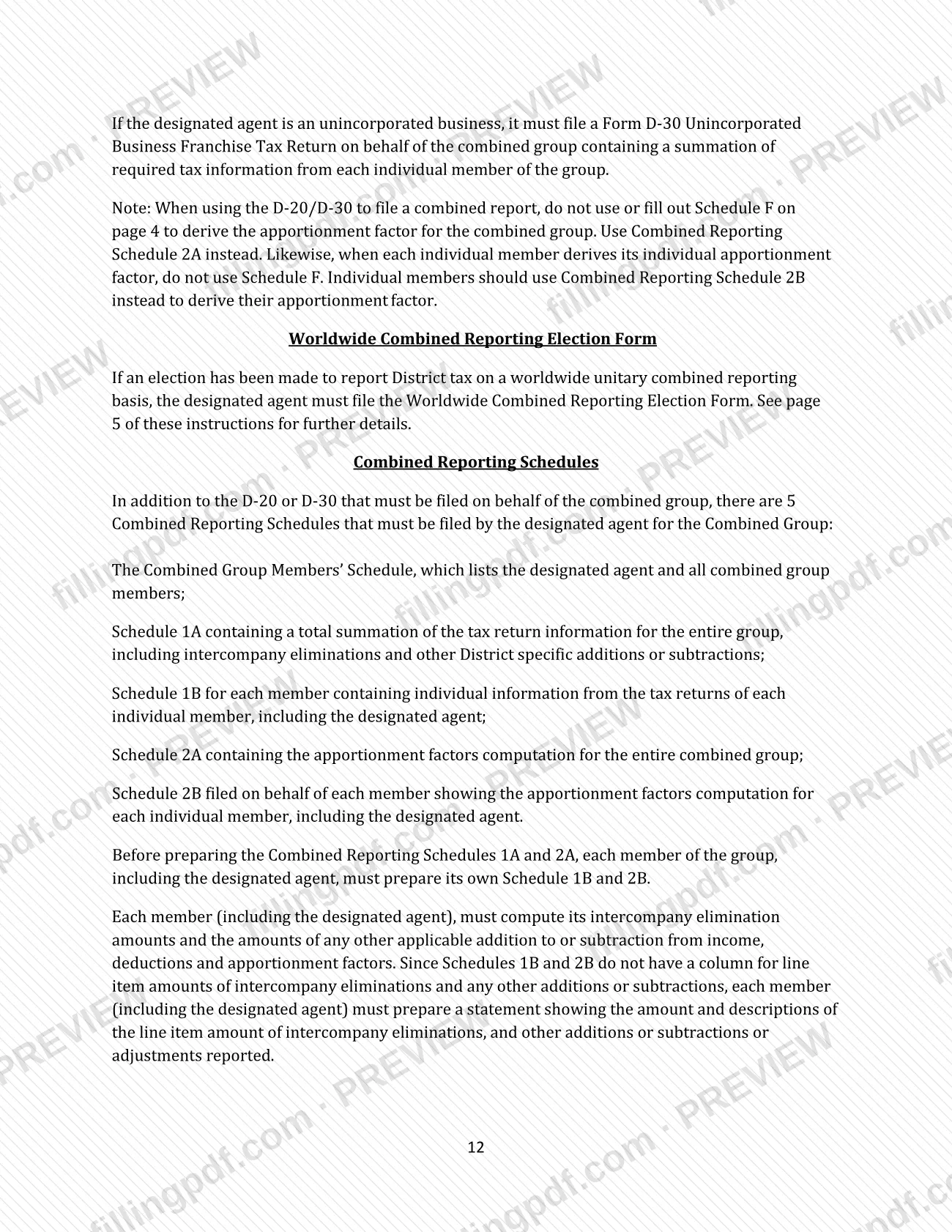
The publication explains included and excluded persons, the designated agent, water's-edge versus worldwide reporting, net operating losses, credits, apportionment, minimum tax, estimated payments, extensions and closing out separate entities. Its forms and schedules are:
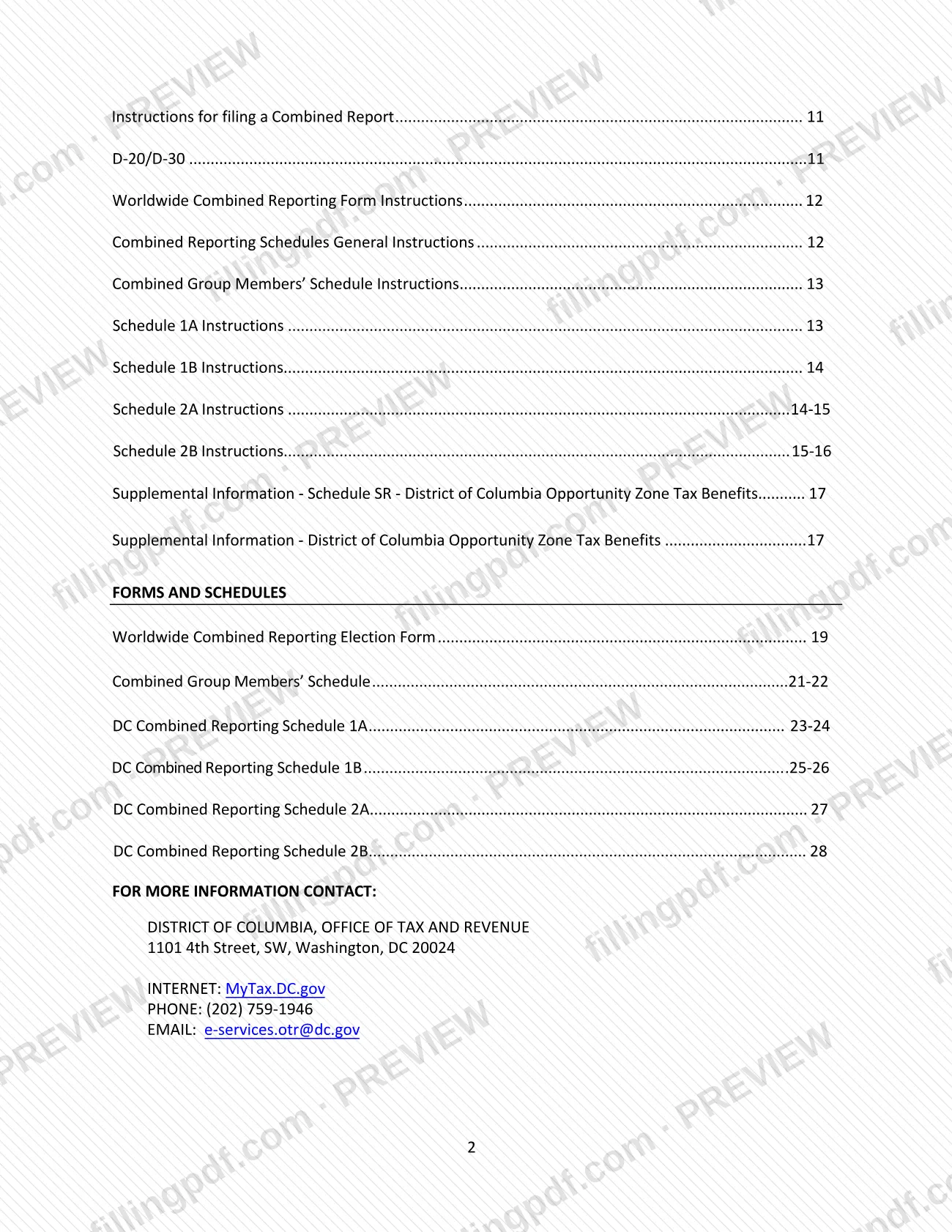
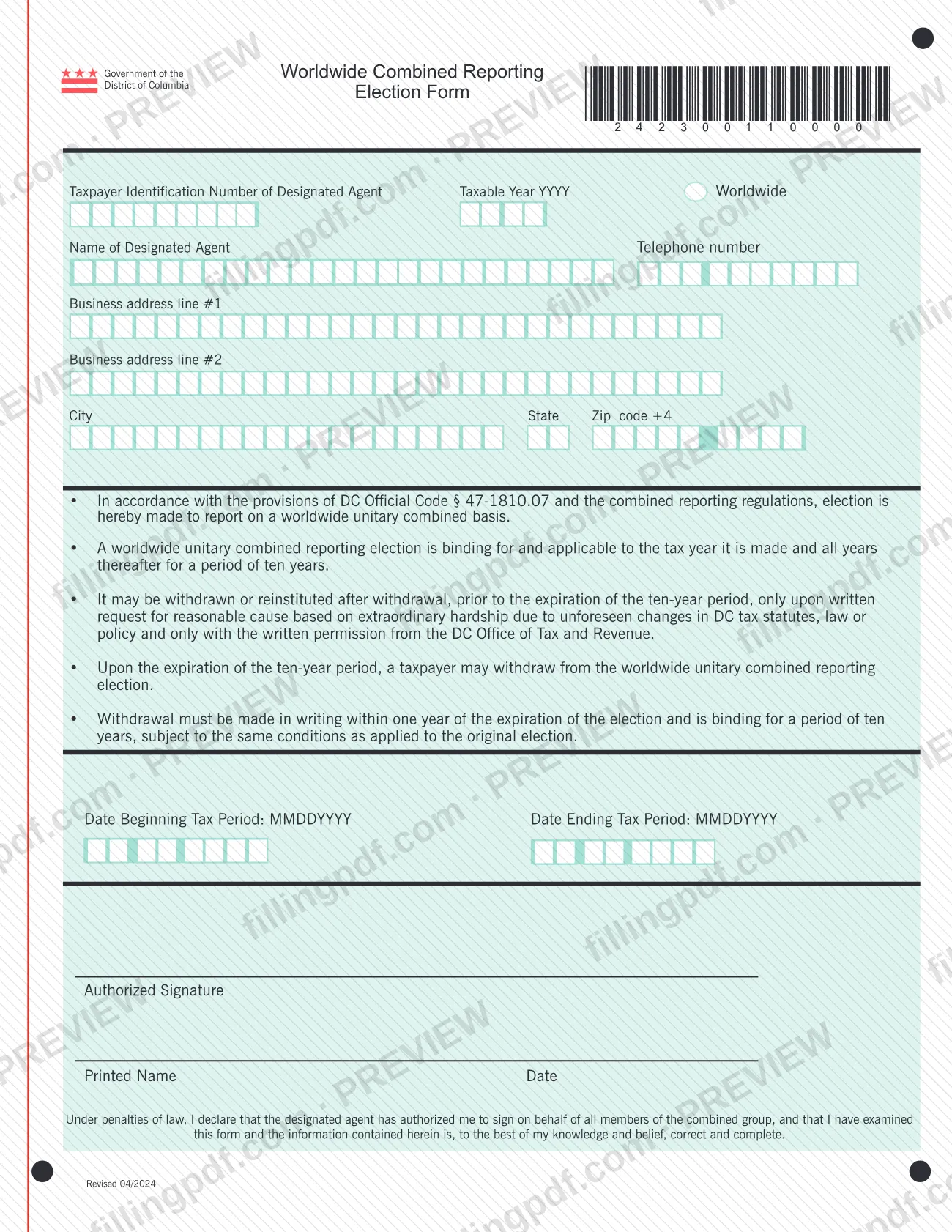
- Worldwide Combined Reporting Election Form (revised 04/2024)
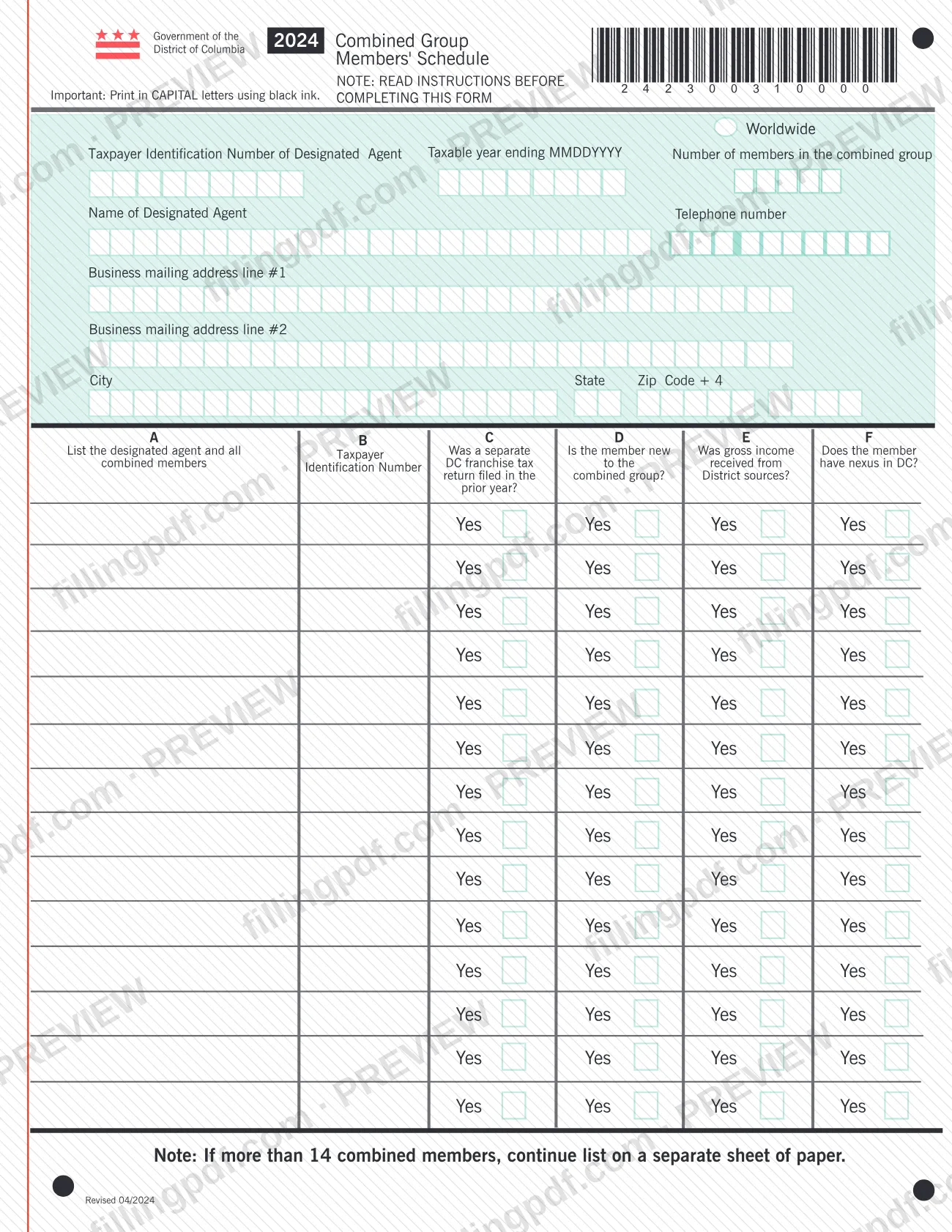
- Combined Group Members' Schedule (revised 04/2024)
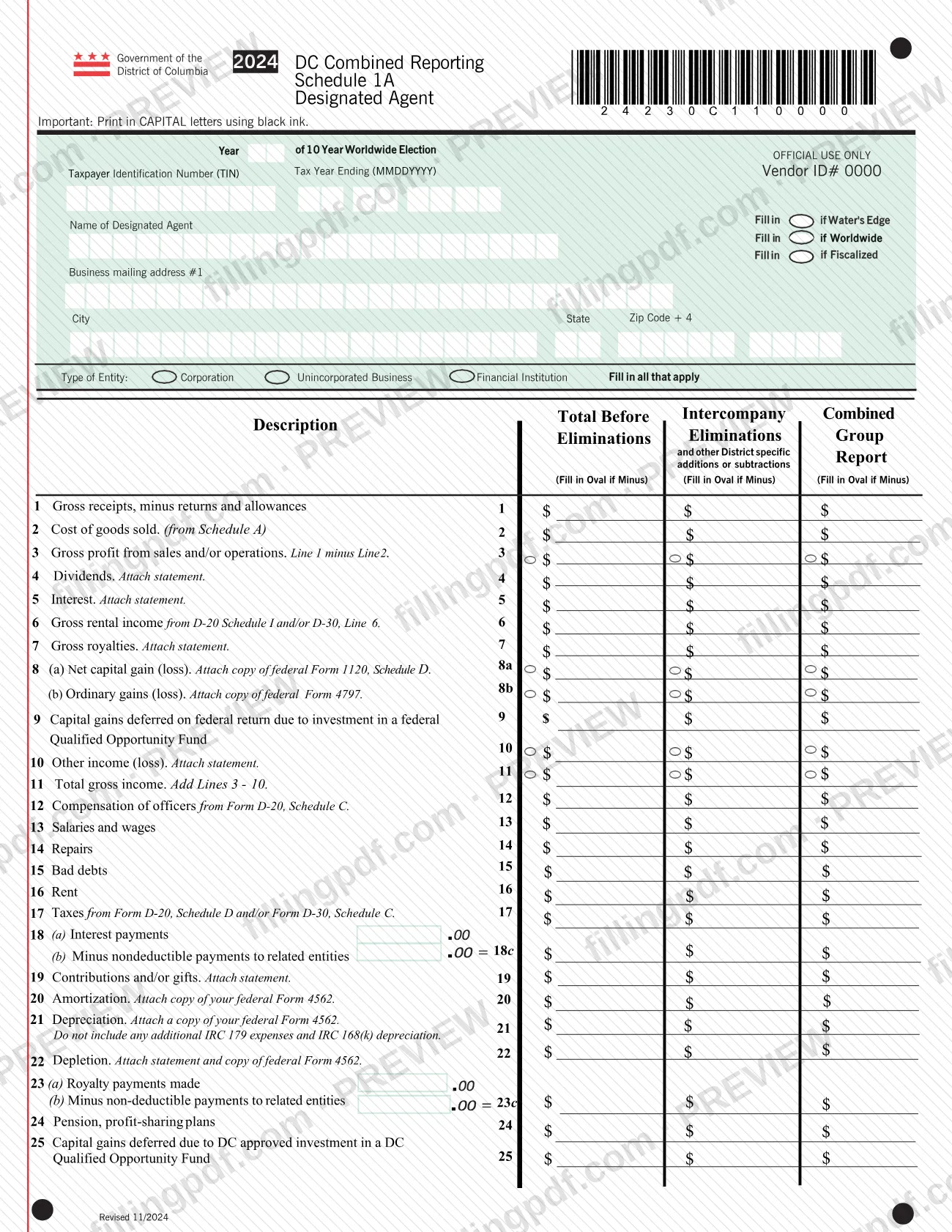
- DC Combined Reporting Schedules 1A, 1B, 2A and 2B (revised 11/2024)
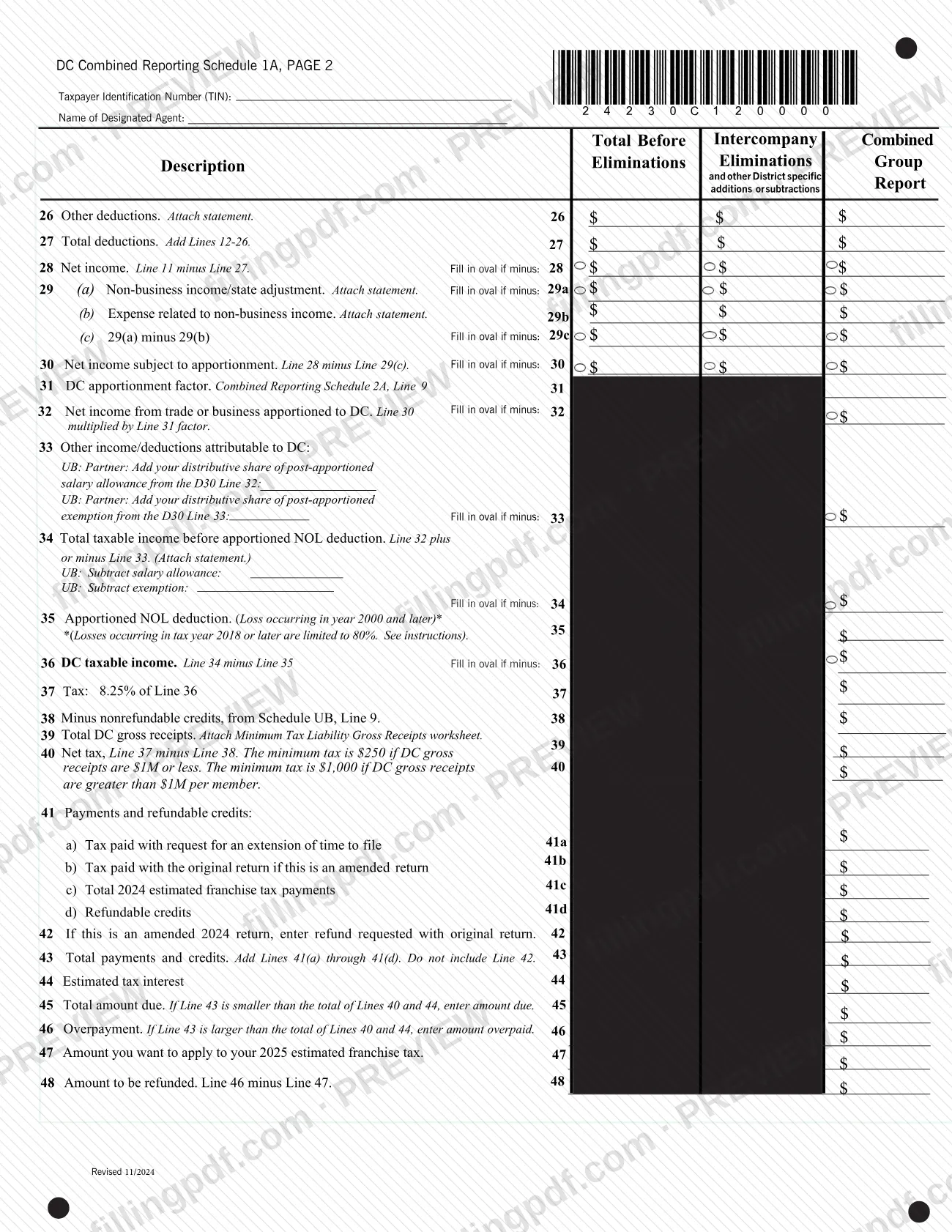
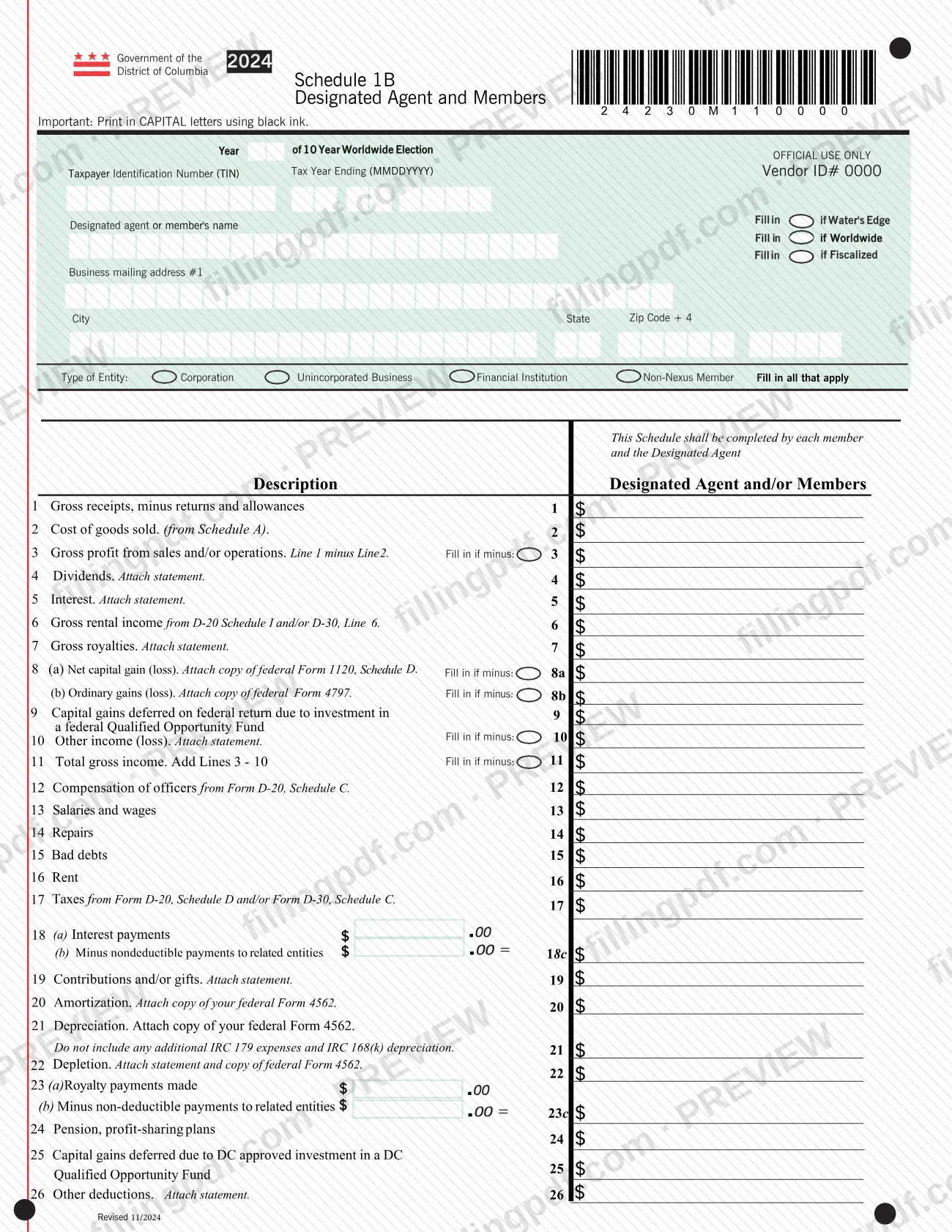
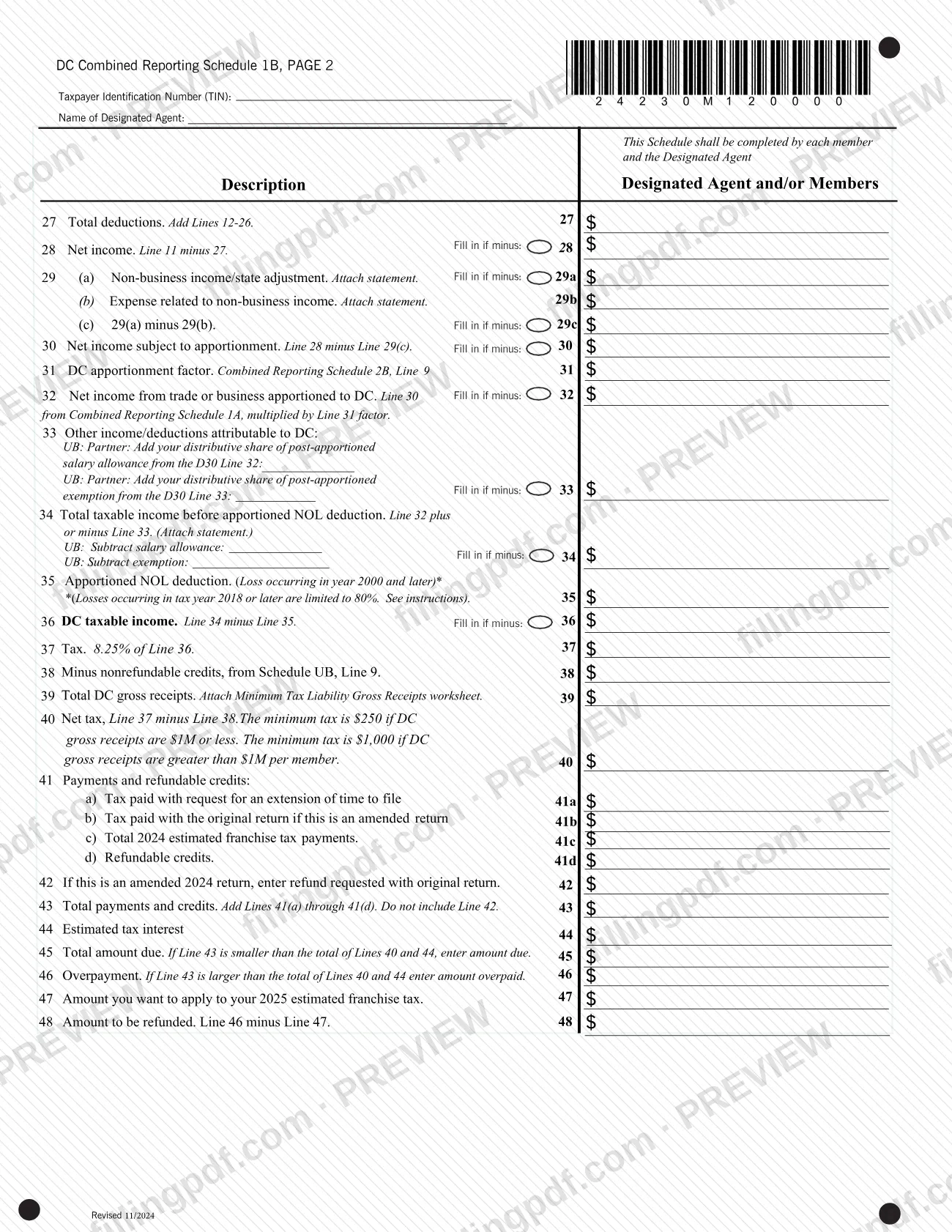
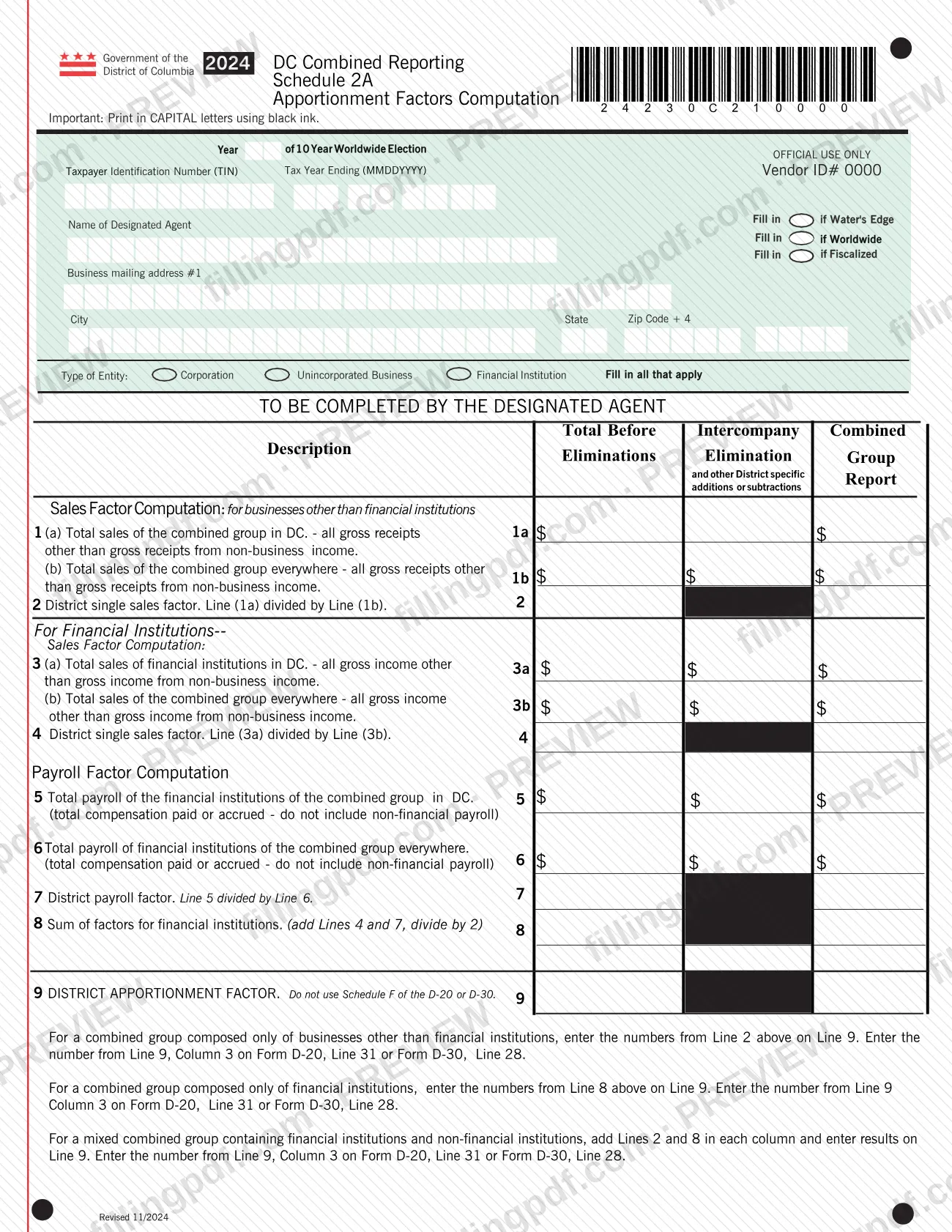
The schedules are filed with the D-20 Corporate Franchise Return or the D-30 Unincorporated Business Franchise Tax Return, which they do not replace. Schedule 1A and Schedule 1B carry the income, deduction, tax and payment lines, and Schedule 2A and Schedule 2B compute the apportionment factors.
Who needs to file 2024 Combined Reporting Instructions – Washington, DC?
A corporation or unincorporated business entity subject to DC tax that is engaged in a unitary business with one or more other corporations or unincorporated business entities must file a combined report, and the group's designated agent completes these schedules.
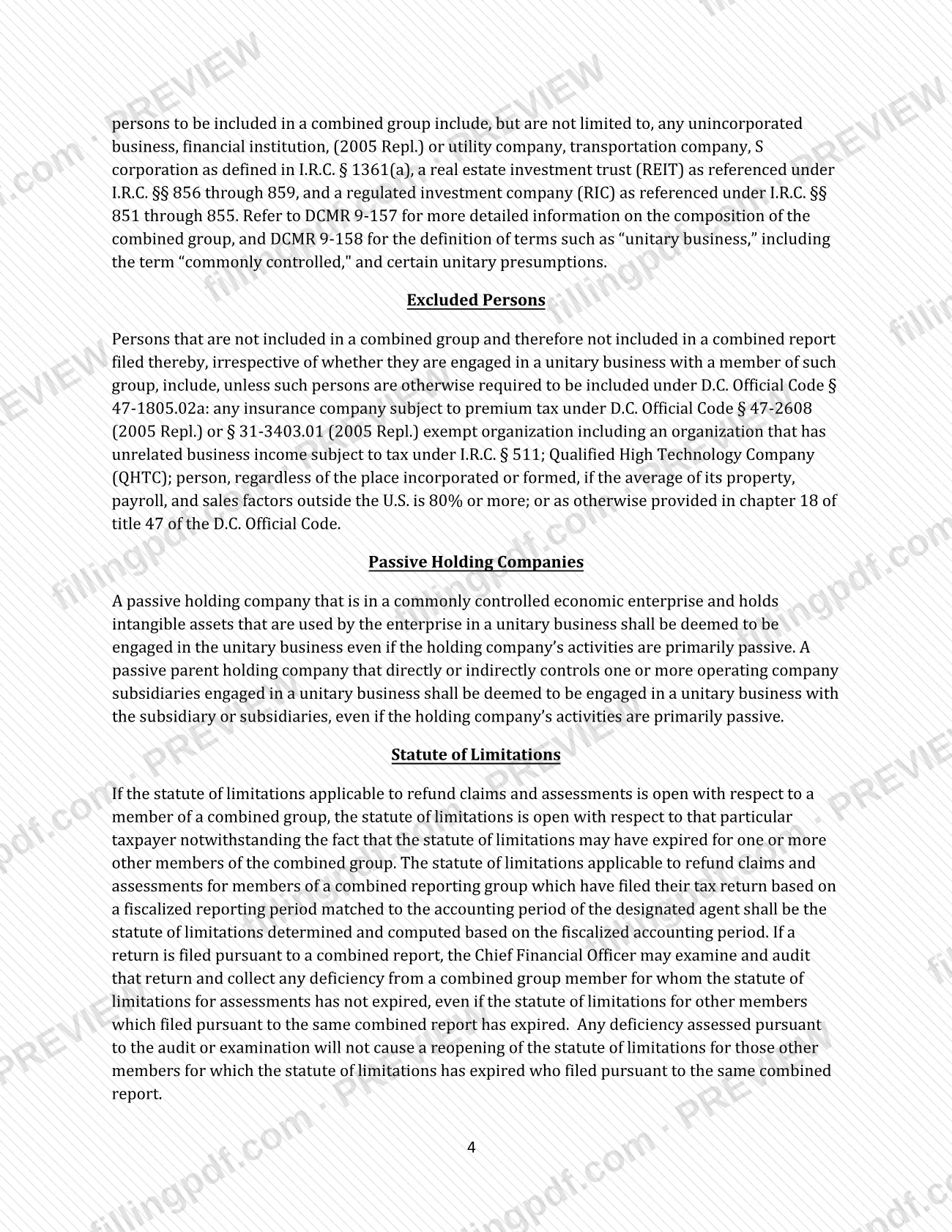
- Included persons: all persons of the kind subject to tax, or that would be subject to tax if doing business in the District, under chapter 18 of title 47 of the D.C. Official Code, even without nexus. This includes unincorporated businesses, financial institutions, utility and transportation companies, S corporations, REITs and RICs.
- Excluded persons: unless otherwise required under D.C. Official Code § 47-1805.02a, insurance companies subject to premium tax, exempt organizations (including unrelated business income subject to tax under I.R.C. § 511), Qualified High Technology Companies, and any person whose average property, payroll and sales factors outside the U.S. are 80% or more.
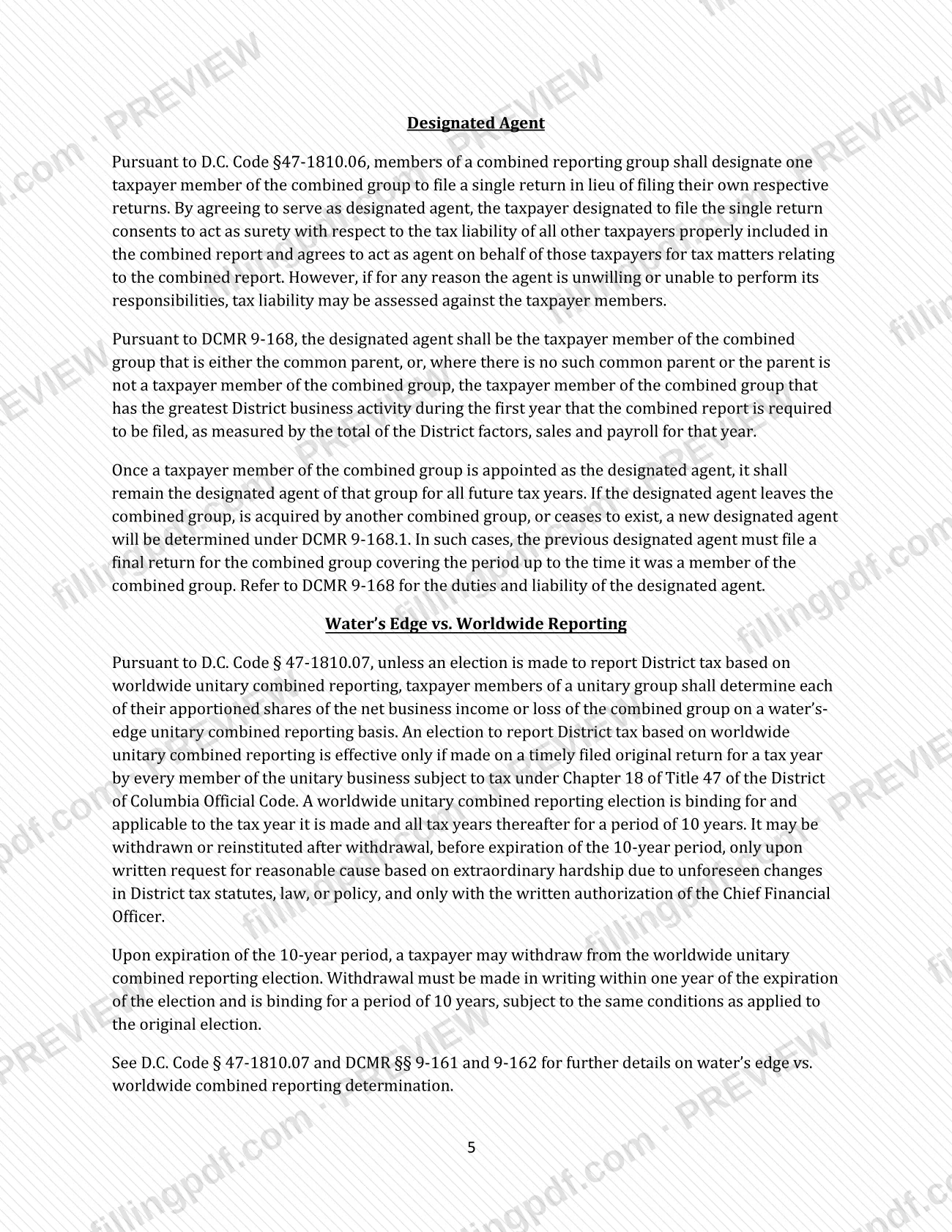
- Designated agent: one taxpayer member files the single return for the group. A non-nexus member cannot be the designated agent. A corporation or financial institution agent files Form D-20; an unincorporated business agent files Form D-30.
- Every member: each member, including the designated agent, prepares its own Schedule 1B and Schedule 2B.
By serving as designated agent, a member consents to act as surety for the tax liability of the other taxpayers in the report.
When to file 2024 Combined Reporting Instructions – Washington, DC
A combined report is required for each tax year beginning after December 31, 2010 in which a DC taxpayer is engaged in a unitary business with related entities. The schedules travel with the D-20 or D-30 that the designated agent files; the instructions print no separate due date for them.
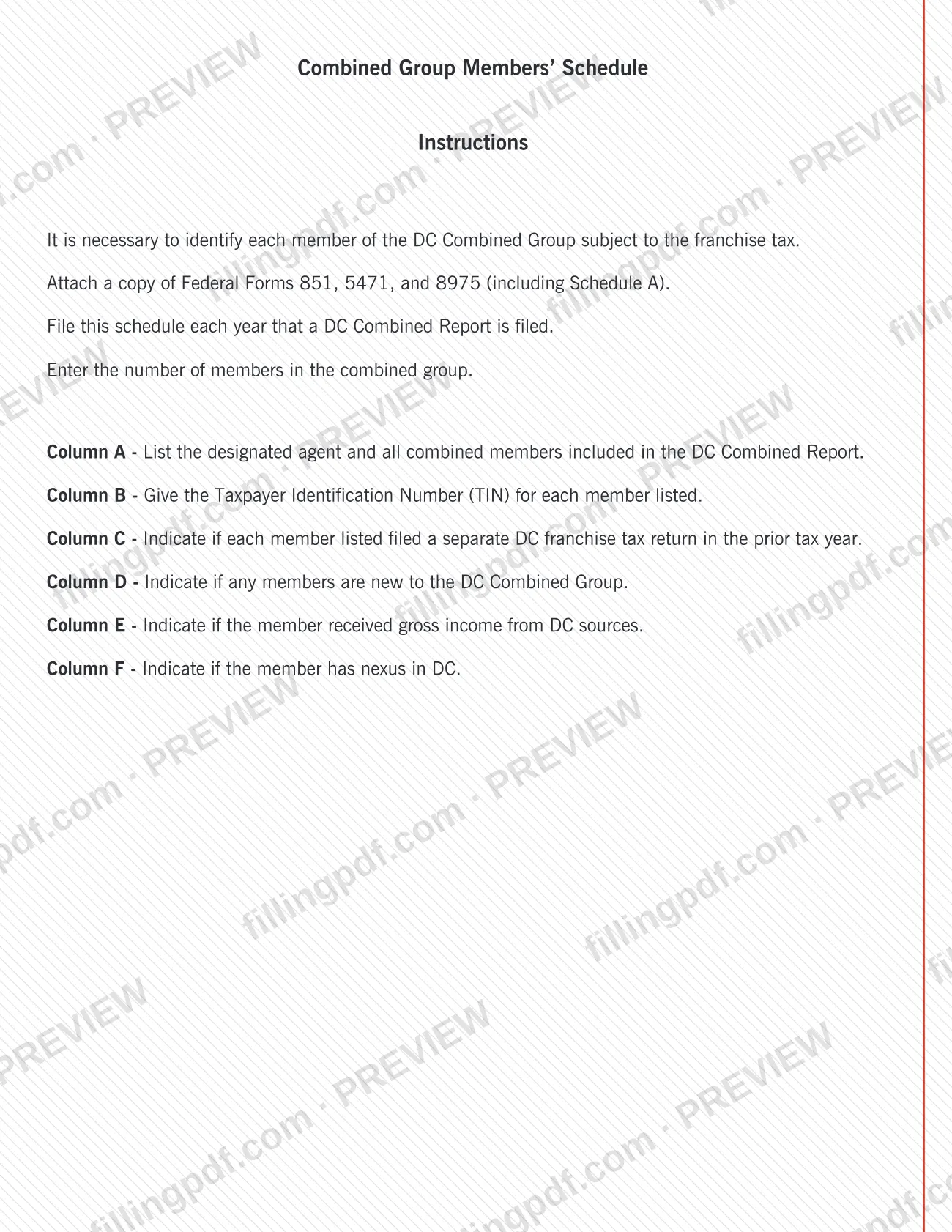
- The Combined Group Members' Schedule must be filed each year a DC combined report is filed.
- An extension to file can be requested no later than the due date of the return, for seven months and never for more than one year. It is not an extension of time to pay: the tax must be paid when you submit the request. Do not use the federal extension form. The designated agent files the request for the whole group.
- A worldwide election is effective only if made on a timely filed original return by every member subject to tax. It binds the election year and the following years for 10 years.
- An entity that filed separately last year and now joins the combined report, other than the designated agent, files a separate final zero return along with the combined report.
Documents you need
- Form D-20 or Form D-30, filed by the designated agent on behalf of the combined group: D-20 if the agent is a corporation or financial institution, D-30 if it is an unincorporated business.
- Combined Group Members' Schedule, filed by the designated agent each year a DC combined report is filed.
- A Schedule 1B and a Schedule 2B for each member, including the designated agent, plus one Schedule 1A and one Schedule 2A for the group.
- Worldwide Combined Reporting Election Form, only if an election to report on a worldwide unitary combined basis has been made.
- A statement for each member showing intercompany eliminations and other additions or subtractions, because Schedules 1B and 2B have no column for them.
- Federal Schedules J, M and M-3, and Federal UTP, if applicable.
- Federal Forms 851, 5471, 5472, 8833, 8868, 8886 and 8975 (including Schedule A), if applicable; complete copies of federal returns must be included or provided on request.
- Schedule SR, one per eligible member, if a member claims the Small Retailer Property Tax Relief Credit.
- For DC Opportunity Zone benefits: the DC QOF Approval letter from DMPED and IRS Forms 8996 and 8997, plus federal Forms 8949, 4797 and Schedules K-1 and D if applicable.
How to fill out 2024 Combined Reporting Instructions – Washington, DC
Identify the designated agent
The designated agent is the common parent or, if there is none or the parent is not a taxpayer member, the taxpayer member with the greatest District business activity in the first combined year. A non-nexus member cannot serve.
Choose water's edge or worldwide
Water's edge is the default. A worldwide election must be made by every member on a timely filed original return; if it applies, complete the Worldwide Combined Reporting Election Form with the agent's TIN, taxable year (YYYY), name, telephone, address, tax period dates (MMDDYYYY), authorized signature, printed name and date.
List the members on the Members' Schedule
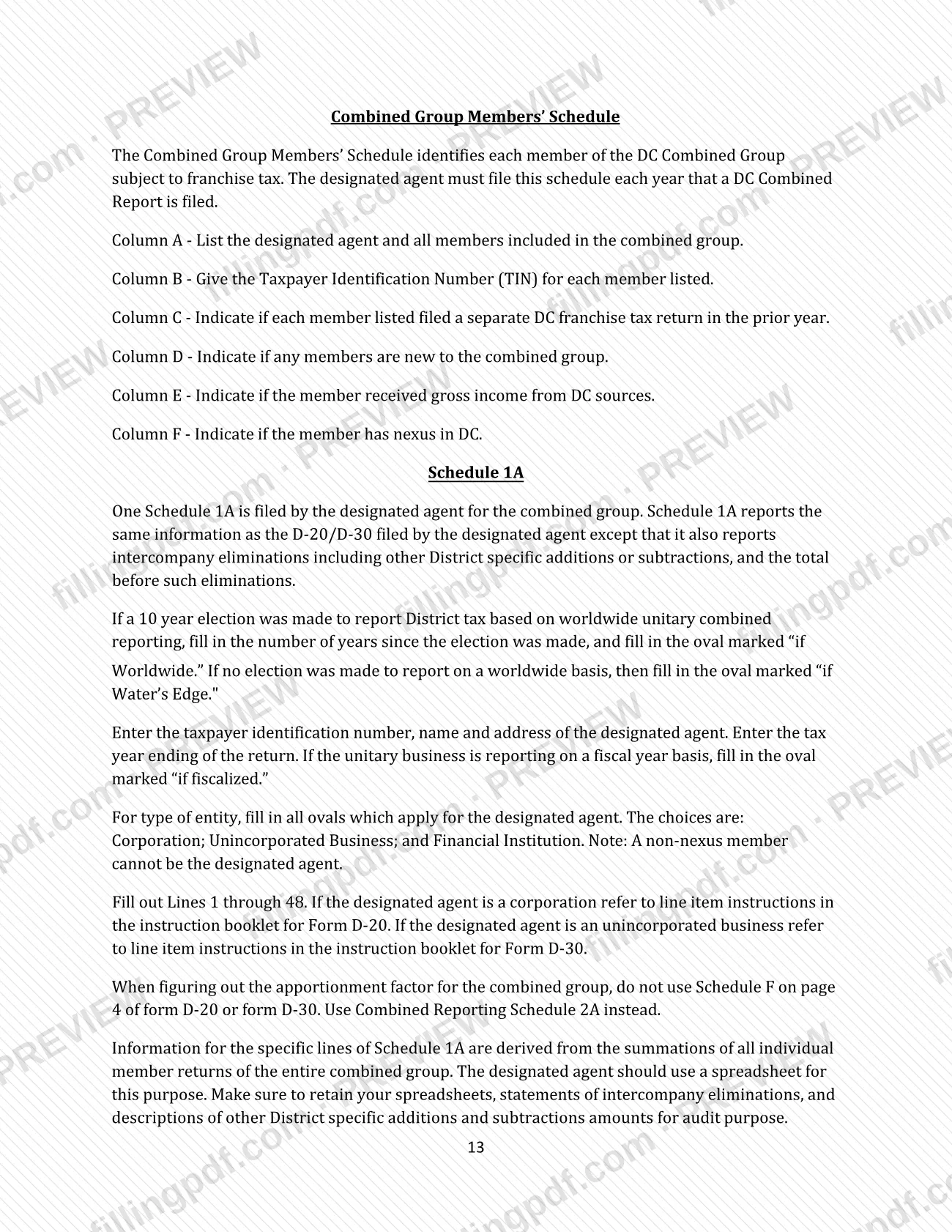
Enter the designated agent's TIN, name, address, taxable year ending and the number of members. In Columns A to F list each member, its TIN, and Yes answers for prior-year separate DC return, new to the group, DC-source gross income and DC nexus. Continue on a separate sheet if needed.
Prepare Schedule 1B for each member
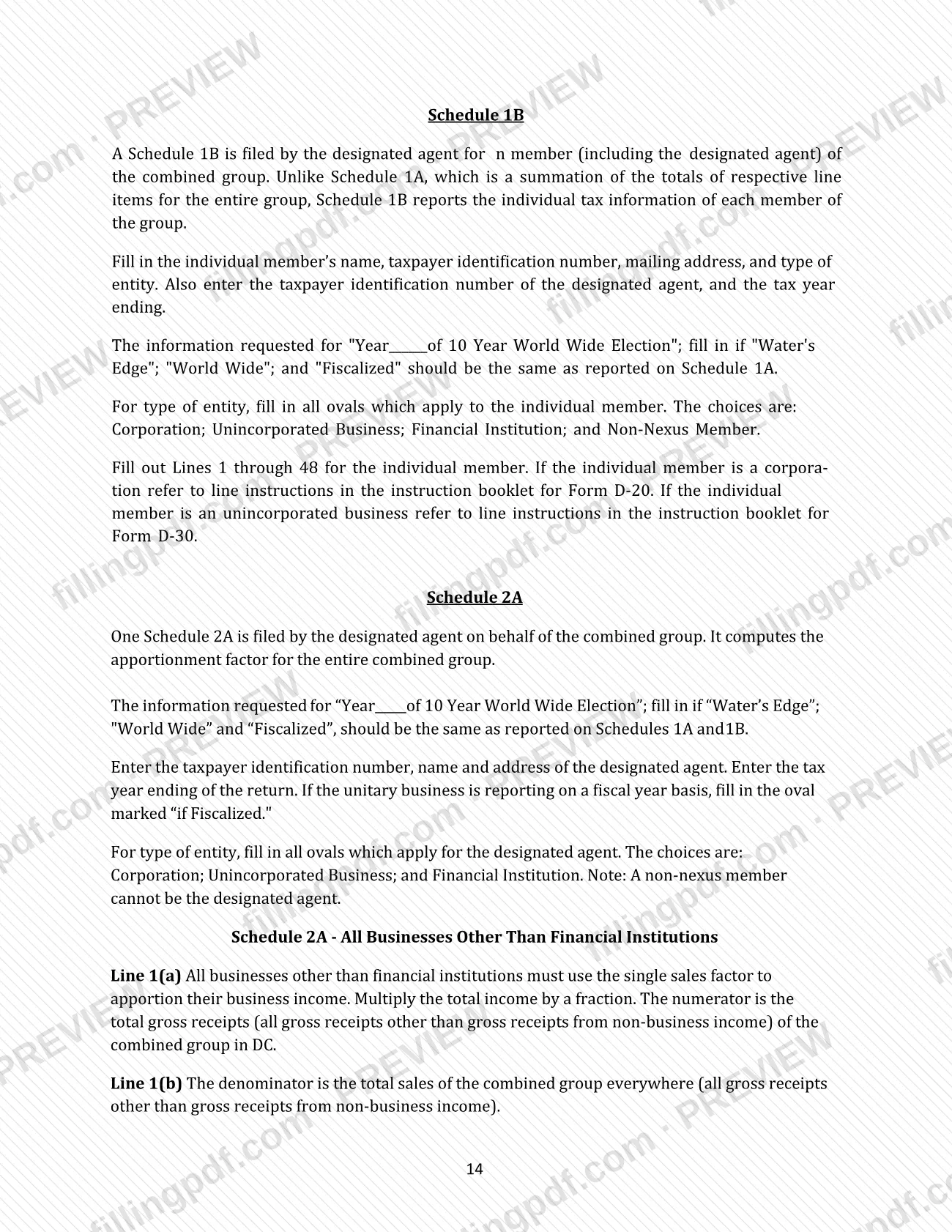
Enter the member's name, TIN, mailing address, entity type (including Non-Nexus Member), the agent's TIN and the tax year ending. Fill out Lines 1 through 48 using the D-20 or D-30 booklet line instructions, and repeat the Water's Edge, Worldwide and Fiscalized ovals from Schedule 1A.
Prepare Schedule 2B for each member
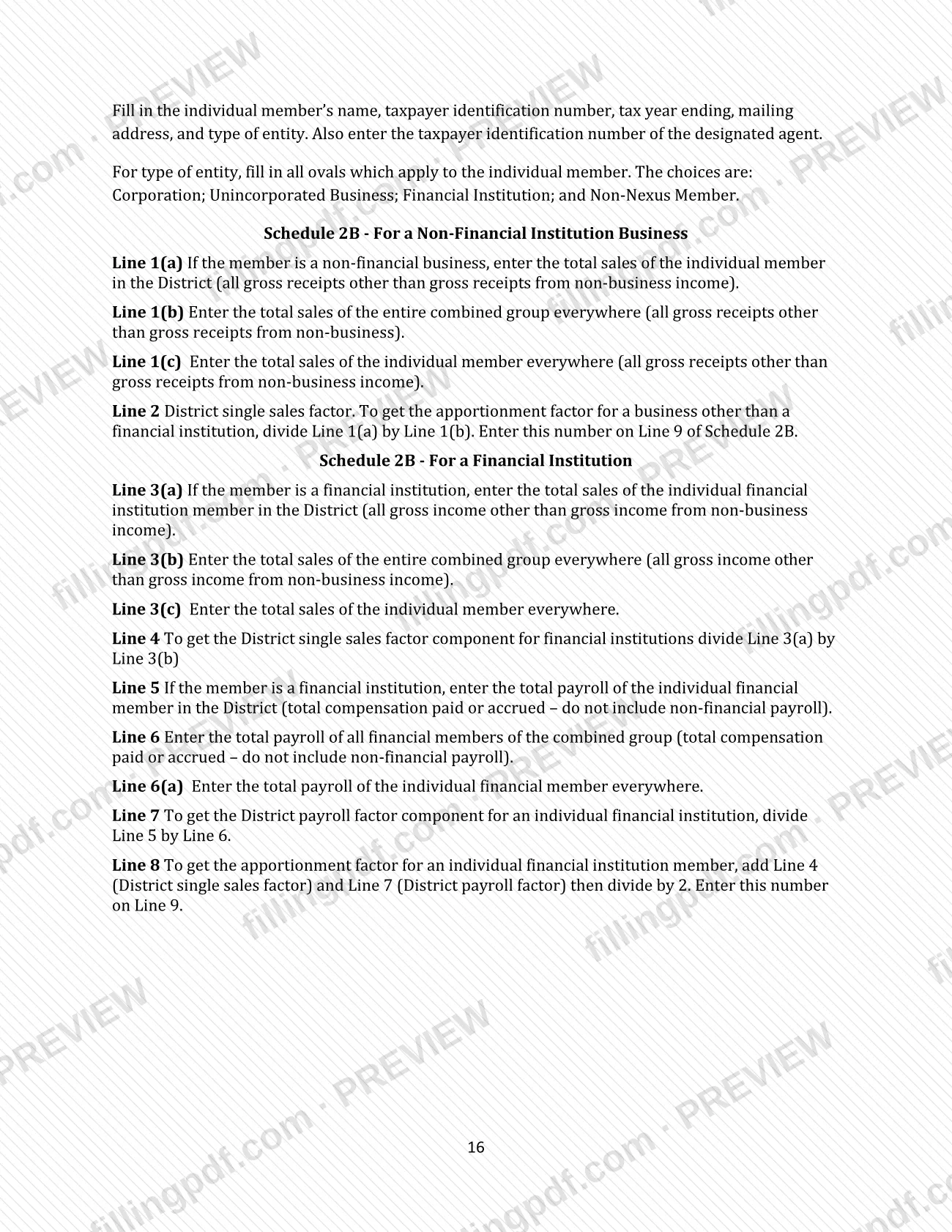
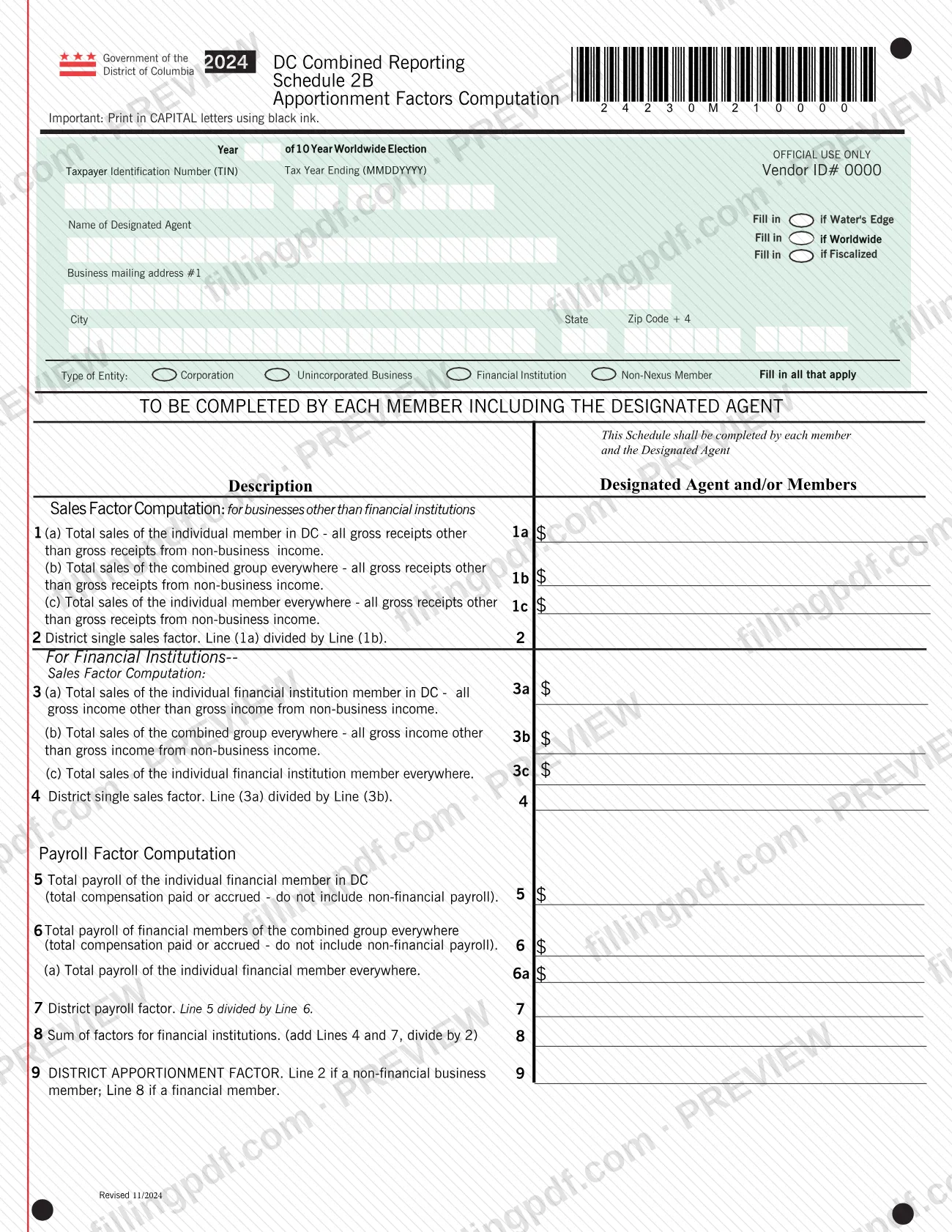
A non-financial business enters Lines 1(a) to 1(c) and divides 1(a) by 1(b) on Line 2. A financial institution completes Lines 3(a) to 3(c), 4, 5, 6, 6(a), 7 and 8. Enter the result on Line 9.
Complete Schedule 1A for the group
The designated agent fills in the Water's Edge or Worldwide oval (with the number of years since a worldwide election), Fiscalized if applicable, and every entity-type oval that applies. Fill out Lines 1 through 48 in the three columns, summing all members' returns; keep your spreadsheets and statements for audit.
Compute the group factor on Schedule 2A
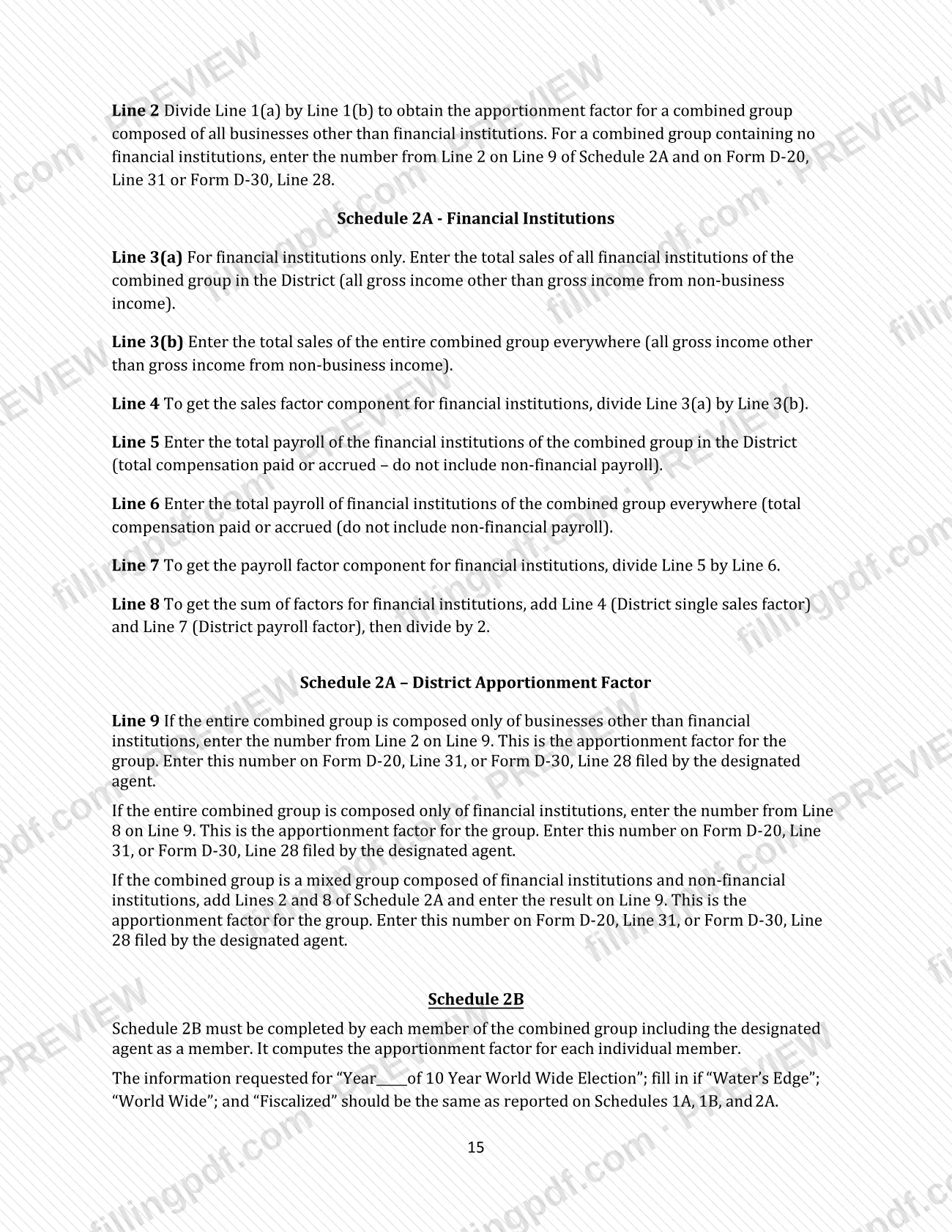
Use Lines 1(a) to 2 for non-financial groups and Lines 3(a) to 8 for financial institutions. On Line 9, enter Line 2 for a group without financial institutions, Line 8 for a group of only financial institutions, or the sum of Lines 2 and 8 for a mixed group.
Carry the factor to the return
Enter the Line 9 result on Form D-20, Line 31, or Form D-30, Line 28. Shade the 'fill in if Combined Report' oval on page 1 and use the designated agent's name and TIN.
Add statements and supporting forms
Prepare the statements the lines call for, such as intercompany eliminations, and gather the federal forms that apply. File a Schedule SR for each member claiming that credit, and the Opportunity Zone documents if they apply.
Review, sign and download the PDF
Check that each member's Schedule 1B and 2B agrees with the group totals on Schedules 1A and 2A and that the Water's Edge, Worldwide and Fiscalized entries match across schedules. Download or print the completed PDF from FillingPDF and assemble the package described under How to submit.
How to submit 2024 Combined Reporting Instructions – Washington, DC
The designated agent files the combined report together with Form D-20 or Form D-30; the instructions name no separate mailing address for the schedules.
- With the D-20 or D-30: attach the Combined Group Members' Schedule, Schedule 1A, a Schedule 1B and 2B for each member, Schedule 2A, and the Worldwide Combined Reporting Election Form if it applies. Shade the fill in if Combined Report oval on page 1 of the return.
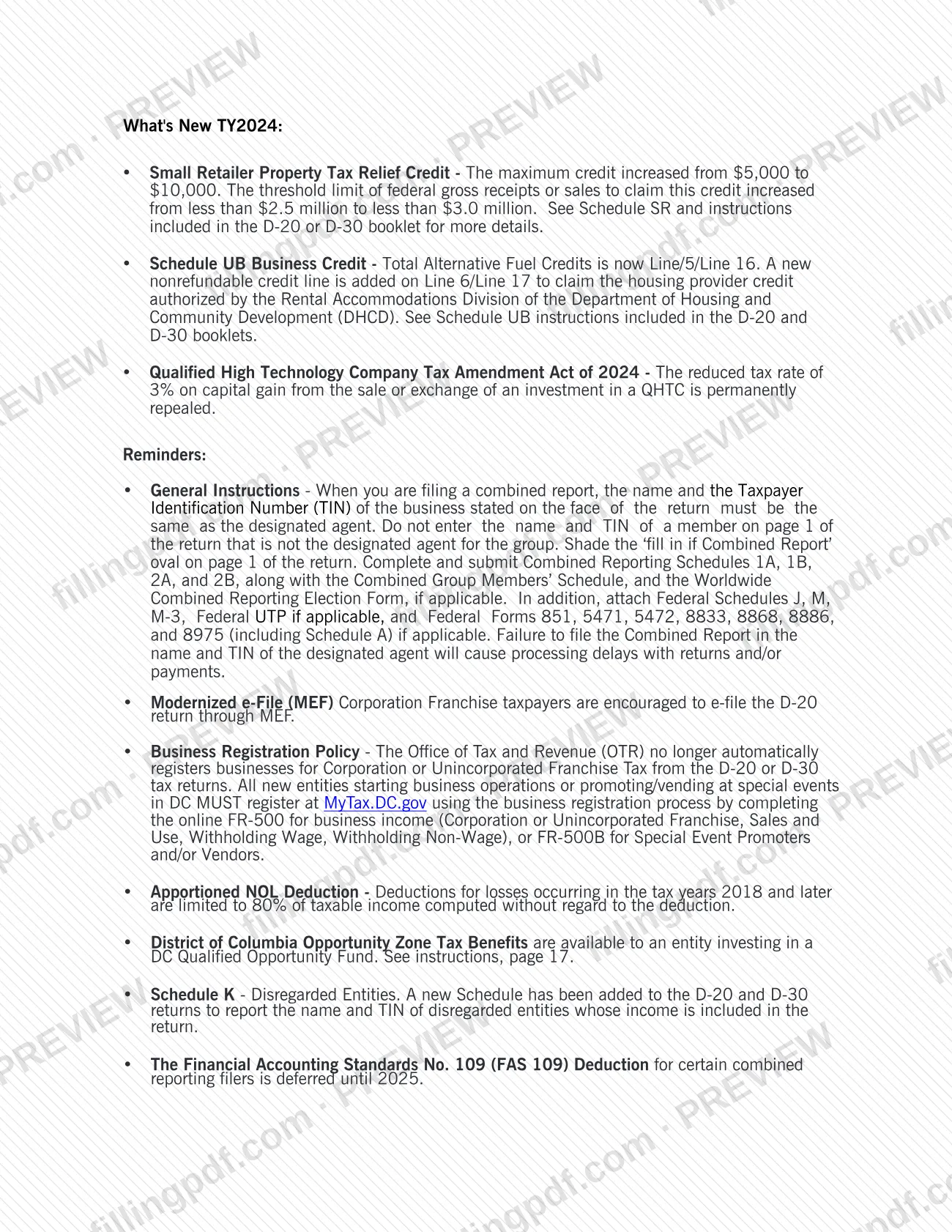
- Electronic filing: OTR encourages Corporation Franchise taxpayers to e-file the D-20 return through Modernized e-File (MEF).
- Business registration: OTR no longer registers businesses for franchise tax from the D-20 or D-30. New entities register at MyTax.DC.gov with the online FR-500 (or FR-500B for special event promoters and vendors).
- Questions: Office of Tax and Revenue, 1101 4th Street, SW, Washington, DC 20024; MyTax.DC.gov; (202) 759-1946; [email protected].
Putting the return in the designated agent's name and TIN matters: filing under another name will cause processing delays with returns and payments. FillingPDF lets you fill out and download the PDF; submission follows the channels above.
Common mistakes to avoid
- Entering the name and TIN of a member other than the designated agent on page 1 of the D-20 or D-30; this causes processing delays with returns and payments.
- Forgetting to shade the 'fill in if Combined Report' oval on page 1 of the return.
- Using Schedule F on page 4 of the D-20 or D-30 to derive the group's apportionment factor instead of Combined Reporting Schedule 2A (or Schedule 2B for a member).
- Naming a non-nexus member as the designated agent; the instructions say a non-nexus member cannot be the designated agent.
- Preparing Schedules 1A and 2A before every member, including the designated agent, has prepared its own Schedules 1B and 2B.
- Leaving out the statement of intercompany eliminations and other adjustments for each member, since Schedules 1B and 2B have no column for them.
- Filing the federal extension form for DC, or treating a seven-month extension to file as extra time to pay the tax.
- Filing the ballpark fee on a combined group basis; each member that meets the criteria files and pays it individually.
- Letting one member use another member's net operating loss carryforward or unused credit; both stay with the member that generated them.
- Leaving out the separate final zero return for a former separate filer, other than the designated agent, that joins the combined report.
Frequently asked questions
What is the DC combined report for franchise tax?
It is the single return a unitary group files so its members can compute DC franchise tax on the group's combined business income. The designated agent files it with Form D-20 or D-30, plus the Combined Group Members' Schedule and Schedules 1A, 1B, 2A and 2B.
Is this a DC property tax form?
No. These instructions cover franchise tax combined reporting. Property tax appears only in the Small Retailer Property Tax Relief Credit, claimed on Schedule SR in the D-20 or D-30 booklet against business franchise taxes for rent or real property taxes paid on a qualified retail location.
Who has to file a DC combined report?
A corporation or unincorporated business subject to DC tax that is engaged in a unitary business with one or more related entities, for tax years beginning after December 31, 2010. Insurance companies subject to premium tax, exempt organizations, QHTCs and certain mostly foreign persons are excluded.
Who is the designated agent and what does it do?
The designated agent is the taxpayer member that files the single return for the group. It is the common parent or, failing that, the member with the greatest District business activity in the first year. It acts as surety for the other members' tax liability.
Do I file Form D-20 or Form D-30 with a combined report?
It depends on the designated agent. A corporation or financial institution files Form D-20; an unincorporated business files Form D-30. Either return summarizes the required tax information of each member, and the apportionment factor comes from Schedule 2A, not Schedule F.
How do I get an extension for a DC combined report?
The designated agent requests it for the whole group no later than the return's due date. It extends the time to file by seven months, never more than one year, and does not extend the time to pay. Do not use the federal extension form.
How long does a worldwide combined reporting election last?
Ten years. It binds the election year and all later years in that period. Early withdrawal needs a written request for reasonable cause based on extraordinary hardship, with written authorization. After the period, withdrawal must be made in writing within one year.
Can I fill out the DC combined reporting schedules online?
You can fill out the PDF online on FillingPDF and download or print it. FillingPDF is independent of OTR and does not file anything; the designated agent submits the schedules with the D-20 or D-30 through OTR's channels.
Ready to fill out 2024 Combined Reporting Instructions – Washington, DC?
Fill out 2024 Combined Reporting Instructions – Washington, DC now