
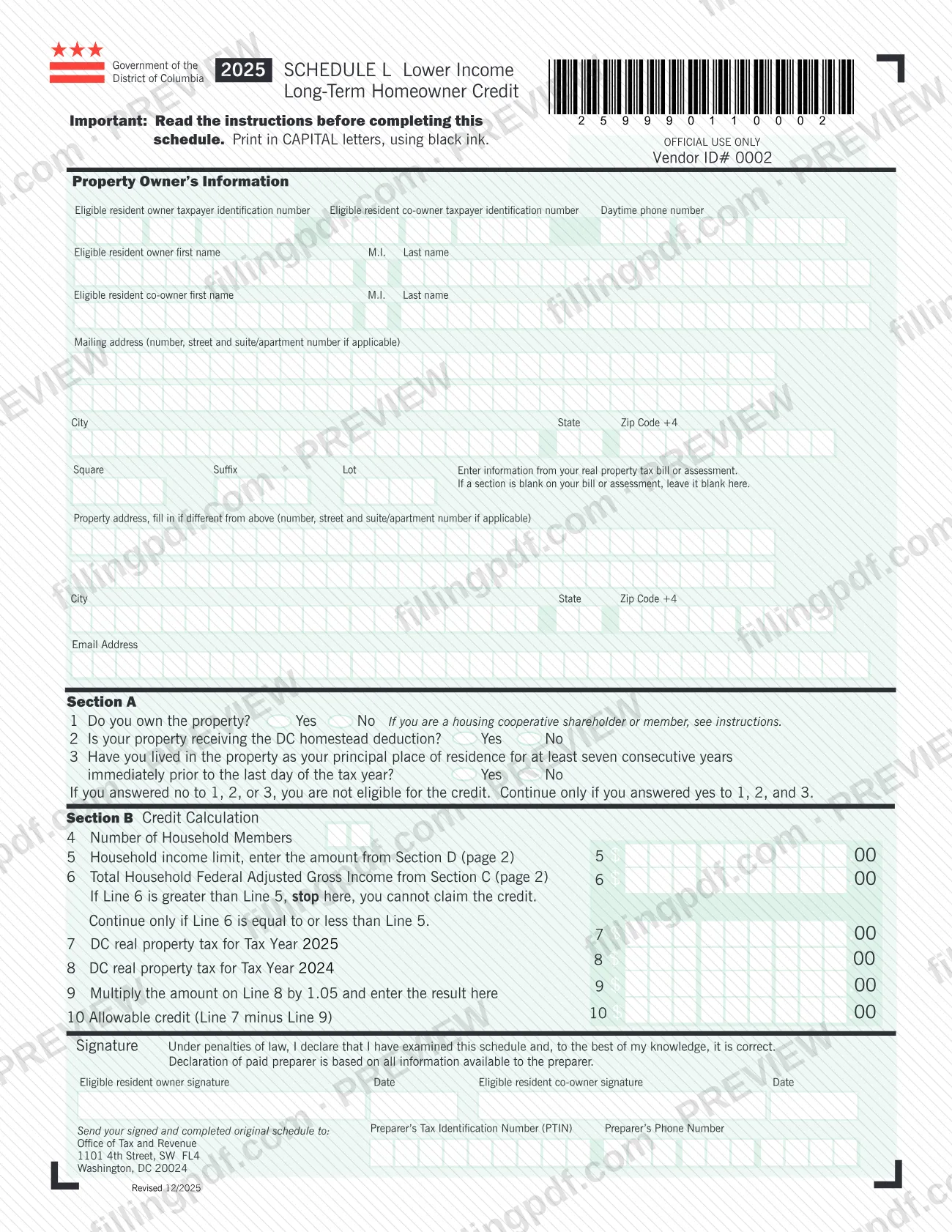
2025 Schedule L, the Lower Income Long-Term Homeowner Credit, is the schedule the District of Columbia Office of Tax and Revenue (OTR) uses to figure a refund tied to DC real property taxes. It is one of the DC property tax forms for residents who have owned and lived in the same home for at least seven consecutive years and whose household income is at or below the limit for their household size. On this page you can fill out the form online on FillingPDF and download or print the completed PDF; the form and its instructions are published by OTR.
Last updated
What is Schedule L?
2025 Schedule L, Lower Income Long-Term Homeowner Credit, is the District of Columbia Office of Tax and Revenue (OTR) schedule on which an eligible long-term homeowner with a limited household income figures the credit for increases in DC real property tax.
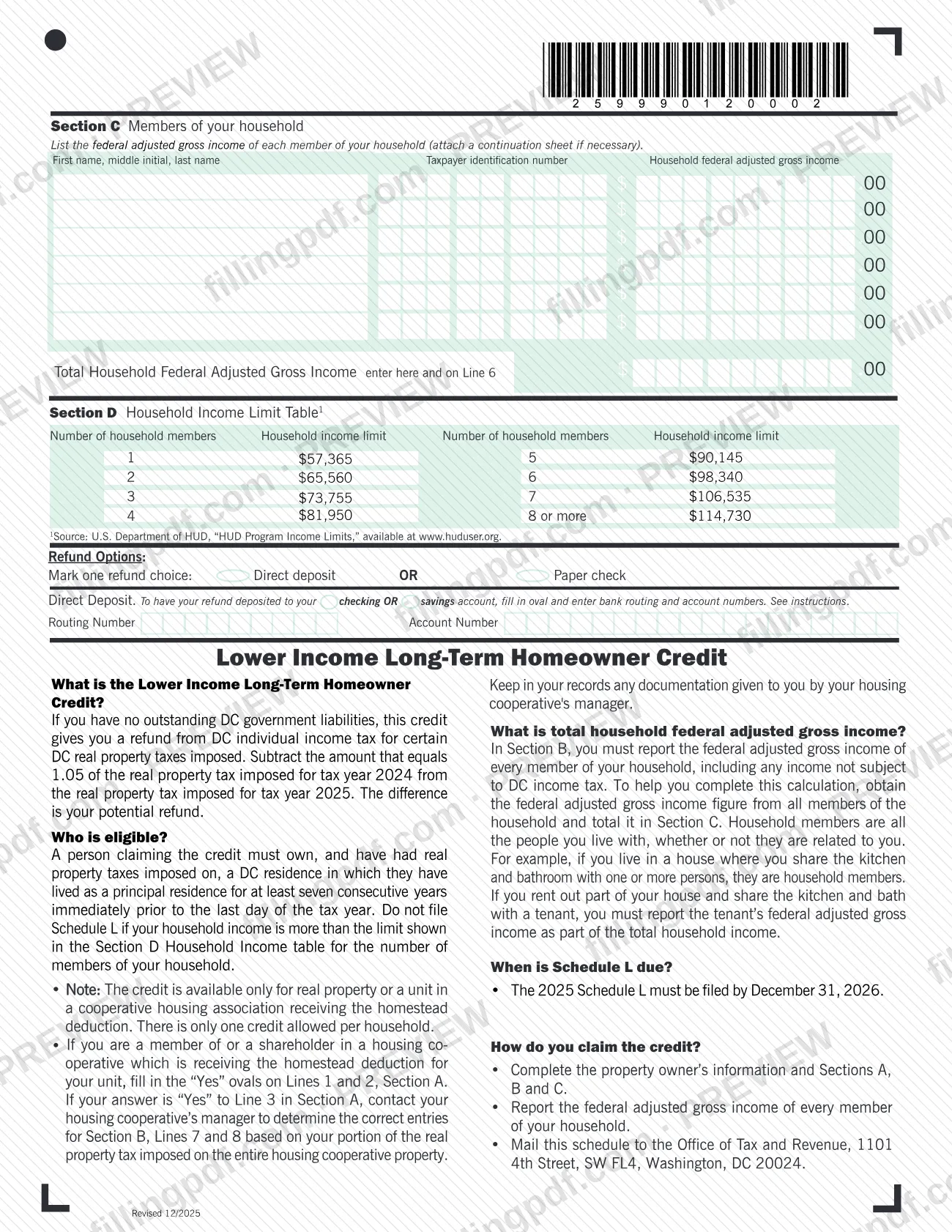
According to the form's instructions, if you have no outstanding DC government liabilities, the credit gives you a refund from DC individual income tax for certain DC real property taxes imposed. The refund is calculated by subtracting 1.05 times the real property tax imposed for tax year 2024 from the real property tax imposed for tax year 2025. The difference is your potential refund.
The schedule has four parts. The property owner's information block identifies the eligible resident owner and co-owner and the property. Section A asks three yes-or-no eligibility questions. Section B (lines 4 to 10) runs the credit calculation. Section C lists each household member's federal adjusted gross income, and Section D holds the household income limit table by number of household members. The form also asks you to choose a refund by direct deposit or paper check.
The credit is available only for real property, or a unit in a cooperative housing association, that receives the homestead deduction. Only one credit is allowed per household. Housing cooperative shareholders and members have special instructions for lines 1, 2, 7 and 8.
Who needs to file Schedule L?
A DC homeowner who has lived in the property as a principal residence for at least seven consecutive years immediately before the last day of the tax year uses Schedule L, provided the property receives the DC homestead deduction and the household income is within the limit.
To continue past Section A, you must answer Yes to all three questions: you own the property (line 1), the property is receiving the DC homestead deduction (line 2), and you have lived in it as your principal place of residence for at least seven consecutive years (line 3). A No answer to any of them means you are not eligible for the credit.
Do not file Schedule L if your total household federal adjusted gross income (line 6) is greater than the household income limit for your number of household members (line 5).
- Only one credit is allowed per household.
- Housing cooperative shareholders or members whose cooperative receives the homestead deduction for their unit mark Yes on lines 1 and 2. If line 3 is Yes, they contact the cooperative's manager for the correct entries on lines 7 and 8, based on their portion of the real property tax imposed on the whole cooperative property.
- Household members are everyone you live with, related or not, such as a person who shares your kitchen and bathroom. A tenant who shares the kitchen and bath counts too.
- A paid preparer can complete the form and enter a PTIN and phone number in the preparer block.
When to file Schedule L
The 2025 Schedule L must be filed by December 31, 2026, according to the form's instructions. The schedule is for tax year 2025, so the seven-year residency test on line 3 is measured to the last day of that tax year.
The form prints no separate rule for early or late filing and states no processing time. To claim the credit, complete the schedule and mail the signed original to the Office of Tax and Revenue as described under how to submit.
Documents you need
- A continuation sheet, attached only if your household has more members than the rows in Section C allow; it lists each member's name, taxpayer identification number and federal adjusted gross income.
How to fill out Schedule L
Enter the property owner's information
Enter the eligible resident owner's and co-owner's taxpayer identification numbers, names, daytime phone number, mailing address and email. Print in capital letters as the form directs.
Enter the property details
Fill in Square, Suffix and Lot from your real property tax bill or assessment, leaving blank any section that is blank there. Add the property address only if it differs from the mailing address.
Answer the Section A questions
Mark Yes or No for line 1 (own the property), line 2 (receiving the DC homestead deduction) and line 3 (lived there at least seven consecutive years). Continue only if all three are Yes.
List household members in Section C
For each member of your household, enter the first name, middle initial, last name, taxpayer identification number and federal adjusted gross income. Total the amounts in the box at the bottom; attach a continuation sheet if needed.
Enter household size and income limit
Line 4: the number of household members. Line 5: the household income limit from the Section D table for that number of members. Line 6: the Section C total.
Compare line 6 with line 5
If line 6 is greater than line 5, stop; you cannot claim the credit. Continue only if line 6 is equal to or less than line 5.
Enter your real property tax amounts
Line 7: DC real property tax for Tax Year 2025. Line 8: DC real property tax for Tax Year 2024. Housing cooperative members get the entries for these lines from the cooperative's manager.
Calculate the allowable credit
Line 9: multiply line 8 by 1.05. Line 10: subtract line 9 from line 7 to find the allowable credit.
Choose your refund method
Mark one: Direct deposit or Paper check. For direct deposit, fill in the checking or savings oval and enter the routing and account numbers.
Sign and date the schedule
The eligible resident owner and any co-owner sign and date under the declaration. A paid preparer enters a PTIN and phone number.
Review and download the completed PDF
Check every line, then download or print the completed PDF from FillingPDF. Mail the signed original to OTR as described under How to submit.
How to submit Schedule L
Schedule L is submitted by mail to OTR; the form names no other channel.
- By mail: send your signed and completed original schedule to Office of Tax and Revenue, 1101 4th Street, SW FL4, Washington, DC 24 — see exact address: Office of Tax and Revenue, 1101 4th Street, SW FL4, Washington, DC 20024.
Mail it so that it is filed by December 31, 2026. If you request a refund by direct deposit, fill in the oval on the form and enter your bank routing and account numbers; otherwise mark Paper check. If you used a paid preparer, the preparer's PTIN and phone number go in the preparer block on page 1. If your household has more members than Section C has rows, attach a continuation sheet. FillingPDF lets you fill out and download the PDF; submission follows the OTR channel described above.
Common mistakes to avoid
- Continuing past Section A after answering No to line 1, 2 or 3; a No on any of them means you are not eligible for the credit.
- Filing when line 6 is greater than line 5; the form says to stop and that you cannot claim the credit.
- Leaving out income of household members who are not relatives or who owe no DC income tax; Section C must include every household member and any income not subject to DC income tax.
- Leaving out a tenant who shares your kitchen and bathroom; the instructions say the tenant's federal adjusted gross income is part of total household income.
- Filling in the Square, Suffix or Lot boxes when they are blank on your tax bill or assessment; the form says to leave them blank.
- Using the wrong figures on lines 7 and 8 as a housing cooperative shareholder or member instead of getting the entries from the cooperative's manager.
- Sending a copy instead of the signed and completed original schedule to the Office of Tax and Revenue.
- Mailing the schedule after December 31, 2026.
- Skipping the refund choice or entering incomplete bank routing and account numbers when choosing direct deposit.
Frequently asked questions
What is the DC Lower Income Long-Term Homeowner Credit?
It is a refund from DC individual income tax for certain DC real property taxes imposed, claimed on Schedule L if you have no outstanding DC government liabilities. The potential refund is the 2025 real property tax minus 1.05 times the 2024 real property tax.
Who is eligible to claim the credit on Schedule L?
You must own and have had real property taxes imposed on a DC residence where you lived as a principal residence for at least seven consecutive years before the last day of the tax year. The property must receive the homestead deduction, and your household income must be within the Section D limit.
When is the 2025 Schedule L due?
The 2025 Schedule L must be filed by December 31, 2026, according to the form's instructions. Mail the signed original to the Office of Tax and Revenue so that it is filed by that date.
Where do I mail Schedule L?
Mail your signed and completed original schedule to Office of Tax and Revenue, 1101 4th Street, SW FL4, Washington, DC 20024. The form gives no other filing channel.
Whose income counts as household income on Schedule L?
Every household member's federal adjusted gross income counts, including income not subject to DC income tax. Household members are all the people you live with, related or not, including a tenant who shares your kitchen and bathroom.
Can I claim the credit if I live in a housing cooperative?
Yes, if the cooperative receives the homestead deduction for your unit. Mark Yes on lines 1 and 2, and if line 3 is Yes, ask the cooperative's manager for the correct entries on lines 7 and 8 based on your share of the property tax.
Can I fill out DC Schedule L online?
You can fill out the fillable PDF online on FillingPDF and download or print it. FillingPDF is an independent service and does not file the schedule with OTR; you mail the signed original to the Office of Tax and Revenue.
What if my household income is above the limit?
Do not file. If line 6 is greater than line 5, the form says to stop because you cannot claim the credit. The limit on line 5 comes from the Section D table and depends on how many people are in your household.
Ready to fill out Schedule L?
Fill out Schedule L now