
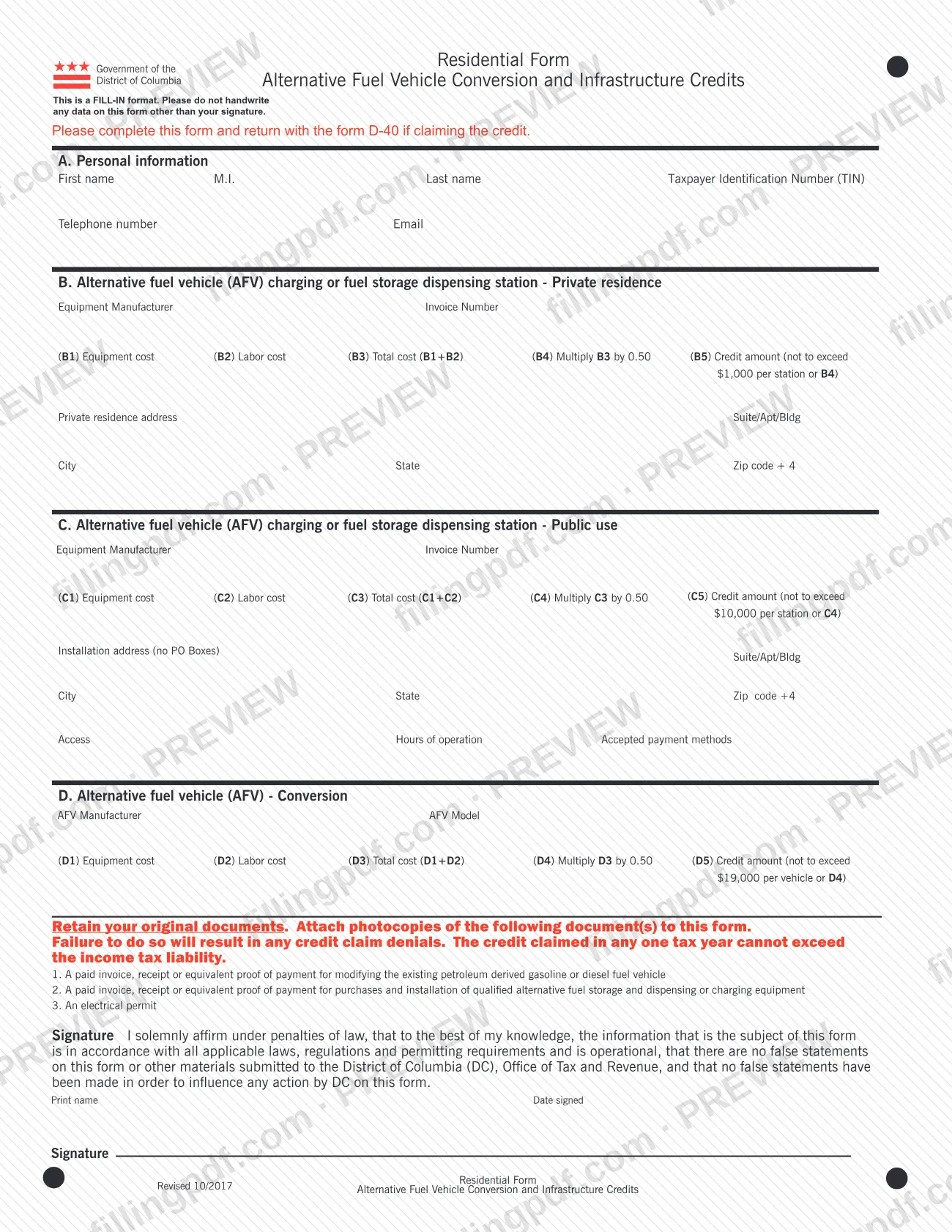
The Alternative Fuel Vehicle Infrastructure and Conversion Residential Form is the District of Columbia Office of Tax and Revenue (OTR) form used to claim the Alternative Fuel Vehicle (AFV) Conversion and Infrastructure Credits. It covers a charging or fuel storage and dispensing station at a private residence, a station open to the public, and the conversion of a gasoline or diesel vehicle. On this page you can fill out the form online on FillingPDF and download or print the completed PDF. The form is returned with Form D-40 when you claim the credit, and the original PDF is published by OTR.
Last updated
What is Alternative Fuel Vehicle Residential Credit Form – DC OTR?
The Alternative Fuel Vehicle Infrastructure and Conversion Residential Form is the Government of the District of Columbia form on which a taxpayer reports the costs of alternative fuel vehicle (AFV) charging or fuel equipment, or of a vehicle conversion, and figures the credit being claimed. OTR lists it as the 2024 edition; the printed revision line reads "Revised 10/2017".
The printed title is "Residential Form, Alternative Fuel Vehicle Conversion and Infrastructure Credits". The form has these parts:
- A. Personal information: name, telephone number and email.
- B. AFV charging or fuel storage dispensing station, private residence: equipment, manufacturer, invoice number, costs on lines B1 to B5 and the residence address.
- C. AFV charging or fuel storage dispensing station, public use: the same cost lines (C1 to C5), plus the installation address, access, hours of operation and accepted payment methods.
- A vehicle block: AFV manufacturer and model, with cost lines D1 to D5.
- Signature: an affirmation under penalties of law, with printed name and date.
On each cost block, the total cost is equipment cost plus labor cost, the total is multiplied by 0.50, and the credit amount is the lesser of that result and the per-station or per-vehicle limit printed on the form. The form states that the credit claimed in any one tax year cannot exceed the income tax liability.
The form is completed in fill-in format and is returned with Form D-40 if you are claiming the credit. It is a supporting claim form, not a tax return.
Who needs to file Alternative Fuel Vehicle Residential Credit Form – DC OTR?
Taxpayers who are claiming the AFV Conversion and Infrastructure Credits and are filing Form D-40 complete this form and return it with that return. The form's own instructions tie it to a claim: it is returned with Form D-40 "if claiming the credit".
Depending on what you paid for, you complete the matching part:
- Section B, if you installed an AFV charging or fuel storage dispensing station at a private residence.
- Section C, if you installed a station for public use. The installation address cannot be a PO Box.
- The vehicle block (lines D1 to D5), if you modified a gasoline or diesel vehicle to run on an alternative fuel.
Everyone completes Section A and signs. By signing you affirm that the information complies with applicable laws, regulations and permitting requirements, that the equipment is operational and that nothing on the form is false.
You do not need the form if you are not claiming the credit. Because the credit claimed in a tax year cannot exceed your income tax liability, the form's limit applies to what you can claim. The form says nothing about anyone signing for the taxpayer.
When to file Alternative Fuel Vehicle Residential Credit Form – DC OTR
Complete this form when you claim the credit on Form D-40, because the form says to return it with Form D-40. It prints no separate due date, so it follows the filing timing of the D-40 it accompanies; check the D-40 instructions for the due date.
You also need the paid invoice or receipt and, for equipment, the electrical permit in hand before you start, since photocopies must be attached. The credit claimed in any one tax year cannot exceed the income tax liability.
Documents you need
- Photocopy of a paid invoice, receipt or equivalent proof of payment for modifying an existing petroleum-derived gasoline or diesel fuel vehicle, when you claim the vehicle conversion credit.
- Photocopy of a paid invoice, receipt or equivalent proof of payment for the purchase and installation of qualified alternative fuel storage and dispensing or charging equipment, when you claim a station credit.
- Photocopy of an electrical permit, listed among the documents to attach to this form.
- Form D-40, which the residential form is returned with when you claim the credit.
How to fill out Alternative Fuel Vehicle Residential Credit Form – DC OTR
Fill in the form by typing
The form is in fill-in format, so enter every item electronically and handwrite nothing except your signature. Return it with Form D-40 if you claim the credit.
Complete Section A personal information
Enter your first name, M.I. and last name, then your telephone number and email.
Describe the residential station in Section B
For a station at a private residence, enter the equipment, the manufacturer and the invoice number. Complete this section only if you are claiming a residential station.
Calculate the residential credit on B1 to B5
Enter equipment cost on B1 and labor cost on B2, and add them for B3. Multiply B3 by 0.50 for B4, then enter on B5 the amount not exceeding the station limit printed on the form or B4.
Enter the private residence address
Give the private residence address, suite/apt/bldg, city, state and ZIP code + 4 of the station.
Complete Section C for public-use stations
If the station is open to the public, enter the equipment, manufacturer and invoice number, then lines C1 to C5 the same way as Section B, using the limit printed for public-use stations.
Enter the public-use installation details
Give the installation address, with no PO Boxes, plus suite/apt/bldg, city, state and ZIP code +4. Then enter access, hours of operation and accepted payment methods.
Complete the vehicle conversion lines
Enter the AFV manufacturer and AFV model, then lines D1 to D5: equipment cost, labor cost, total cost, the total multiplied by 0.50, and a credit amount that does not exceed the per-vehicle limit printed on the form or D4.
Prepare the photocopied attachments
Gather photocopies of the paid invoice, receipt or proof of payment for the vehicle modification and for the equipment, and of the electrical permit. Keep your originals.
Sign, print your name and date
Print your name, enter the date signed and sign. The signature affirms the information is accurate, lawful and operational.
Review and download the completed PDF
Check that totals, caps and addresses are correct and that the credit does not exceed your income tax liability. Download or print the completed PDF from FillingPDF and attach it with its documents to Form D-40.
How to submit Alternative Fuel Vehicle Residential Credit Form – DC OTR
This form is not filed on its own: the form says to return it with Form D-40 if you are claiming the credit. It prints no separate mailing address, portal or appointment rule.
- With Form D-40: attach the completed form to your D-40 and submit both the way the D-40 is submitted.
- Attachments: include photocopies of the required documents and keep your originals. The form warns that missing documents will result in credit claim denials.
- Signature: sign the form; it is the only item that may be handwritten.
For the D-40 filing channels and addresses, use OTR's D-40 instructions and the OTR website. FillingPDF lets you fill out and download the PDF; submission follows the OTR channels used for Form D-40.
Common mistakes to avoid
- Handwriting entries on the form; it is a fill-in format, and only your signature may be handwritten.
- Leaving out the photocopies of the invoice or receipt or the electrical permit; the form says missing documents result in credit claim denials.
- Sending original documents instead of photocopies; the form tells you to retain your originals.
- Submitting the form without Form D-40 when claiming the credit; it is meant to be returned with the D-40.
- Entering a PO Box as the installation address in the public-use section; the form says no PO Boxes.
- Entering a credit amount above the limit printed on the form for the station or vehicle instead of the lesser of that limit and the result of line B4, C4 or D4.
- Claiming more credit in a tax year than your income tax liability, which the form says cannot be exceeded.
- Signing for equipment that is not operational or that lacks required permits, when the signature affirms compliance and that the equipment is operational.
- Leaving the signature, printed name or date signed blank.
Frequently asked questions
What is the DC Alternative Fuel Vehicle Infrastructure and Conversion Residential Form?
It is the OTR form used to claim the Alternative Fuel Vehicle Conversion and Infrastructure Credits. It records costs for a residential or public-use charging or fuel station and for a vehicle conversion, and it is returned with Form D-40.
Is this a DC property tax form?
No. Although people may find it while searching for dc property tax, the form ties the credit to Form D-40 and to income tax liability, and it is returned with the D-40, not with a property tax filing.
Do I have to attach documents to this form?
Yes. Attach photocopies of the paid invoice, receipt or equivalent proof of payment for the vehicle modification and for the equipment, plus an electrical permit. Keep your originals. The form warns that failing to attach them results in denial of credit claims.
Where do I send the AFV credit residential form?
Return it with Form D-40 if you are claiming the credit. The form prints no separate address or portal, so follow the OTR instructions for submitting Form D-40.
Is there a deadline for this form?
No separate due date is printed on it. It is returned with Form D-40, so check the D-40 instructions for the filing deadline.
Is there a limit on the credit I can claim?
Yes. Each cost block caps the credit at the lesser of half of total cost (line 4) and a per-station or per-vehicle limit printed on the form. In any one tax year the credit also cannot exceed your income tax liability.
Can I handwrite this form?
No. The form says it is in fill-in format and that nothing should be handwritten except your signature. Complete it electronically, then print and sign it.
Can I fill out this form online on FillingPDF?
Yes. You can fill out the PDF online on FillingPDF and download or print it. FillingPDF is independent of OTR and does not file the form; you return it with Form D-40 through OTR's channels.
Ready to fill out Alternative Fuel Vehicle Residential Credit Form – DC OTR?
Fill out Alternative Fuel Vehicle Residential Credit Form – DC OTR now