
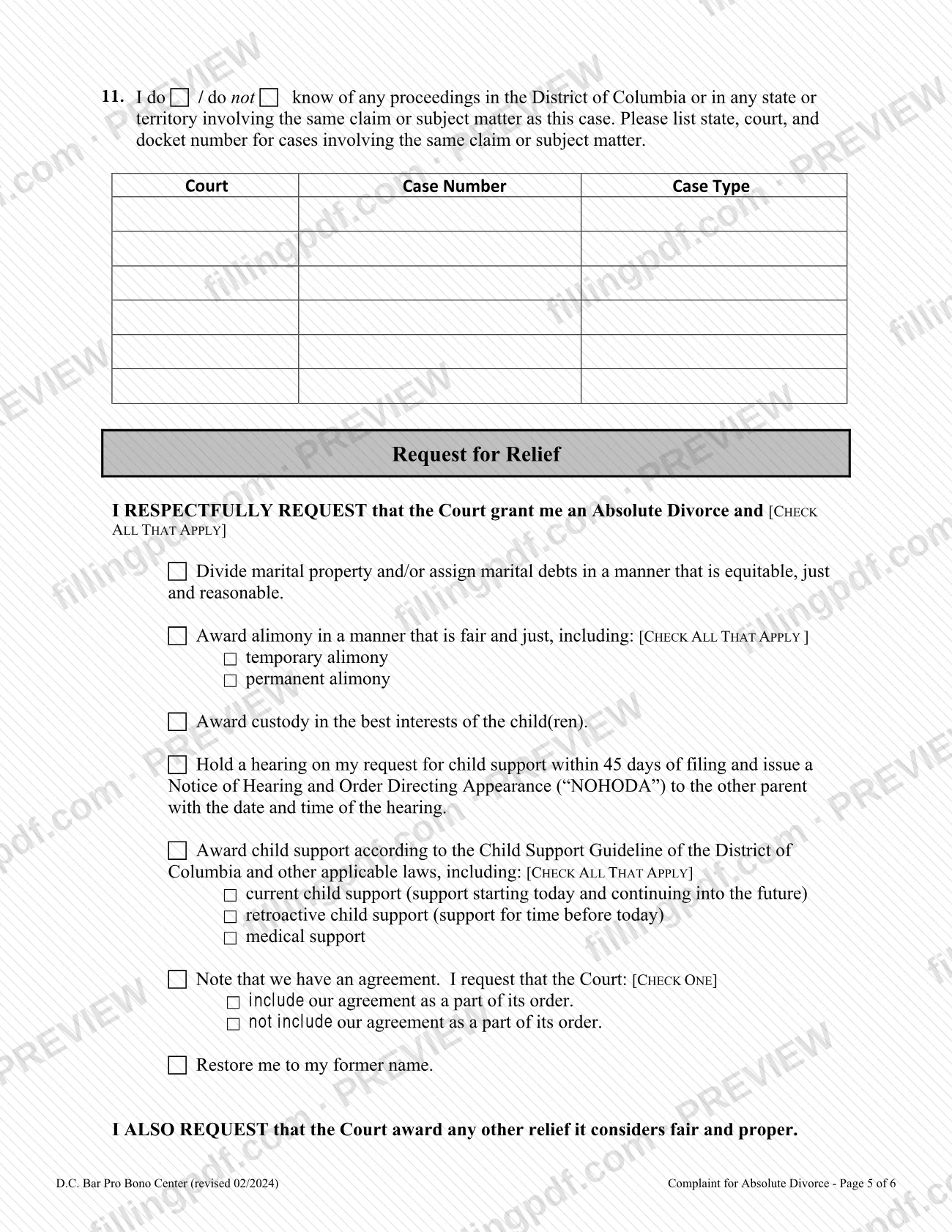
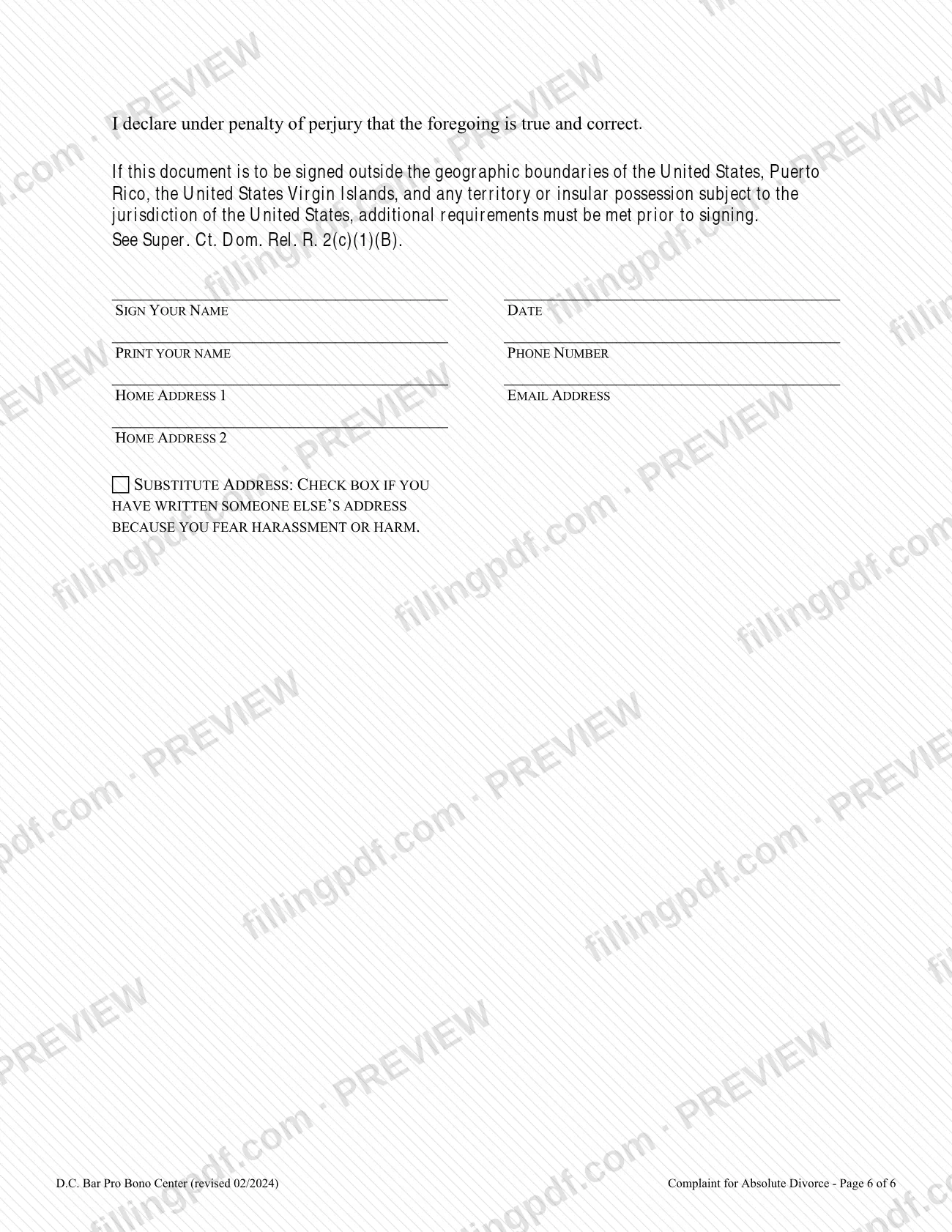
The Complaint for Divorce is the form a spouse uses to ask the Superior Court of the District of Columbia, Family Court, Domestic Relations Branch, to end a marriage and decide related matters such as property, debt, alimony, custody and child support. The PDF is printed under the title Complaint for Absolute Divorce, runs six pages and refers to Attachments A, B and C for the property, custody and support details. On FillingPDF you can fill out the form online and download or print the completed PDF; the official PDF is published by the D.C. Courts.
Last updated
What is Complaint for Divorce – District of Columbia?
The Complaint for Divorce is the form on which a spouse, as plaintiff, asks the Superior Court of the District of Columbia for an absolute divorce and related relief such as division of property and debt, alimony, custody and child support.
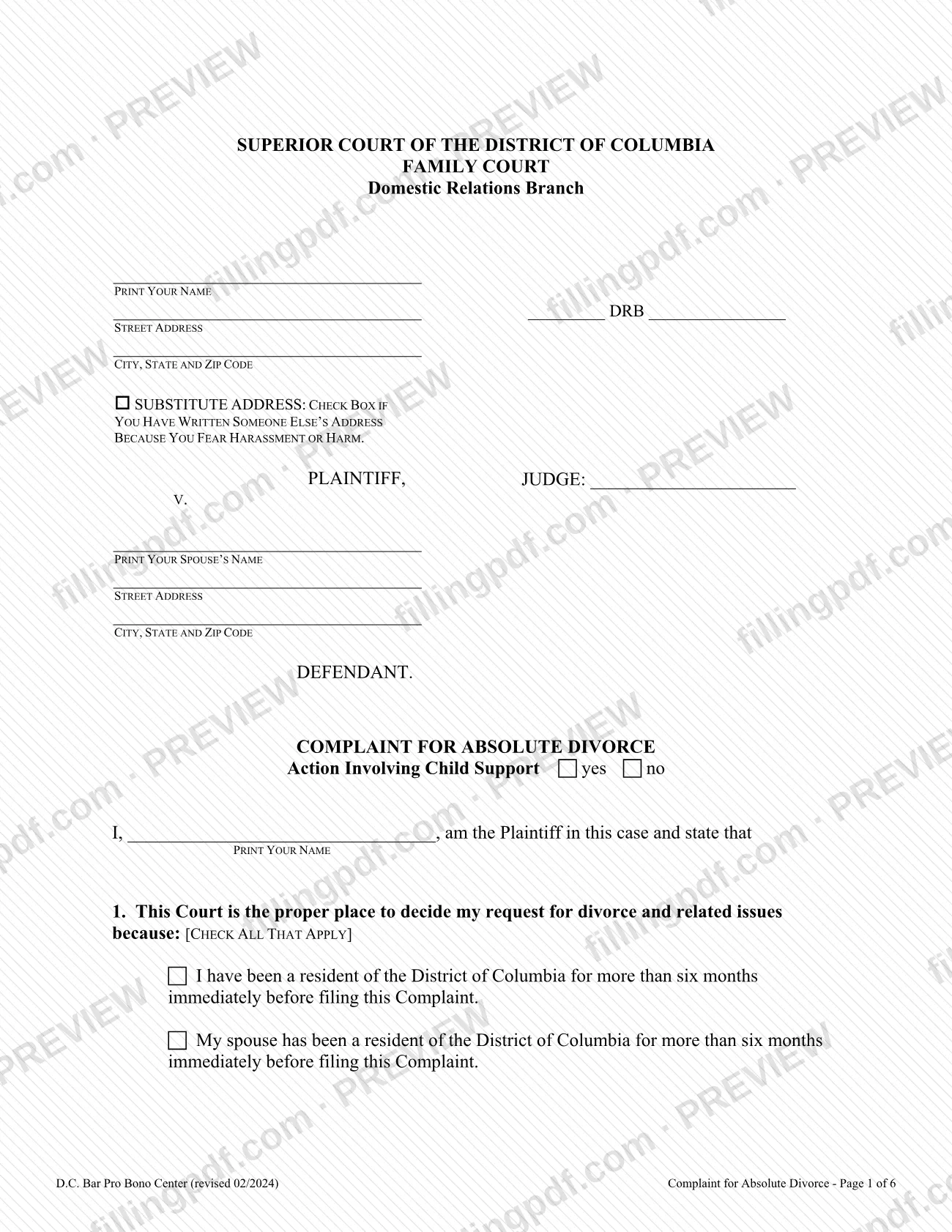
The PDF carries the caption of the Superior Court of the District of Columbia, Family Court, Domestic Relations Branch, and its printed title is Complaint for Absolute Divorce. The footer credits the D.C. Bar Pro Bono Center, shows "revised 02/2024" and numbers the pages 1 to 6. The D.C. Courts forms page describes it as a form to ask the court to end your marriage and handle related matters like child support.
The plaintiff answers numbered items, and in most of them chooses between saying there is nothing to decide, saying there is an agreement, or asking the court to decide:
- Item 1: why the court is the proper place (residency).
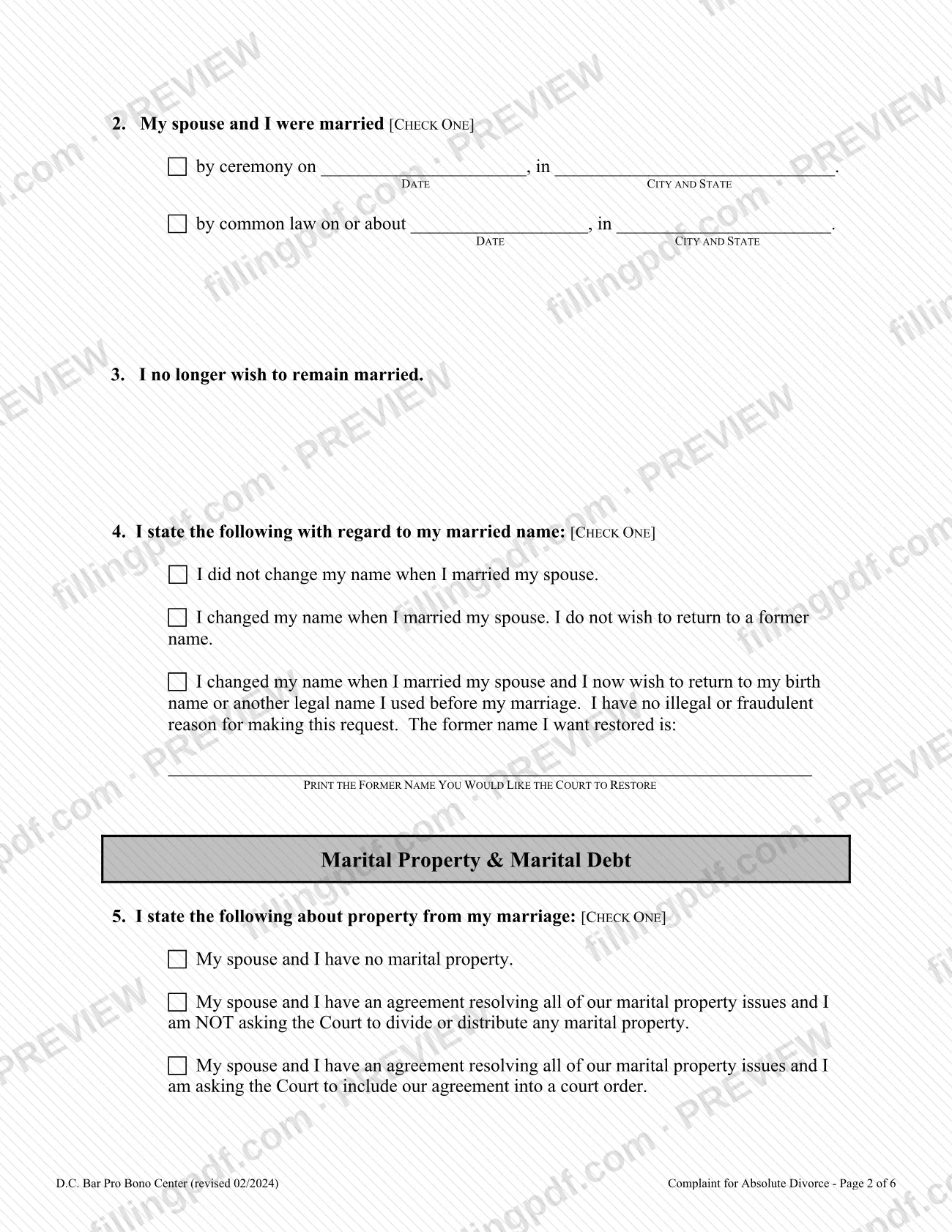
- Items 2 and 3: how and where the couple married, and that the plaintiff no longer wishes to remain married.
- Item 4: married name, including a request to return to a former name.
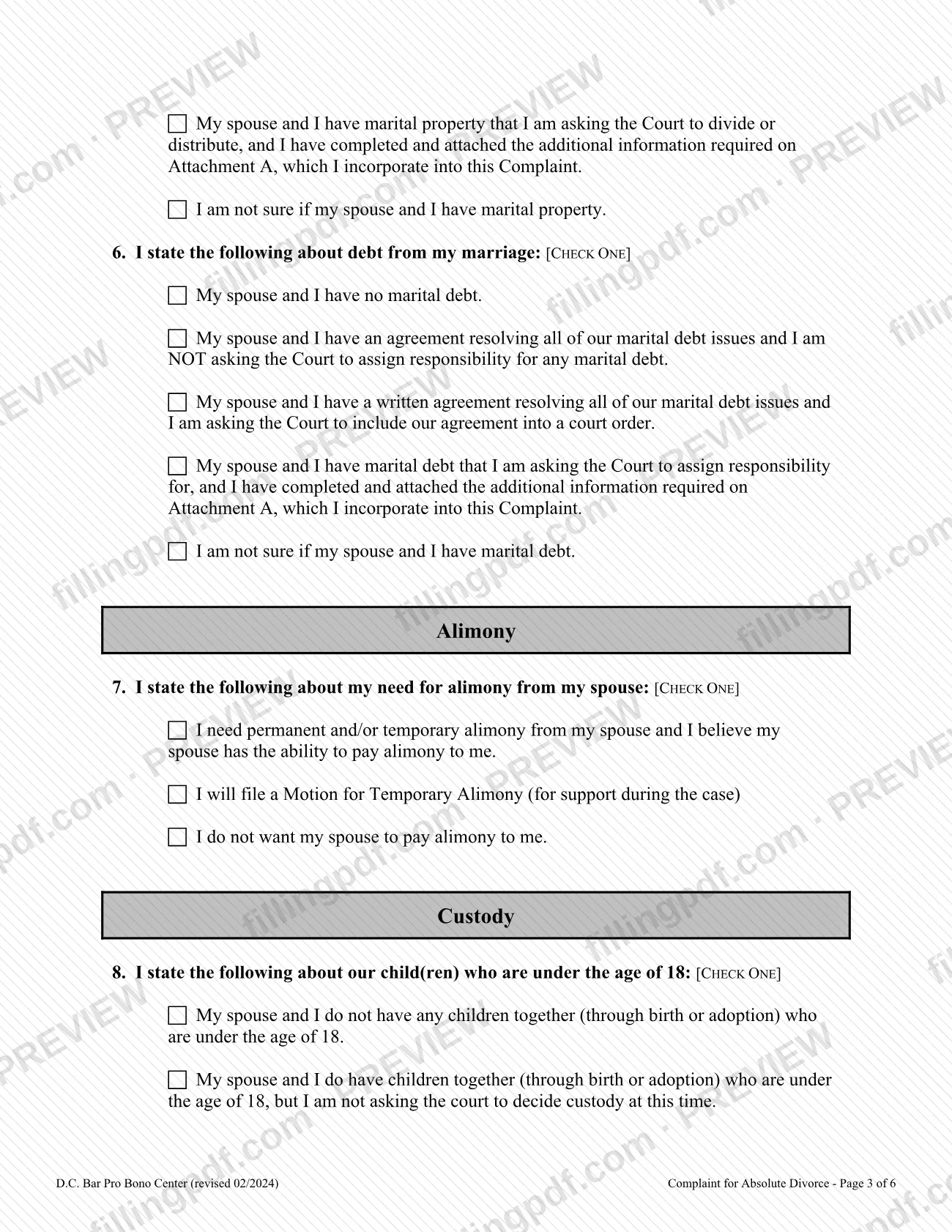
- Items 5 and 6: marital property and marital debt.
- Item 7: alimony.
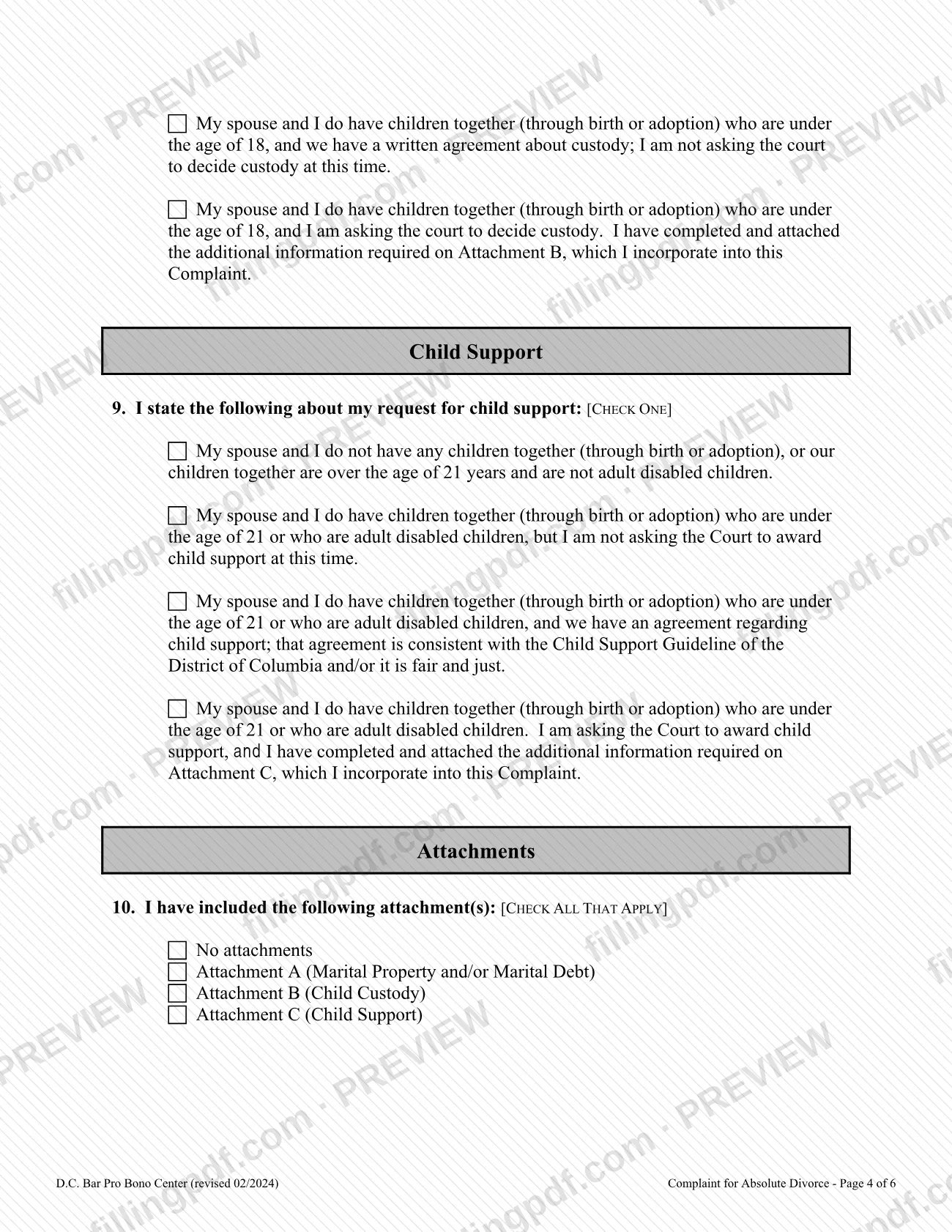
- Items 8 and 9: custody of children under 18 and child support.
- Items 10 and 11: attachments and other proceedings on the same subject.
A Request for Relief section and a declaration under penalty of perjury close the form. Property and debt details go on Attachment A, custody on Attachment B and child support on Attachment C. A request for temporary alimony during the case is made by a separate Motion for Temporary Alimony. The court's forms page offers the form in English, Spanish and Amharic.
Who needs to file Complaint for Divorce – District of Columbia?
The spouse who wants to start the divorce case files the Complaint for Divorce as the plaintiff; the other spouse is named as the defendant. The form is for a marriage entered into by ceremony or by common law, and the plaintiff states that he or she no longer wishes to remain married.
The court must be the proper place for the case. Item 1 lets you check each statement that applies: you have been a resident of the District of Columbia for more than six months immediately before filing, or your spouse has.
The form also serves a plaintiff who wants the court to handle related issues. You use it if you want to:
- have the court divide marital property or assign marital debt;
- ask for permanent or temporary alimony;
- ask the court to decide custody of children under 18;
- ask for child support for children under 21 or adult disabled children;
- return to a former name.
If you and your spouse already have agreements, or you are not asking the court to decide an issue, you check the matching option instead. The form allows a substitute address if you fear harassment or harm. If you sign outside the United States, Puerto Rico, the U.S. Virgin Islands or another U.S. territory or possession, additional requirements apply under Super. Ct. Dom. Rel. R. 2(c)(1)(B).
When to file Complaint for Divorce – District of Columbia
File the Complaint for Divorce when you are ready to ask the court to end your marriage and you meet the residency statement in item 1: you or your spouse must have been a resident of the District of Columbia for more than six months immediately before filing the complaint. The form sets no other deadline.
Some timing points come from the form itself. If you ask for a hearing on child support in the Request for Relief, the form asks the court to hold it within 45 days of filing and to issue a Notice of Hearing and Order Directing Appearance ("NOHODA") to the other parent. If you want support during the case, the alimony item says you will file a separate Motion for Temporary Alimony.
Complete any attachment the form calls for before you file, because items 5, 6, 8 and 9 each say the additional information must be completed and attached.
Documents you need
- Attachment A (Marital Property and/or Marital Debt): complete and attach it if, in item 5 or 6, you ask the court to divide marital property or assign responsibility for marital debt.
- Attachment B (Child Custody): complete and attach it if, in item 8, you ask the court to decide custody of children under 18.
- Attachment C (Child Support): complete and attach it if, in item 9, you ask the court to award child support.
- Written statement or details of any related case: item 11 asks you to list the state, court, docket number and case type of any proceeding on the same claim or subject matter, if you know of one.
How to fill out Complaint for Divorce – District of Columbia
Complete the caption for both spouses
Print your name, street address, and city, state and ZIP code as plaintiff, then your spouse's name and address as defendant. Check the SUBSTITUTE ADDRESS box only if you wrote someone else's address because you fear harassment or harm.
Mark the child support action box
Under the title, answer Action Involving Child Support with yes or no. Print your name on the line that begins "I, ... am the Plaintiff."
Check the residency statement
In item 1, check all that apply: you, your spouse or both have been residents of the District of Columbia for more than six months immediately before filing.
Enter the marriage details
In item 2, check by ceremony or by common law, then enter the date and the city and state. Item 3, that you no longer wish to remain married, needs no entry.
Choose your married name option
In item 4, check one: you did not change your name, you changed it and do not wish to return to a former name, or you want a former name restored. For the last option, print the former name on the line provided.
State your property and debt position
In items 5 and 6, check one option each: none, an agreement you are not asking the court to enforce, an agreement you want included in a court order, property or debt for the court to decide, or not sure. If you ask the court to decide, complete Attachment A.
Answer the alimony question
In item 7, check one: you need permanent and/or temporary alimony, you will file a Motion for Temporary Alimony, or you do not want alimony.
Complete custody and child support items
In item 8, choose the statement about children under 18 that fits; complete Attachment B if you ask the court to decide custody. In item 9, do the same for child support and Attachment C.
List your attachments
In item 10, check No attachments or each of Attachment A, B and C that you include.
Disclose related proceedings
In item 11, mark whether you do or do not know of other proceedings with the same claim or subject matter. If you do, list the court, case number and case type.
Select the relief you request
In the Request for Relief, check all that apply: property and debt, alimony (temporary, permanent), custody, a child support hearing within 45 days, child support types, whether the agreement is included in the order, and restoring your former name.
Sign, date and add contact details
On page 6, sign (adding slashes either side of your name to sign electronically), date, print your name and enter phone number, home address 1 and 2, and email. Check the substitute address box if it applies.
Review and download the completed PDF
Check that every CHECK ONE item has one box and every attachment you need is complete. Download or print the completed PDF from FillingPDF and file it as described under How to submit.
How to submit Complaint for Divorce – District of Columbia
The Complaint for Divorce is filed with the Superior Court of the District of Columbia, Family Court, Domestic Relations Branch, the court named in its caption; the form itself prints no address, portal or appointment rule.
- Forms page: the D.C. Courts page at https://www.dccourts.gov/court-resources/search-forms/complaint-divorce offers the form in English, Spanish and Amharic.
- Signature: sign and date page 6. The form lets you sign electronically by adding slashes on either side of your name, like /this/. If you sign outside the United States or its territories, additional requirements apply under Super. Ct. Dom. Rel. R. 2(c)(1)(B).
- Attachments: include Attachment A, B or C if you checked it in item 10.
FillingPDF lets you fill out and download the PDF; submission follows the court's channels.
Common mistakes to avoid
- Leaving both residency boxes in item 1 unchecked; the court is the proper place only if you or your spouse lived in the District of Columbia for more than six months immediately before filing.
- Checking more than one box in an item that says CHECK ONE, such as items 2, 4, 5, 6, 7, 8 and 9.
- Asking the court to divide property, assign debt, decide custody or award child support without completing and attaching Attachment A, B or C.
- Checking attachments in item 10 that do not match the options chosen in items 5, 6, 8 and 9, or checking No attachments when an attachment is required.
- Choosing the name-restoration option in item 4 without printing the former name you want restored, or forgetting the matching Restore me to my former name box in the Request for Relief.
- Not listing the court, case number and case type in item 11 when you do know of another proceeding on the same claim or subject matter.
- Typing a name to sign electronically without slashes on either side, as the signature line instructs.
- Signing outside the United States or its territories without meeting the additional requirements under Super. Ct. Dom. Rel. R. 2(c)(1)(B).
Frequently asked questions
What is a complaint for divorce in DC Superior Court?
It is the form a spouse files as plaintiff to ask the Superior Court of the District of Columbia for an absolute divorce. It also lets you ask the court to handle property, debt, alimony, custody, child support and a return to a former name. Its printed title is Complaint for Absolute Divorce.
Who can file the Complaint for Divorce in the District of Columbia?
A married spouse who states that he or she no longer wishes to remain married and that the court is the proper place. Item 1 requires that you, your spouse or both have been a District of Columbia resident for more than six months immediately before filing.
Do I have to attach anything to the Complaint for Divorce?
Only what your answers require. Attachment A covers marital property and debt you ask the court to decide, Attachment B covers custody and Attachment C covers child support. If you ask for none of these, you check No attachments in item 10.
Can I sign the Complaint for Divorce electronically?
The signature line says to add slashes on either side of your name, like /this/, to sign electronically. If you sign outside the United States, Puerto Rico, the U.S. Virgin Islands or another U.S. territory, extra requirements apply under Super. Ct. Dom. Rel. R. 2(c)(1)(B).
What if my spouse and I already agree on property or custody?
Check the option for an agreement. For property and debt you can say you are not asking the court to divide anything, or ask the court to include the agreement in a court order. Custody and child support have similar options, and the Request for Relief lets you ask for the agreement to be included or not.
Can I ask to go back to my former name on this form?
Yes. In item 4, check the option for returning to your birth name or another legal name used before marriage, state that you have no illegal or fraudulent reason, and print the former name. Then check Restore me to my former name in the Request for Relief.
Can I use a different address on the complaint?
Yes, if you fear harassment or harm. Write someone else's address and check the SUBSTITUTE ADDRESS box in the caption and again by your home address on page 6. The form gives no further rules for this option.
Is the Complaint for Divorce available in Spanish?
The D.C. Courts forms page lists the Complaint for Divorce for download in English, Spanish and Amharic. This page covers the English version.
Can I fill out the Complaint for Divorce online?
You can fill out the PDF online on FillingPDF and download or print it. FillingPDF is an independent service and does not file the complaint with the court; you file it through the court's own channels.
Ready to fill out Complaint for Divorce – District of Columbia?
Fill out Complaint for Divorce – District of Columbia now