
The confidential information form is a Superior Court of the District of Columbia form on which a party gives the court identifying details that must not appear in the public record. Under Administrative Order 15-14, a party filing a case in the Superior Court submits it with any initial pleading except a charging document. On this page you can fill out the form online on FillingPDF and download or print the completed PDF; the official PDF is published by the District of Columbia Courts at dccourts.gov.
Last updated
What is Confidential Information Form – District of Columbia?
The Confidential Information Form is the Superior Court of the District of Columbia form used to give the court private information about the people in a case, such as date of birth, Social Security number or Taxpayer Identification Number, and driver's license number, without placing it in the public record.
The notice printed on the form, citing Superior Court Administrative Order 15-14, says that any date of birth, Social Security number or driver's license number provided is kept confidential, is not made part of any public record and is used only for the Court's internal business purposes. The form is not kept in the case file. It is returned to the filer or destroyed after the information is entered into the Court's case management system.
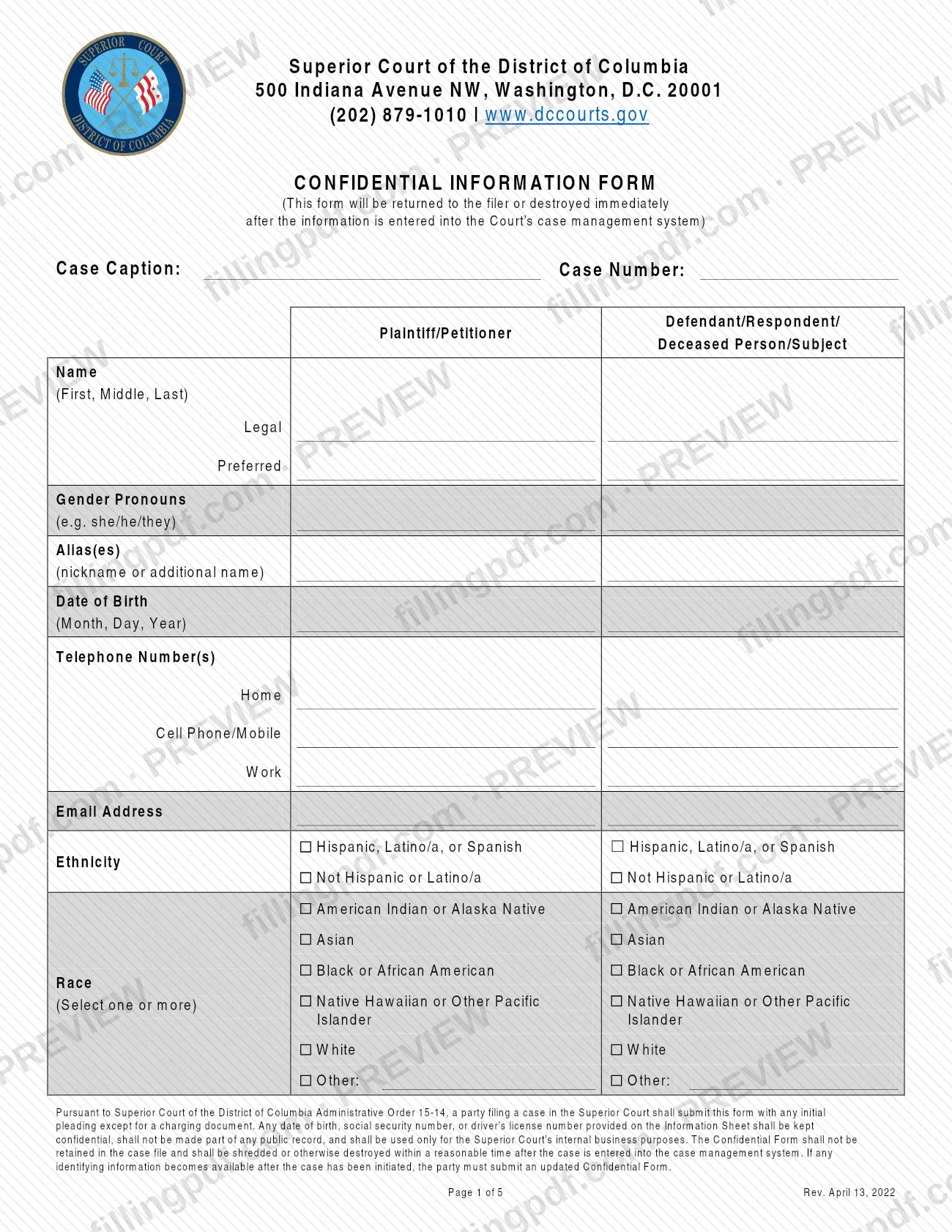
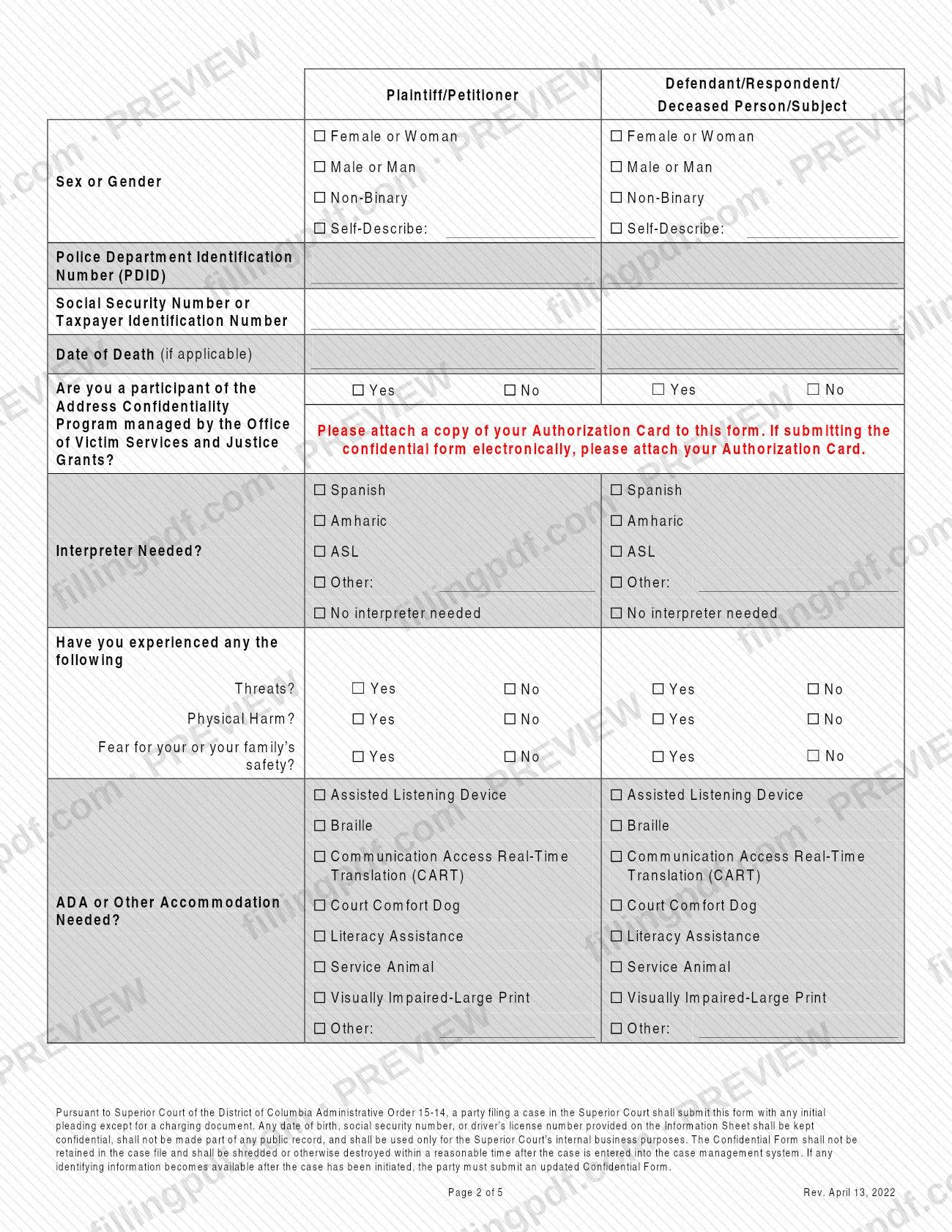
The five-page form has a general part for every filer (case caption, names, contact details, ethnicity and race, sex or gender, PDID, Social Security or Taxpayer Identification Number, Address Confidentiality Program participation, interpreter needs, safety questions and ADA or other accommodations). It adds a Domestic Violence Cases Only part and a Family Court Cases Only part.
The District of Columbia Courts page for the form lists downloadable versions in English, Spanish and Amharic. It is not a charging document and is not filed in place of the initial pleading.
Who needs to file Confidential Information Form – District of Columbia?
A party filing a case in the Superior Court of the District of Columbia submits this form with any initial pleading, except a charging document. Charging documents are excluded.
- Plaintiffs, petitioners, defendants and respondents: the form has a column for each role, and it also has a column for a deceased person or subject of the case.
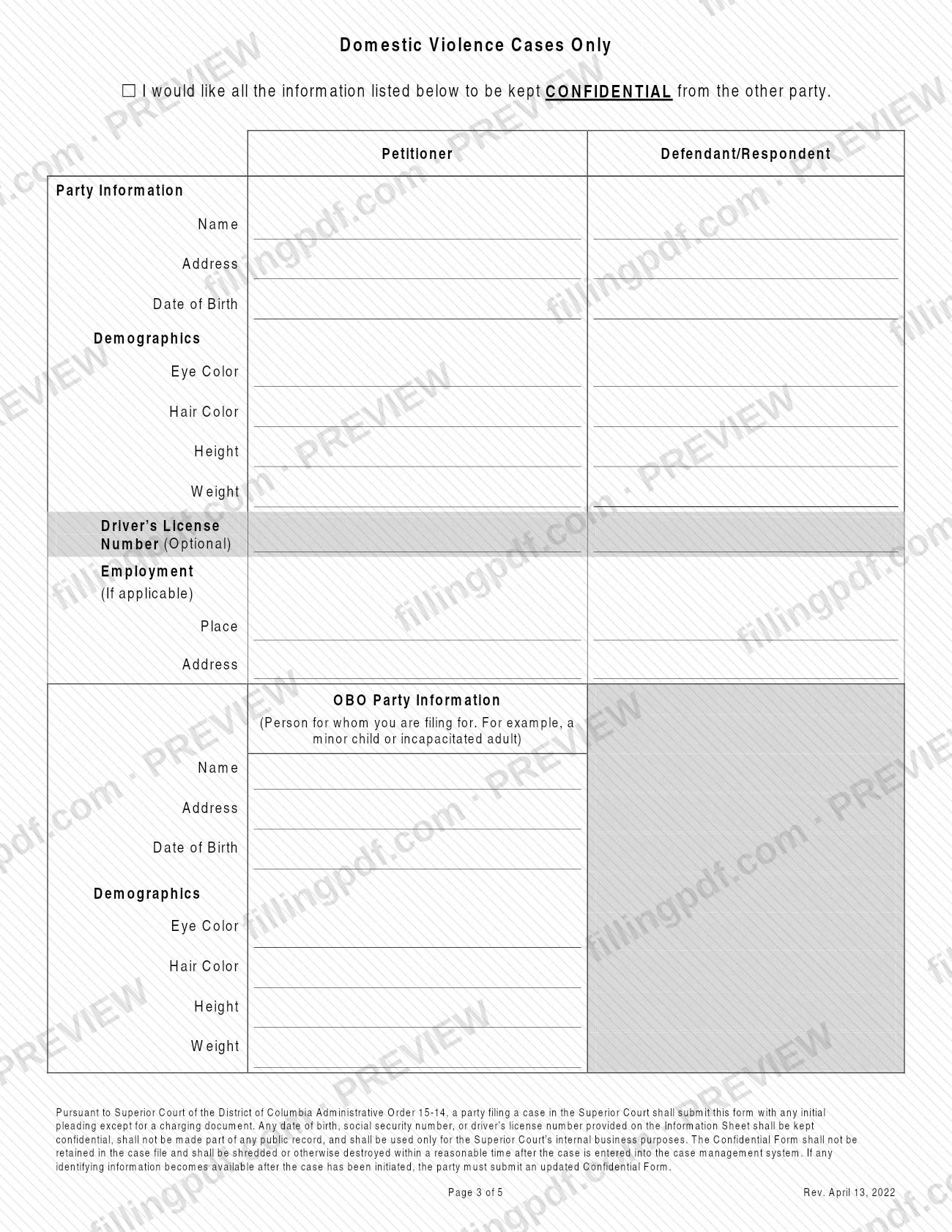
- Domestic violence filers: complete the Domestic Violence Cases Only pages (party information, a box to keep the listed information confidential from the other party, and additional questions). The form asks for the details of a person you file for, such as a minor child or incapacitated adult, in the OBO Party Information block.
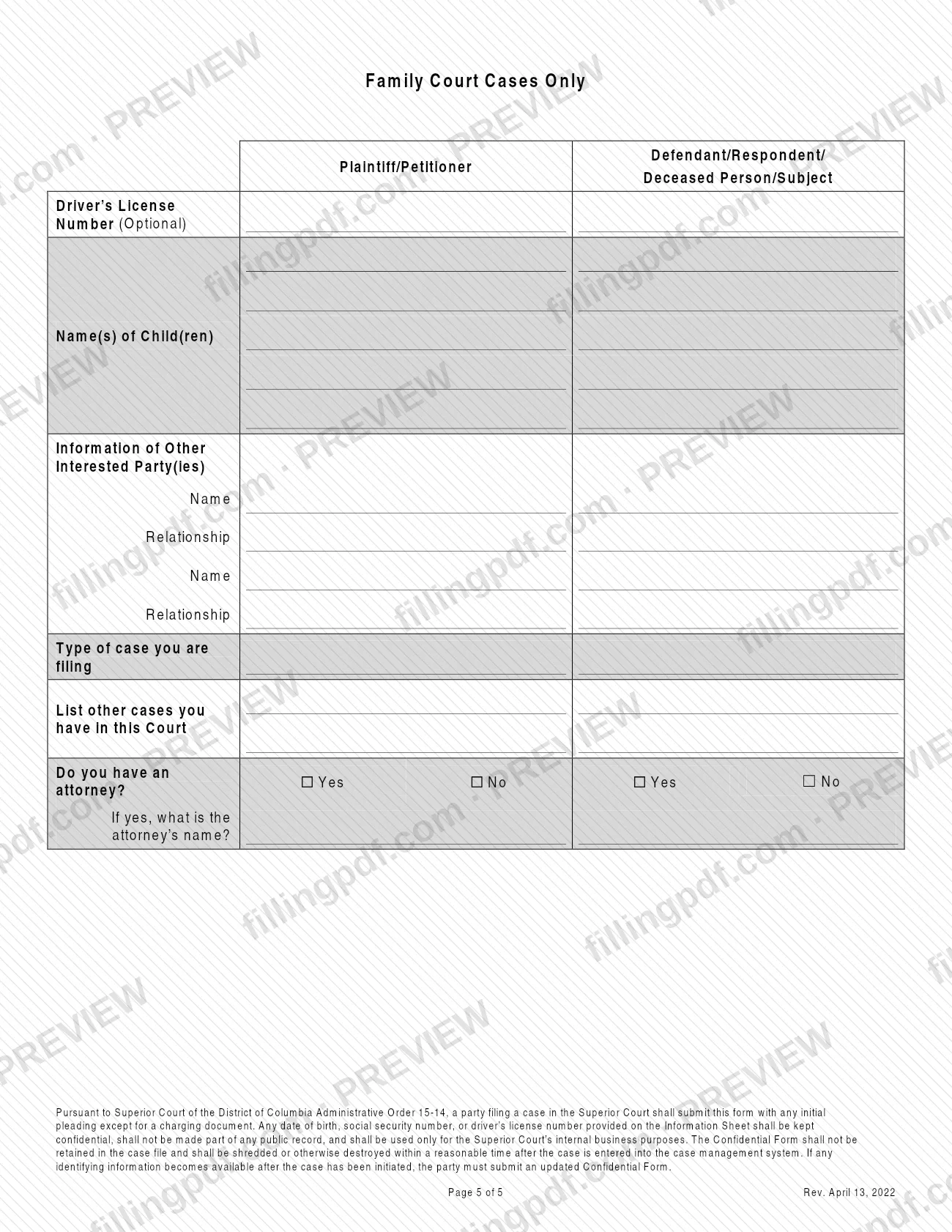
- Family Court filers: complete the Family Court Cases Only page (children's names, other interested parties, type of case, other cases in this Court and whether you have an attorney).
- Participants in the Address Confidentiality Program managed by the Office of Victim Services and Justice Grants must attach a copy of their Authorization Card.
Parties who need an interpreter or an ADA or other accommodation can say so on the form. If identifying information becomes available after the case has started, the party must submit an updated form.
When to file Confidential Information Form – District of Columbia
Submit the form together with your initial pleading when you file a case in the Superior Court of the District of Columbia. Administrative Order 15-14, cited on the form, excludes a charging document from this rule.
The duty does not end with the first filing. If any identifying information becomes available after the case has been initiated, the party must submit an updated Confidential Information Form. The form prints no other deadline.
The Court does not keep the form in the case file: it is returned to the filer or destroyed after the information is entered into the case management system.
Documents you need
- A copy of your Authorization Card, only if you answer Yes to participating in the Address Confidentiality Program managed by the Office of Victim Services and Justice Grants; attach it electronically if you submit the form electronically.
How to fill out Confidential Information Form – District of Columbia
Enter the case caption and number
At the top of page 1, write the Case Caption and the Case Number. These identify the case the form belongs to.
Choose the correct party column
Use the column for Defendant/Respondent/Plaintiff/Petitioner for the filer or party, and the Deceased Person/Subject column when the form asks about that person.
Enter names and contact details
Give the legal name (First, Middle, Last), a preferred name, gender pronouns (for example she/he/they), any alias, date of birth (Month, Day, Year), home, cell/mobile and work telephone numbers, and an email address.
Select ethnicity and race
Check one ethnicity option. For Race, select one or more options, or enter a description next to Other.
Complete sex or gender and identifiers
On page 2, check Female or Woman, Male or Man, Non-Binary or Self-Describe. Then enter the Police Department Identification Number (PDID), the Social Security Number or Taxpayer Identification Number and, if applicable, the Date of Death.
Answer the Address Confidentiality Program question
Check Yes or No for participation in the Address Confidentiality Program managed by the Office of Victim Services and Justice Grants. If Yes, attach a copy of your Authorization Card.
Mark interpreter, safety and accommodation items
Check the interpreter language (Spanish, Amharic, ASL, Other) or No interpreter needed. Answer Yes or No on Threats, Physical Harm and Fear for your or your family's safety, then check any ADA or Other Accommodation needed.
Complete the domestic violence pages
Only in a domestic violence case, use page 3 to enter the Petitioner and Defendant/Respondent details (name, address, date of birth, eye color, hair color, height, weight, optional driver's license number, employment) and the OBO Party Information. Check the box if you want the information kept CONFIDENTIAL from the other party.
Answer the additional domestic violence questions
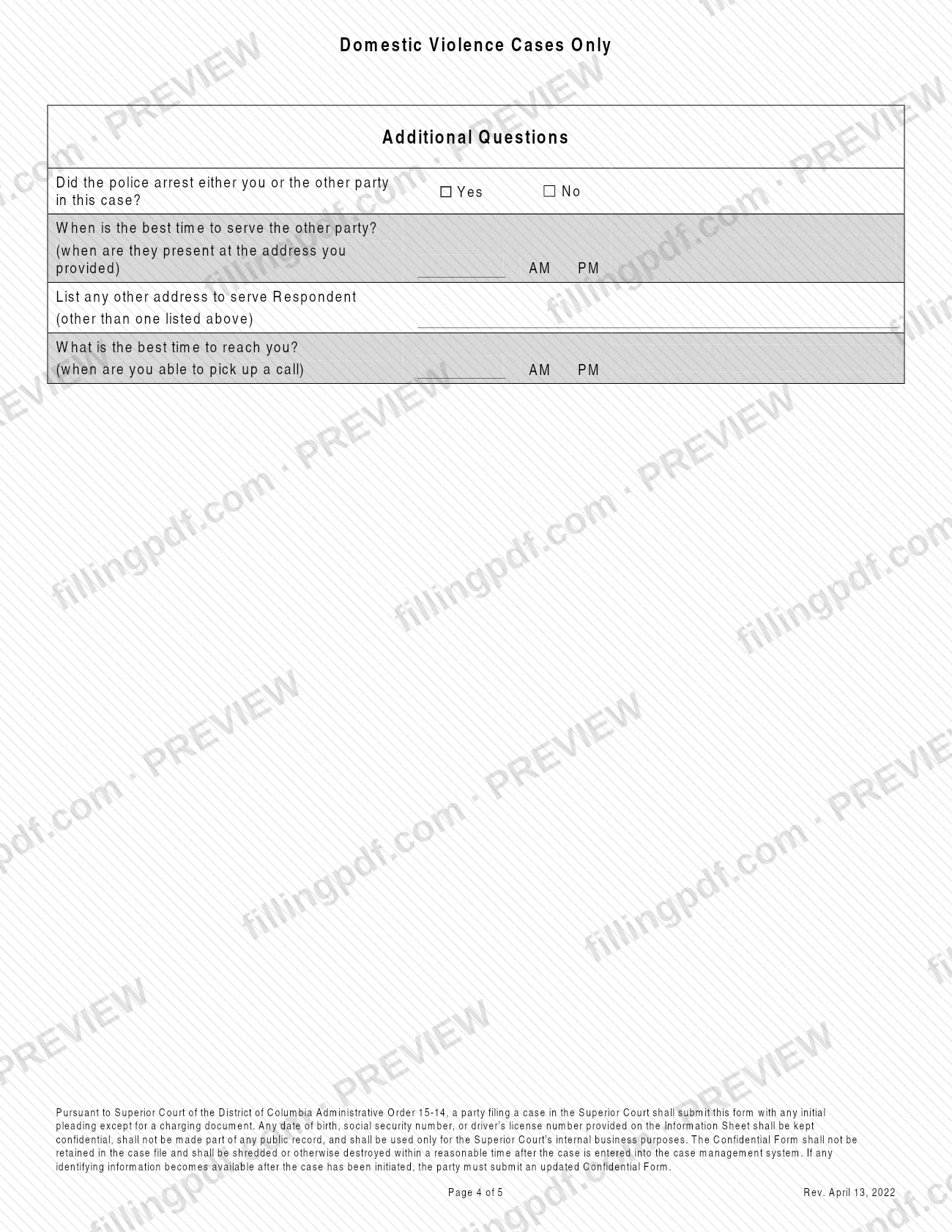
On page 4, say whether the police arrested either party, the best time to serve the other party (AM or PM), any other address to serve the Respondent, and the best time to reach you.
Complete the Family Court page
Only in a Family Court case, use page 5 for the optional driver's license number, children's names, other interested parties and their relationship, the type of case, other cases in this Court, and whether you have an attorney and their name.
Review and download the completed PDF
Check every page that applies and attach your Authorization Card if required. Download or print the completed PDF from FillingPDF and submit it with your initial pleading through the Court's channels.
How to submit Confidential Information Form – District of Columbia
The form is submitted with the initial pleading you file in the Superior Court; it has no separate filing address or portal of its own. The form mentions that it can be submitted electronically, and the court's address and telephone number on its first page are:
- Court: Superior Court of the District of Columbia, 500 Indiana Avenue NW, Washington, D.C. 20001
- Telephone: (202) 879-1010
- Website: www.dccourts.gov
If you take part in the Address Confidentiality Program, attach a copy of your Authorization Card to the form; when you submit the form electronically, attach the card electronically. After the information is entered into the Court's case management system, the form is returned to you or destroyed. FillingPDF lets you fill out and download the PDF; submission follows the Court's channels above.
Common mistakes to avoid
- Leaving the form out of the package when filing an initial pleading; Administrative Order 15-14 requires it with any initial pleading except a charging document.
- Answering Yes to the Address Confidentiality Program question without attaching a copy of your Authorization Card.
- Not submitting an updated form when identifying information becomes available after the case has been initiated.
- Filling in the Domestic Violence Cases Only or Family Court Cases Only pages in a case that is neither; each page is marked for its own case type.
- Skipping the box asking that the listed information be kept CONFIDENTIAL from the other party in a domestic violence case where you want that protection.
- Expecting the Court to keep the form in the case file; it is returned to the filer or destroyed after the data is entered.
- Entering the filer's details in the wrong column; the form has separate columns for the Defendant/Respondent/Plaintiff/Petitioner and for the Deceased Person/Subject.
Frequently asked questions
What is the Confidential Information Form for DC Superior Court?
It is a Superior Court of the District of Columbia form for giving the court private details about the people in a case, such as date of birth, Social Security number and driver's license number. The court keeps them out of the public record and uses them only for internal business purposes.
Who has to submit the confidential information form?
A party filing a case in the Superior Court submits it with any initial pleading, except a charging document, under Administrative Order 15-14. Domestic violence filers and Family Court filers also complete the pages marked for their case type.
Does the confidential information form become part of the public record?
No. The form says the date of birth, Social Security number and driver's license number are kept confidential and not made part of any public record. The form is not retained in the case file and is returned to the filer or destroyed after data entry.
What if new identifying information comes up after I file?
Submit an updated Confidential Information Form. The notice on the form says that if any identifying information becomes available after the case has been initiated, the party must submit an updated form.
Do I need to attach anything to the form?
Only if you participate in the Address Confidentiality Program managed by the Office of Victim Services and Justice Grants. Then you attach a copy of your Authorization Card, and you attach it electronically if you submit the form electronically.
Is the confidential information form available in Spanish or Amharic?
Yes. The District of Columbia Courts page for the form offers downloads in English, Spanish and Amharic. The form itself also lets you mark an interpreter need for Spanish, Amharic, ASL or another language.
Which parts are only for domestic violence or Family Court cases?
Pages 3 and 4 are marked Domestic Violence Cases Only, and page 5 is marked Family Court Cases Only. Complete them only if your case is of that type; the general pages 1 and 2 apply to every filer.
Can I fill out the confidential information form online?
You can fill out the PDF online on FillingPDF and download or print it. FillingPDF is independent of the Court and does not file the form; you submit it with your initial pleading through the Court's channels.
Ready to fill out Confidential Information Form – District of Columbia?
Fill out Confidential Information Form – District of Columbia now