
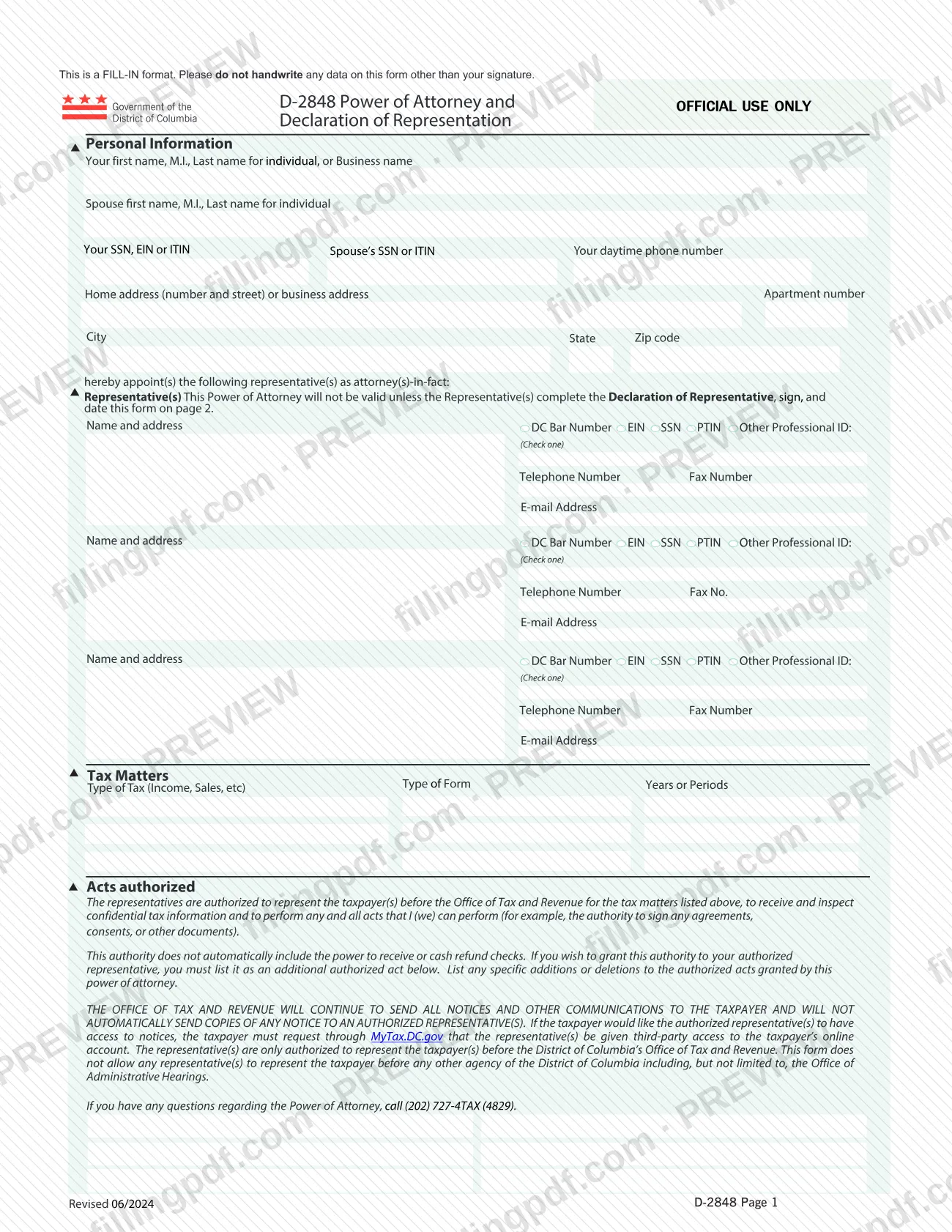
Form D-2848, Power of Attorney and Declaration of Representation, is the District of Columbia form that lets a taxpayer appoint up to three representatives to act before the Office of Tax and Revenue (OTR). The form is not tied to one tax: the Tax Matters section asks you to write the type of tax and the years or periods the authority covers. On this page you can fill out the form online on FillingPDF and download or print the completed PDF; OTR publishes the original fill-in version at the link below.
Last updated
What is D-2848?
Form D-2848, Power of Attorney and Declaration of Representation, is the District of Columbia form on which a taxpayer appoints one or more attorneys-in-fact to represent them before the Office of Tax and Revenue (OTR), and on which each representative declares their qualifying status.
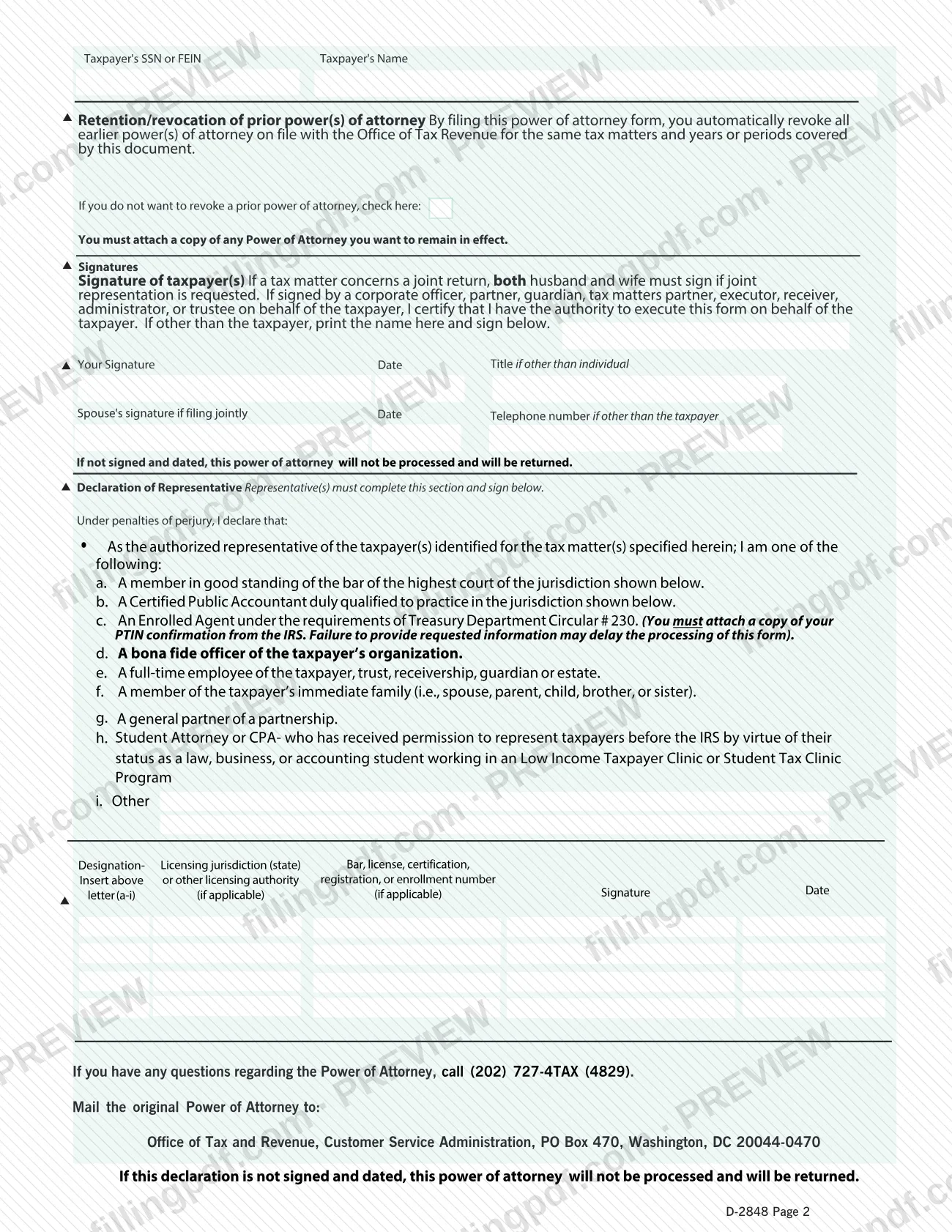
The form has two pages. Page 1 collects the taxpayer's personal information, up to three representatives, the tax matters covered (type of form, type of tax such as income or sales, and years or periods) and the acts authorized. Page 2 covers retention or revocation of earlier powers of attorney, the taxpayer's signatures and the Declaration of Representative, which the representative completes, signs and dates. The power of attorney is not valid unless the representative completes that declaration.
The authority granted lets the representatives represent the taxpayer before OTR for the listed matters, receive and inspect confidential tax information, and perform any act the taxpayer could perform, such as signing agreements or consents. It does not automatically include receiving or cashing refund checks; that must be listed as an additional authorized act.
OTR keeps sending notices to the taxpayer and does not automatically copy the representative. A taxpayer who wants the representative to see notices must request third-party access to the online account through MyTax.DC.gov. The form is published in a fill-in format, and the printed note on it says to handwrite nothing except your signature. Revision printed: 06/2024.
Who needs to file D-2848?
Taxpayers who want someone else to deal with the DC Office of Tax and Revenue (OTR) for them use Form D-2848. The form has room for an individual, a spouse and a business name, and for up to three representatives appointed as attorneys-in-fact for the tax matters, years or periods you list.
Each representative declares, under penalties of perjury, that they are one of the following:
- a member in good standing of the bar of the highest court of the jurisdiction shown;
- a Certified Public Accountant duly qualified to practice in that jurisdiction;
- an Enrolled Agent under Treasury Department Circular #230;
- a bona fide officer of the taxpayer's organization;
- a full-time employee of the taxpayer, trust, receivership, guardian or estate;
- a member of the taxpayer's immediate family (spouse, parent, child, brother or sister);
- a general partner of a partnership;
- a student attorney or CPA working in a Low Income Taxpayer Clinic or Student Tax Clinic Program;
- other.
If the matter concerns a joint return and joint representation is requested, both husband and wife must sign. A corporate officer, partner, guardian, tax matters partner, executor, receiver, administrator or trustee may sign for the taxpayer by certifying the authority to do so, printing the name and giving a title.
Do not use this form to represent a taxpayer before any other District agency, including the Office of Administrative Hearings; it authorizes representation before OTR only.
When to file D-2848
File Form D-2848 when you want a representative to act for you before OTR on a specific tax matter. The form prints no deadline or expiration date, and OTR's page gives no processing time.
Timing matters in one respect: filing the form automatically revokes all earlier powers of attorney on file with OTR for the same tax matters and years or periods. If you want an earlier power of attorney to stay in effect, check the box in the retention/revocation section and attach a copy of it when you file.
The form is processed only when it is signed and dated by the taxpayer and the representative signs and dates the declaration on page 2. An unsigned or undated form is returned.
Documents you need
- Copy of your PTIN confirmation from the IRS, required only if a representative signs the declaration as an Enrolled Agent (option c); missing information may delay processing.
- Copy of any earlier power of attorney you want to remain in effect, required only if you check the box in the retention/revocation section.
How to fill out D-2848
Enter taxpayer information
Under Personal Information, enter your first name, M.I. and last name (or business name), your spouse's name if applicable, your SSN, EIN or ITIN, your spouse's SSN or ITIN, and your daytime phone number. Add the home or business address, apartment number, city, state and zip code.
List your representatives
In the Representative(s) section, enter each representative's name and address and check one identifier: DC Bar Number, EIN, SSN, PTIN or Other Professional ID. Add the telephone number, fax number and e-mail address; the form has three blocks.
Describe the tax matters
Under Tax Matters, enter the type of form, the type of tax (Income, Sales, etc) and the years or periods the power of attorney covers.
Add or remove acts authorized
Read the standard authority, then list any specific additions or deletions. If you want a representative to receive or cash refund checks, list it here as an additional authorized act.
Choose whether to keep earlier powers
Filing revokes earlier powers of attorney for the same matters and periods. To keep one, check the box in the retention/revocation section and attach a copy.
Sign as the taxpayer
Enter the taxpayer's name and SSN or FEIN at the top of page 2, then sign and date. A spouse signs too on a joint matter. If you sign for the taxpayer in another capacity, print your name, give your title and add your telephone number.
Complete the Declaration of Representative
Each representative enters the designation letter (a–i), the licensing jurisdiction, and the bar, license, certification, registration or enrollment number if applicable, then signs and dates. An Enrolled Agent attaches the PTIN confirmation.
Review and download the PDF
Check every section, confirm no data is handwritten apart from signatures, then download or print the completed PDF from FillingPDF and mail the original as described under How to submit.
How to submit D-2848
Form D-2848 is submitted by mail: send the original to the Office of Tax and Revenue (OTR) at this address:
- By mail: Office of Tax and Revenue, Customer Service Administration, PO Box 470, Washington, DC 20044-0470.
The form names no other channel. Before mailing, make sure the taxpayer has signed and dated page 2 and the representative has completed, signed and dated the Declaration of Representative; otherwise the power of attorney will not be processed and will be returned. Attach a copy of your PTIN confirmation from the IRS if a representative is an Enrolled Agent, and a copy of any earlier power of attorney you want to keep in effect.
Mailing the form does not give the representative access to your notices. To do that, the taxpayer must request third-party access to the online account through MyTax.DC.gov. For questions about the power of attorney, call (202) 727-4TAX (4829). FillingPDF lets you fill out and download the PDF; submission follows the channel above.
Common mistakes to avoid
- Handwriting entries on the fill-in version; the form says not to handwrite any data other than your signature.
- Leaving the Declaration of Representative on page 2 blank or unsigned; the power of attorney is not valid unless the representative completes, signs and dates it.
- Submitting the form unsigned or undated; OTR will not process it and will return it.
- Having only one spouse sign when the matter concerns a joint return and joint representation is requested; both husband and wife must sign.
- Assuming the representative may receive or cash refund checks; that authority must be listed as an additional authorized act.
- Not checking the retention box and attaching the earlier power of attorney, which is automatically revoked for the same tax matters and years or periods.
- Expecting OTR to send copies of notices to the representative; the taxpayer must request third-party access through MyTax.DC.gov.
- Using the form to appoint someone before the Office of Administrative Hearings or another District agency; it covers OTR only.
Frequently asked questions
What is Form D-2848 used for?
Form D-2848 is the DC power of attorney that lets a taxpayer appoint representatives to act before the Office of Tax and Revenue (OTR) for listed tax matters. The representatives can receive and inspect confidential tax information and perform acts the taxpayer could perform, such as signing agreements or consents.
Can I use Form D-2848 for DC property tax matters?
The form names no specific tax. The Tax Matters section asks you to write the type of form, the type of tax (Income, Sales, etc) and the years or periods, and the authority covers only what you list there, before OTR. To confirm that your matter qualifies, call OTR at (202) 727-4TAX (4829).
Who can act as my representative on Form D-2848?
A bar member in good standing, a CPA, an Enrolled Agent, an officer or full-time employee of your organization, an immediate family member, a general partner, a student attorney or CPA in a tax clinic, or another representative. Each declares the category on page 2, under penalties of perjury.
Where do I mail Form D-2848?
Mail the original to the Office of Tax and Revenue, Customer Service Administration, PO Box 470, Washington, DC 20044-0470. The form names no other submission channel. It must be signed and dated, or OTR will not process it and will return it.
Can my representative receive my refund check?
Not automatically. The form says the authority does not include the power to receive or cash refund checks unless you list it as an additional authorized act in the Acts authorized section. Add it there if you want to grant it.
Will OTR send my notices to my representative?
No. OTR continues to send notices to the taxpayer and does not automatically send copies to the representative. To give the representative access, the taxpayer must request third-party access to the online account through MyTax.DC.gov.
Does filing Form D-2848 cancel my earlier power of attorney?
Yes, for the same tax matters and years or periods. Filing automatically revokes earlier powers of attorney on file with OTR. To keep one in effect, check the box in the retention/revocation section and attach a copy of that power of attorney.
Do both spouses have to sign Form D-2848?
Yes, if the matter concerns a joint return and joint representation is requested: both husband and wife must sign. The form has a spouse signature line and date for joint filers.
Can I fill out Form D-2848 online on FillingPDF?
Yes. You can fill out the fill-in PDF online on FillingPDF and download or print it. FillingPDF is an independent service and does not file the form with OTR; you mail the signed original to OTR yourself.
Ready to fill out D-2848?
Fill out D-2848 now