
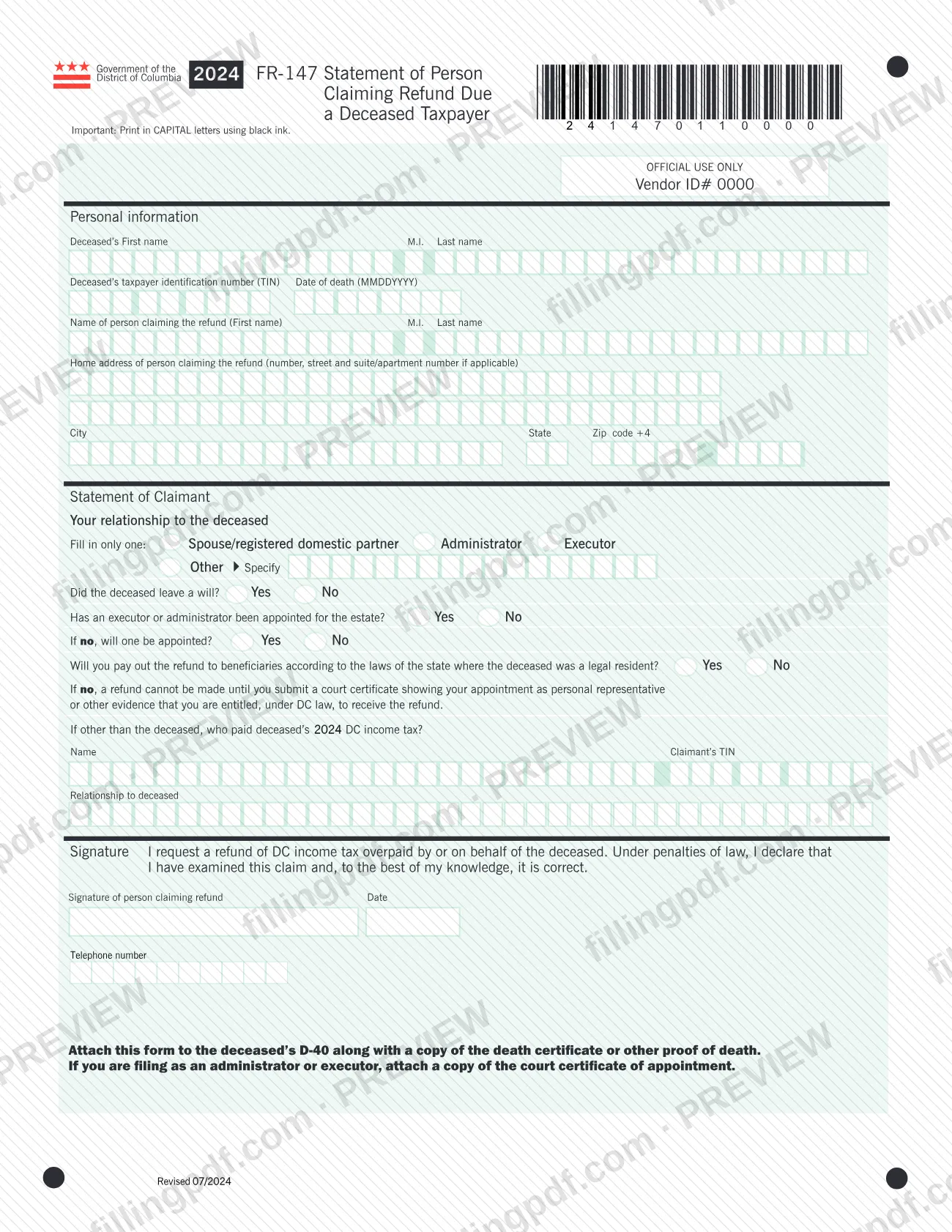
Form FR-147, Statement of Person Claiming Refund Due a Deceased Taxpayer, is the 2024 form the District of Columbia Office of Tax and Revenue (OTR) uses when someone asks for a DC income tax refund that belongs to a person who has died. The claimant states their relationship to the deceased and signs a declaration that the claim is correct. On this page you can fill out the form online on FillingPDF and download or print the completed PDF; the original is published by OTR, and the form is attached to the deceased's D-40.
Last updated
What is FR-147?
Form FR-147, Statement of Person Claiming Refund Due a Deceased Taxpayer, is the District of Columbia Office of Tax and Revenue (OTR) form on which a person asks for a refund of DC income tax overpaid by or on behalf of a deceased taxpayer.
The printed declaration reads: "I request a refund of DC income tax overpaid by or on behalf of the deceased." The claimant signs under penalties of law, stating that they have examined the claim and that, to the best of their knowledge, it is correct.
The form has three blocks. Personal information identifies the deceased (name, taxpayer identification number (TIN) and date of death) and the person claiming the refund (name and home address). Statement of Claimant records the claimant's relationship to the deceased and answers about a will, the appointment of an executor or administrator, and payment of the refund to beneficiaries. The Signature block holds the claimant's signature, date and telephone number.
FR-147 is not a tax return. It is attached to the deceased's D-40, together with proof of death. It also concerns DC income tax only: it is not a property tax form, even though both are handled by DC tax authorities. OTR's page for the form lists the 2024 FR-147 and a fill-in version of it.
Who needs to file FR-147?
The person claiming a DC income tax refund on behalf of a deceased taxpayer completes Form FR-147. The form asks you to mark only one relationship to the deceased:
- Spouse/registered domestic partner;
- Administrator;
- Executor;
- Other, with the relationship specified.
Your answers about the estate affect whether the refund can be paid. The form asks whether the deceased left a will, whether an executor or administrator has been appointed, and, if not, whether one will be appointed. It also asks whether you will pay out the refund to beneficiaries according to the laws of the state where the deceased was a legal resident.
If you answer No to that last question, the form states that a refund cannot be made until you submit a court certificate showing your appointment as personal representative, or other evidence that you are entitled under DC law to receive the refund.
If you file as an administrator or executor, a copy of the court certificate of appointment must be attached.
When to file FR-147
Submit Form FR-147 when you file the deceased's D-40, because the form says to attach it to that return. No separate due date is printed on FR-147 itself, so it travels with the D-40 and follows whatever filing timing applies to that return.
Have the date of death (entered as MMDDYYYY), a copy of the death certificate or other proof of death, and, for an administrator or executor, the court certificate of appointment ready before you start, since they must go with the form.
For deadlines that apply to the D-40, check the OTR page at https://otr.cfo.dc.gov/publication/2024-fr-147 or the D-40 instructions.
Documents you need
- A copy of the death certificate or other proof of death, attached to Form FR-147 and the deceased's D-40.
- A copy of the court certificate of appointment, if you are filing as an administrator or executor.
- A court certificate showing your appointment as personal representative, or other evidence that you are entitled under DC law to receive the refund, if you answer No to paying the refund to beneficiaries.
- The deceased's D-40, to which Form FR-147 is attached.
How to fill out FR-147
Follow the printing instruction
The form says to print in CAPITAL letters using black ink. Keep entries in capitals even when typing them.
Identify the deceased taxpayer
Under Personal information, enter the deceased's first name, M.I. and last name, the deceased's taxpayer identification number (TIN) and the date of death in MMDDYYYY format.
Enter the claimant's name and address
Enter the first name, M.I. and last name of the person claiming the refund. Add the home address (number, street and suite/apartment number if applicable), city, state and ZIP code +4.
Select your relationship to the deceased
Under Statement of Claimant, fill in only one: Spouse/registered domestic partner, Administrator, Executor or Other. If you choose Other, write the relationship in the Specify space.
Answer the will and executor questions
Mark Yes or No for whether the deceased left a will and whether an executor or administrator has been appointed. If none has been appointed, mark whether one will be appointed.
Answer the payment to beneficiaries question
Mark Yes or No for whether you will pay out the refund to beneficiaries according to the laws of the state where the deceased was a legal resident. If you mark No, a court certificate or other evidence of your right to the refund is needed before it can be paid.
Add the claimant's TIN and relationship
Enter your own TIN as claimant and restate your relationship to the deceased in the spaces provided.
Sign, date and add a phone number
The claimant signs and dates the declaration and enters a telephone number. The signature confirms the claim is correct to the best of your knowledge, under penalties of law.
Gather the attachments
Prepare a copy of the death certificate or other proof of death, and a copy of the court certificate of appointment if you are an administrator or executor.
Review and download the completed PDF
Check names, TINs and the MMDDYYYY date, then download or print the completed PDF from FillingPDF and attach it to the deceased's D-40 as described under How to submit.
How to submit FR-147
Form FR-147 is submitted as an attachment to the deceased's D-40; the form prints no separate mailing address, portal or appointment rule of its own.
- Attach to the D-40. Place the completed, signed FR-147 with the deceased's D-40.
- Add proof of death. Include a copy of the death certificate or other proof of death.
- Add the court certificate when it applies. If you file as an administrator or executor, attach a copy of the court certificate of appointment.
- Send the package where the D-40 is filed. Use the filing channel and address that apply to the D-40; OTR publishes the form at https://otr.cfo.dc.gov/publication/2024-fr-147.
FillingPDF lets you fill out and download the PDF; submission follows the channels above.
Common mistakes to avoid
- Filing Form FR-147 on its own instead of attaching it to the deceased's D-40.
- Leaving out the copy of the death certificate or other proof of death that must accompany the form.
- Filing as an administrator or executor without attaching a copy of the court certificate of appointment.
- Marking more than one relationship box; the form says to fill in only one.
- Answering No to paying the refund to beneficiaries without submitting a court certificate or other evidence of entitlement; the refund cannot be made until you do.
- Entering the date of death in a format other than MMDDYYYY.
- Using lowercase letters or a color other than black ink; the form says to print in CAPITAL letters using black ink.
- Omitting the claimant's signature, date or telephone number from the Signature block.
Frequently asked questions
What is Form FR-147 used for?
Form FR-147 is the DC Office of Tax and Revenue statement used to request a refund of DC income tax overpaid by or on behalf of a deceased taxpayer. The claimant identifies the deceased, states their relationship and signs a declaration under penalties of law.
Is Form FR-147 a DC property tax form?
No. FR-147 concerns DC income tax: the claimant requests a refund of DC income tax overpaid by or on behalf of the deceased. If you searched for DC property tax, this form does not apply; it is attached to the deceased's D-40.
Who can file Form FR-147?
The person claiming the refund files it and marks one relationship: Spouse/registered domestic partner, Administrator, Executor or Other, with the relationship specified. Administrators and executors must attach a copy of the court certificate of appointment.
What do I attach to Form FR-147?
Attach the form to the deceased's D-40 along with a copy of the death certificate or other proof of death. If you file as an administrator or executor, also attach a copy of the court certificate of appointment.
Where do I send Form FR-147?
The form prints no separate address. It says to attach it to the deceased's D-40, so it goes with that return through whichever filing channel applies to the D-40. OTR's page for the form is at https://otr.cfo.dc.gov/publication/2024-fr-147.
What if no executor or administrator has been appointed?
The form asks whether one has been appointed and, if not, whether one will be. If you will not pay the refund to beneficiaries under the laws of the deceased's state of legal residence, the refund cannot be made until you submit a court certificate of appointment or other evidence of your right to it.
Can I fill out Form FR-147 online?
Yes. You can fill out the PDF online on FillingPDF and download or print it. FillingPDF is independent and does not file the form with OTR; you submit it with the deceased's D-40 through the channels that apply to that return.
Is there a separate deadline for Form FR-147?
No due date is printed on the form. It is attached to the deceased's D-40, so it is submitted when that return is filed and follows the D-40's timing.
Ready to fill out FR-147?
Fill out FR-147 now