
Form FR-19 is the inheritance tax return that the District of Columbia Office of Tax and Revenue (OTR) publishes for the estates of individuals who died on or before 3/31/1987. The personal representative uses it to total the decedent's assets and deductions, compute the D.C. inheritance tax by beneficiary and figure the D.C. pick-up estate tax. On this page you can fill out Form FR-19 online on FillingPDF and download or print the completed PDF; the original form is published by OTR at the official link below.
Last updated
What is FR-19?
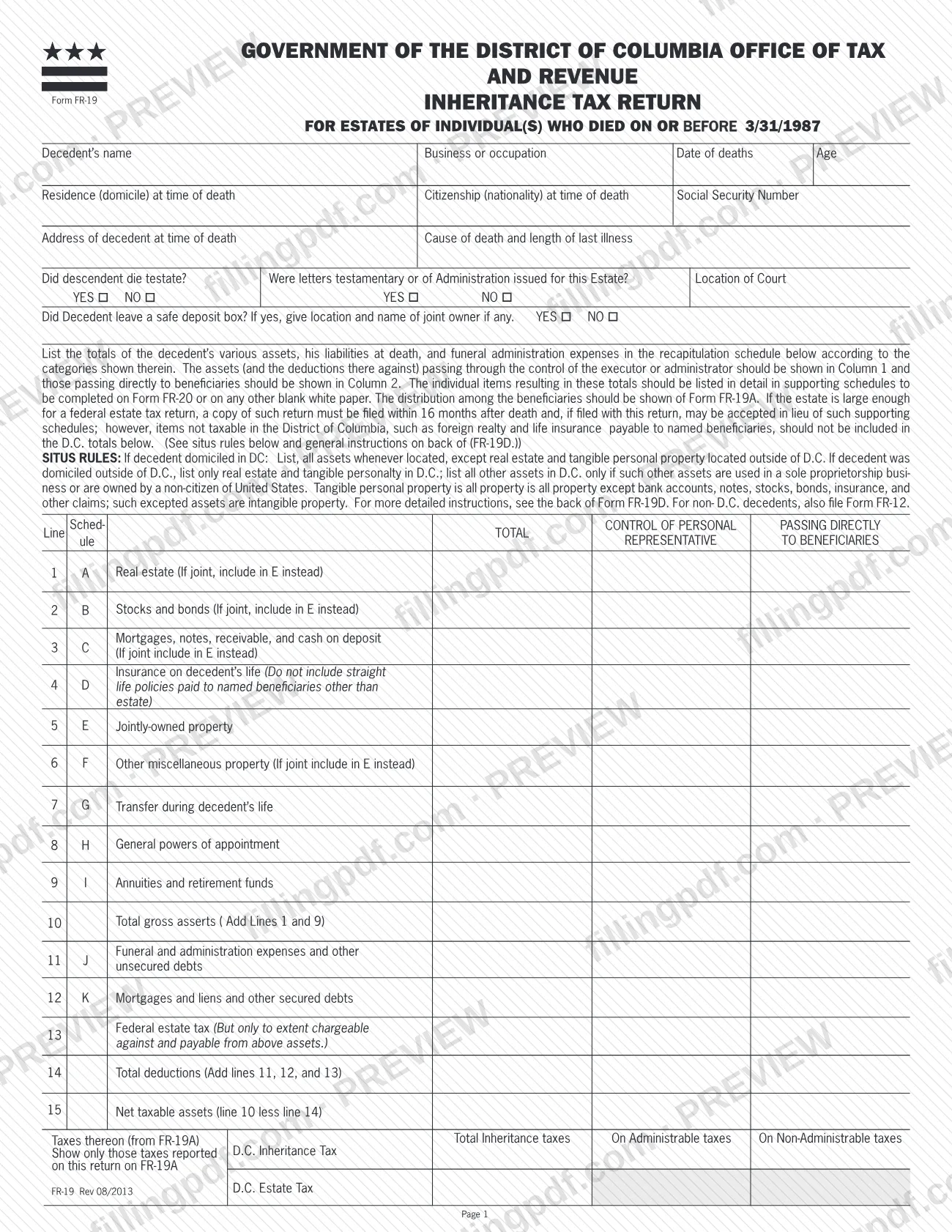
Form FR-19, Inheritance Tax Return for Estates of Individual(s) Who Died On or Before March 31, 1987, is the District of Columbia return on which an estate reports the decedent's assets and deductions and computes the D.C. inheritance tax and D.C. estate tax owed.
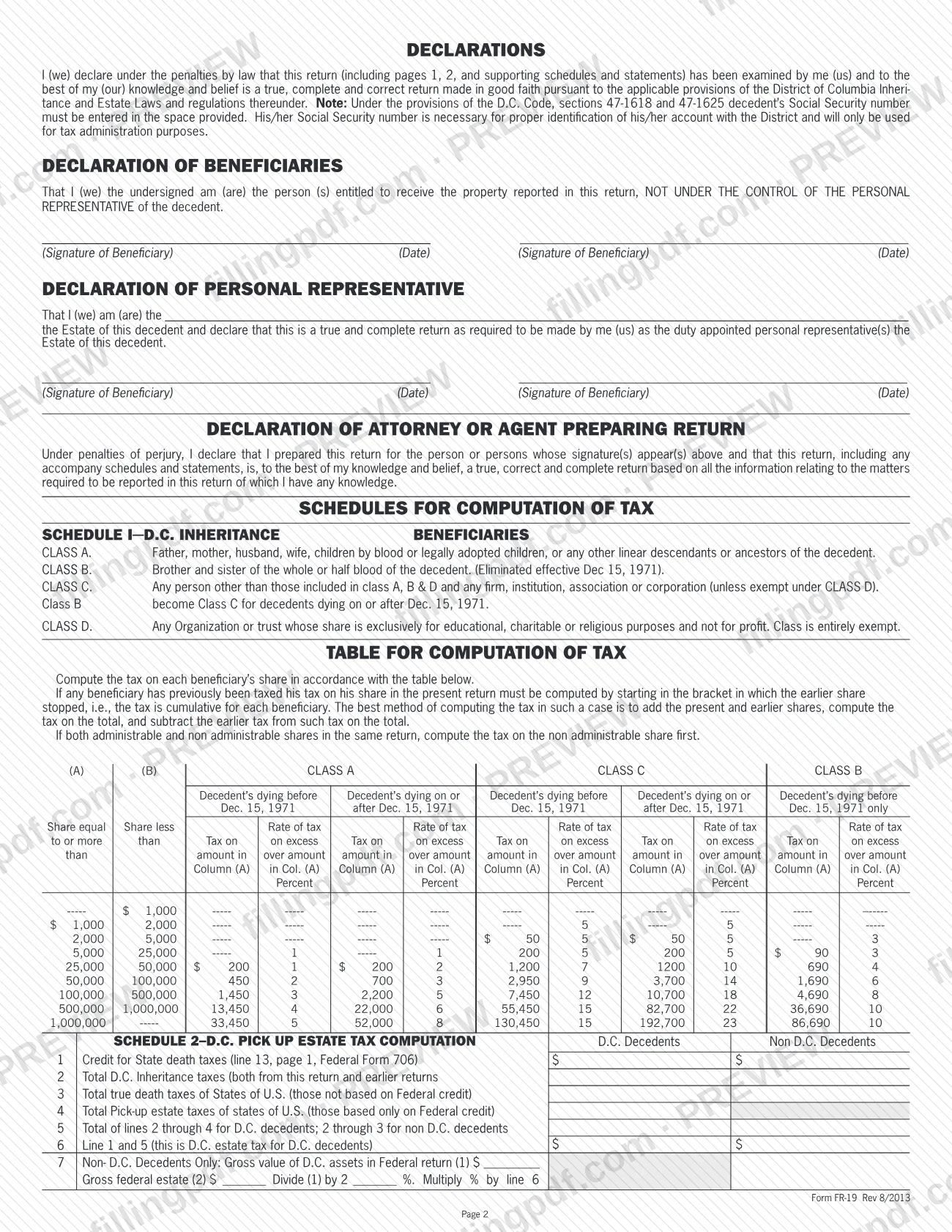
The Office of Tax and Revenue (OTR) issues the form. It is a two-page return. Page 1 holds the decedent's details and a recapitulation schedule, with lines 1 to 15 split into three columns: assets under the control of the personal representative, assets passing directly to beneficiaries, and the total. Page 2 holds the declarations, Schedule I (D.C. Inheritance Beneficiaries, in Classes A to D), the table for computing the tax and Schedule 2 (D.C. Pick Up Estate Tax Computation).
The individual items behind the totals are listed in supporting schedules on Form FR-20 or on blank white paper. The distribution among the beneficiaries is shown on Form FR-19A. The form refers to Form FR-19D for the general instructions and a fuller statement of the situs rules, and to Form FR-12, which is also filed for decedents who were not domiciled in D.C.
The form is not a federal return. If the estate is large enough to require a federal estate tax return, a copy of that return is part of the filing, as described under When to file.
Who needs to file FR-19?
The main group is the personal representative (executor or administrator) of the estate of an individual who died on or before 3/31/1987, as the form's title states. The representative completes the recapitulation and signs the Declaration of Personal Representative.
Others who take part in the return:
- Beneficiaries sign the Declaration of Beneficiaries for property that is not under the control of the personal representative.
- An attorney or agent who prepares the return completes the Declaration of Attorney or Agent Preparing Return.
- Estates of decedents domiciled outside D.C. also file Form FR-12, and list on this return only the assets the situs rules assign to D.C.
The situs rules on the form decide which assets are listed. For a decedent domiciled in D.C., list all assets wherever located, except real estate and tangible personal property located outside D.C. For a decedent domiciled outside D.C., list only real estate and tangible personal property in D.C. Other assets are listed only if they are used in a sole proprietorship business or owned by a non-citizen of the United States.
Items that D.C. does not tax, such as foreign realty and life insurance payable to named beneficiaries, stay out of the D.C. totals.
When to file FR-19
The form prints no due date of its own for the return. The only time limit it states is for the federal return: if the estate is large enough for a federal estate tax return, a copy of it must be filed within 16 months after death. When that copy is filed together with Form FR-19, it may be accepted in place of the supporting schedules.
The date of death also matters inside the return. The tax table has separate columns for decedents dying before December 15, 1971 and on or after that date, so the date you enter at the top of page 1 decides which column you use. For any other filing deadline or penalty, contact OTR or check its page for Form FR-19.
Documents you need
- Supporting schedules listing the individual items behind the totals, on Form FR-20 or on any other blank white paper.
- Form FR-19A, which shows the distribution among the beneficiaries and the taxes on each share.
- A copy of the federal estate tax return, only if the estate is large enough for one: it must be filed within 16 months after death and, if filed with this return, may be accepted in lieu of the supporting schedules.
- Form FR-12, only when the decedent was domiciled outside D.C.
How to fill out FR-19
Enter the decedent's details
At the top of page 1, enter the decedent's name, business or occupation, date of death, age, residence (domicile) at death, citizenship (nationality), Social Security Number, address at death, and cause of death and length of last illness.
Answer the estate questions
Check YES or NO for whether the decedent died testate and whether letters testamentary or of administration were issued, and enter the location of the court.
Answer the safe deposit box question
Check YES or NO. If yes, give the location and the name of any joint owner.
Enter assets on lines 1 to 9
Use the recapitulation schedule (Schedules A to I): real estate, stocks and bonds, mortgages, notes and cash on deposit, life insurance, jointly-owned property, other property, transfers during life, powers of appointment, and annuities and retirement funds. Put assets under the personal representative's control in Column 1 and assets passing directly to beneficiaries in Column 2, and apply the situs rules.
Complete the gross assets total
On line 10, total gross assets, add the asset lines as the form directs, in each column and in the total column.
Enter deductions on lines 11 to 14
Enter funeral and administration expenses and other unsecured debts (line 11, Schedule J), mortgages and liens and other secured debts (line 12, Schedule K) and federal estate tax chargeable against these assets (line 13). Add them on line 14.
Figure net assets and taxes
Line 15 is net taxable assets, line 10 less line 14. In the taxes section, enter the total inheritance taxes from Form FR-19A, split into administrable and non-administrable taxes, and the D.C. estate tax.
Complete Schedule I and the tax table
Classify each beneficiary in Class A, C or D (Class B applies only to decedents dying before December 15, 1971) and compute the tax on each share from the table, using the column for the date of death. Class D is entirely exempt.
Complete Schedule 2 pick-up tax
Enter the credit for state death taxes from line 13, page 1, of federal Form 706, then the D.C. inheritance taxes and other state taxes on lines 2 to 5. Line 6 is the D.C. estate tax. Line 7 is for non-D.C. decedents only.
Sign the declarations
Beneficiaries sign the Declaration of Beneficiaries for property not under the personal representative's control. The personal representative signs and dates the Declaration of Personal Representative. A preparing attorney or agent completes that declaration.
Review and download the PDF
Check that the totals agree with your supporting schedules and Form FR-19A and that the Social Security number is entered. Download or print the completed PDF from FillingPDF and assemble the package described under How to submit.
How to submit FR-19
The form names no mailing address, portal or office, so confirm the current filing channel with the District of Columbia Office of Tax and Revenue (OTR) through its page for Form FR-19 at https://otr.cfo.dc.gov/publication/fr-19-inheritance-tax-return-estates-individuals-who-died-or-march-31-1987 before you send anything.
Assemble the return as the form describes:
- The completed pages 1 and 2 of Form FR-19, signed in the declarations that apply.
- Supporting schedules on Form FR-20 or on blank white paper, or a copy of the federal estate tax return if it is filed with this return and is accepted in their place.
- Form FR-19A, which shows the distribution among the beneficiaries and the taxes reported.
- Form FR-12 as well, for a decedent domiciled outside D.C.
The decedent's Social Security number must be entered in the space provided. The form says OTR uses it only for tax administration. FillingPDF lets you fill out and download the PDF; submission follows the OTR channels above.
Common mistakes to avoid
- Including items D.C. does not tax, such as foreign realty or life insurance payable to named beneficiaries, in the D.C. totals when the federal return is used in place of schedules.
- Listing jointly-owned property on lines 1, 2, 3 or 6 instead of line 5 (Schedule E); the form says to include joint property in E.
- Entering straight life policies paid to named beneficiaries other than the estate on line 4, which the form excludes.
- Leaving out the decedent's Social Security number, which the declaration says must be entered.
- Listing all assets for a decedent domiciled outside D.C. instead of only the D.C. real estate and tangible personal property and the other assets the situs rules allow.
- Omitting Form FR-12 for a decedent domiciled outside D.C.
- Computing the tax on an administrable share before the non-administrable share; the form says to compute the non-administrable share first.
- Ignoring a beneficiary's earlier taxed share; the tax is cumulative, so the new tax starts in the bracket where the earlier share stopped.
- Deducting federal estate tax on line 13 beyond the part chargeable against and payable from the assets listed.
Frequently asked questions
What is Form FR-19?
Form FR-19 is the D.C. Office of Tax and Revenue inheritance tax return for the estates of individuals who died on or before 3/31/1987. It totals the decedent's assets and deductions, computes the inheritance tax by beneficiary class and figures the D.C. pick-up estate tax.
Who has to sign Form FR-19?
The personal representative signs the Declaration of Personal Representative. Beneficiaries sign the Declaration of Beneficiaries for property not under the representative's control, and an attorney or agent who prepared the return completes the preparer declaration.
Which assets go on the DC inheritance tax return?
It depends on where the decedent was domiciled. For a D.C. domiciliary, list all assets except real estate and tangible personal property outside D.C. For a non-D.C. domiciliary, list D.C. real estate and tangible property, plus other assets only if used in a sole proprietorship or owned by a non-citizen.
Do I attach the federal estate tax return to Form FR-19?
If the estate is large enough for a federal estate tax return, a copy must be filed within 16 months after death. If filed with Form FR-19, it may be accepted in place of the supporting schedules, but items D.C. does not tax stay out of the D.C. totals.
What are Forms FR-19A, FR-19D and FR-20?
Form FR-19A shows the distribution among the beneficiaries and the taxes reported. Form FR-19D holds the general instructions and detailed situs rules. Form FR-20, or blank white paper, is used for the supporting schedules behind the totals.
What do I file for a decedent who lived outside DC?
File Form FR-19 listing only the assets the situs rules assign to D.C., and also file Form FR-12. Schedule 2 has a separate column and line 7 for non-D.C. decedents to apportion the D.C. estate tax.
Can I fill out Form FR-19 online?
You can fill out the PDF online on FillingPDF and download or print it. FillingPDF is an independent service and does not file the return with OTR; you submit it through the channels OTR provides.
Ready to fill out FR-19?
Fill out FR-19 now