
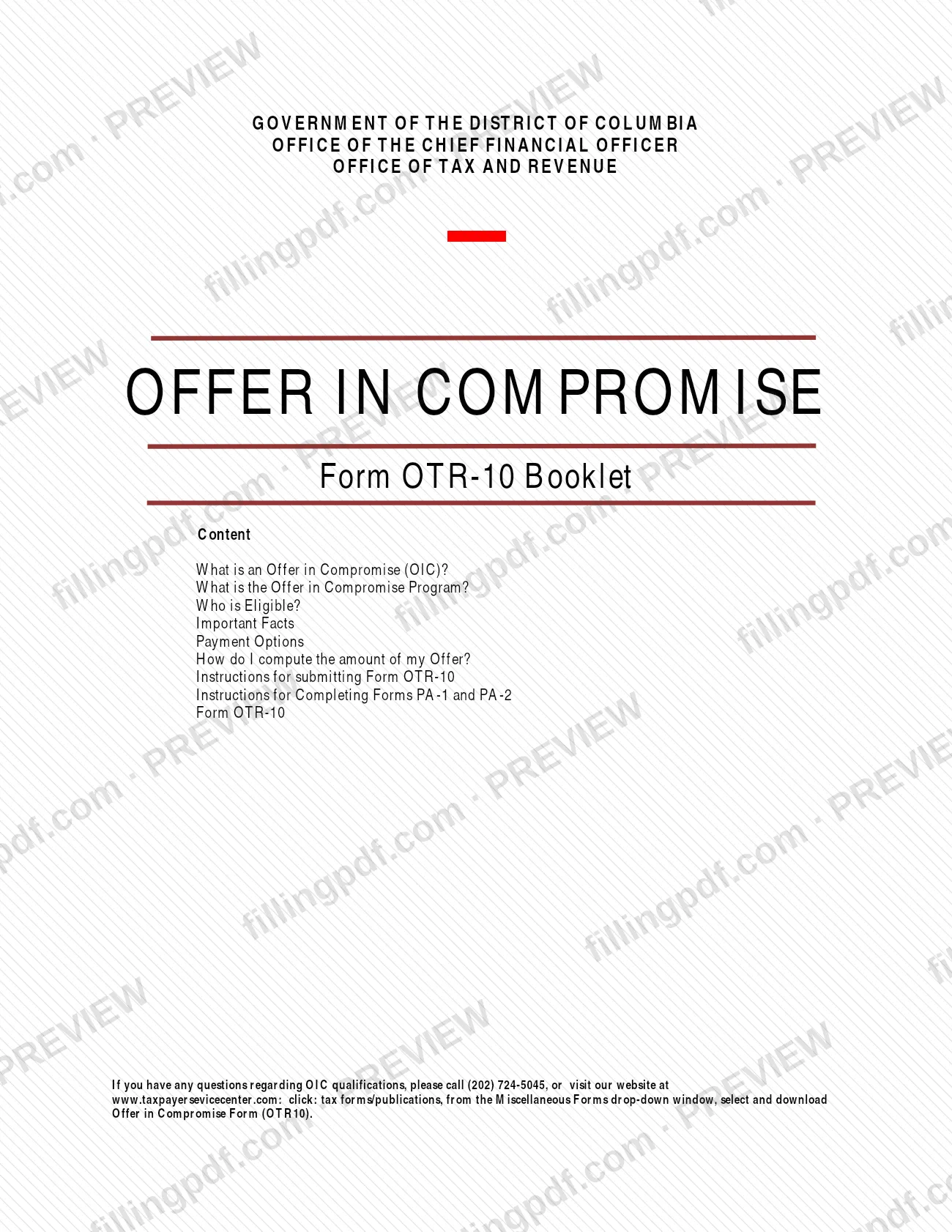
Form OTR-10 is the Offer in Compromise application of the District of Columbia Office of Tax and Revenue (OTR), part of the Office of the Chief Financial Officer. A taxpayer uses it to propose paying less than the full amount of an assessed tax debt, either because of doubt as to liability or doubt as to collectibility. On FillingPDF you can fill out Form OTR-10 online and download or print the completed PDF; the offer itself is filed with OTR, as described under how to submit. The OTR booklet that contains the form and its instructions is published at otr.cfo.dc.gov.
Last updated
What is OTR-10?
Form OTR-10, Offer in Compromise, is the application the DC Office of Tax and Revenue (OTR) uses to consider a taxpayer's offer to settle unpaid tax liabilities for less than the full amount due. Once signed, it serves as the offer contract.
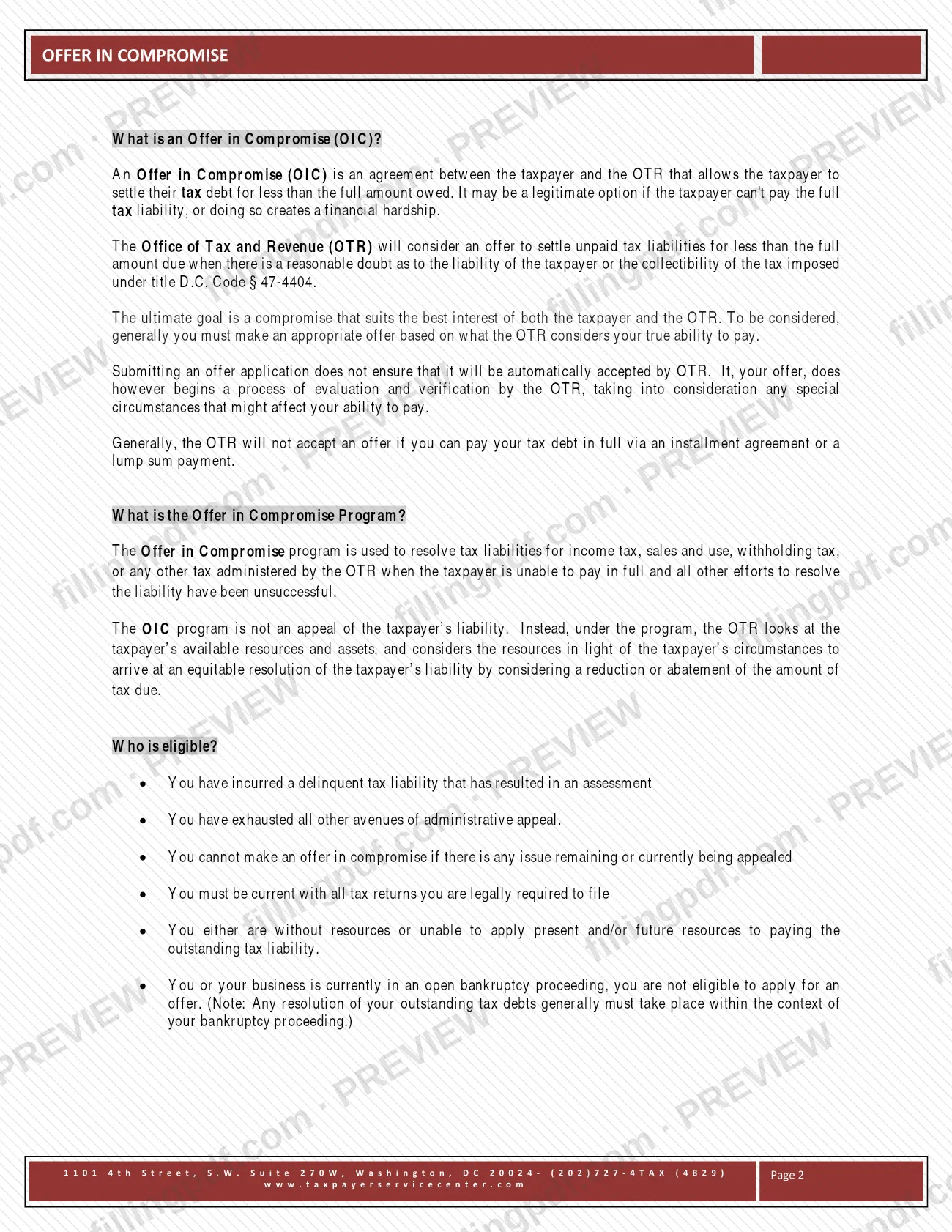
The form identifies the taxpayer, the tax type and periods to be compromised, the amount offered and the proposed payment terms. OTR considers an offer when there is reasonable doubt as to the liability of the taxpayer or the collectibility of the tax, under D.C. Code § 47-4404. The booklet says the program covers income tax, sales and use tax, withholding tax or any other tax administered by OTR, when the taxpayer cannot pay in full and other efforts to resolve the debt have failed.
An offer in compromise is not an appeal of the liability. OTR looks at your available resources and assets and your circumstances to decide whether a reduction or abatement is justified. Submitting an offer does not guarantee acceptance.
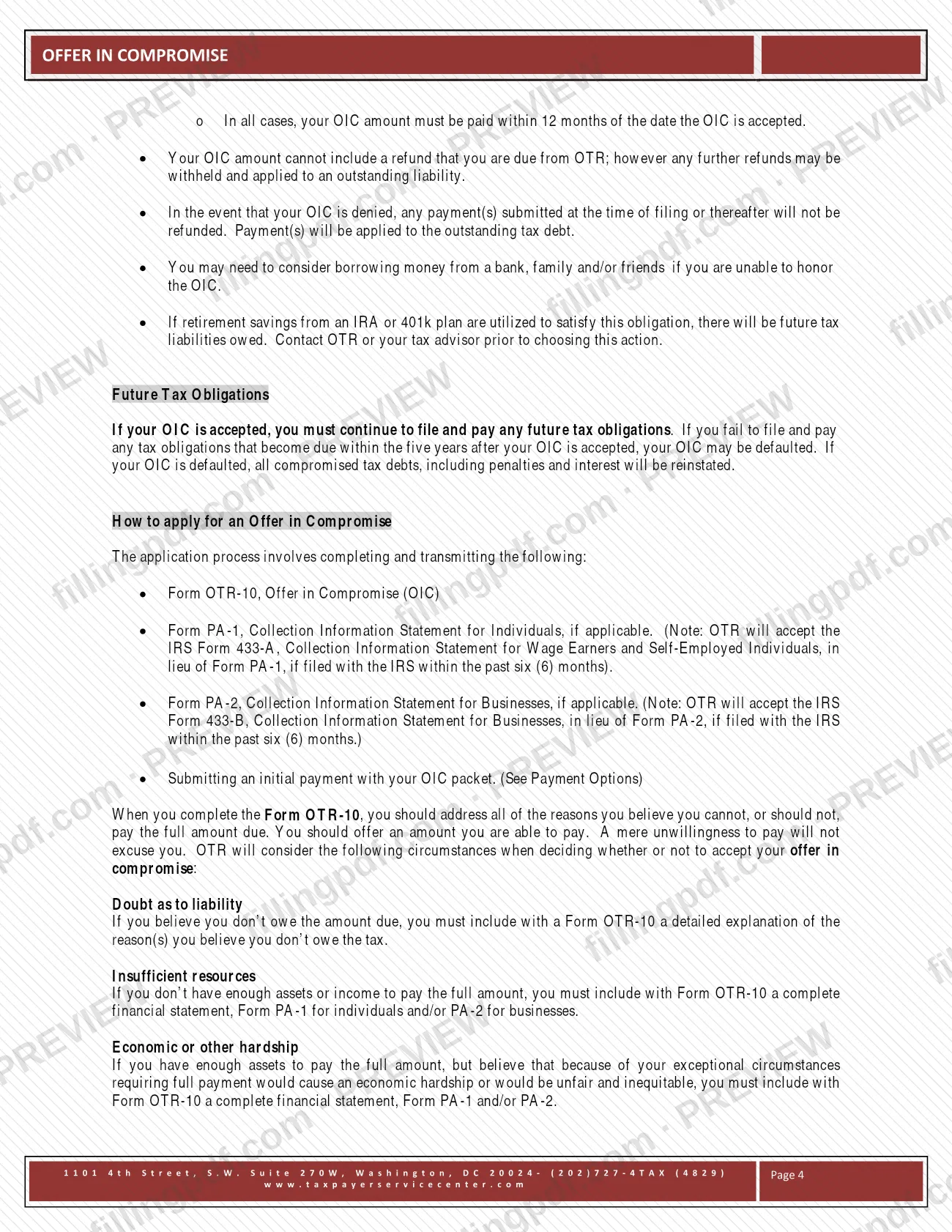
Form OTR-10 is submitted with companion forms: Form PA-1, Collection Information Statement for Individuals, and Form PA-2, Collection Information Statement for Businesses, when they apply. OTR accepts IRS Form 433-A or Form 433-B instead if filed with the IRS within the past six months.
Who needs to file OTR-10?
Taxpayers with an assessed DC tax debt who cannot pay it in full, or for whom full payment would cause hardship, use Form OTR-10. The booklet lists these eligibility conditions:
- You have a delinquent tax liability that has been assessed.
- You have exhausted all other administrative appeals; no issue may remain or be under appeal.
- You are current with all tax returns you are legally required to file.
- You are without resources, or unable to apply present or future resources to the debt.
You are not eligible if you or your business is in an open bankruptcy proceeding. You also may not submit an offer for tax years that have not been assessed. OTR generally will not accept an offer if you can pay in full through an installment agreement or a lump sum.
Filing status rules: individuals file one Form OTR-10 covering all tax years they want to compromise. A business files one form naming all parties responsible for the debt. If you and a spouse, domestic partner or ex-spouse owe both joint and separate debts, file one form for the joint debts and a second for your individual debts. If your spouse does not want to file, you may still submit a form to compromise your responsibility for the joint debt.
When to file OTR-10
File Form OTR-10 after the tax has been assessed and you have exhausted administrative appeals; the booklet sets no calendar deadline for the offer itself. The financial information you attach must reflect activity within the 6 months before the date you submit the offer.
Timing rules tied to the offer:
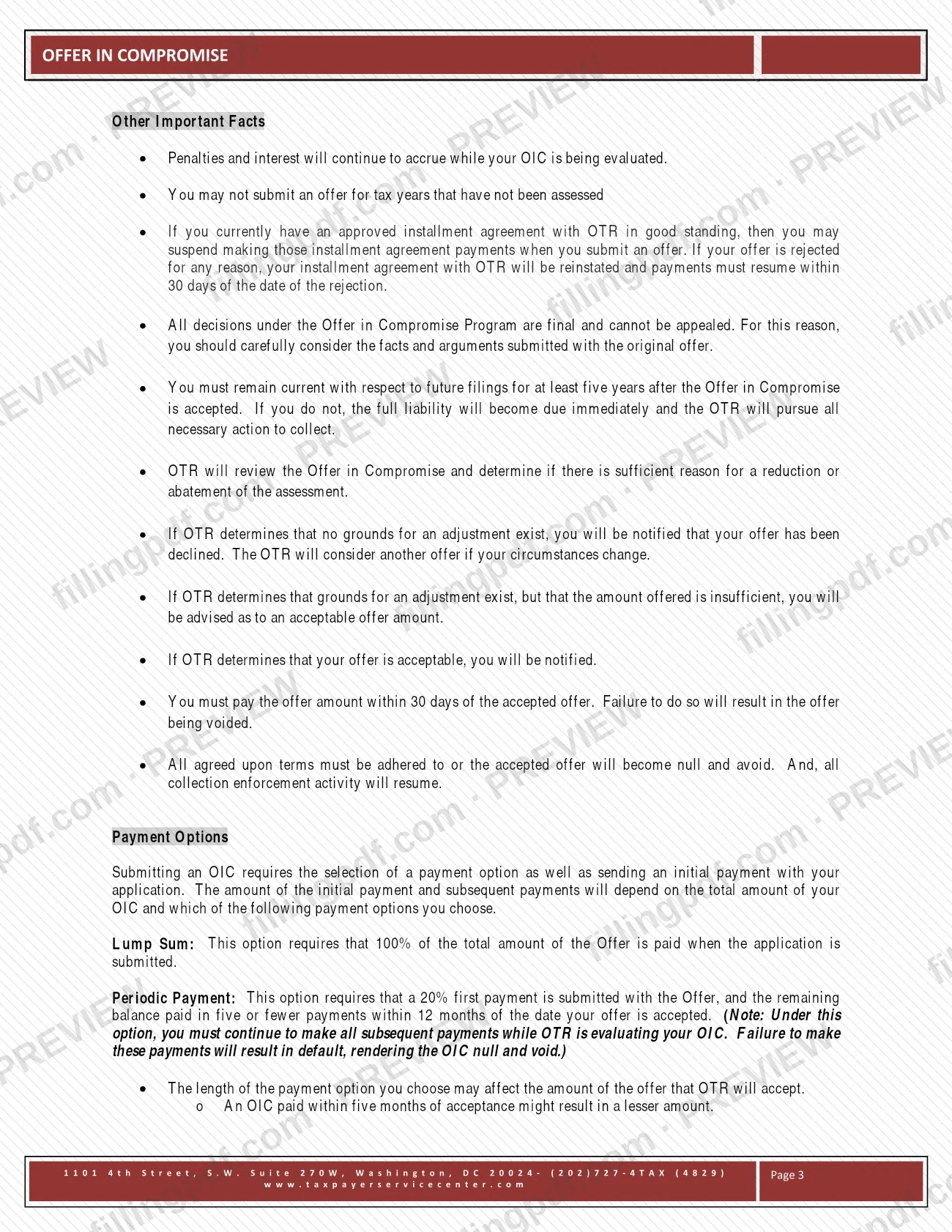
- Penalties and interest keep accruing while OTR evaluates it.
- If OTR rejects the offer, you may submit another offer with different payment terms within 30 days of the denial.
- If you have an approved installment agreement in good standing, you may suspend those payments when you submit an offer; if the offer is rejected, payments must resume within 30 days of the rejection.
- If the offer is accepted, you must pay the offer amount within 30 days of acceptance or the offer is voided, and you must stay current on filings and payments for five years.
Documents you need
- Form PA-1, Collection Information Statement for Individuals, when you are an individual; IRS Form 433-A is accepted instead if filed with the IRS within the past six months.
- Form PA-2, Collection Information Statement for Businesses, when a business owes; IRS Form 433-B is accepted instead if filed with the IRS within the past six months.
- Supporting documentation listed at the end of Form PA-1 or PA-2 (or IRS 433-A or 433-B). Send copies, not originals.
- A copy of your latest federal income tax return(s) for the business and for each individual responsible for the tax, for an offer based on doubt as to collectibility.
- A detailed written explanation of why you believe you do not owe the tax, for an offer based on doubt as to liability.
- A separate schedule listing the type of tax, tax period and amount of each tax bill you want to compromise, as line 4 instructs.
- An additional sheet for the line 7 explanation, if you need more space.
- Your initial payment by credit card, certified funds or money order: 100% of the offer for a lump sum, or a 20% first payment for the periodic payment option.
How to fill out OTR-10
Gather your financial information
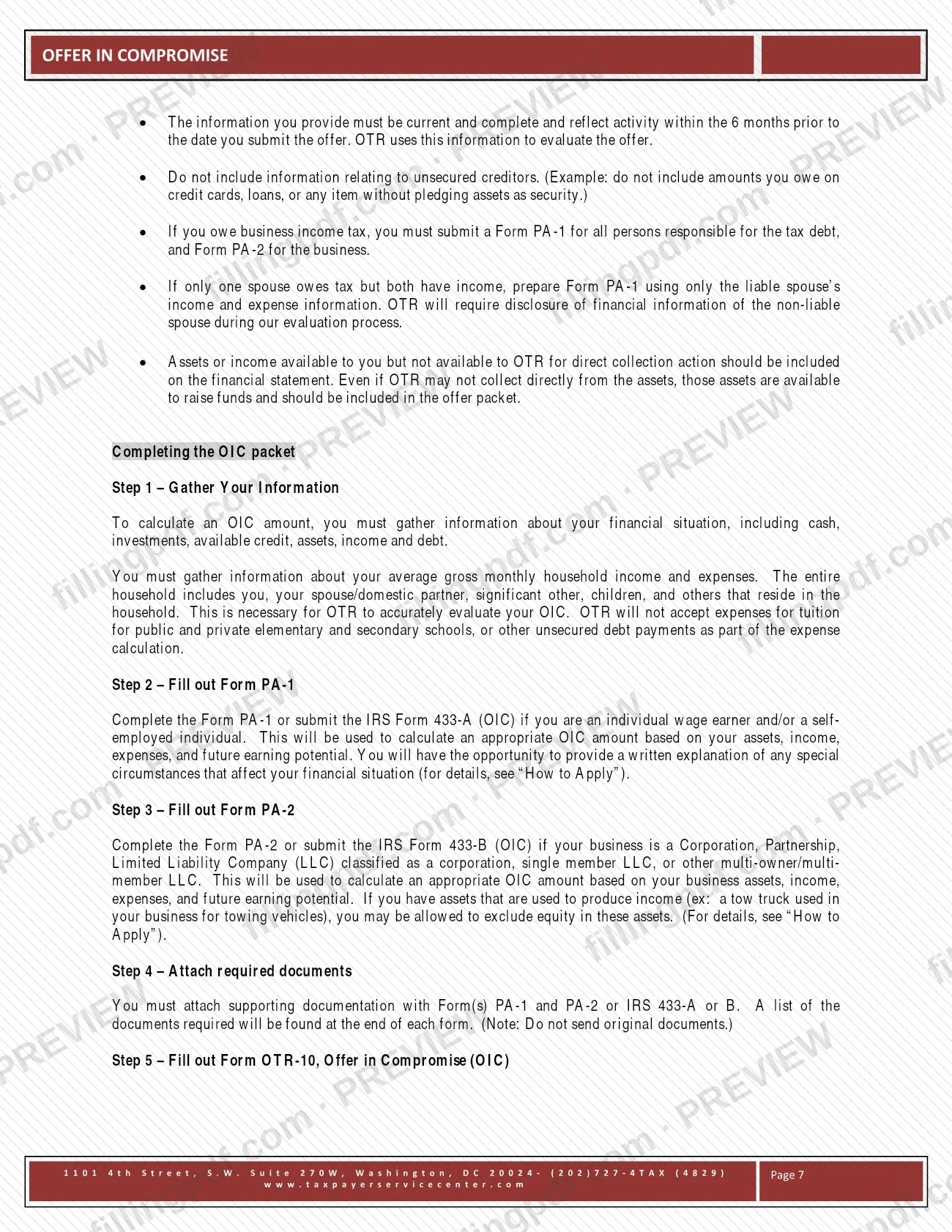
Collect cash, investments, available credit, assets, income and debt, plus your average gross monthly household income and expenses. The household includes you, your spouse or domestic partner, significant other, children and others living with you.
Enter taxpayer name, address and phones
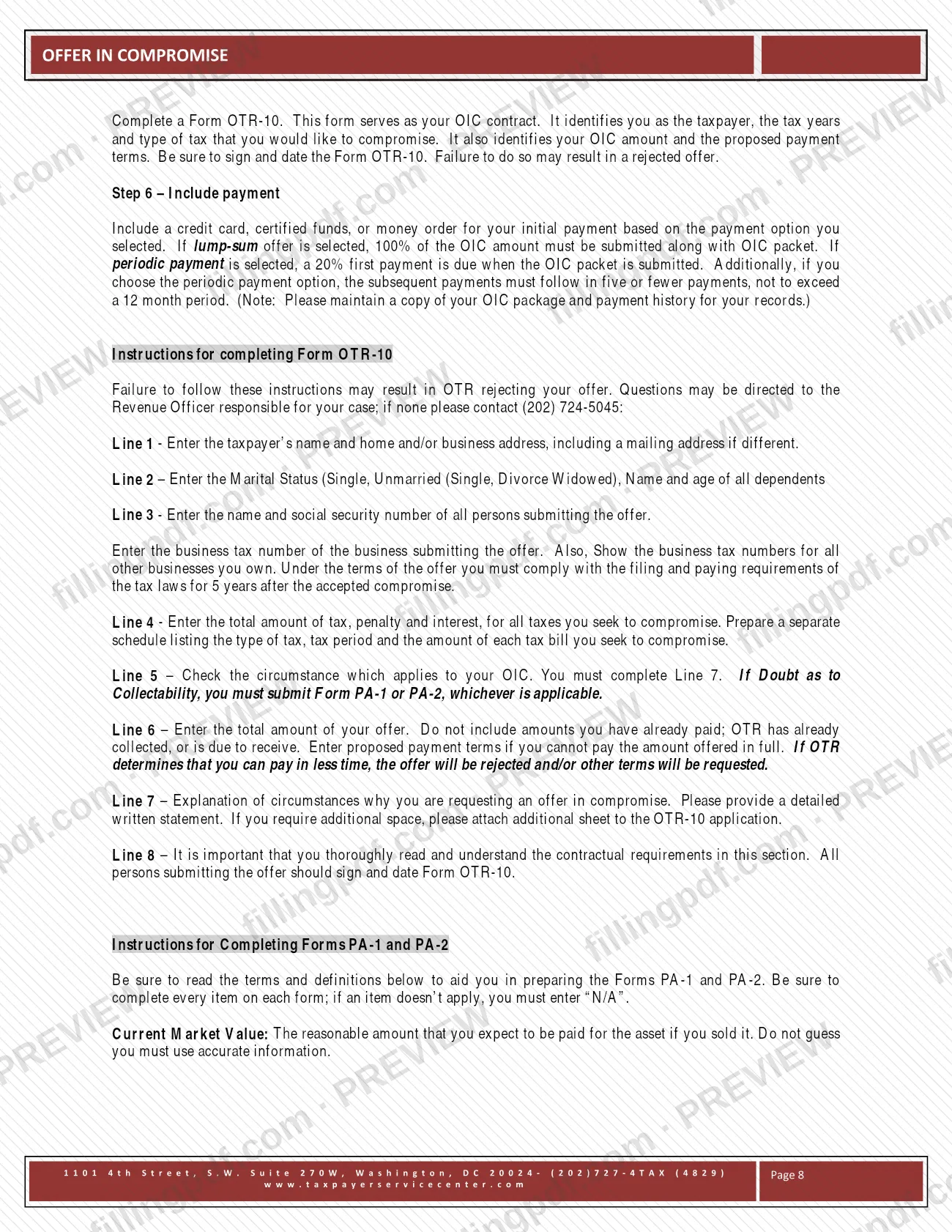
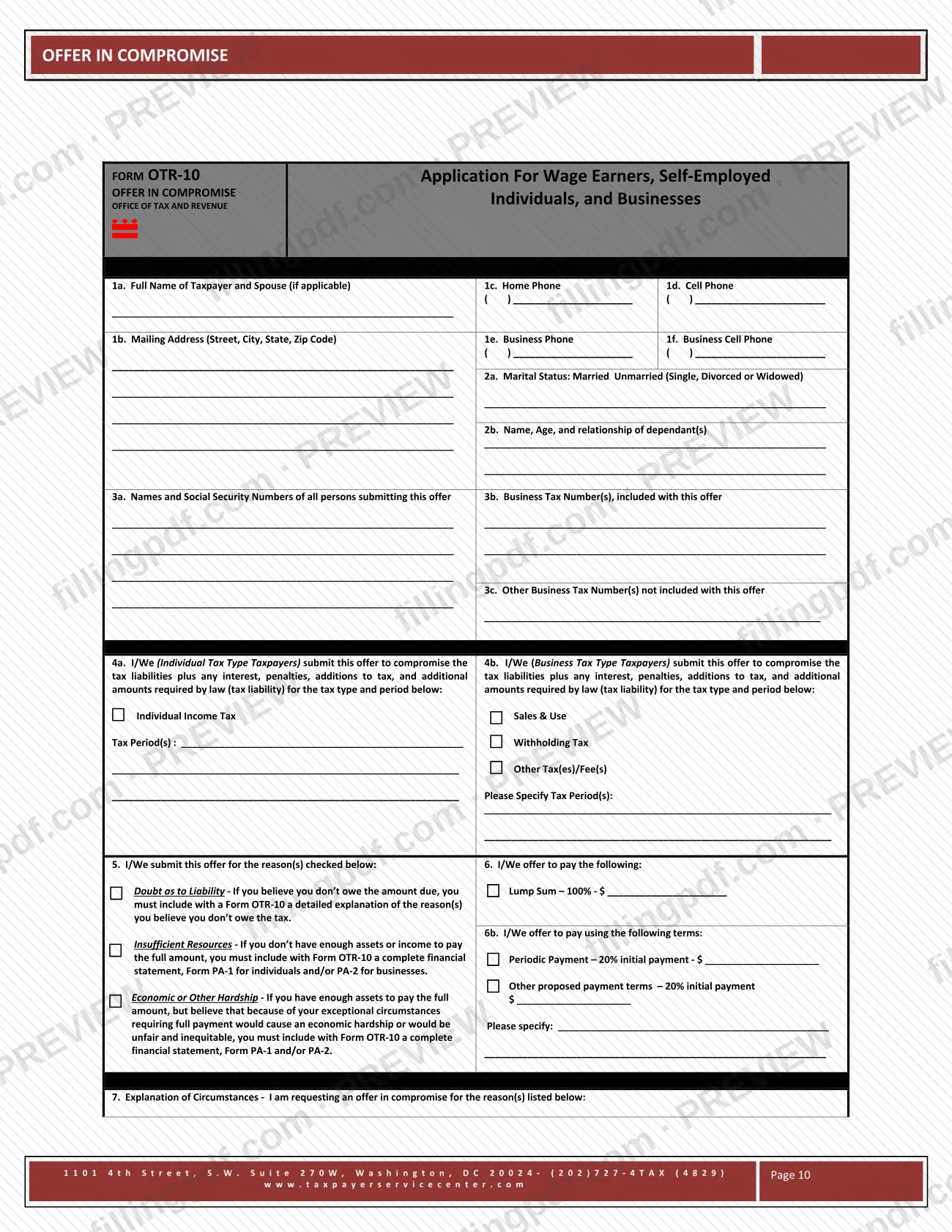
Line 1a: full name of the taxpayer and spouse, if applicable. Line 1b: mailing address. Lines 1c to 1f: home, cell, business and business cell phone numbers.
Enter marital status and dependents
Line 2a: check Married or Unmarried (Single, Divorced or Widowed). Line 2b: the name, age and relationship of each dependent.
List persons and business tax numbers
Line 3a: the names and Social Security numbers of everyone submitting the offer. Line 3b: business tax numbers included with the offer; line 3c: other business tax numbers you own that are not included.
Identify the tax debt to compromise
On line 4a (individual tax types) or 4b (business tax types), check the tax type and enter the tax periods. Line 4 asks for the total of tax, penalty and interest; attach a separate schedule listing each tax type, period and amount.
Check the reason for your offer
Line 5: check Doubt as to Liability, Insufficient Resources, or Economic or Other Hardship. Each has attachment rules printed on the form; if you check Doubt as to Collectability, submit Form PA-1 or PA-2.
Enter your offer amount and terms
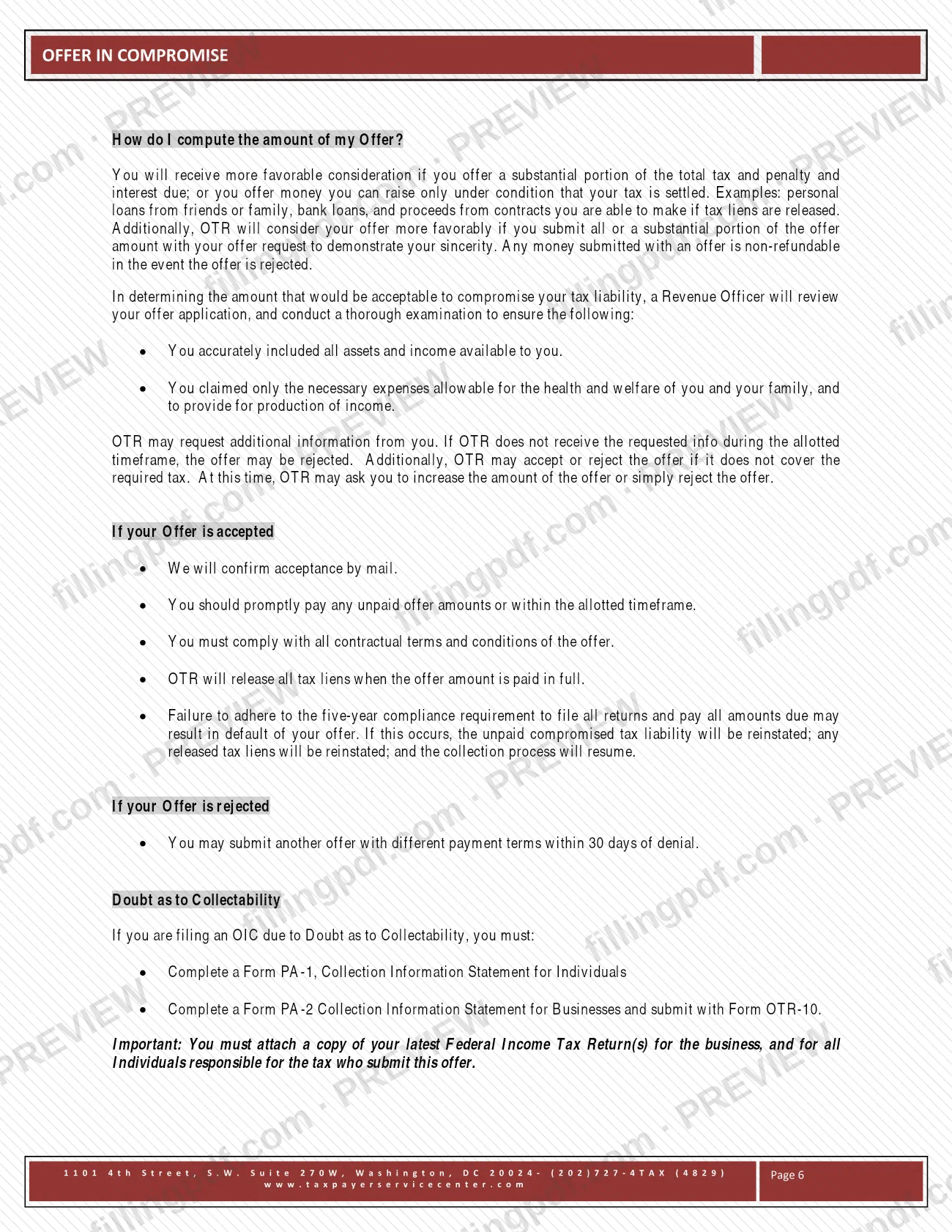
Line 6: enter the Lump Sum amount (100%), or under 6b the Periodic Payment with its 20% initial payment, or other proposed terms. Do not include amounts you already paid.
Explain your circumstances
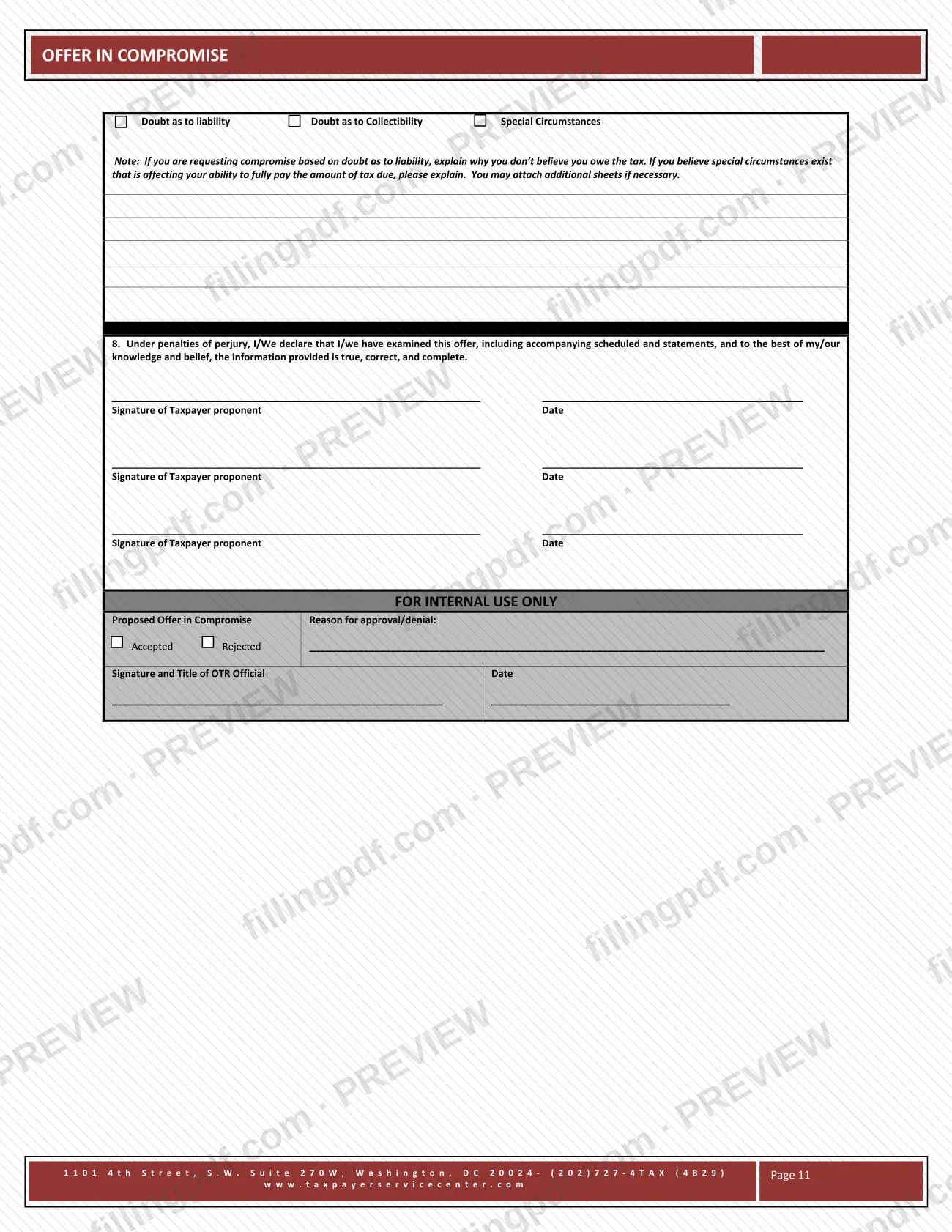
Line 7: write a detailed statement of why you are requesting the compromise, and attach additional sheets if needed. For doubt as to liability, explain why you do not believe you owe the tax.
Complete Forms PA-1 and PA-2
Fill out Form PA-1 (individuals) and/or PA-2 (businesses), or use IRS 433-A or 433-B, entering "N/A" where an item does not apply. Attach the supporting documents listed at the end of each form.
Read, sign and date line 8
Read the contractual terms in line 8. Every person submitting the offer signs and dates Form OTR-10; an unsigned form can be rejected.
Review and download the PDF
Check that every line, schedule and attachment is complete, then download or print the completed PDF from FillingPDF. Assemble the packet with your initial payment and submit it through the channel described under How to submit.
How to submit OTR-10
File the completed offer packet with OTR in person at the address below; the booklet names this one filing location and gives no mailing address, portal or appointment rule.
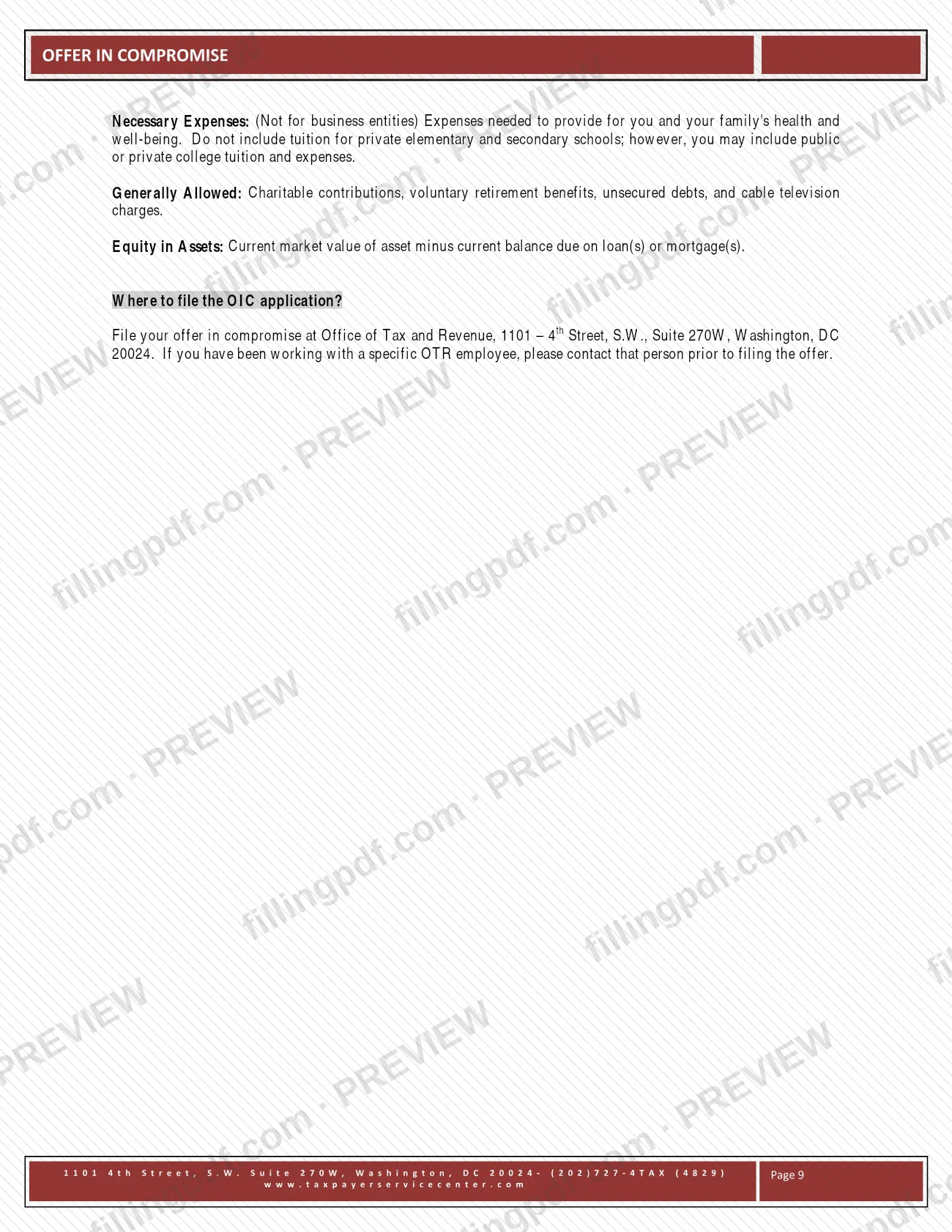
- Where: Office of Tax and Revenue, 1101 – 4th Street, S.W., Suite 270W, Washington, DC 20024. If you have been working with a specific OTR employee, contact that person before filing.
- What to include: Form OTR-10, Form PA-1 and/or PA-2 (or IRS Form 433-A or 433-B filed with the IRS within the past six months), supporting documents, and your initial payment. Do not send original documents.
- Payment: a credit card, certified funds or a money order. A lump-sum offer requires 100% of the offer amount with the packet; the periodic payment option requires a 20% first payment.
- Questions: call (202) 724-5045 or contact the Revenue Officer assigned to your case.
Keep a copy of your packet and payment history. Any money sent with an offer is not refunded if the offer is rejected. FillingPDF lets you fill out and download the PDF; submission follows the channels above.
Common mistakes to avoid
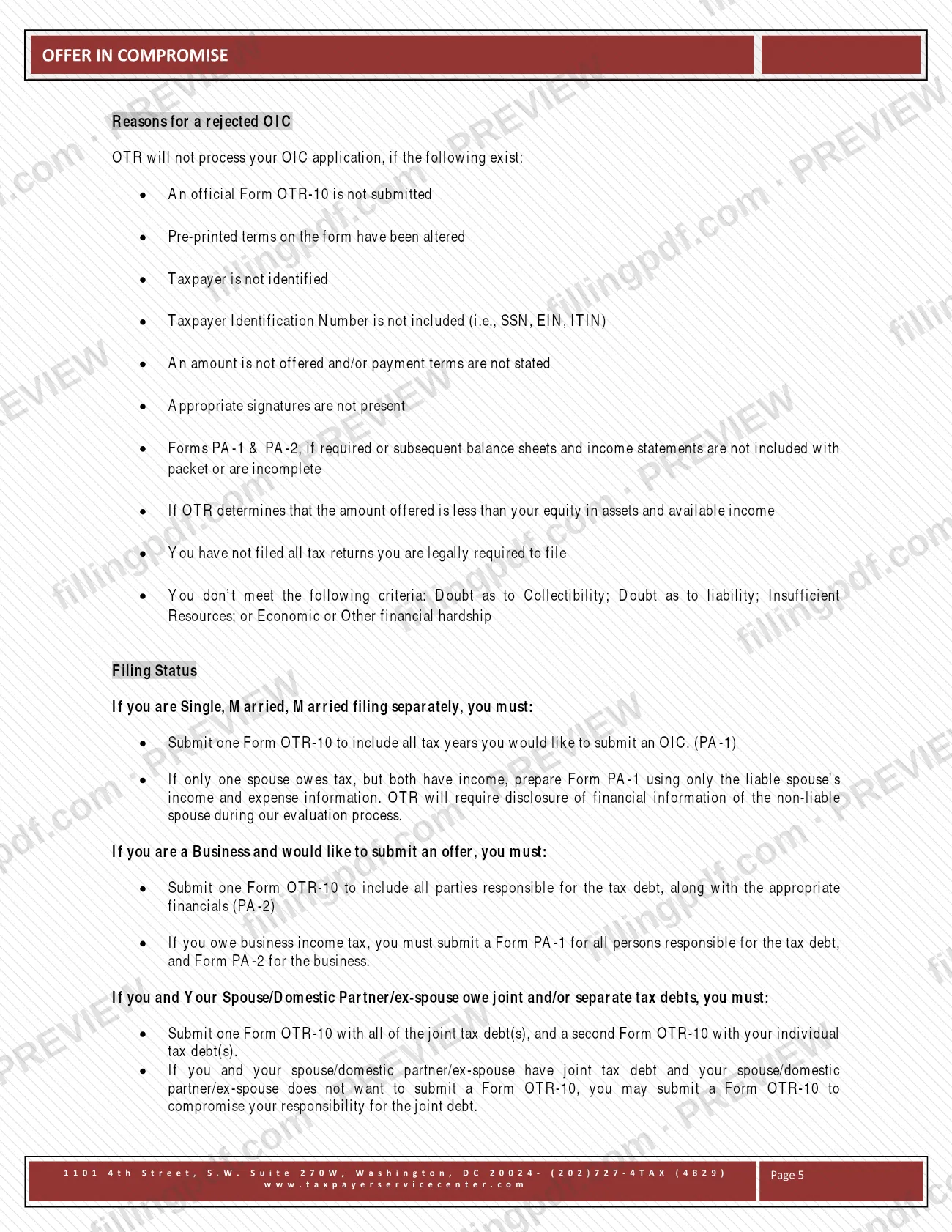
- Altering the pre-printed terms on Form OTR-10 or submitting something other than the official form; OTR will not process the application.
- Leaving out the taxpayer's identification number (SSN, EIN or ITIN), the offer amount, the payment terms or a required signature.
- Omitting Form PA-1 or PA-2, or sending incomplete ones; enter "N/A" on every item that does not apply instead of leaving it blank.
- Applying while you have unfiled required returns, an open bankruptcy proceeding, or an issue still under appeal.
- Including tax years that have not been assessed.
- Listing unsecured debts such as credit cards, or tuition for elementary and secondary schools, as expenses on the financial statement.
- Sending original documents instead of copies with the packet.
- Including a refund owed by OTR in the offer amount, or entering on line 6 amounts you have already paid.
- Combining joint and individual tax debts on one Form OTR-10 instead of filing two forms.
- Expecting to appeal a decision or recover payments: OTR decisions are final, and payments sent with a denied offer are applied to the debt.
Frequently asked questions
What is Form OTR-10?
Form OTR-10 is the Offer in Compromise application of the DC Office of Tax and Revenue. You use it to propose settling an assessed tax debt for less than the full amount owed, based on doubt as to liability or collectibility. Once signed, it serves as your offer contract.
Can I use Form OTR-10 for a DC property tax debt?
The booklet says the program covers income tax, sales and use, withholding tax or any other tax administered by OTR, and line 4 lists those types plus "Other Tax(es)/Fee(s)". It does not name property tax, so call OTR at (202) 724-5045 to confirm your debt qualifies.
Who is eligible for an offer in compromise in DC?
You need an assessed delinquent liability, no remaining or pending appeal issues, all required returns filed, and an inability to pay in full. You are not eligible while you or your business is in an open bankruptcy proceeding.
How do I pay for an offer in compromise?
Choose Lump Sum, with 100% of the offer paid when you submit, or Periodic Payment, with a 20% first payment and the rest in five or fewer payments within 12 months of acceptance. Pay by credit card, certified funds or money order.
Where do I file Form OTR-10?
File it at the Office of Tax and Revenue, 1101 – 4th Street, S.W., Suite 270W, Washington, DC 20024. The booklet names no other filing location. If you work with a specific OTR employee, contact that person before filing.
Can I appeal if OTR rejects my offer?
No. The booklet says all decisions under the program are final and cannot be appealed. You may, however, submit another offer with different payment terms within 30 days of the denial. Payments sent with a rejected offer are not refunded.
What happens after OTR accepts my offer?
OTR confirms acceptance by mail. You must pay the offer amount within 30 days or the offer is voided, and you must file and pay on time for five years. OTR releases tax liens once the offer amount is paid in full.
Can I fill out Form OTR-10 online on FillingPDF?
Yes. You can fill out the PDF online on FillingPDF and download or print it. FillingPDF is independent of OTR and does not file the offer; you submit the packet and payment to OTR yourself.
Ready to fill out OTR-10?
Fill out OTR-10 now