
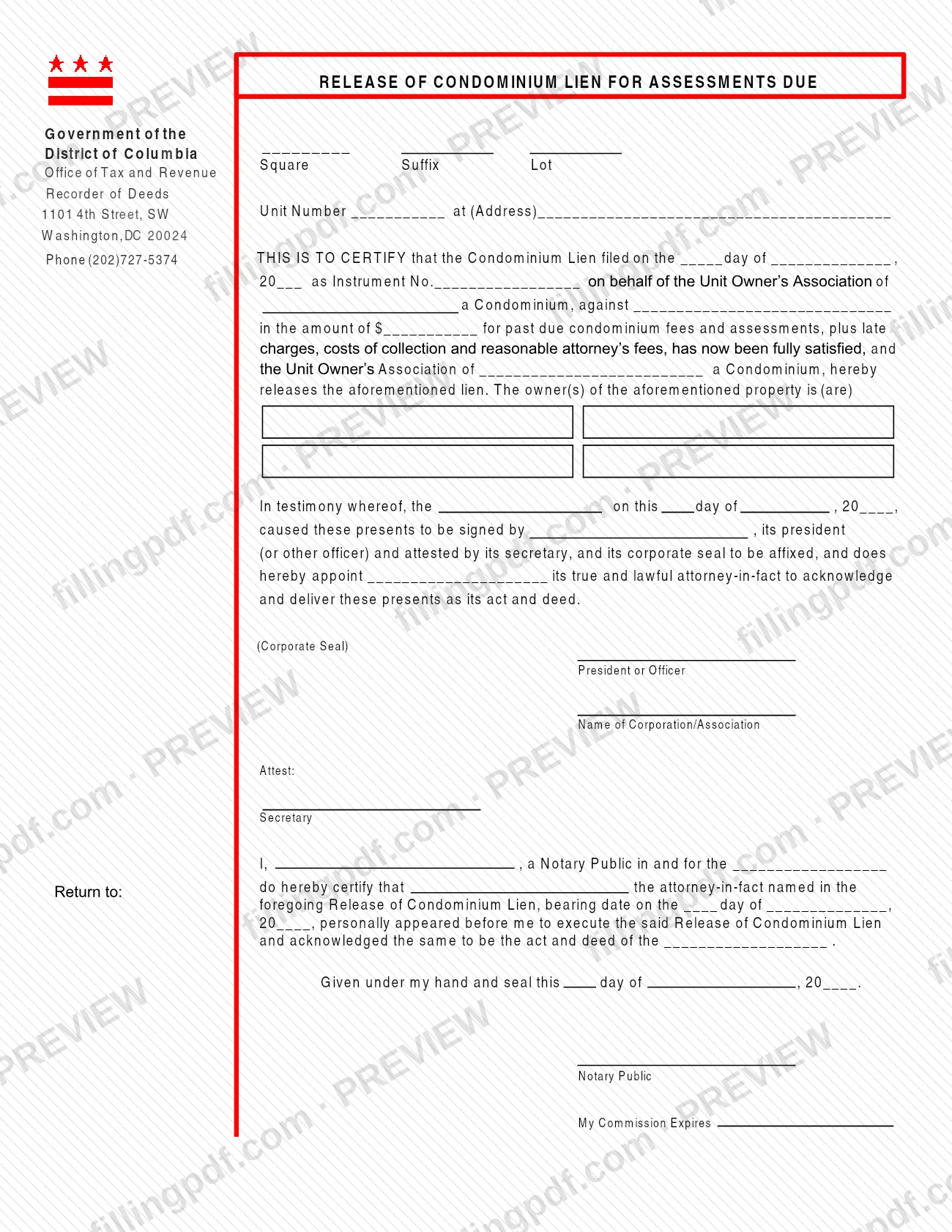
Form ROD 13, Release of Condominium Lien for Assessments Due, is a District of Columbia form, printed under the Office of Tax and Revenue (OTR) Recorder of Deeds heading, that releases a condominium lien once the past due fees and assessments behind it have been fully satisfied. It appears on the OTR website, but it is not a DC property tax form: the lien it releases is one a Unit Owner's Association filed for condominium fees, late charges, costs of collection and attorney's fees. On this page you can fill out the form online on FillingPDF and download or print the completed PDF; the official PDF is published by OTR.
Last updated
What is ROD 13?
Form ROD 13, Release of Condominium Lien for Assessments Due, is the District of Columbia form on which a Unit Owner's Association of a Condominium certifies that a condominium lien for past due fees and assessments has been fully satisfied and releases that lien.
The form is headed Government of the District of Columbia, Office of Tax and Revenue, Recorder of Deeds, 1101 4th Street, SW, Washington, DC 20024, phone (202)727-5374. It has three working parts:
- A certification that identifies the property (Square, Suffix, Lot, Unit Number and address) and the lien being released: the day, month and year it was filed, its Instrument No., the Unit Owner's Association of the condominium, the person it was filed against and the amount, described as past due condominium fees and assessments plus late charges, costs of collection and reasonable attorney's fees.
- An execution clause, in which the association causes the release to be signed by its president (or other officer), attested by its secretary, sealed with its corporate seal, and names an attorney-in-fact to acknowledge and deliver it.
- A notary public's certificate that the attorney-in-fact personally appeared, executed the release and acknowledged it as the act and deed of the association.
The form also has a Return to: line. The lien it releases concerns condominium fees and assessments owed to an association; the form does not deal with DC real property tax. The OTR page lists it as Release of Condominium Lien for Assessments Due, and the printed form shows no revision date.
Who needs to file ROD 13?
The main user is a Unit Owner's Association of a Condominium whose lien for past due condominium fees and assessments, filed against a unit owner, has been fully satisfied and is now to be released.
The form is completed and signed on the association's side:
- President or other officer: signs for the association, in the name of the corporation or association.
- Secretary: attests the signature.
- Attorney-in-fact: named in the form to acknowledge and deliver the release; this person appears before the notary.
- Notary public: completes the certificate at the end of the form.
The form identifies the unit owner(s) of the property on a separate line, but it does not ask the owner to sign. Do not use it for a lien that has not been fully satisfied: the certification states that the lien has been fully satisfied. It is also not a property tax document, since it covers condominium fees and assessments, late charges, costs of collection and attorney's fees. The form says nothing about who else may sign for the association, so confirm any other arrangement with the Recorder of Deeds.
When to file ROD 13
Complete Form ROD 13 after the condominium lien has been fully satisfied, because the form certifies that the lien "has now been fully satisfied." The form prints no deadline of its own, and no filing window or renewal period.
Have these items ready before you start: the date the lien was filed, its Instrument No., the name of the Unit Owner's Association and of the person the lien was filed against, the amount of the lien and the property's Square, Suffix, Lot and Unit Number. The form also carries its own signing dates: the date the association executes it and the date of the notary's certificate, which refer to the same release. For any timing rule that applies to recording a release, contact the Recorder of Deeds at (202)727-5374.
How to fill out ROD 13
Identify the property
At the top, enter the Square, Suffix and Lot, then the Unit Number and the property address on the line that follows.
Describe the lien being released
Enter the day, month and year the Condominium Lien was filed and its Instrument No. Then give the name of the Unit Owner's Association of the condominium and the person the lien was filed against.
Enter the amount and association name
Write the lien amount for past due condominium fees and assessments, then repeat the name of the Unit Owner's Association of the condominium in the release sentence. Complete the line naming the owner(s) of the property.
Complete the execution clause
Enter the date of signing, the name of the corporation or association, and the name of the president (or other officer) who signs. The secretary attests, and the corporate seal is affixed.
Name the attorney-in-fact
Write the name of the person the association appoints as its attorney-in-fact to acknowledge and deliver the release.
Prepare the notary certificate
The notary enters their name, the jurisdiction they serve, the date of the release, the association's name and the date given under hand and seal. The attorney-in-fact must appear before the notary to execute the release.
Add the notary commission date
The notary signs and completes the My Commission Expires line. Fill in the Return to: line with where the document should come back to.
Review, sign and download the PDF
Check the lien date, Instrument No., amount and names against the filed lien. Download or print the completed PDF from FillingPDF, then obtain the required signatures, seal and notarization before submitting it as described under How to submit.
How to submit ROD 13
The form itself names no filing channel, mailing address or portal. What it prints is the Recorder of Deeds contact block and a Return to: line.
- Recorder of Deeds, Office of Tax and Revenue: 1101 4th Street, SW, Washington, DC 20024, phone (202)727-5374, as shown in the header of the form. Call this number to confirm how and where the signed release is delivered and what must accompany it.
- Return to: line: complete it with the name and address of the person or office that should receive the document back.
- Agency page: the form is listed at https://otr.cfo.dc.gov/publication/rod-13-release-condominium-lien-assessments-due.
The package should be the fully signed, attested, sealed and notarized release, since the notary's certificate is part of the form. The form states no fee and no processing time; ask the Recorder of Deeds. FillingPDF lets you fill out and download the PDF; submission follows the agency's channels.
Common mistakes to avoid
- Releasing a lien that has not been fully satisfied; the form certifies that the lien has now been fully satisfied.
- Leaving out the Instrument No. or the filing date of the lien, so the release does not identify which lien it releases.
- Omitting the property identifiers at the top: Square, Suffix, Lot, Unit Number and address.
- Missing the secretary's attestation or the corporate seal, which the execution clause says are part of the signing.
- Leaving the attorney-in-fact's name blank when the form appoints that person to acknowledge and deliver the release.
- Having the attorney-in-fact sign without personally appearing before the notary, as the notary's certificate states.
- Leaving the notary's date or the "My Commission Expires" line incomplete.
- Treating the form as a DC property tax document; it releases a lien for condominium fees and assessments.
Frequently asked questions
What is Form ROD 13?
Form ROD 13, Release of Condominium Lien for Assessments Due, is a District of Columbia form on which a Unit Owner's Association of a Condominium certifies that a lien for past due condominium fees and assessments is fully satisfied and releases it.
Is ROD 13 a DC property tax form?
No. Although it is posted on the DC Office of Tax and Revenue website, ROD 13 releases a lien for past due condominium fees and assessments, late charges, costs of collection and attorney's fees. It is not a DC property tax return or bill.
Who signs Form ROD 13?
The association's president (or other officer) signs, the secretary attests and the corporate seal is affixed. The association also names an attorney-in-fact, who appears before a notary public to acknowledge the release. The form has no signature line for the unit owner.
Does ROD 13 have to be notarized?
The form includes a notary public's certificate stating that the attorney-in-fact personally appeared and acknowledged the release as the association's act and deed. Complete that block with the notary's name, date and commission expiration.
What do I need to know before filling out ROD 13?
You need the property's Square, Suffix, Lot, Unit Number and address, the date the lien was filed, its Instrument No., the association's name, the person the lien was filed against and the lien amount. You also need the officer and attorney-in-fact names.
Where do I send Form ROD 13?
The form prints no filing channel. Its header gives the Recorder of Deeds at 1101 4th Street, SW, Washington, DC 20024, phone (202)727-5374, and it has a Return to: line. Call the office to confirm how it accepts the signed release.
Can I fill out ROD 13 online?
Yes. You can fill out the PDF online on FillingPDF and download or print it. FillingPDF is an independent service and does not file the release; you still need signatures, the seal and notarization, and delivery follows the agency's channels.
Ready to fill out ROD 13?
Fill out ROD 13 now