
ROD Form 37, Affidavit Of Transfer Pursuant To Entity Conversion, is a sworn statement used with the DC Office of Tax and Revenue (OTR) Recorder of Deeds to claim an exemption from DC transfer and/or recordation tax when a deed records real property moving to an entity that was created by a conversion. It is one of the OTR forms tied to DC property tax and deed recordation. You can fill out the form online on FillingPDF and download or print the completed PDF; the original is published by OTR at otr.cfo.dc.gov.
Last updated
What is ROD 37?
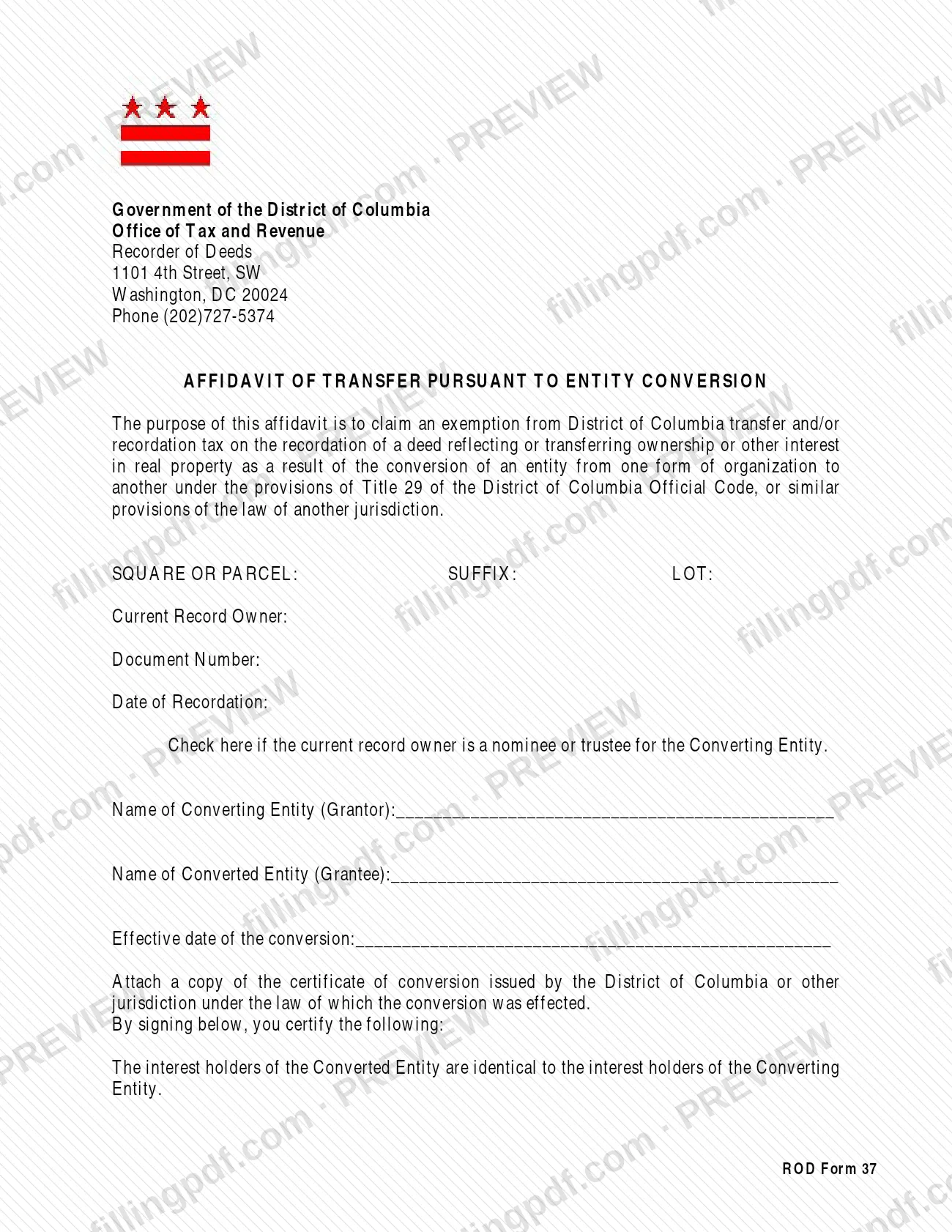
Affidavit Of Transfer Pursuant To Entity Conversion (ROD Form 37) is the District of Columbia affidavit used to claim an exemption from transfer and/or recordation tax on the recordation of a deed that reflects or transfers ownership of real property because an entity changed its form of organization.
The form is issued under the Government of the District of Columbia, Office of Tax and Revenue, Recorder of Deeds. It applies to a conversion made under Title 29 of the District of Columbia Official Code, or under similar provisions of the law of another jurisdiction.
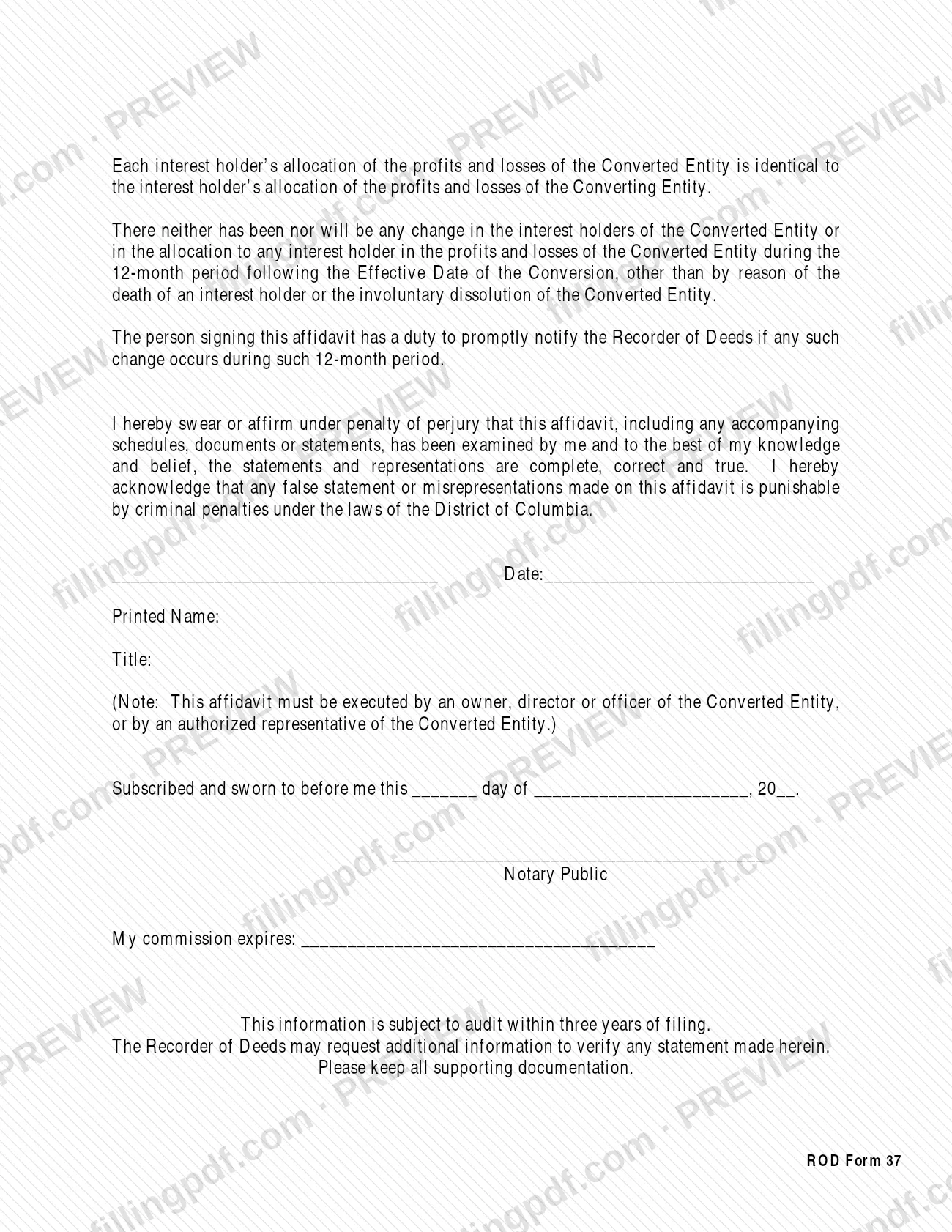
The page identifies the property by Square or Parcel, Suffix and Lot, and names the current record owner, the document number and the date of recordation. It also names the Converting Entity (Grantor), the Converted Entity (Grantee) and the effective date of the conversion. By signing, the person certifies that the interest holders and their allocations of profits and losses are identical before and after the conversion, and that neither will change during the 12-month period after the effective date, other than by the death of an interest holder or the involuntary dissolution of the Converted Entity.
The affidavit must be sworn before a notary public. The form states that the information is subject to audit within three years of filing and that the Recorder of Deeds may ask for more information to verify any statement.
Who needs to file ROD 37?
Use ROD Form 37 if a deed to be recorded in the District of Columbia reflects or transfers ownership or another interest in real property as a result of an entity's conversion from one form of organization to another, and you want to claim the transfer and/or recordation tax exemption the form describes. The conversion must fall under Title 29 of the District of Columbia Official Code or similar provisions of the law of another jurisdiction.
The form prints who must sign: the affidavit must be executed by an owner, director or officer of the Converted Entity, or by an authorized representative of the Converted Entity.
The certifications limit who can truthfully use it. The interest holders of the Converted Entity must be identical to those of the Converting Entity, and each holder's share of profits and losses must be identical. If the current record owner is only a nominee or trustee for the Converting Entity, you check the box on the form for that case.
The form does not describe other transfers, so do not use it for them.
When to file ROD 37
The triggering event is the recordation of a deed that reflects or transfers an interest in real property because of an entity conversion: the affidavit supports the exemption claim on that recordation. The form sets no separate calendar deadline.
Timing matters afterward. The certifications cover the 12-month period following the effective date of the conversion, and the person signing has a duty to promptly notify the Recorder of Deeds if the interest holders or their profit-and-loss allocations change during that period, other than by death of an interest holder or involuntary dissolution of the Converted Entity.
The form also states that the information is subject to audit within three years of filing, and asks you to keep all supporting documentation.
Documents you need
- A copy of the certificate of conversion issued by the District of Columbia or by the other jurisdiction under whose law the conversion was effected; the form says to attach it.
- A notary public's jurat on the form itself: the affidavit is subscribed and sworn before a notary, who also enters the commission expiration date.
How to fill out ROD 37
Identify the property
Enter the SQUARE OR PARCEL, the SUFFIX and the LOT for the real property covered by the deed.
Enter the current record owner
Write the Current Record Owner, the Document Number and the Date of Recordation. Check the box if the current record owner is a nominee or trustee for the Converting Entity.
Name the converting entity
Enter the Name of Converting Entity (Grantor), the entity as it existed before the conversion.
Name the converted entity
Enter the Name of Converted Entity (Grantee), the entity that resulted from the conversion.
Enter the effective date
Write the effective date of the conversion, as shown on the certificate of conversion. The 12-month certification period runs from this date.
Read the certifications
Confirm that the interest holders and their profit-and-loss allocations are identical before and after the conversion and will not change for 12 months, except by death or involuntary dissolution.
Sign, date and identify yourself
Sign and date the affidavit and print your name and title. Only an owner, director or officer of the Converted Entity, or its authorized representative, may sign.
Have the affidavit notarized
Sign before a notary public, who completes the day, month and year of the jurat, signs and enters the commission expiration date.
Review and download the PDF
Check the entries against the certificate of conversion, then download or print the completed PDF from FillingPDF and attach a copy of the certificate.
How to submit ROD 37
The form is directed to the Recorder of Deeds, Office of Tax and Revenue, 1101 4th Street, SW, Washington, DC 20024, phone (202)727-5374. It supports an exemption claim made on the recordation of a deed, and it names no other channel, portal or mailing address.
- Before filing: complete the form, sign and date it, and have the notary complete the jurat and commission expiration.
- Attach: a copy of the certificate of conversion issued by the District of Columbia or the other jurisdiction under whose law the conversion was effected.
- Questions: call the Recorder of Deeds at (202)727-5374 to confirm how to present the affidavit with your deed.
- Records: keep all supporting documentation; the Recorder of Deeds may request additional information.
FillingPDF lets you fill out and download the PDF; submission follows the Recorder of Deeds' channels.
Common mistakes to avoid
- Leaving out the copy of the certificate of conversion, which the form says to attach.
- Signing without a notary present; the affidavit must be subscribed and sworn before a notary public.
- Having someone sign who is not an owner, director or officer of the Converted Entity or its authorized representative.
- Claiming the exemption when the interest holders or their profit-and-loss allocations differ between the Converting and Converted Entities.
- Failing to notify the Recorder of Deeds promptly of a change in interest holders or allocations during the 12-month period after the effective date.
- Forgetting to check the box when the current record owner is a nominee or trustee for the Converting Entity.
- Reversing the entities: the Converting Entity is the grantor and the Converted Entity is the grantee.
- Discarding supporting documents, although the form says to keep them and states that the information is subject to audit within three years of filing.
Frequently asked questions
What is ROD Form 37 used for?
ROD Form 37 is an affidavit claiming an exemption from DC transfer and/or recordation tax on the recordation of a deed when real property ownership changes because an entity converted from one form of organization to another under Title 29 of the DC Official Code or a similar law elsewhere.
Who can sign the Affidavit Of Transfer Pursuant To Entity Conversion?
An owner, director or officer of the Converted Entity, or an authorized representative of the Converted Entity, must execute it. The signature must be made before a notary public, because the affidavit is subscribed and sworn.
What do I have to attach to ROD Form 37?
Attach a copy of the certificate of conversion issued by the District of Columbia or by the other jurisdiction under whose law the conversion was effected. The form lists no other attachment, but it tells you to keep all supporting documentation.
Does ROD Form 37 need to be notarized?
Yes. The form includes a jurat that reads "Subscribed and sworn to before me," with a space for the day, month and year, the notary public's signature and the date the notary's commission expires.
What happens if the interest holders change after the conversion?
The person who signed has a duty to promptly notify the Recorder of Deeds if the interest holders, or their allocation of profits and losses, change within 12 months after the effective date. Death of an interest holder or involuntary dissolution of the entity are the only stated exceptions.
Where do I get help with ROD Form 37?
The form lists the Recorder of Deeds, Office of Tax and Revenue, 1101 4th Street, SW, Washington, DC 20024, phone (202)727-5374. Call that office to confirm how to present the affidavit with your deed.
Can I fill out ROD Form 37 online on FillingPDF?
You can fill out the PDF online on FillingPDF and download or print it. FillingPDF is an independent service and does not file the affidavit or record your deed; you present it through the Recorder of Deeds.
Ready to fill out ROD 37?
Fill out ROD 37 now