
Form ROD 4, Documentation Required for Claiming Exemption from Recordation and/or Transfer Taxes, is the checklist the District of Columbia Office of Tax and Revenue (OTR), Recorder of Deeds, uses to show what must be provided with a deed to claim a tax exemption. It sorts exemptions into 19 numbered situations, such as gifts between family members, deeds from an estate, a revocable trust, a non-profit organization or a re-recording. On this page you can fill out the form online on FillingPDF and download or print the completed PDF; the original is published by OTR at otr.cfo.dc.gov.
Last updated
What is ROD 4?
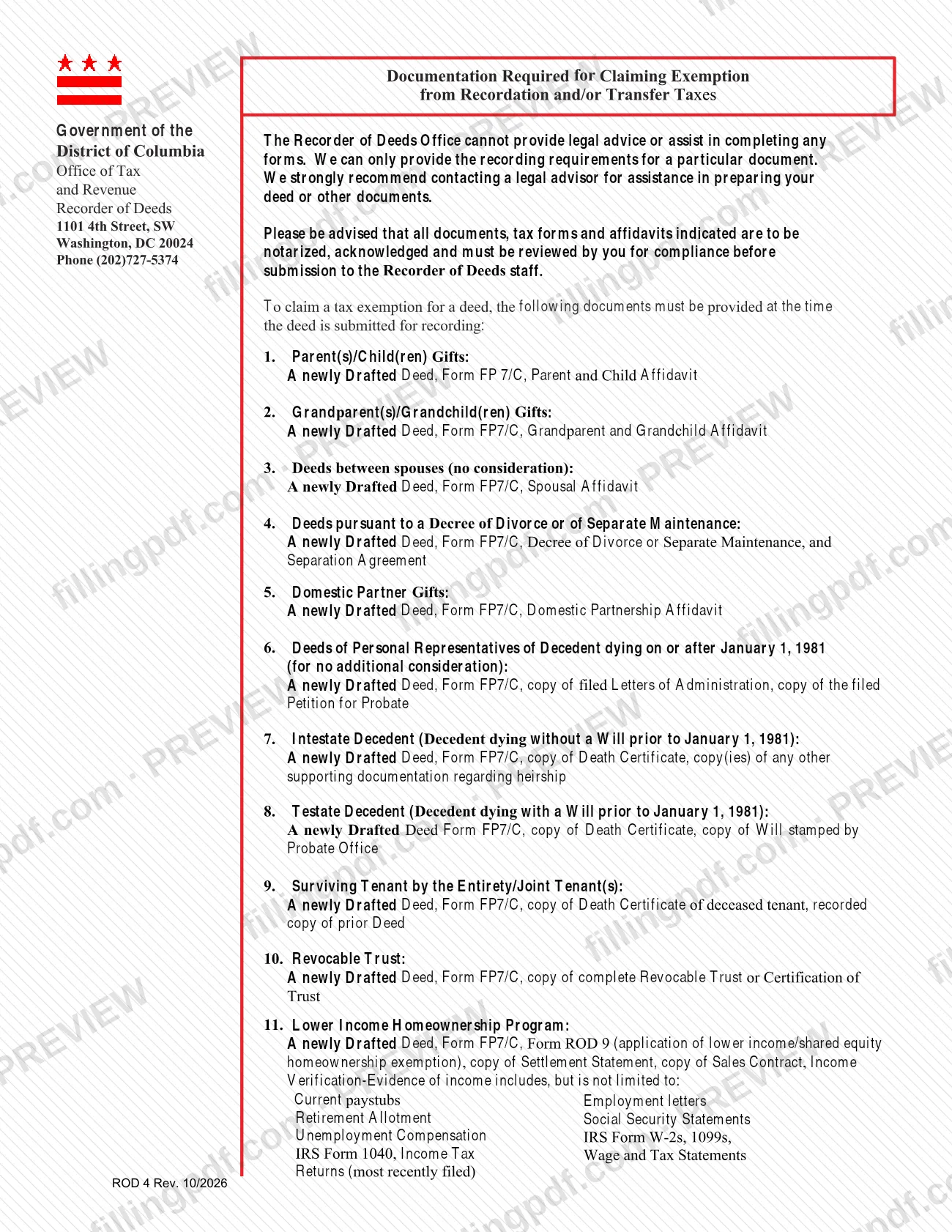
Form ROD 4, Documentation Required for Claiming Exemption from Recordation and/or Transfer Taxes, is the District of Columbia Office of Tax and Revenue (OTR) Recorder of Deeds checklist of the documents that must accompany a deed to claim exemption from recordation and/or transfer taxes.
The checklist is a single reference sheet, printed with the Recorder of Deeds office details (1101 4th Street, SW, Washington, DC 20024). For each of 19 situations it names the newly drafted deed on Form FP7/C and the supporting papers that go with it. Examples include the Parent and Child Affidavit, the Spousal Affidavit, the decree of divorce and separation agreement, letters of administration, a death certificate, a trust or certification of trust, and Form ROD 9, Form ROD 38, Form ROD 37 or Form ROD 24 where the situation calls for them.
Two points shape how it is used. The Recorder of Deeds states that it cannot provide legal advice or help complete District of Columbia forms; it can only give the recording requirements for a document. And exemptions that do not appear on the list must be documented according to the requirements of the specific exemption claimed and the type of filing. For the list of exemptions themselves, ROD 4 refers readers to ROD 7 and ROD 8 in the Recorder of Deeds Forms Center.
The revision printed on the form is ROD 4 Rev. 10/2026.
Who needs to file ROD 4?
Anyone who is asking the DC Recorder of Deeds to record a deed and wants a recordation and/or transfer tax exemption for it uses this checklist to see what to provide. The groups it lists are:
- parents and children, and grandparents and grandchildren, in gifts;
- spouses, in deeds with no consideration, and domestic partners, in gifts;
- parties to a deed under a decree of divorce or of separate maintenance;
- personal representatives of a decedent, and heirs of an intestate or testate decedent, with different papers depending on whether the death was before or on/after January 1, 1981;
- a surviving tenant by the entirety or joint tenant;
- a revocable trust;
- buyers under the Lower Income Homeownership Program;
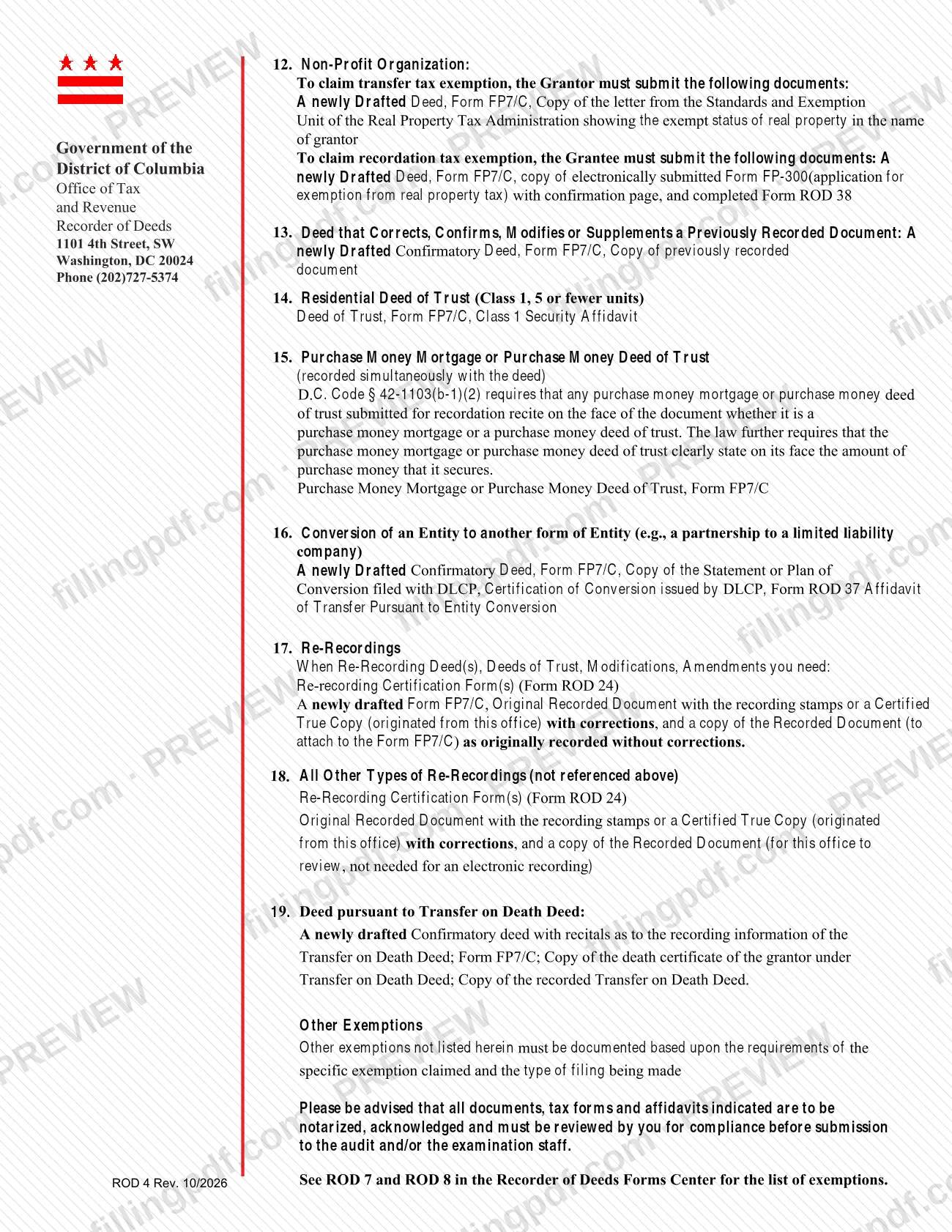
- non-profit organizations, where the grantor and the grantee submit different documents;
- parties to a confirmatory deed, an entity conversion, a transfer on death deed, a residential deed of trust (Class 1, 5 or fewer units) or a purchase money mortgage or deed of trust;
- anyone re-recording a deed, deed of trust, modification or amendment.
If your exemption is not on the list, ROD 4 says to document it according to the specific exemption claimed. The Recorder of Deeds does not give legal advice and recommends contacting a legal advisor to prepare your deed or other documents.
When to file ROD 4
Provide the documents at the time the deed is submitted for recording. ROD 4 states that to claim a tax exemption for a deed, the listed documents must be provided when the deed goes to the Recorder of Deeds, so no later submission is contemplated.
Timing within the list depends on the situation. For a decedent's deed, the date of death sorts you into a category: personal representatives of a decedent dying on or after January 1, 1981, versus intestate or testate decedents dying before that date. For a non-profit, the grantor's documents support the transfer tax exemption and the grantee's documents support the recordation tax exemption. ROD 4 prints no separate filing deadline and no processing time of its own.
Documents you need
- A newly drafted deed on Form FP7/C: listed for the gift, spousal, divorce, domestic partner, decedent, tenant, trust, Lower Income Homeownership Program, non-profit and re-recording situations. Deeds of trust and purchase money instruments also use Form FP7/C.
- Affidavit for the relationship: Parent and Child, Grandparent and Grandchild, Spousal (deeds between spouses, no consideration) or Domestic Partnership Affidavit, matching the gift or transfer.
- For a deed under a Decree of Divorce or of Separate Maintenance: the decree and the Separation Agreement.
- Personal representative of a decedent dying on or after January 1, 1981 (no additional consideration): copy of filed Letters of Administration and copy of the filed Petition for Probate.
- Intestate decedent (died without a Will before January 1, 1981): copy of the Death Certificate and copy(ies) of any other supporting documentation regarding heirship.
- Testate decedent (died with a Will before January 1, 1981): copy of the Death Certificate and copy of the Will stamped by the Probate Office.
- Surviving tenant by the entirety or joint tenant: copy of the Death Certificate of the deceased tenant and a recorded copy of the prior deed.
- Revocable trust: copy of the complete Revocable Trust or a Certification of Trust.
- Lower Income Homeownership Program: Form ROD 9, copy of the Settlement Statement, copy of the Sales Contract and income verification, such as current paystubs, employment letters, Social Security statements, W-2s, 1099s or the most recently filed Form 1040.
- Non-profit organization, transfer tax: the grantor submits a copy of the letter from the Standards and Exemption Unit of the Real Property Tax Administration showing the exempt status of the property in the grantor's name.
- Non-profit organization, recordation tax: the grantee submits a copy of the electronically submitted Form FP-300 with confirmation page and a completed Form ROD 38.
- Deed correcting, confirming, modifying or supplementing a recorded document, or a transfer on death deed: a newly drafted Confirmatory Deed, and a copy of the previously recorded document (for a transfer on death deed, also the grantor's death certificate).
- Residential deed of trust (Class 1, 5 or fewer units): Deed of Trust on Form FP7/C and a Class 1 Security Affidavit.
- Entity conversion: copy of the Statement or Plan of Conversion filed with DLCP, Certification of Conversion issued by DLCP and Form ROD 37 Affidavit of Transfer Pursuant to Entity Conversion.
- Re-recordings: Re-recording Certification Form(s) (Form ROD 24), the original recorded document with recording stamps or a Certified True Copy from the office with corrections, and a copy as originally recorded.
How to fill out ROD 4
Find your exemption category
Read the 19 numbered items and pick the one that matches your deed, such as Parent(s)/Child(ren) Gifts, Revocable Trust or Re-Recordings. If none fits, see the Other Exemptions note and ROD 7 and ROD 8.
Draft a new deed on Form FP7/C
Items 1 to 12, 16, 17 and 19 call for a newly drafted deed, and item 13 for a newly drafted Confirmatory Deed, all on Form FP7/C. Items 14 and 15 use Form FP7/C for the Deed of Trust and the purchase money instrument.
Add the relationship affidavit or decree
For items 1 to 5, add the matching affidavit (Parent and Child, Grandparent and Grandchild, Spousal or Domestic Partnership), or the Decree of Divorce or Separate Maintenance and Separation Agreement.
Add estate, tenancy and trust papers
For items 6 to 10 and 19, attach the listed copies: Letters of Administration and Petition for Probate, Death Certificate, stamped Will, prior recorded deed, trust or Certification of Trust, or the recorded Transfer on Death Deed.
Add program, non-profit and entity forms
Item 11 needs Form ROD 9 with settlement statement, sales contract and income evidence. Item 12 splits into grantor and grantee documents, and item 16 needs the DLCP conversion papers and Form ROD 37.
Prepare corrections and re-recordings
For item 17 or 18, add Form ROD 24 and the original recorded document with recording stamps or a Certified True Copy with corrections; item 17 also needs a newly drafted Form FP7/C and a copy as originally recorded.
Notarize and check compliance
Have every document, tax form and affidavit listed for your category notarized and acknowledged, and review them for compliance yourself before submission.
Review and download the completed PDF
Check that the category you selected matches the documents you gathered. Download or print the completed PDF from FillingPDF and take it with the deed to the Recorder of Deeds as described under How to submit.
How to submit ROD 4
ROD 4 itself is not filed. Its documents are provided to the Recorder of Deeds staff at the time the deed is submitted for recording, and the form prints no separate portal or mailing address for them.
- Recorder of Deeds office: Office of Tax and Revenue, Recorder of Deeds, 1101 4th Street, SW, Washington, DC 20024. Phone (202)727-5374.
- Electronic recording: item 18 refers to electronic recording, noting that a copy of the recorded document for office review is not needed in that case. The form gives no details on how to record electronically, so ask the Recorder of Deeds.
Before you submit, the form requires that all documents, tax forms and affidavits indicated are notarized and acknowledged, and that you review them for compliance. The Recorder of Deeds cannot provide legal advice or help complete District of Columbia forms. For the list of available exemptions, see ROD 7 and ROD 8 in the Recorder of Deeds Forms Center. FillingPDF lets you fill out and download the PDF; submission follows the agency's channels above.
Common mistakes to avoid
- Submitting an old deed instead of a newly drafted deed on Form FP7/C, which most listed exemption situations require.
- Providing documents that are not notarized and acknowledged, when ROD 4 says all documents, tax forms and affidavits indicated must be.
- Using the wrong decedent category: the papers differ for deaths on or after January 1, 1981 and for intestate or testate decedents who died before that date.
- Having a non-profit grantee file the grantor's letter, or the reverse: the grantor supports the transfer tax exemption and the grantee supports the recordation tax exemption.
- Leaving out Form ROD 9, the settlement statement, the sales contract or income evidence in a Lower Income Homeownership Program deed.
- Omitting the Form FP-300 confirmation page or Form ROD 38 in a non-profit recordation tax claim.
- Re-recording without Form ROD 24 or without the original recorded document with its recording stamps (or a Certified True Copy from the office).
- Drafting a purchase money mortgage or deed of trust without stating on its face that it is one and the amount of purchase money it secures, as D.C. Code § 42-1103(b-1)(2) requires.
- Expecting Recorder of Deeds staff to complete forms or give legal advice; the office provides only recording requirements.
Frequently asked questions
What is Form ROD 4?
Form ROD 4 is the DC Office of Tax and Revenue Recorder of Deeds checklist of documents to provide with a deed to claim exemption from recordation and/or transfer taxes. It covers 19 situations, from family gifts and estates to non-profits and re-recordings.
Is Form ROD 4 a DC property tax form?
No. ROD 4 concerns exemption from recordation and/or transfer taxes when a deed is recorded. It does not itself claim a real property tax exemption, although its non-profit item asks the grantee for a copy of Form FP-300, the application for exemption from real property tax.
When do I have to provide the ROD 4 documents?
At the time the deed is submitted for recording. ROD 4 states that the documents for your exemption must be provided then. The form prints no separate deadline or processing time.
Do the documents have to be notarized?
Yes. ROD 4 says all documents, tax forms and affidavits indicated are to be notarized and acknowledged, and that you must review them for compliance before submitting them to the Recorder of Deeds staff.
What if my exemption is not on the ROD 4 list?
Document it according to the requirements of the specific exemption you claim and the type of filing. ROD 4 refers readers to ROD 7 and ROD 8 in the Recorder of Deeds Forms Center for the list of exemptions.
What do I need to re-record a deed?
You need Re-recording Certification Form(s) (Form ROD 24) and the original recorded document with recording stamps or a Certified True Copy from the office with corrections. Item 17 also requires a newly drafted Form FP7/C and a copy as originally recorded.
Can the Recorder of Deeds help me complete the forms?
No. The Recorder of Deeds states it cannot provide legal advice or help complete District of Columbia forms; it can only give the recording requirements for a document. It recommends contacting a legal advisor.
Can I fill out Form ROD 4 online on FillingPDF?
You can fill out the PDF online on FillingPDF and download or print it. FillingPDF is an independent service, not affiliated with OTR, and does not submit anything to the Recorder of Deeds; you provide the documents with your deed through the agency's channels.
Ready to fill out ROD 4?
Fill out ROD 4 now