

Form FR-399, Qualified High Technology Companies (QHTC), is the Office of Tax and Revenue (OTR) booklet for tax years 2021, 2022 and 2023 that defines a Qualified High Technology Company in the District of Columbia and lists the tax benefits it can claim. It also covers DC property tax rules for QHTCs: the personal property tax exemption ended effective July 1, 2021, while a reduction in real property tax remains for qualified leasehold improvements. On FillingPDF you can fill out Form FR-399 online and download or print the completed PDF; the QHTC self-certification itself is submitted only online at MyTax.DC.gov.
Last updated
What is FR-399?
Form FR-399, Qualified High Technology Companies (QHTC), is the Office of Tax and Revenue (OTR) booklet for tax years 2021, 2022 and 2023 that defines a Qualified High Technology Company, lists its DC tax benefits, and includes credit claim forms FP-332, FP-333 and FP-334.
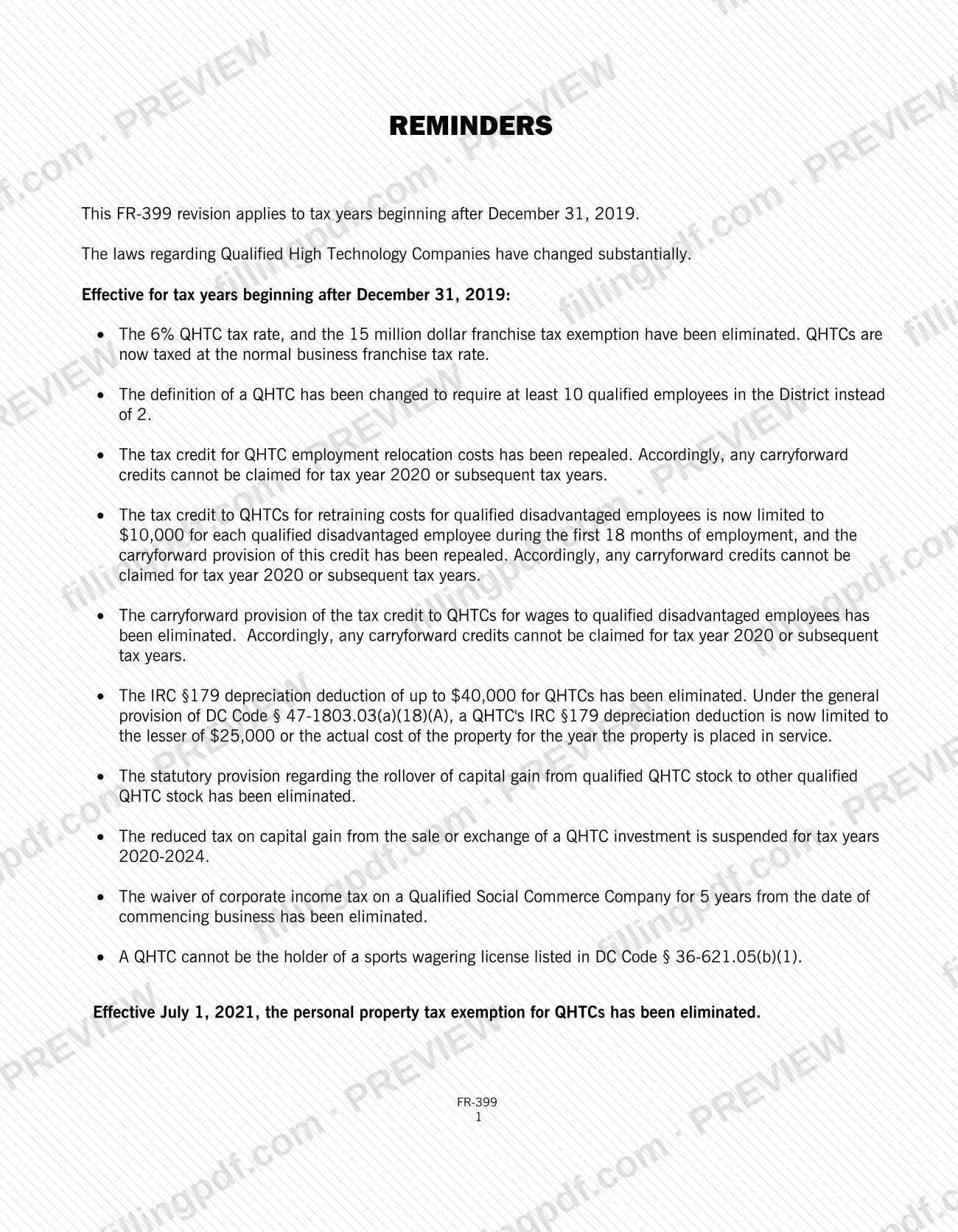
OTR is part of the Government of the District of Columbia's Office of the Chief Financial Officer. This revision applies to tax years beginning after December 31, 2019, and reflects the QHTC Tax Incentives Modification Amendment Act of 2020, which repealed or limited many earlier benefits and raised the required number of qualified employees in the District from 2 to 10. The booklet also cites the New E-Conomy Transformation Act of 2000 and the Qualified High Technology Clarification Act of 2014.
The booklet is not a tax return. It contains:
- reminders about the changed QHTC rules and the online self-certification;
- the definition of a QHTC, its permitted activities and exclusions;
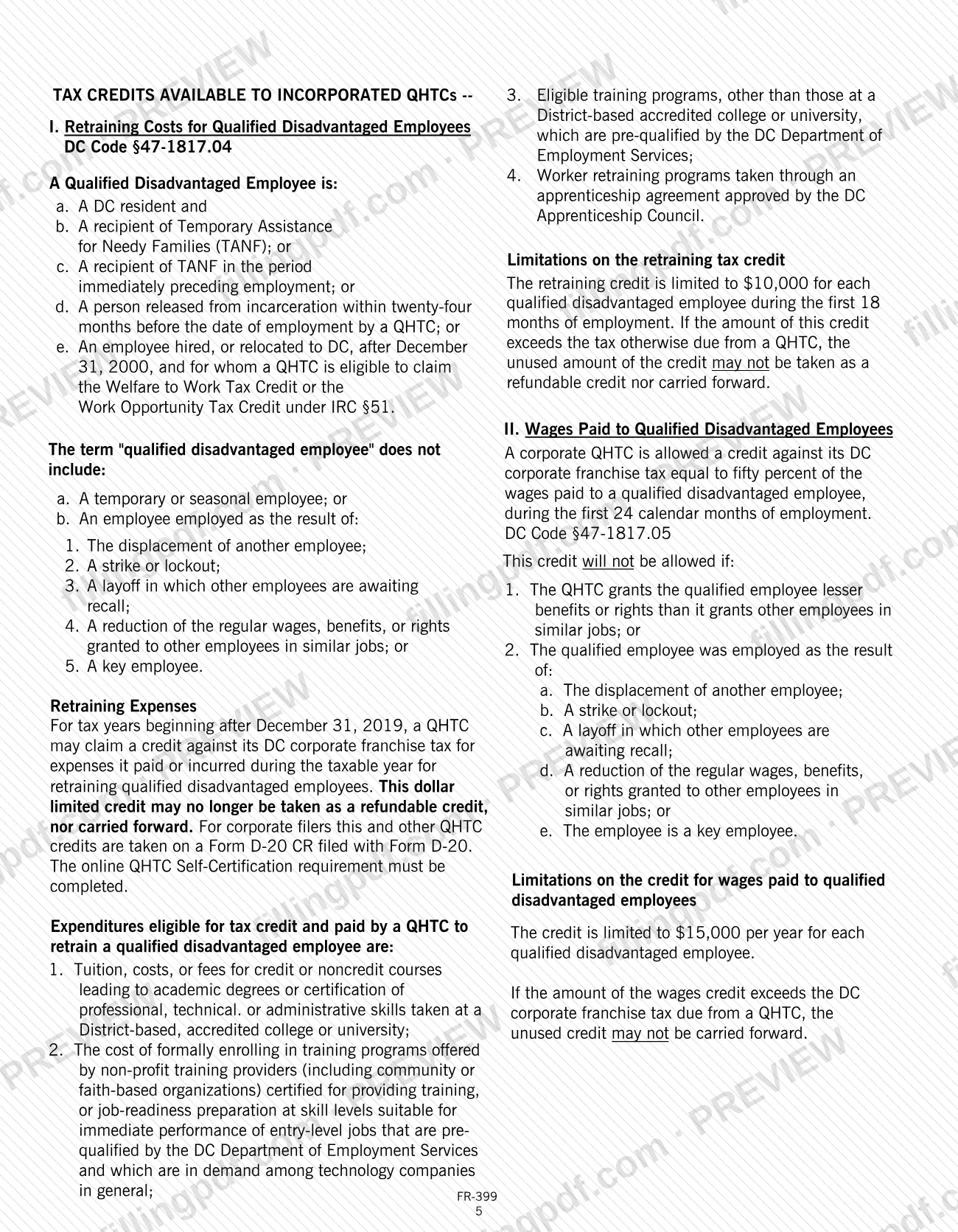
- the tax benefits for incorporated and unincorporated QHTCs;
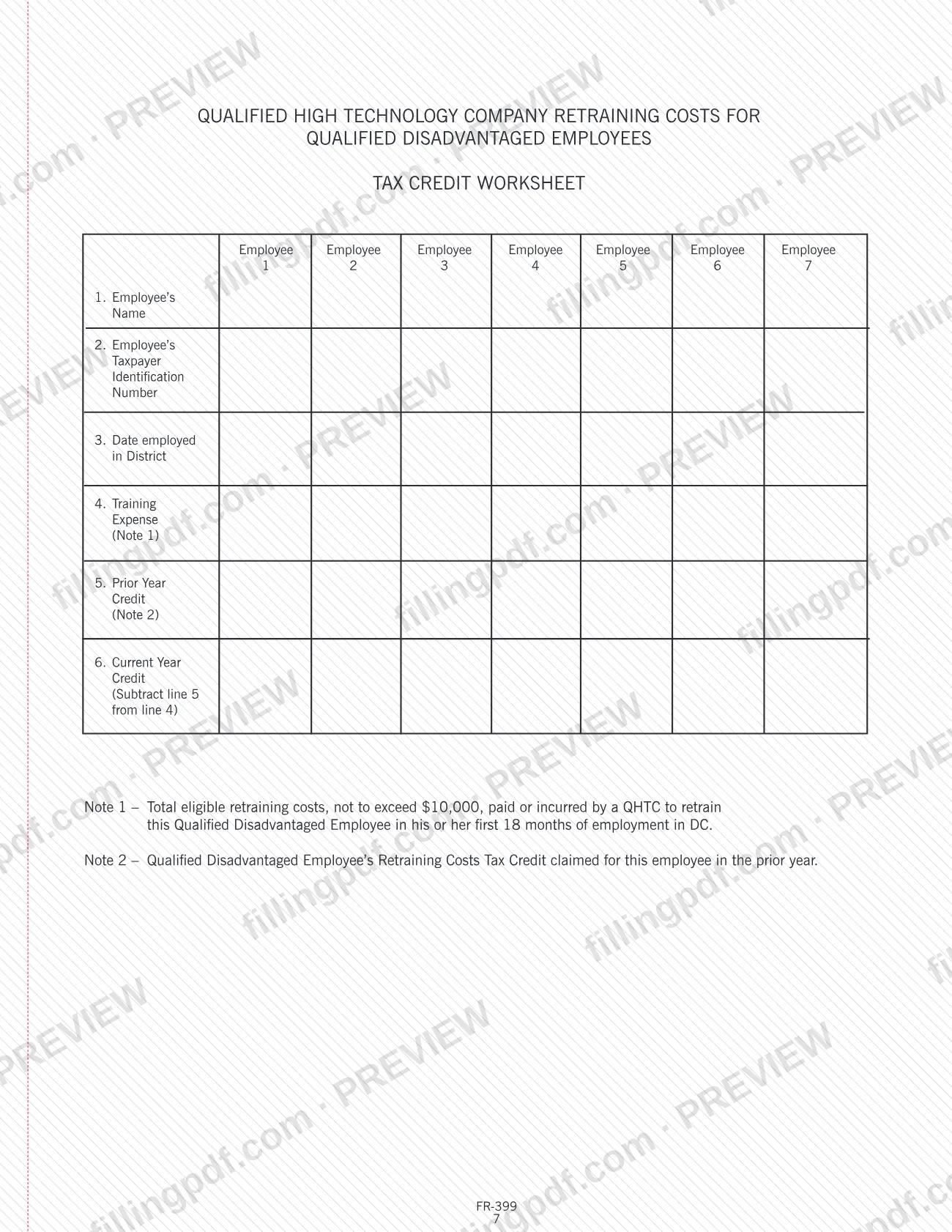
- the retraining-costs worksheet and Forms FP-332, FP-333 and FP-334;
- the Certification of Gross Revenue Worksheet.
Returns themselves are filed on other forms the booklet names: Form D-20 (DC Corporate Franchise Tax Return), Form D-65 (DC Partnership Return), Form D-40 (Individual Income Tax Return), Form FR-800 (DC Sales and Use Tax Return) and Form FP-31 (DC Personal Property Tax Return). Benefits are claimed only after the online self-certification is completed.
Who needs to file FR-399?
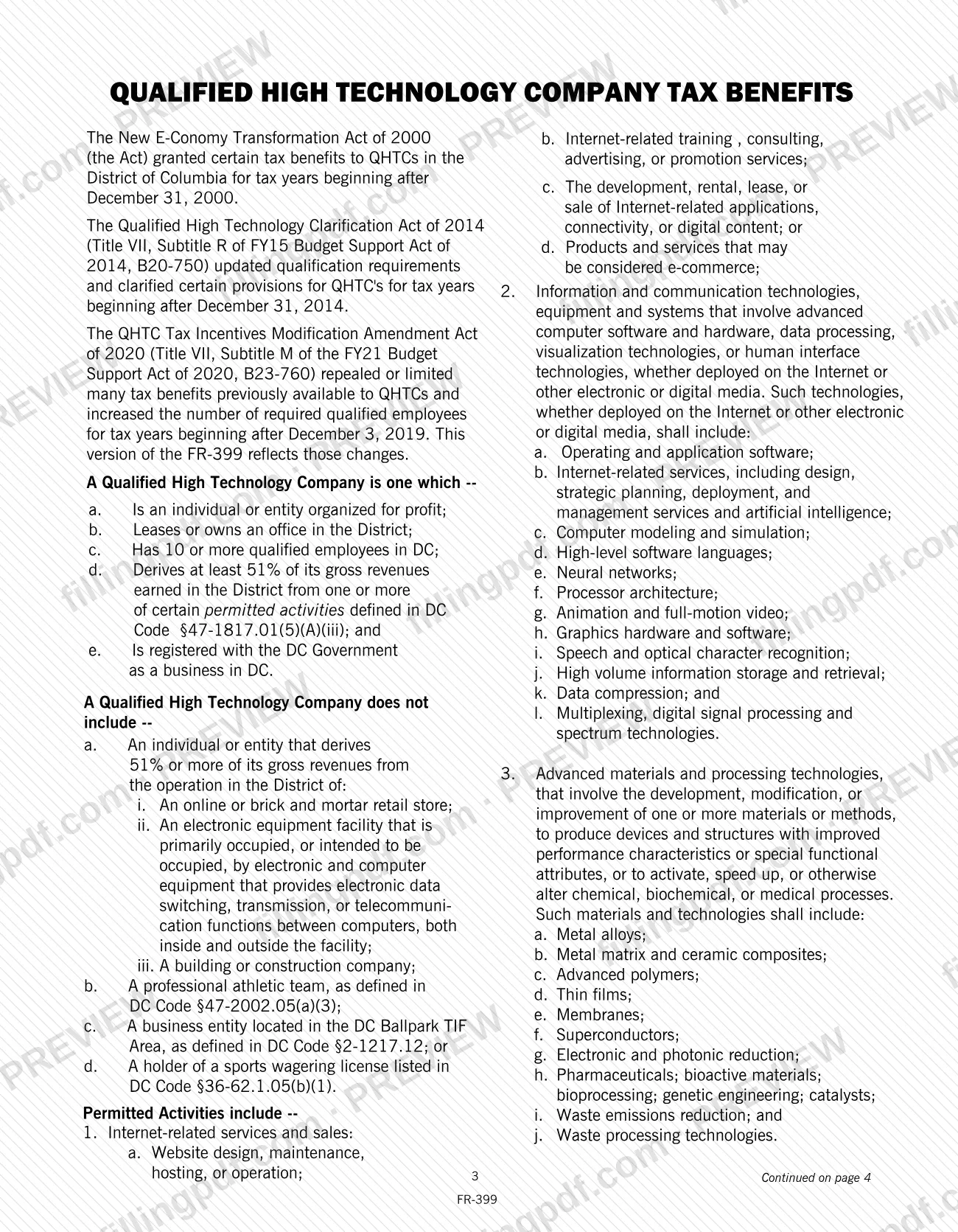
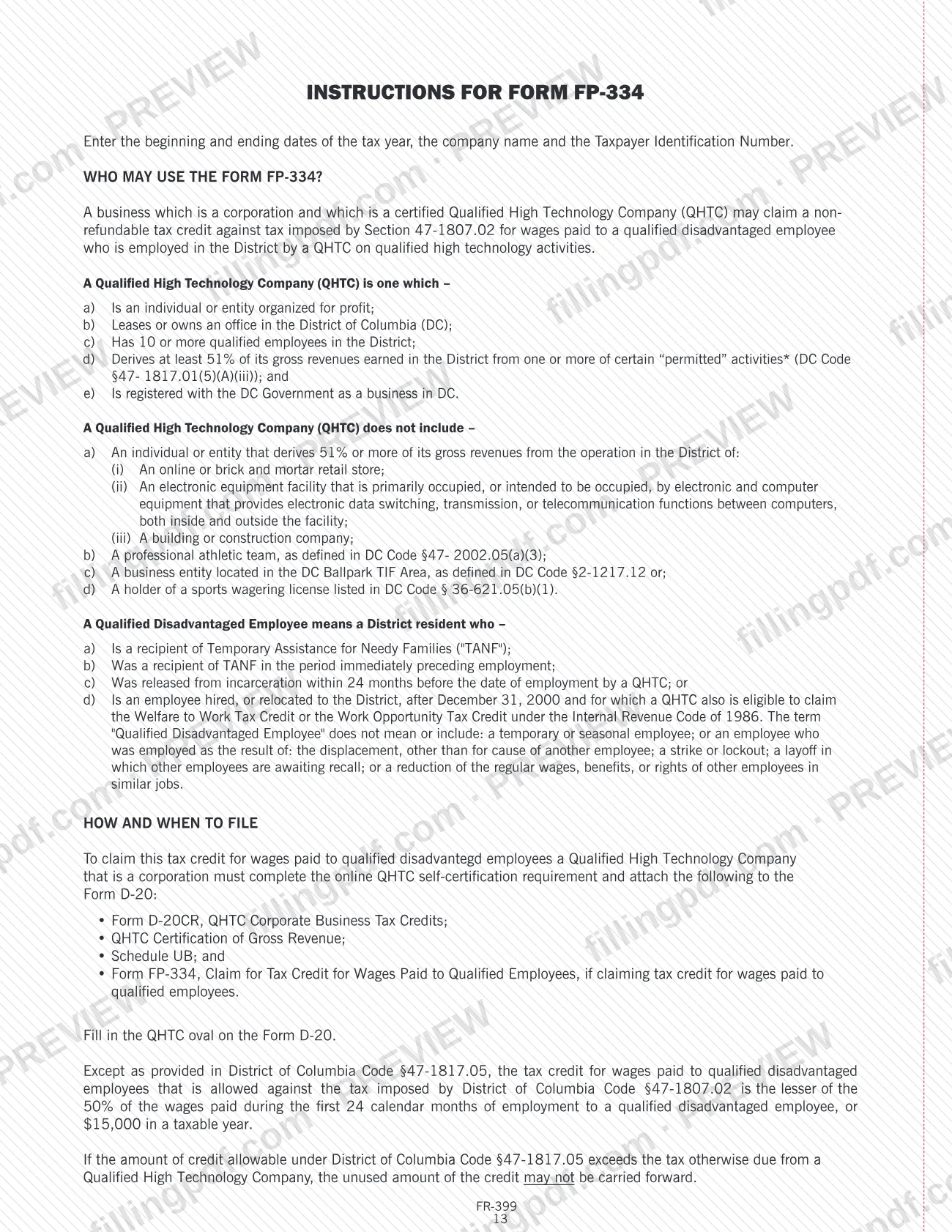
Any business that qualifies and wishes to be certified as a Qualified High Technology Company uses the QHTC self-certification this booklet describes. A QHTC is an individual or entity organized for profit that leases or owns an office in the District, has 10 or more qualified employees in DC, earns at least 51% of its DC gross revenues from permitted activities, and is registered with the DC Government as a business.
- Incorporated QHTCs claim credits on Form D-20 and the attached forms; Forms FP-332, FP-333 and FP-334 are for corporations that are certified QHTCs.
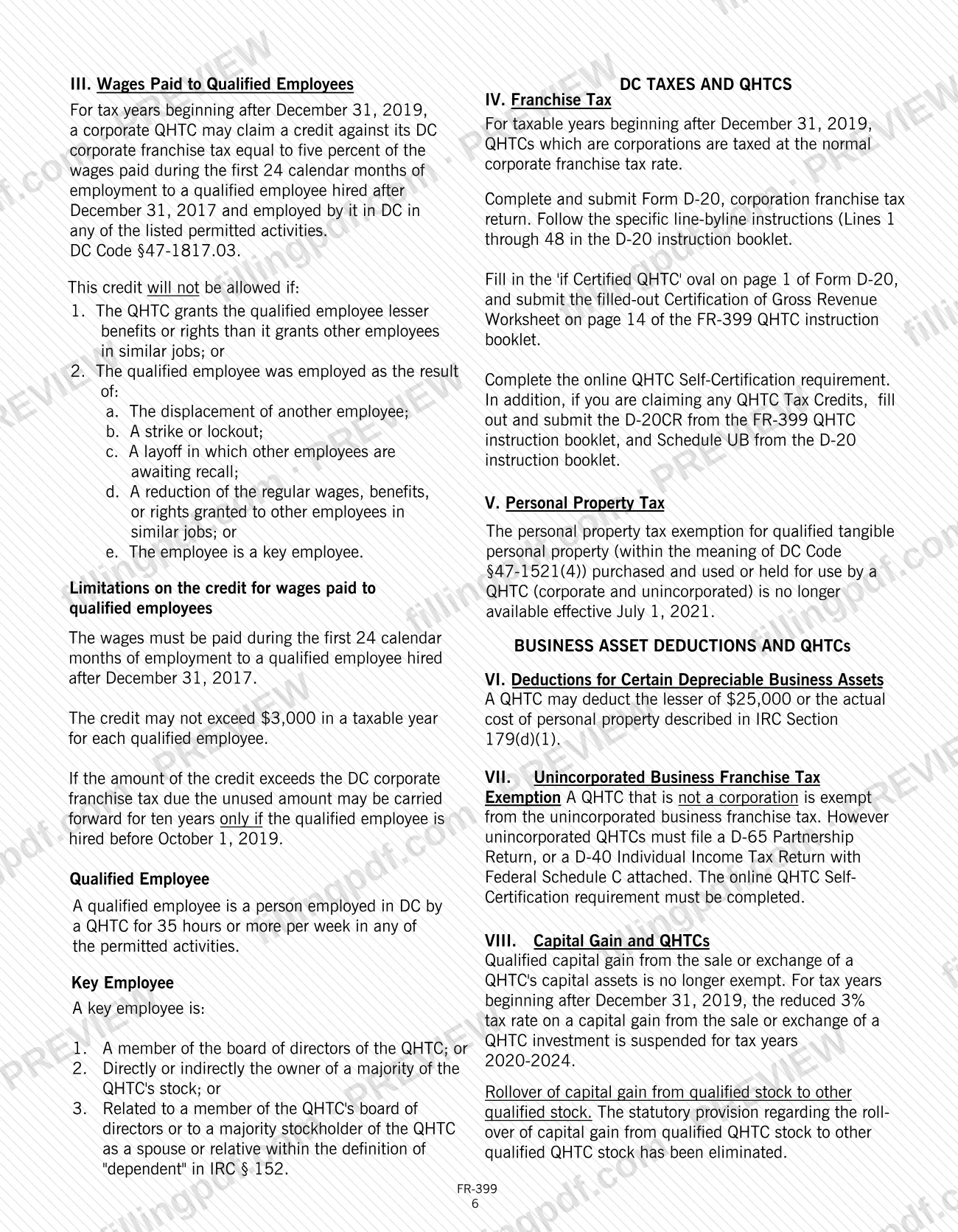
- Unincorporated QHTCs are exempt from the unincorporated business franchise tax but must file a D-65 Partnership Return, or a D-40 Individual Income Tax Return with Federal Schedule C attached.
- Signers: the self-certification is completed online by an Owner, General Partner or Officer authorized to sign.
A QHTC does not include an individual or entity that derives 51% or more of its gross revenues from operating, in the District, an online or brick and mortar retail store, an electronic equipment facility (data hotel) or a building or construction company. It also excludes professional athletic teams, business entities in the DC Ballpark TIF Area and holders of a sports wagering license listed in DC Code § 36-621.05(b)(1).
When to file FR-399
The QHTC self-certification must be filed every year to obtain a QHTC certificate of benefits, and online self-certification has been required since January 1, 2019. Credit claims are attached to the return for the tax year; this booklet sets no separate due date, so the due date is that of the return (Form D-20, D-65 or D-40) in its own instruction booklet.
This revision applies to tax years 2021, 2022 and 2023. Prior-year return data, including QHTC revenues, employee credits and exemptions, will be requested for future certifications. Carryforward credits cannot be claimed for tax year 2020 or later for relocation costs, retraining costs or wages to qualified disadvantaged employees. The credit for wages paid to qualified employees carries forward 10 years only for employees hired before October 1, 2019.
Documents you need
- Completed online QHTC self-certification at MyTax.DC.gov, required before any QHTC tax credit or other QHTC benefit is claimed.
- Form D-20, DC Corporate Franchise Tax Return, for incorporated QHTCs, with the "if Certified QHTC" oval filled in on page 1.
- Form D-20CR, QHTC Corporate Business Tax Credits, when an incorporated QHTC claims any QHTC tax credit.
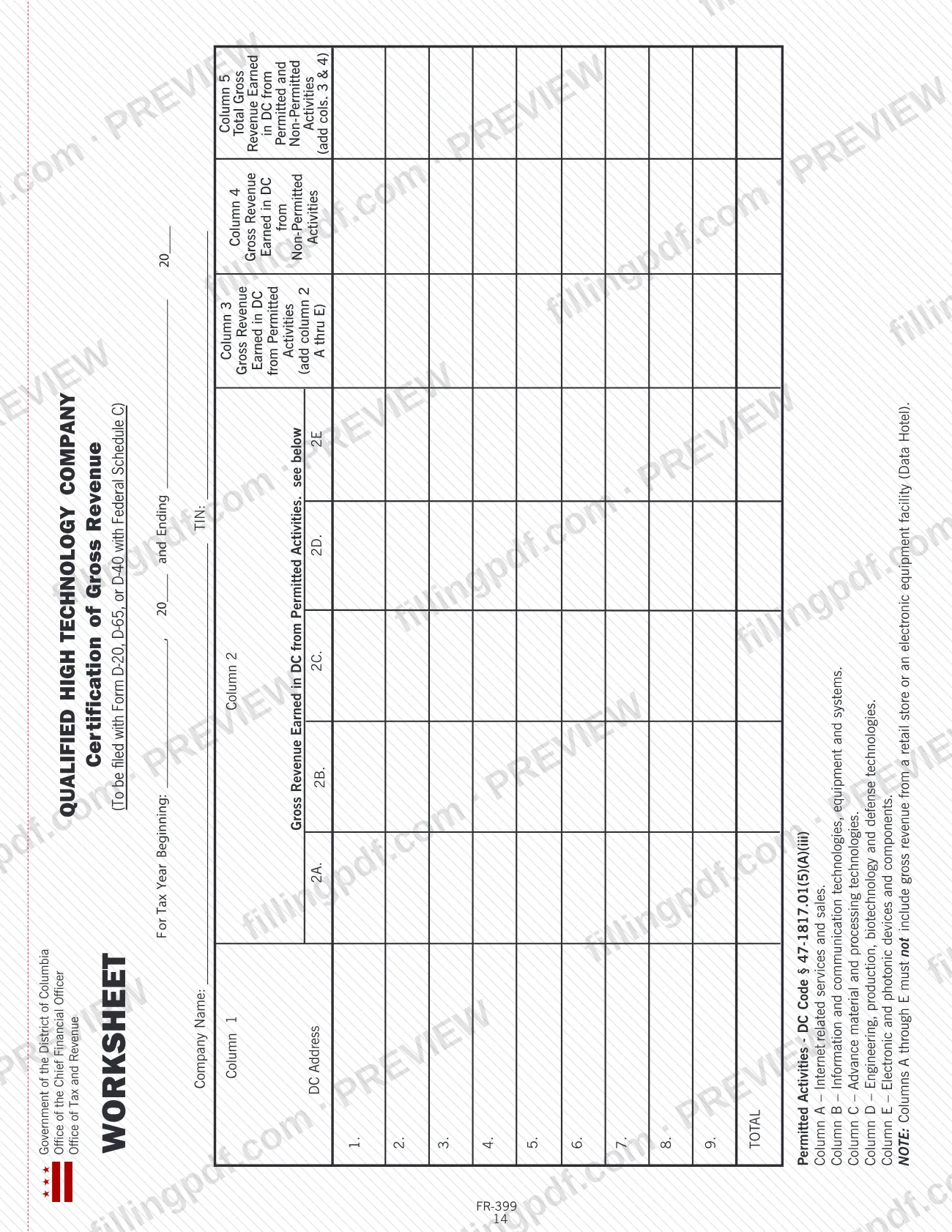
- QHTC Certification of Gross Revenue Worksheet (page 14 of the booklet), filed with Form D-20, D-65, or D-40 with Federal Schedule C.
- Schedule UB from the D-20 instruction booklet, when an incorporated QHTC claims QHTC tax credits.
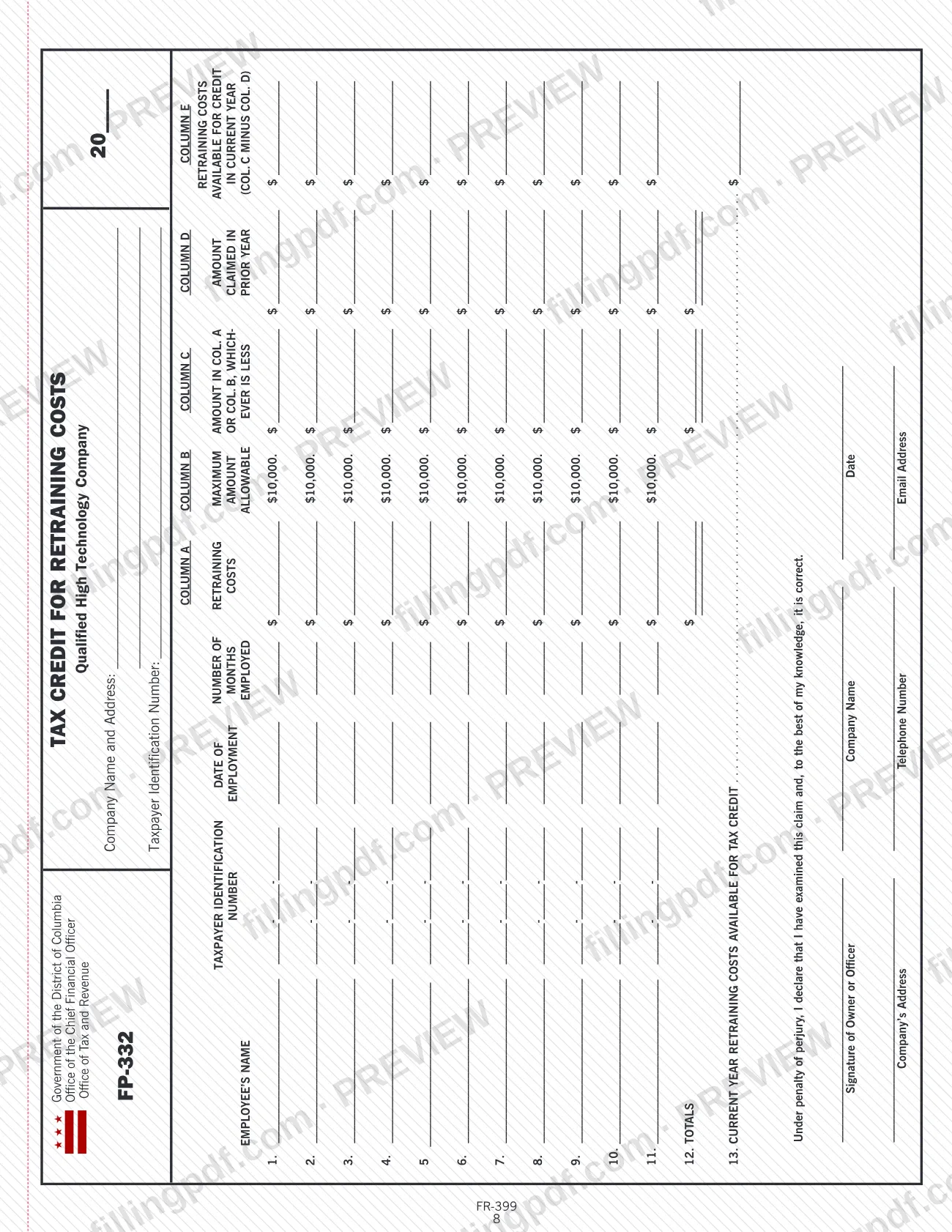
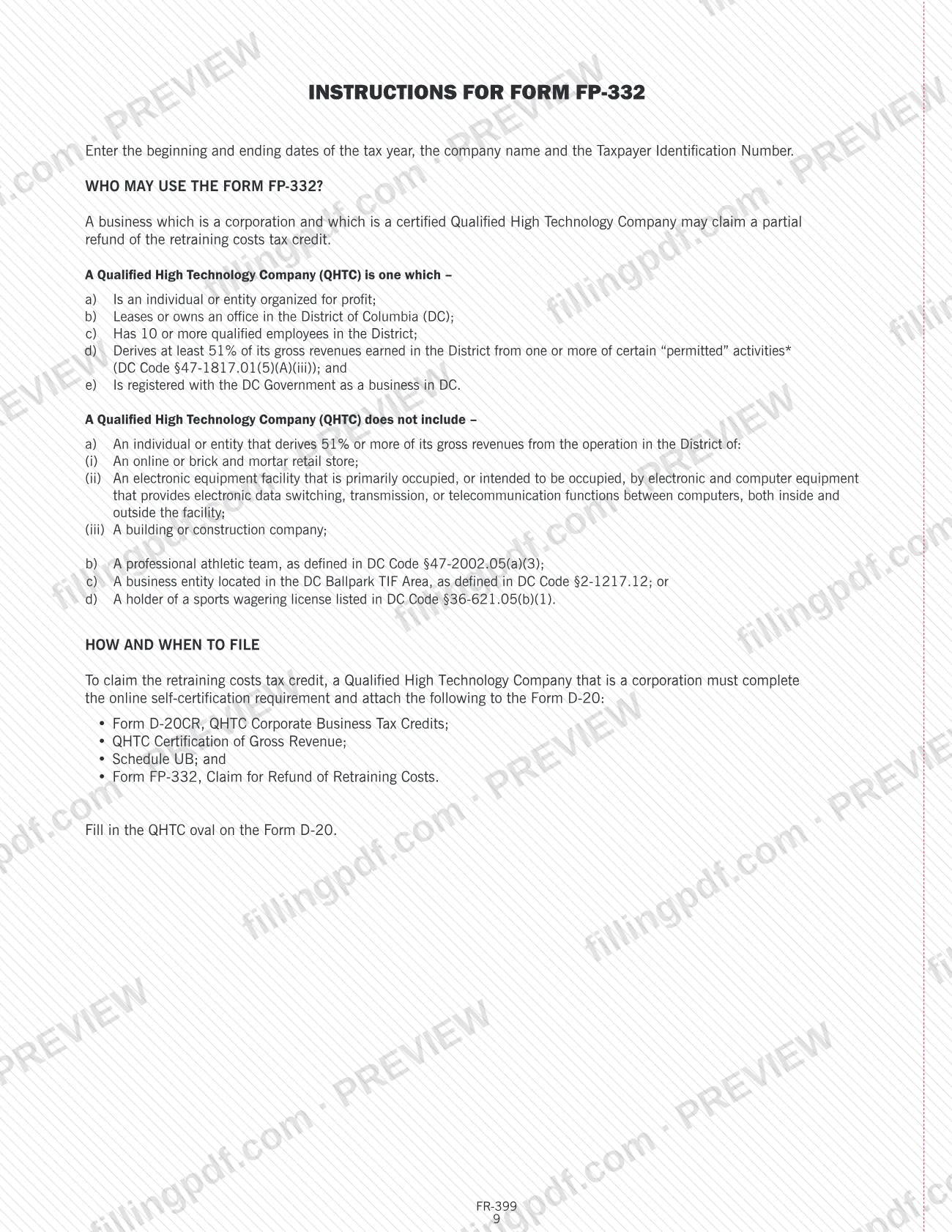
- Form FP-332, Claim for Refund of Retraining Costs, only when claiming the retraining costs credit for qualified disadvantaged employees.
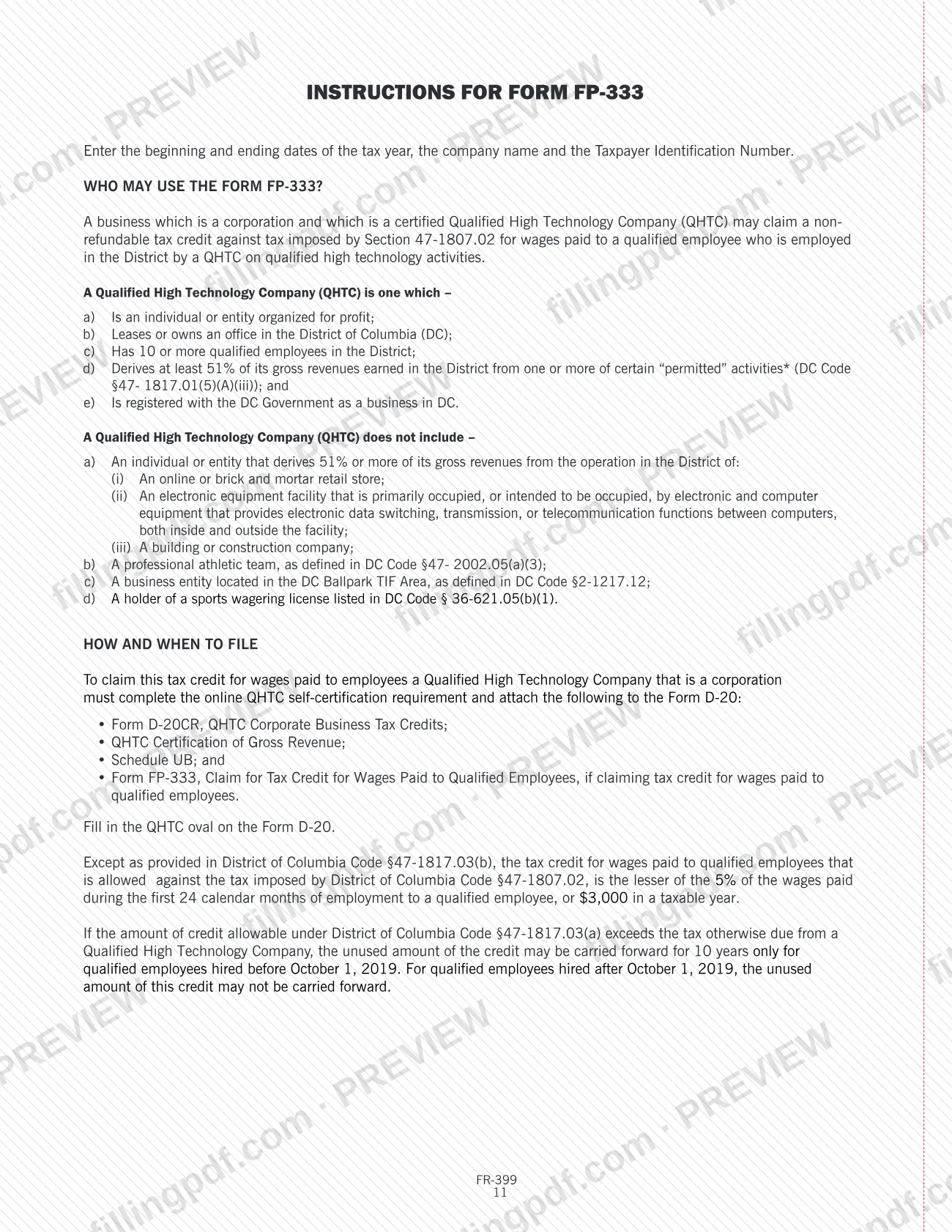
- Form FP-333, Claim for Tax Credit for Wages Paid to Qualified Employees, only when claiming the wages credit for qualified employees.
- Form FP-334, for the credit for wages paid to qualified disadvantaged employees, only when claiming that credit.
- Form D-65 Partnership Return, or Form D-40 Individual Income Tax Return with Federal Schedule C attached, for unincorporated QHTCs.
How to fill out FR-399
Confirm your business is a QHTC
Check the definition on page 3: for-profit, an office leased or owned in the District, 10 or more qualified employees in DC, at least 51% of DC gross revenues from permitted activities, and registration as a DC business. Make sure none of the exclusions applies.
Gather your self-certification details
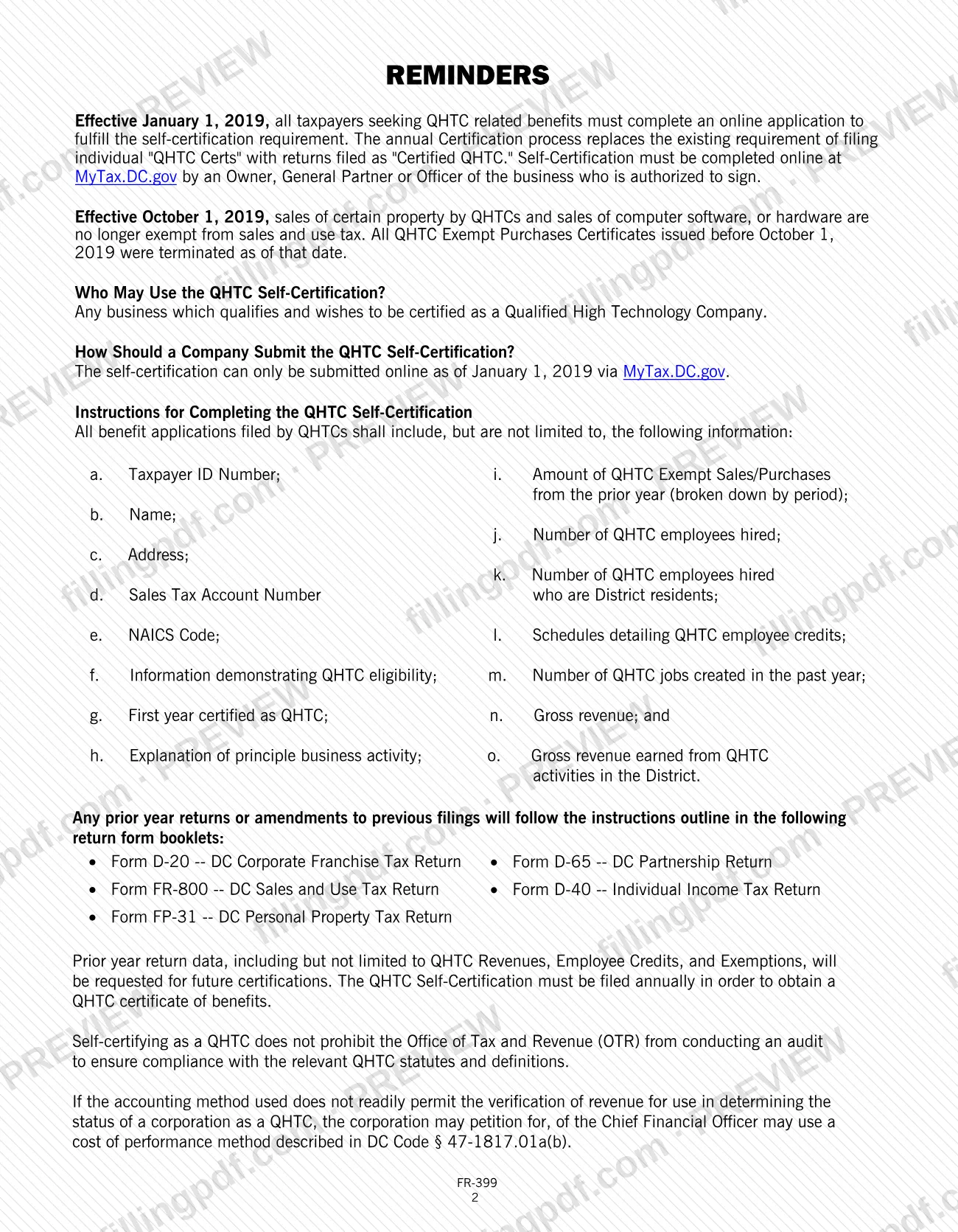
Page 2 lists what a benefit application includes, such as Taxpayer ID Number, name, address, Sales Tax Account Number, NAICS Code, first year certified, gross revenue and QHTC employee counts. Have them ready.
Complete the online self-certification
Self-certification is not completed on the PDF. An Owner, General Partner or Officer authorized to sign files it online at MyTax.DC.gov.
Fill out the Certification of Gross Revenue
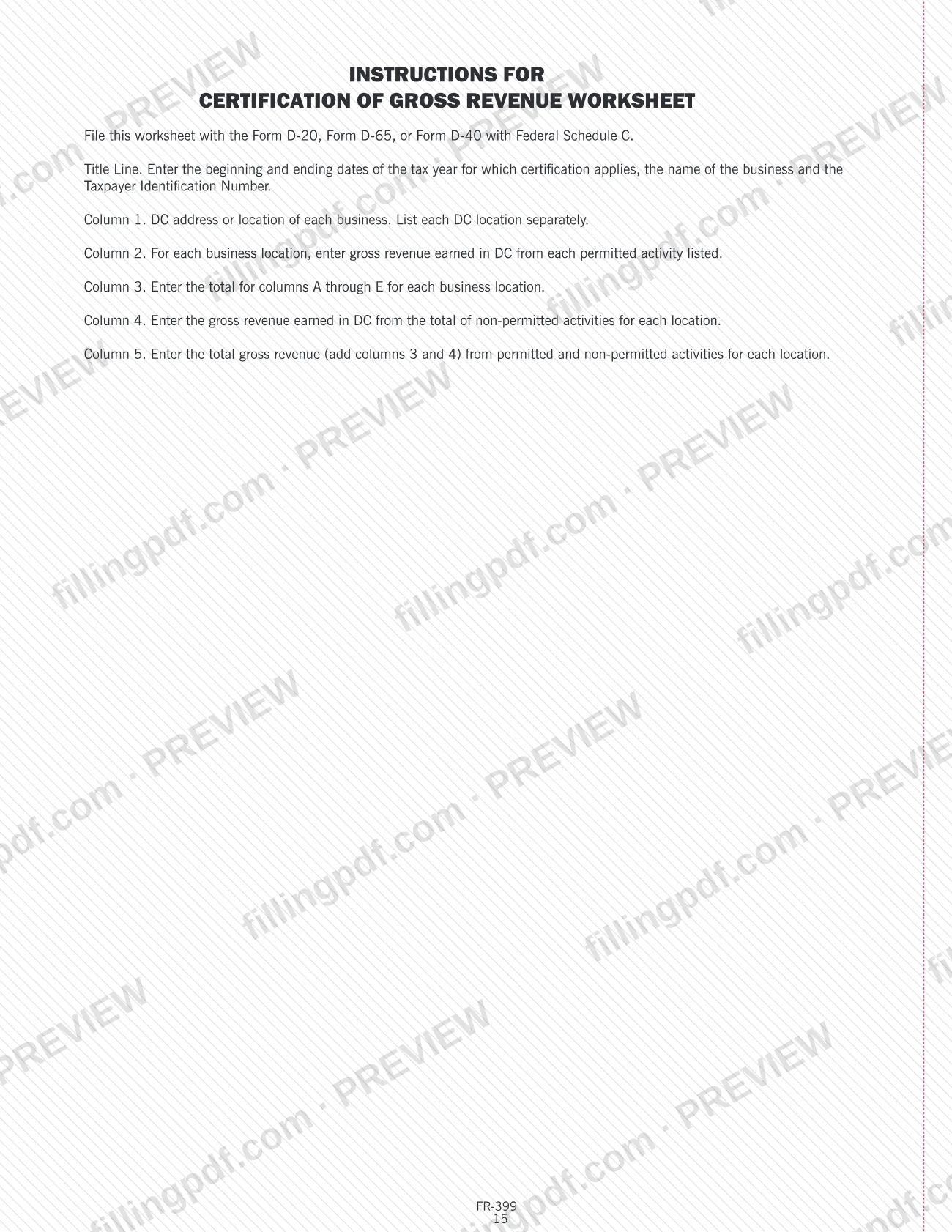
On page 14, enter the tax-year dates, company name and TIN. List each DC location in Column 1, revenue from each permitted activity in Column 2 (A through E), the total in Column 3, non-permitted revenue in Column 4 and the total gross revenue in Column 5.
Complete the retraining costs worksheet
On page 7, enter for each qualified disadvantaged employee (up to seven) the name on line 1, the taxpayer identification number on line 2, the date employed in the District on line 3, the training expense on line 4 and the prior-year credit on line 5. Line 6 is line 4 minus line 5.
Complete Form FP-332
Enter the tax-year dates, company name and TIN. For each employee, list name, TIN, date of employment, months employed and allowable retraining costs, apply the printed maximum, subtract any prior-year claim, then enter totals on line 12 and the result on line 13.
Complete Form FP-333
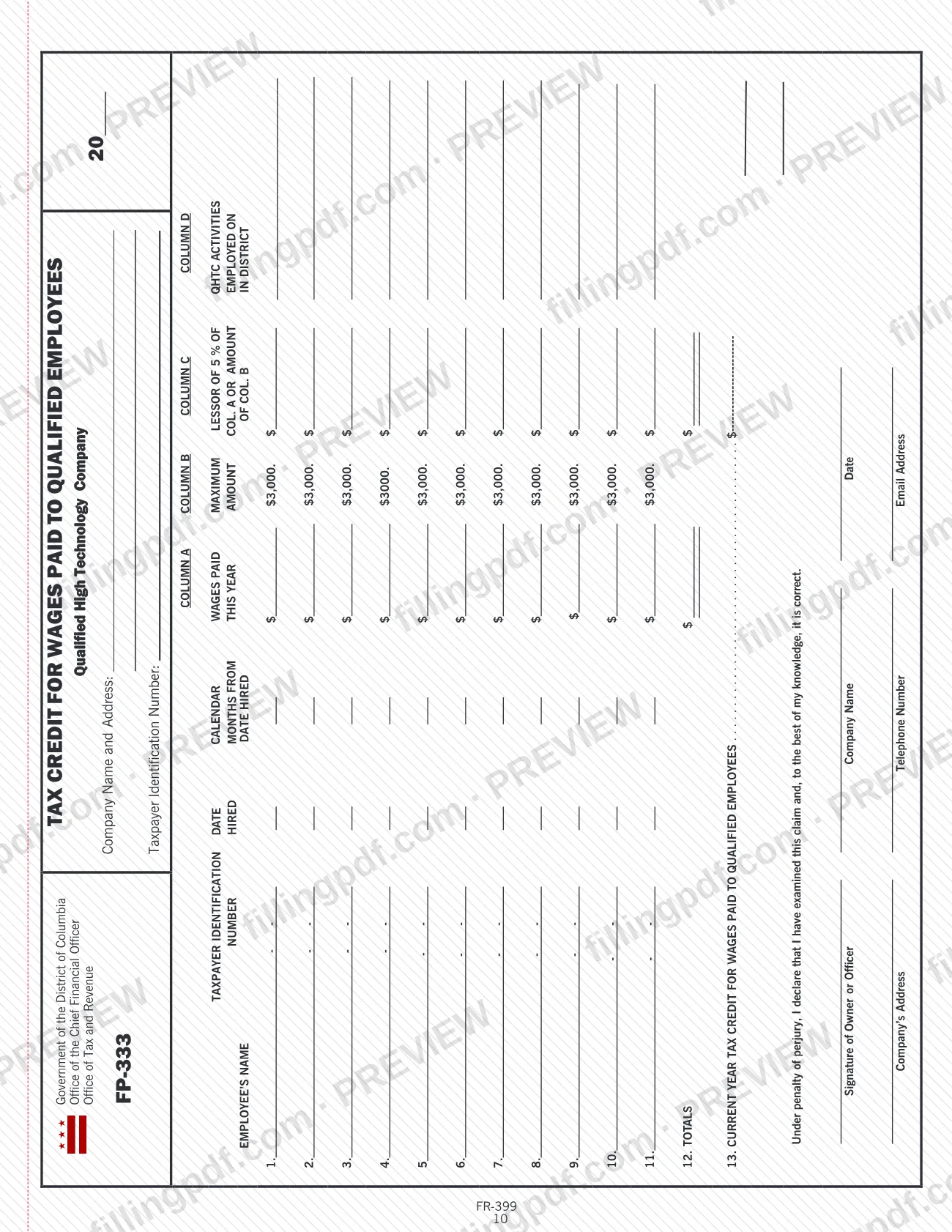
For each qualified employee, enter name, TIN, date hired, calendar months, wages paid this year and the QHTC activities employed on, applying the lesser-of limit printed in the column heading. Enter totals on line 12 and the credit on line 13.
Complete Form FP-334
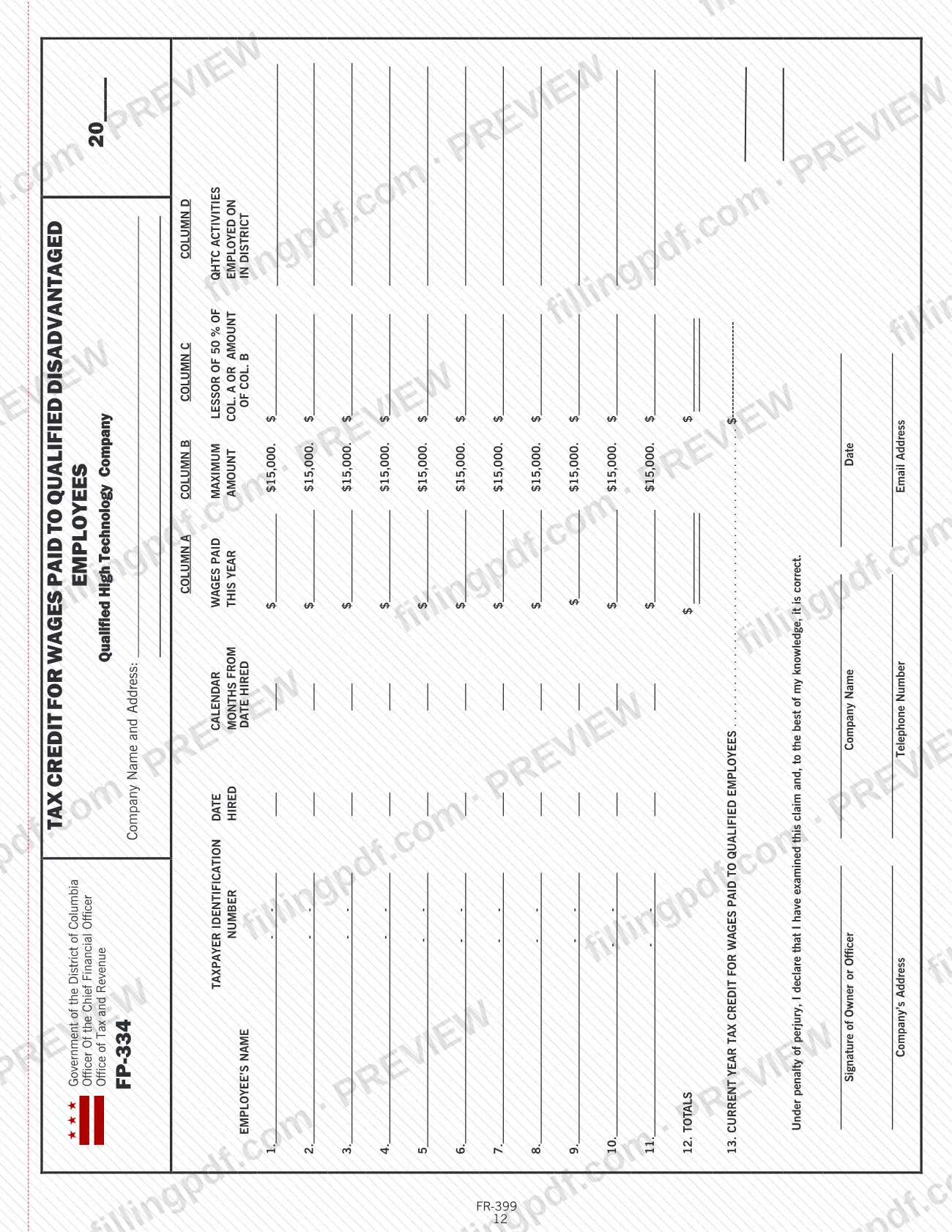
For each qualified disadvantaged employee, enter the same details as on FP-333, using the lesser-of limit printed on FP-334. Enter totals on line 12 and the current-year credit on line 13.
Sign the claim forms
Each FP form carries a declaration under penalty of perjury. The owner or officer signs and enters company name, date, company address, telephone number and email address.
Review, download and assemble
Check totals and employee details against your records, then download or print the completed PDF from FillingPDF. Assemble it with Form D-20, D-20CR, Schedule UB and the Certification of Gross Revenue as described under How to submit.
How to submit FR-399
There are two routes: the online self-certification and the return filed with the credit forms attached.
- Self-certification: it can be submitted only online at MyTax.DC.gov, by an Owner, General Partner or Officer authorized to sign. It replaced the earlier practice of filing individual "QHTC-CERTs" with returns.
- Incorporated QHTCs: complete the online self-certification, fill in the "if Certified QHTC" oval on page 1 of Form D-20, and attach Form D-20CR (QHTC Corporate Business Tax Credits), the Certification of Gross Revenue Worksheet (page 14 of the booklet), Schedule UB and the claim form you need: FP-332, FP-333 or FP-334.
- Unincorporated QHTCs: file Form D-65, or Form D-40 with Federal Schedule C, with the Certification of Gross Revenue Worksheet.
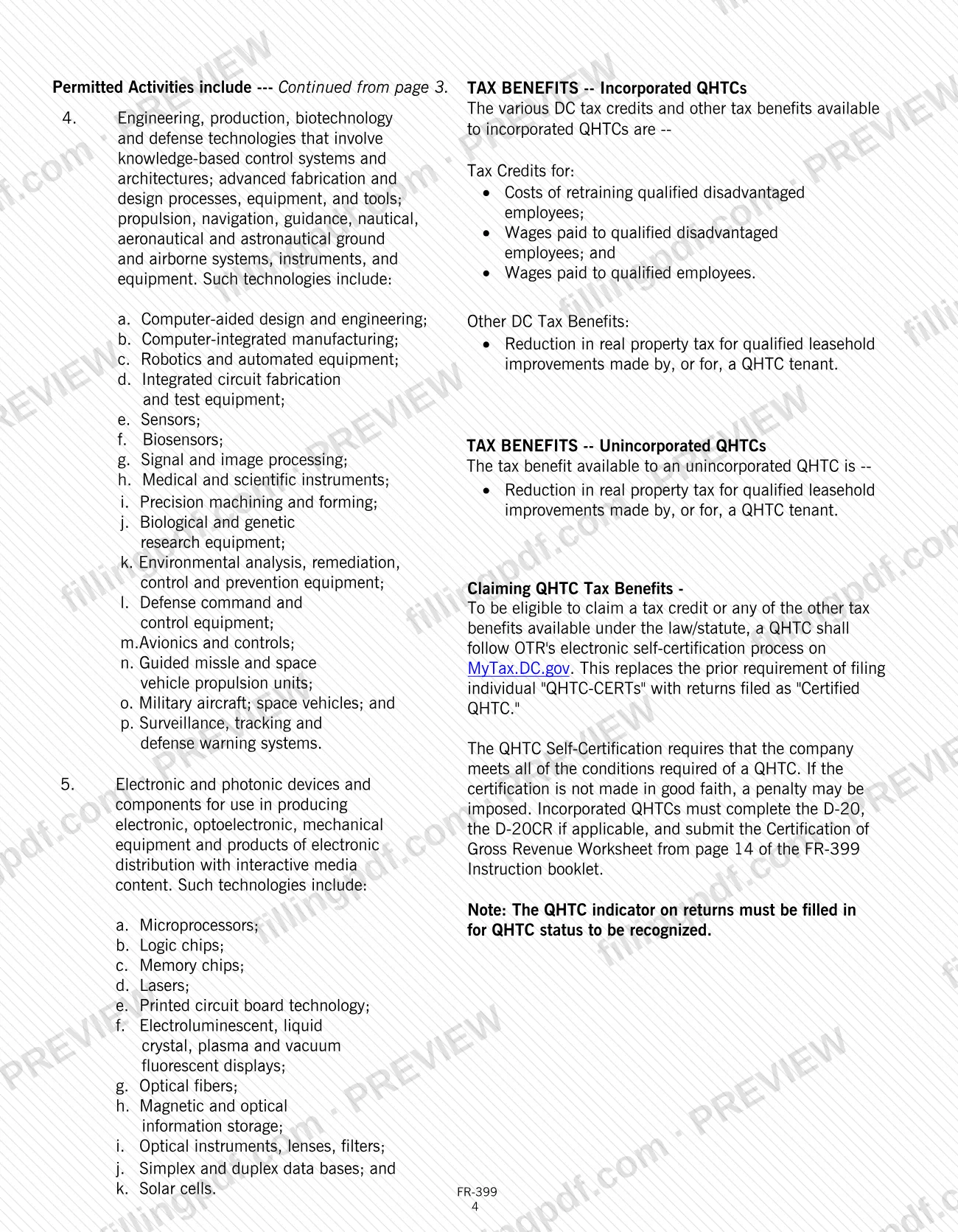
The booklet prints no mailing address, so use the filing instructions in the booklet for the return you file. The QHTC indicator on the return must be filled in for QHTC status to be recognized. FillingPDF lets you fill out and download the PDF; submission follows the channels above.
Common mistakes to avoid
- Trying to self-certify on paper: since January 1, 2019 the QHTC self-certification can be submitted only online at MyTax.DC.gov.
- Leaving the QHTC oval unfilled on Form D-20; the booklet says the QHTC indicator on returns must be filled in for QHTC status to be recognized.
- Counting revenue from a retail store or an electronic equipment facility (data hotel) in columns A through E of the Certification of Gross Revenue Worksheet.
- Claiming a QHTC with fewer than 10 qualified employees in the District; this revision requires 10 or more.
- Carrying forward relocation, retraining or disadvantaged-employee wage credits to tax year 2020 or later; the booklet says they cannot be claimed.
- Claiming the personal property tax exemption for QHTCs after July 1, 2021, or the old special QHTC tax rate; QHTCs are taxed at the normal franchise tax rate.
- Carrying forward an unused qualified-employee wages credit for an employee hired on or after October 1, 2019; only earlier hires qualify.
- Filing Form D-20 as an unincorporated QHTC instead of a D-65 Partnership Return, or a D-40 with Federal Schedule C.
- Counting a temporary or seasonal employee, or a key employee, as a qualified disadvantaged employee or qualified employee for a credit.
Frequently asked questions
What is Form FR-399 used for?
Form FR-399 is the OTR booklet for Qualified High Technology Companies (QHTCs) for tax years 2021 to 2023. It defines a QHTC, describes its DC tax benefits and includes the Certification of Gross Revenue Worksheet and credit claim Forms FP-332, FP-333 and FP-334.
Can I self-certify as a QHTC on paper?
No. The booklet says that since January 1, 2019 the QHTC self-certification can be submitted only online at MyTax.DC.gov. An Owner, General Partner or Officer authorized to sign must complete it, and it must be filed annually to obtain a certificate of benefits.
Does a QHTC get a DC property tax exemption?
Not for personal property: the exemption for qualified tangible personal property ended effective July 1, 2021. QHTCs, incorporated or not, can still get a reduction in real property tax for qualified leasehold improvements made by or for a QHTC tenant.
Who qualifies as a Qualified High Technology Company?
A for-profit individual or entity that leases or owns an office in the District, has 10 or more qualified employees in DC, earns at least 51% of its DC gross revenues from permitted activities and is registered as a DC business. Retail stores, data hotels and construction companies earning 51% or more are excluded.
What do I attach to claim a QHTC tax credit?
An incorporated QHTC completes the online self-certification, fills in the QHTC oval on Form D-20 and attaches Form D-20CR, the Certification of Gross Revenue, Schedule UB and the matching claim form: FP-332, FP-333 or FP-334.
Do unincorporated QHTCs file Form D-20?
No. An unincorporated QHTC is exempt from the unincorporated business franchise tax but files a D-65 Partnership Return, or a D-40 Individual Income Tax Return with Federal Schedule C attached. The online self-certification must still be completed.
Can I carry forward an unused QHTC credit?
It depends on the credit. Retraining credits and wage credits for qualified disadvantaged employees cannot be carried forward. The wages credit for qualified employees carries forward 10 years only for employees hired before October 1, 2019.
What happens if my QHTC certification is not made in good faith?
A penalty may be imposed. The booklet also says that self-certifying does not prevent the Office of Tax and Revenue from auditing to confirm that you meet the QHTC statutes and definitions, so keep records supporting your gross revenue and employee figures.
Can I fill out Form FR-399 online on FillingPDF?
Yes. You can fill out the fillable PDF online on FillingPDF and download or print it. FillingPDF is an independent service, not OTR, and does not file or certify anything; the self-certification is completed only on MyTax.DC.gov.
Ready to fill out FR-399?
Fill out FR-399 now