
The Inventory Form is the report that a guardian, conservator, committee, trustee or receiver completes for the Superior Court of the District of Columbia, Probate Division, to list what an estate consists of. It covers real estate, bank deposits, mortgage notes, stocks, bonds, other securities and personal assets, and it ends with a sworn verification. On this page you can fill out the inventory form online on FillingPDF and download or print the completed PDF; the original is published by the District of Columbia Courts.
Last updated
What is 907.10.v2?
The Inventory Form is the Superior Court of the District of Columbia, Probate Division, form on which a fiduciary reports the assets that make up an estate. The District of Columbia Courts describe it as a form you can use to report the assets of a deceased person's estate to the court.
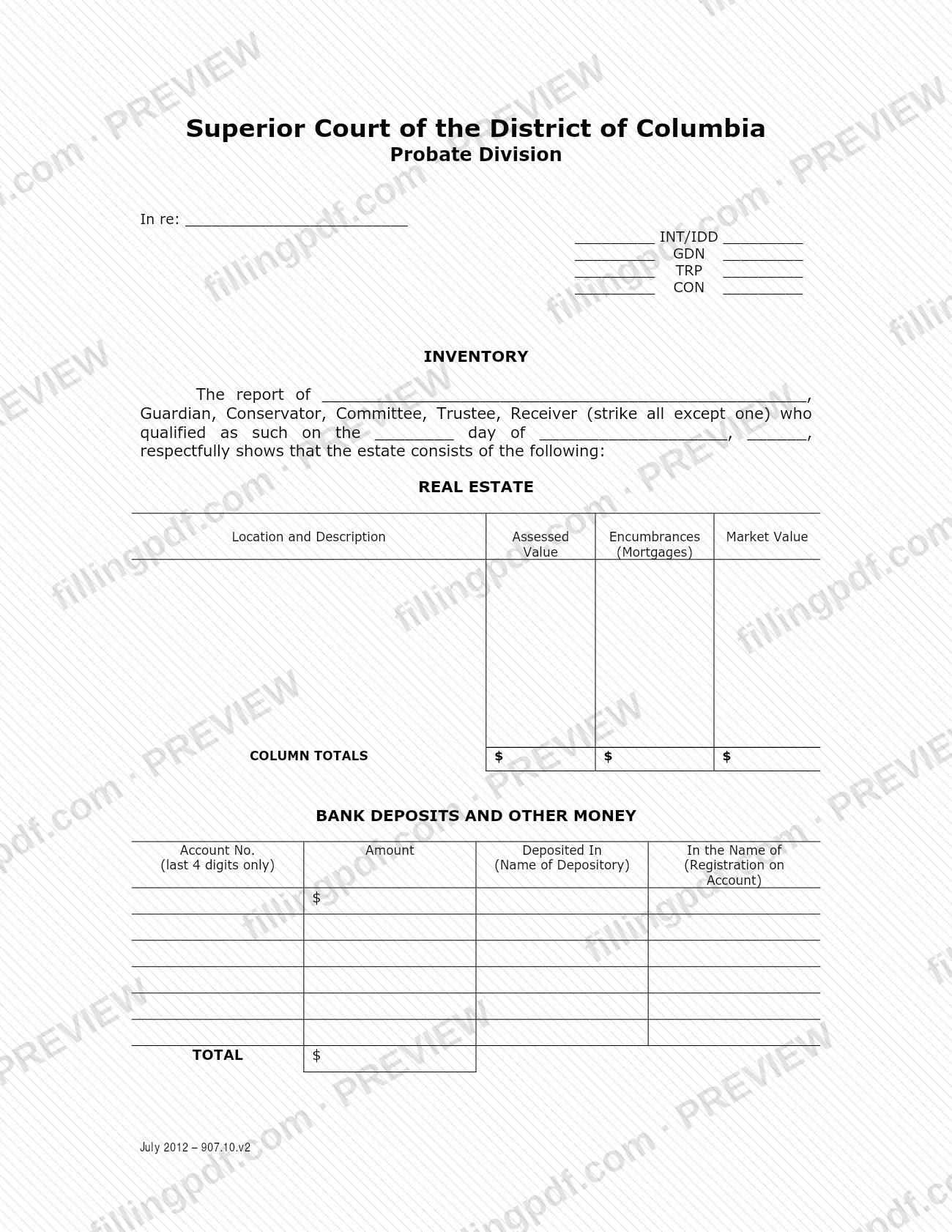
The printed form is titled INVENTORY and is marked "July 2012 – 907.10.v2". It opens with a caption ("In re:") and lines for the case number under INT/IDD, GDN, TRP or CON. The person reporting names himself or herself and states the date on which he or she qualified, then lists the estate in sections:
- Real estate, with assessed value, encumbrances (mortgages) and market value.
- Bank deposits and other money.
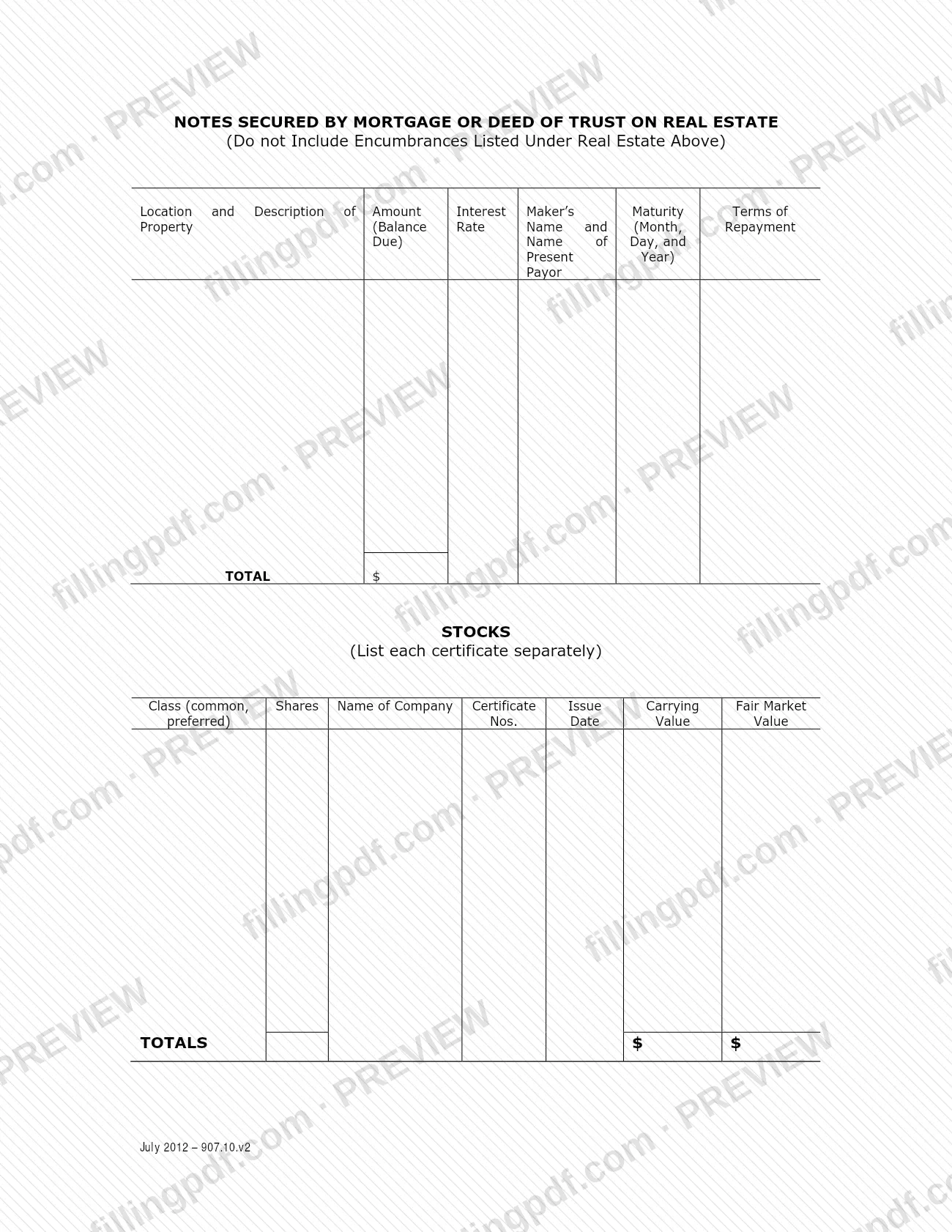
- Notes secured by mortgage or deed of trust on real estate.
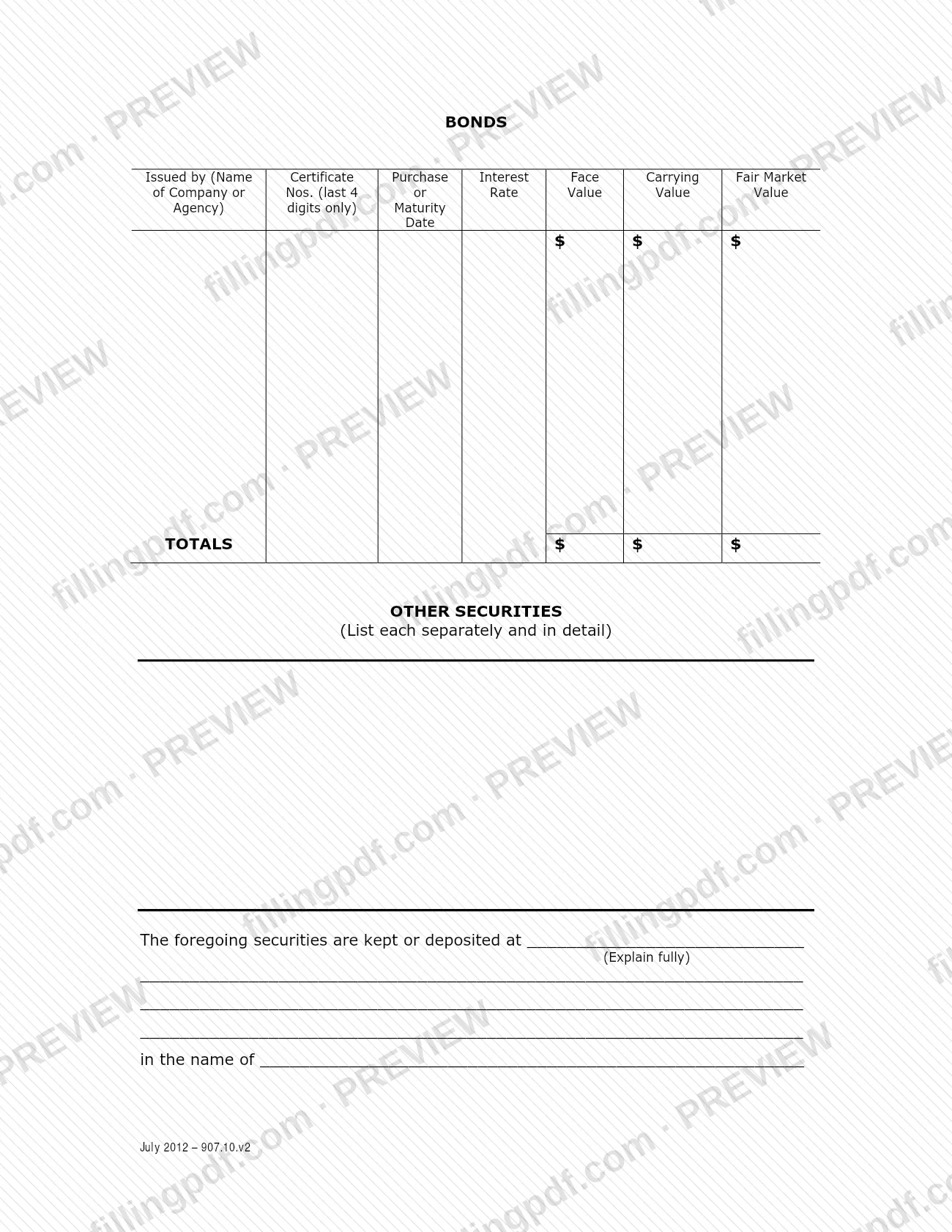
- Stocks, bonds and other securities, and where they are kept.
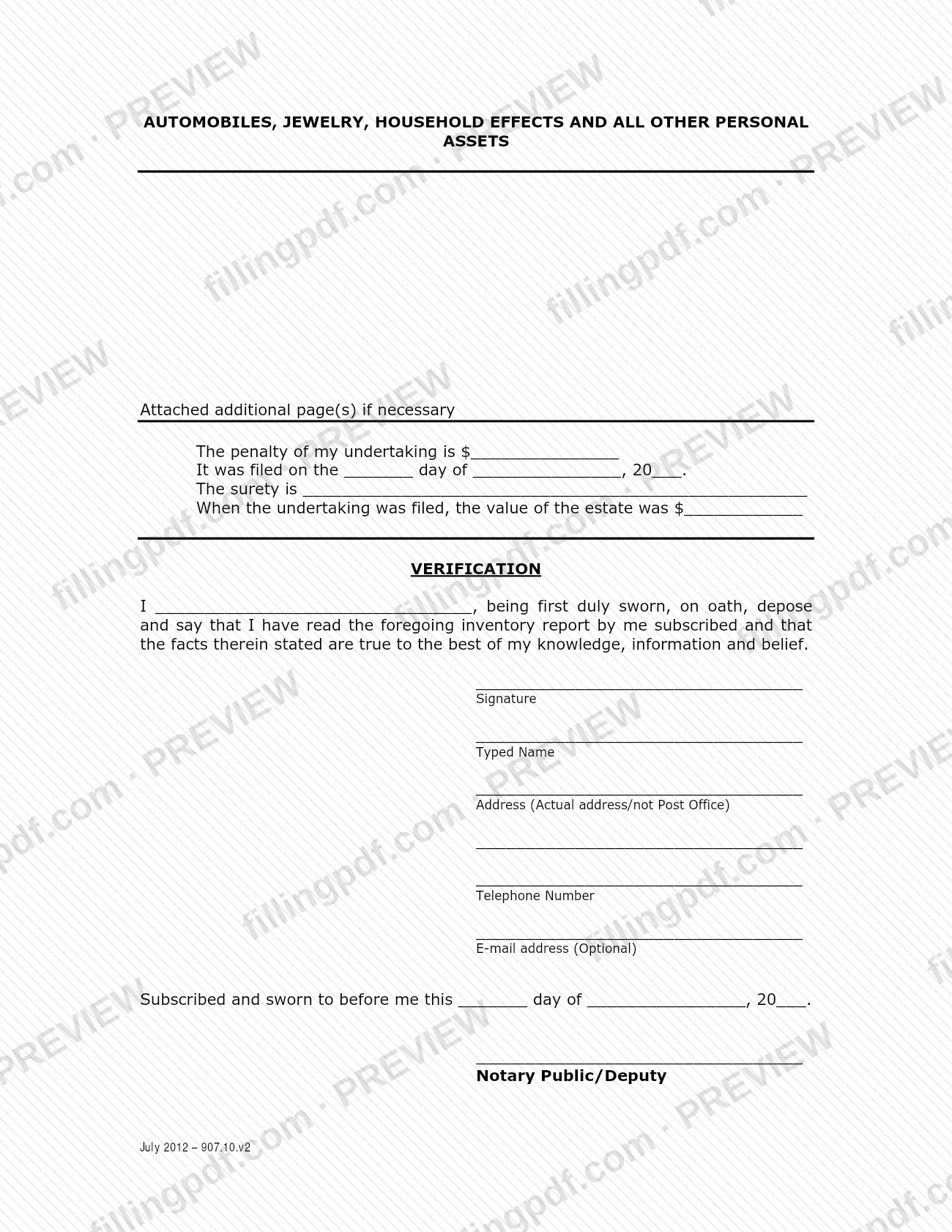
- Automobiles, jewelry, household effects and all other personal assets.
A block at the end records the undertaking: the penalty, the date it was filed, the surety and the value of the estate when it was filed. The form closes with a verification sworn before a notary public or deputy. The court's page offers the form in English.
Who needs to file 907.10.v2?
The form is completed by the person who holds the fiduciary role for the estate: a guardian, conservator, committee, trustee or receiver. The form says to strike all of those titles except the one that applies, and it asks for the date on which that person qualified.
The caption lists the case types the form is used with: INT/IDD, GDN, TRP and CON, each with its own case-number line. The court's page describes the form as a way to report the assets of a deceased person's estate to the court.
The person reporting signs the verification under oath, so the form is completed in that person's name and not by someone else on his or her behalf. The form prints no exemptions and does not describe a representative signing in place of the fiduciary.
When to file 907.10.v2
The form is completed after the fiduciary has qualified, because it asks for the day, month and year of qualification and reports what the estate consists of. No due date is printed on it, so check the court's rules or the Probate Division for any deadline in your case. The undertaking block asks for the value of the estate at the time the undertaking was filed, so have that information at hand when you complete the form. The verification must be sworn before a notary public or deputy, which means the signing happens only once the rest of the form is complete.
Documents you need
- Additional page(s), if the space under Automobiles, Jewelry, Household Effects and All Other Personal Assets is not enough; the form says to attach them if necessary.
How to fill out 907.10.v2
Complete the case caption
Under "In re:", enter the name of the matter and the case number on the line for the type that applies: INT/IDD, GDN, TRP or CON.
Identify yourself and your role
Enter your name in the report line and strike all of Guardian, Conservator, Committee, Trustee, Receiver except your title. Then enter the day, month and year you qualified.
List the real estate
For each property enter the location and description, assessed value, encumbrances (mortgages) and market value, then the column totals.
Enter bank deposits and money
For each account give the account number (last 4 digits only), the amount, the name of the depository and the name in which the account is registered. Enter the total.
Add mortgage and deed of trust notes
Enter the property, balance due, interest rate, maker's and payor's name, maturity date and repayment terms. Do not include encumbrances already listed under Real Estate.
List stocks and bonds
For stocks, list each certificate separately with class, shares, company, certificate number, issue date, carrying value and fair market value. For bonds, give the issuer, certificate number (last 4 digits only), purchase date, interest rate or maturity, and the face, carrying and fair market values.
Describe other securities and their location
List each other security separately and in detail. Then state where the securities are kept or deposited, explain fully, and give the name in which they are held.
List personal assets
Enter automobiles, jewelry, household effects and all other personal assets. Attach additional pages if you need more room.
Complete the undertaking block
Enter the penalty of the undertaking, the day, month and year it was filed, the surety, and the value of the estate when the undertaking was filed.
Complete the verification details
Enter your name in the verification, then your signature line details: typed name, actual address (not a Post Office box), telephone number and, if you wish, an e-mail address.
Review, sign before a notary, and download
Check every total and entry. Sign only in front of the notary public or deputy, who completes the sworn line. Download or print the completed PDF from FillingPDF.
How to submit 907.10.v2
The form is a report addressed to the Superior Court of the District of Columbia, Probate Division. It prints no mailing address, portal or other filing channel, so confirm how to file it with the Probate Division through the District of Columbia Courts page for the form: https://www.dccourts.gov/court-resources/search-forms/inventory-form.
Before filing, make sure the package is complete:
- Every section is filled or left blank where it does not apply.
- Additional pages are attached if the personal assets section needs more room.
- The verification is signed and the notary public or deputy has completed the "Subscribed and sworn to before me" line.
FillingPDF lets you fill out and download the PDF; submission follows the court's channels.
Common mistakes to avoid
- Leaving all the titles Guardian, Conservator, Committee, Trustee, Receiver unmarked instead of striking all except the one that applies.
- Writing a full account number in the Bank Deposits section; the form asks for the last 4 digits only.
- Listing mortgages already shown as encumbrances under Real Estate again in the section for notes secured by mortgage or deed of trust.
- Grouping stock certificates together; the form says to list each certificate separately.
- Giving a Post Office box as the address in the verification; the form asks for the actual address, not a Post Office address.
- Entering the full certificate number for a bond instead of the last 4 digits.
- Describing other securities briefly; the form says to list each separately and in detail.
- Signing the verification before appearing in front of the notary public or deputy who completes the sworn statement.
- Leaving the undertaking block (penalty, filing date, surety, estate value) blank.
Frequently asked questions
What is the inventory form for the DC Superior Court?
It is the Probate Division report on which a guardian, conservator, committee, trustee or receiver lists what an estate consists of. The District of Columbia Courts describe it as a form to report the assets of a deceased person's estate to the court.
Who completes the inventory form?
The person who qualified in the fiduciary role: a guardian, conservator, committee, trustee or receiver. The form tells you to strike all of those titles except the one that applies, and the same person signs the sworn verification.
Does the inventory form have to be notarized?
The form includes a verification in which you swear that the facts are true, followed by a line "Subscribed and sworn to before me" for a notary public or deputy. Sign it only in front of that person.
Should I write my full account numbers on the inventory form?
No. In the Bank Deposits section the form asks for the account number as the last 4 digits only, and for bonds it asks for the certificate number as the last 4 digits only.
What if I need more space for personal assets?
Attach additional pages. The section for automobiles, jewelry, household effects and all other personal assets says to attach additional page(s) if necessary.
Can I fill out the inventory form online?
You can fill out the PDF online on FillingPDF and download or print it. FillingPDF is independent of the District of Columbia Courts and does not file the form; you file it through the court's channels.
Do I list mortgages twice on the inventory form?
No. Mortgages on real estate go in the Encumbrances (Mortgages) column under Real Estate. The section for notes secured by mortgage or deed of trust says not to include encumbrances already listed there.
Is an e-mail address required on the inventory form?
No. The e-mail address line on the verification is marked Optional. The address line, however, asks for your actual address and not a Post Office box.
Ready to fill out 907.10.v2?
Fill out 907.10.v2 now