
The motion for alternative service is the form a Plaintiff in a Domestic Relations Branch case at the Superior Court of the District of Columbia, Family Court, uses to ask the judge to approve a different way of serving the Complaint and Summons. It applies when the Plaintiff has already tried the ordinary methods and the Defendant has not been served. On this page you can fill out the form online on FillingPDF and download or print the completed PDF; the form is published by the District of Columbia Courts.
Last updated
What is MOTION FOR ALTERNATIVE SERVICE – District of Columbia?
The MOTION FOR ALTERNATIVE SERVICE is a court form, used in the Family Court's Domestic Relations Branch of the Superior Court of the District of Columbia, in which a Plaintiff reports failed attempts to serve the Defendant and asks the judge to approve another way of giving notice.
The District of Columbia Courts describe it as a form you can use to ask the court to approve an alternative method of serving court papers when normal delivery methods have failed. In the form, the Complaint and Summons are called "the documents."
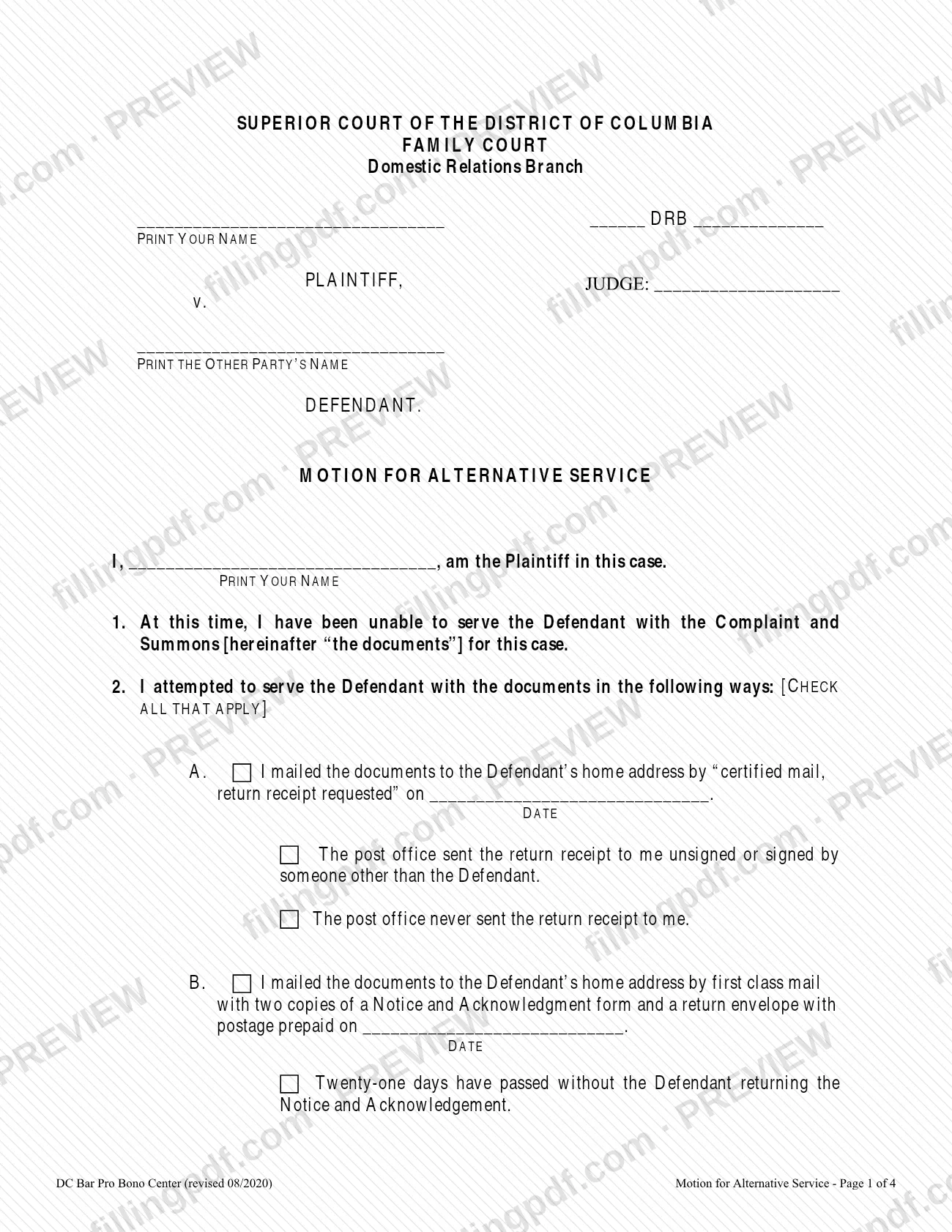
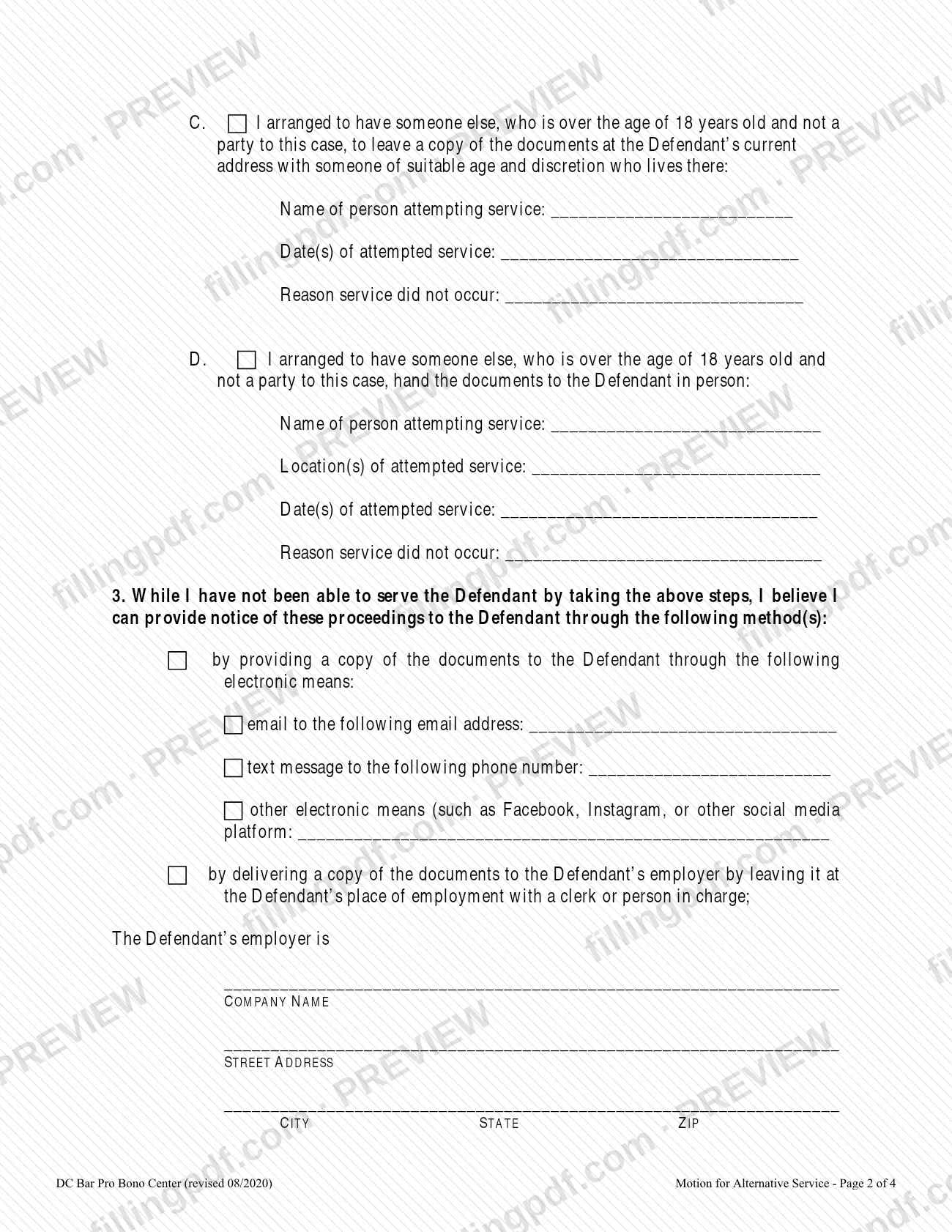
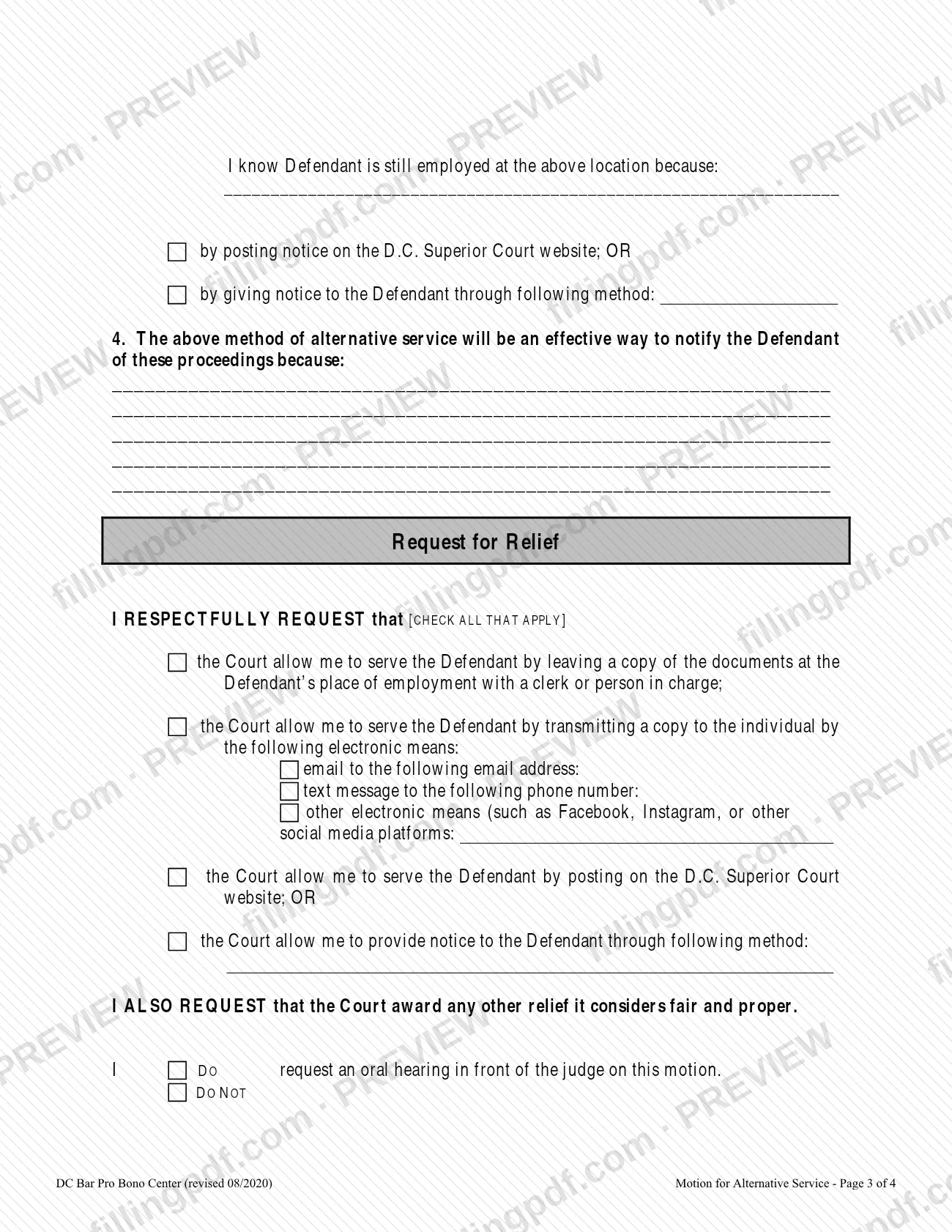
The motion has four parts. Item 2 lists the attempts already made: certified mail with return receipt requested, first class mail with a Notice and Acknowledgment form, leaving the documents with a person of suitable age and discretion at the Defendant's current address, or hand delivery to the Defendant, the last two by an adult who is not a party to the case. Item 3 proposes the new method: email, text message or another electronic means, delivery to the Defendant's employer, posting on the D.C. Superior Court website, or another method. Item 4 explains why that method will work. A Request for Relief, an oral hearing choice, a signature block under penalty of perjury and a Points and Authorities section follow.
The form's footer credits the DC Bar Pro Bono Center and shows the revision "revised 08/2020." The Points and Authorities cite Super. Ct. Dom. Rel. R. 4(c) and D.C. Code §§ 13-336, 13-338-40 and 16-4601.07(a).
Who needs to file MOTION FOR ALTERNATIVE SERVICE – District of Columbia?
The form is written for the Plaintiff in a Domestic Relations Branch case at the Superior Court of the District of Columbia who has not been able to serve the Defendant with the Complaint and Summons. It opens with the sentence "I am the Plaintiff in this case," so it is worded for the person who started the case, not for the Defendant.
Before using it, you should have tried at least one of the service methods listed in item 2 and be able to describe what happened: the date of each mailing, the name of anyone who tried to serve for you, the places and dates of the attempts, and why service did not occur. Anyone you ask to deliver the documents for you must be over 18 and not a party to the case.
You also need a proposed alternative in item 3, such as an email address, a phone number for text messages, the Defendant's workplace or posting on the court website, and a reason it would reach the Defendant.
The form says nothing about a representative signing for you; the signature block is for the Plaintiff.
When to file MOTION FOR ALTERNATIVE SERVICE – District of Columbia
File the motion after you have tried to serve the Defendant with the Complaint and Summons and could not. The form asks you to describe those attempts first, so it comes after them and not before. If you chose first class mail with a Notice and Acknowledgment form, the form relies on twenty-one days having passed without the Defendant returning it. No separate due date is printed on the form. It belongs to the case you already have, with the case number and judge shown in its caption.
Documents you need
- Any supporting documents you choose to attach to the motion: list each one under item 4 of the Points and Authorities in Support of Motion, which asks you to list any documents you are attaching.
How to fill out MOTION FOR ALTERNATIVE SERVICE – District of Columbia
Complete the case caption
At the top, print your name as Plaintiff, the other party's name as Defendant, the DRB case number and the judge's name.
Print your name in the opening line
In the line that begins "I, ... am the Plaintiff in this case," print your name. Item 1 states that you have been unable to serve the Defendant with the Complaint and Summons.
Describe mailing attempts in item 2
Check every method that applies. For A, enter the date of certified mail and check whether the return receipt came back unsigned or signed by someone else, or never came. For B, enter the date of first class mailing and check if twenty-one days passed without the Notice and Acknowledgment.
Describe attempts by another person
For C and D, enter the name of the adult non-party who tried to serve, the date(s), the location(s) for D, and the reason service did not occur.
Choose the alternative method in item 3
Check each method you propose: email address, text message number, other electronic means such as social media, delivery to the employer, posting on the D.C. Superior Court website, or another method you describe.
Add employer details if used
If you chose the employer, enter the company name, street address, city, state and ZIP, and explain how you know the Defendant is still employed there.
Explain why the method will work
In item 4, use the lines provided to explain why the method you proposed will be an effective way to notify the Defendant of the proceedings.
Complete the Request for Relief
Check each form of service you ask the court to allow and repeat the email address, phone number, platform or other method. Then mark whether you DO or DO NOT request an oral hearing.
Sign and enter your contact details
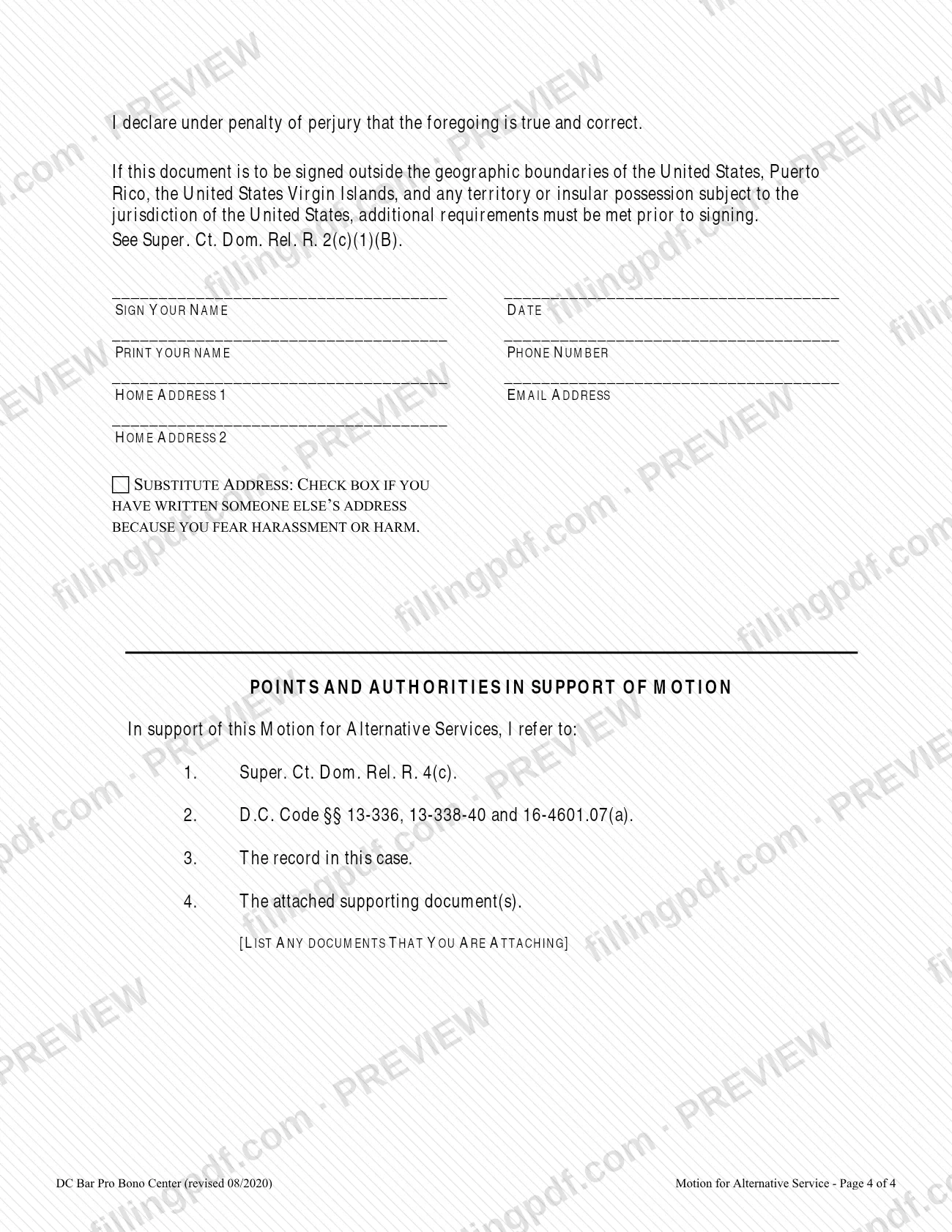
Sign, or add slashes on either side, /like this/, to sign electronically, then enter the date, your printed name, phone number, home addresses and email. Check the substitute address box only if you wrote someone else's address because you fear harassment or harm.
List attached documents
Under Points and Authorities, item 4, list any documents you are attaching. Items 1 to 3 already cite the rules, code sections and the case record.
Review and download the completed PDF
Check that every box you ticked has its details, then download or print the completed PDF from FillingPDF and file it with the court in your case.
How to submit MOTION FOR ALTERNATIVE SERVICE – District of Columbia
The form prints no filing address, portal, fee or deadline. It is a motion in your own case, so it is directed to the Superior Court of the District of Columbia, Family Court, Domestic Relations Branch, under the case number and judge you enter in the caption. List any supporting documents you attach under Points and Authorities, item 4. For how the court accepts filings, use the District of Columbia Courts page for this form at https://www.dccourts.gov/court-resources/search-forms/motion-alternative-service. FillingPDF lets you fill out and download the PDF; submission follows the court's own filing channels.
Common mistakes to avoid
- Leaving the case number, the judge or either party's name off the caption, so the motion cannot be matched to your case.
- Checking a box in item 2 without giving the date, the name of the person who tried to serve, the places or the reason service did not occur, where the form asks for them.
- Proposing an alternative method in item 3 but leaving item 4 blank; the form asks why that method will be an effective way to notify the Defendant.
- Choosing service at the Defendant's employer without stating the company name, street address, city, state and ZIP, or how you know the Defendant still works there.
- Asking for email, text message or social media service in the Request for Relief without entering the address, phone number or platform.
- Not marking whether you DO or DO NOT request an oral hearing in front of the judge.
- Signing outside the United States or its territories without meeting the additional requirements the form cites in Super. Ct. Dom. Rel. R. 2(c)(1)(B).
- Attaching documents without listing them under Points and Authorities, item 4.
Frequently asked questions
What is a motion for alternative service?
It is a request, made in your court case, asking the judge to approve a different way of serving court papers when normal delivery methods have failed. On this D.C. Superior Court form, the Plaintiff lists failed attempts, proposes a new method and asks the court to allow it.
Who can file the Motion for Alternative Service?
The form is written for the Plaintiff in a Domestic Relations Branch case, as it begins "I am the Plaintiff in this case." You complete it after being unable to serve the Defendant with the Complaint and Summons.
What alternative methods can I ask the court to approve?
The form offers email, text message or other electronic means such as social media, leaving the documents with a clerk or person in charge at the Defendant's workplace, and posting on the D.C. Superior Court website. You can also describe another method.
Do I have to try to serve the Defendant before filing this motion?
Yes, the form asks you to describe the attempts you made. Item 2 covers certified mail, first class mail with a Notice and Acknowledgment form, leaving the documents at the Defendant's current address, and hand delivery by an adult who is not a party to the case.
Do I need to ask for a hearing on the motion?
The form asks you to mark whether you DO or DO NOT request an oral hearing in front of the judge on the motion. Mark one of the two options before signing.
Can I sign the motion electronically?
The signature line says you can add slashes to either side of your name, /like this/, to sign electronically. If you sign outside the United States or its territories, the form says additional requirements under Super. Ct. Dom. Rel. R. 2(c)(1)(B) must be met first.
Can I fill out the motion for alternative service online?
You can fill out the PDF online on FillingPDF and download or print it. FillingPDF is an independent service: it does not file the motion or serve anything, and you file it with the court yourself.
Ready to fill out MOTION FOR ALTERNATIVE SERVICE – District of Columbia?
Fill out MOTION FOR ALTERNATIVE SERVICE – District of Columbia now