
A motion for contempt is the filing on which you ask the Superior Court of the District of Columbia, Family Court, Domestic Relations Branch, to find that the other party violated an order in your domestic relations case. The form covers violations of custody, visitation, alimony and the division of marital property or debt, and lets you request sanctions and a hearing. On this page you can fill out the form online on FillingPDF and download or print the completed PDF; the form is published by the District of Columbia Courts, and filing and service follow the court's rules.
Last updated
What is Motion for Contempt (Domestic Relations Order) – District of Columbia?
The Motion for Contempt (Domestic Relations Order) is the Superior Court of the District of Columbia form on which a party to a domestic relations case asks the court to find that the other party violated a domestic relations order.
The printed form is titled Motion for Contempt of a Domestic Relations Order and carries the caption of the Family Court, Domestic Relations Branch. It bears the note "DC Bar Pro Bono Center (revised 04/2021)" and is published on the District of Columbia Courts' forms page, which also offers Spanish and Amharic downloads. It runs five pages.
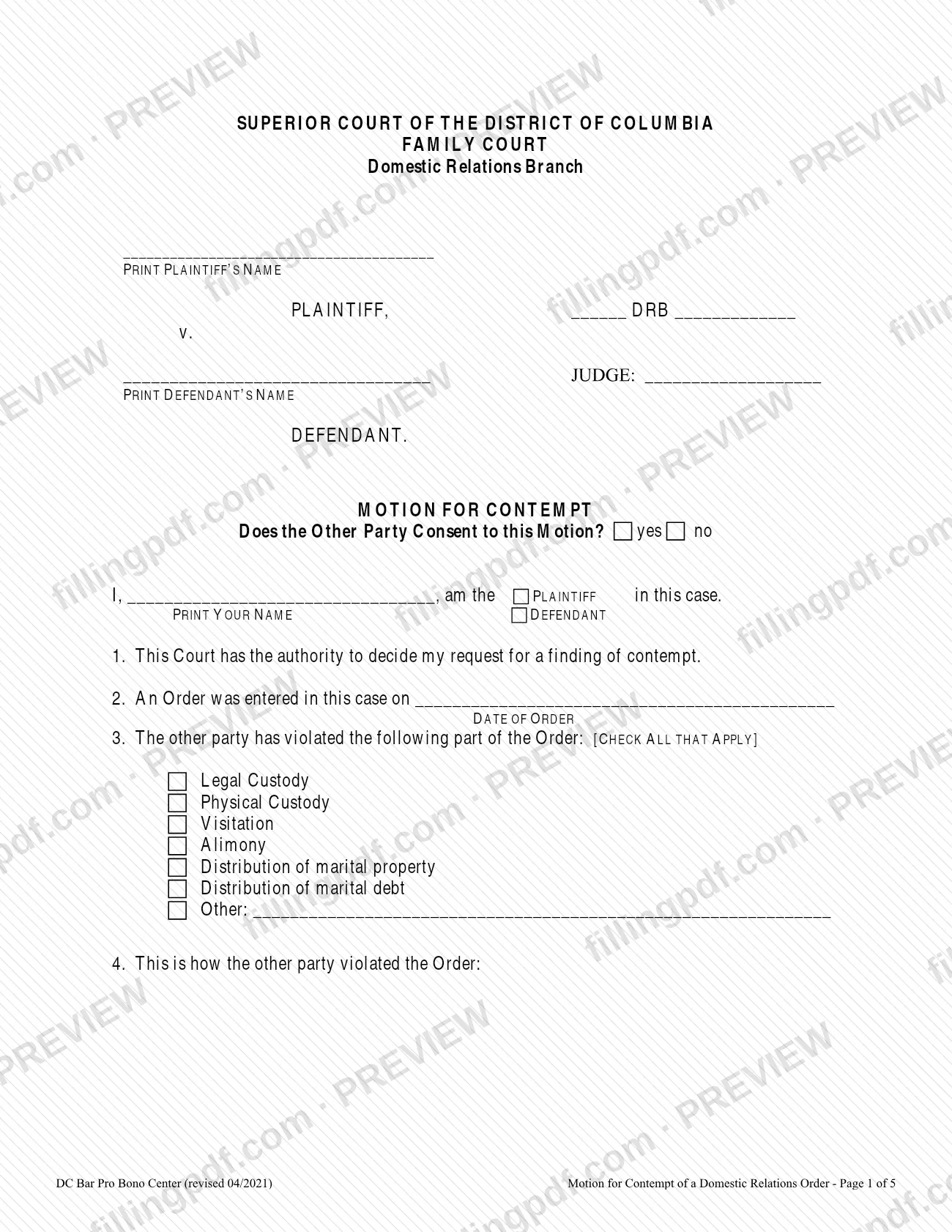
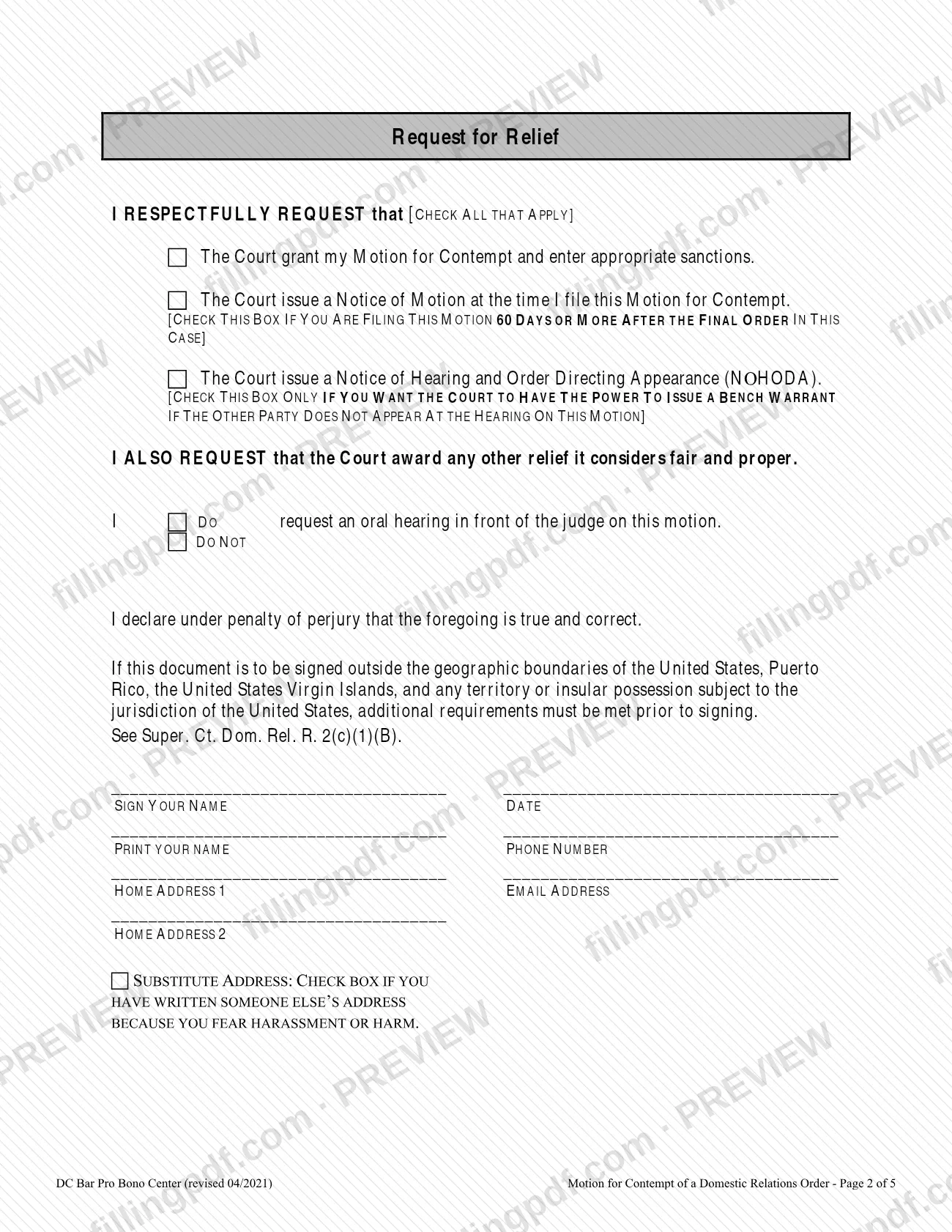
Pages 1 and 2 are the motion itself. You give the case caption, say whether the other party consents, state the date of the order, check the part of the order that was violated (legal custody, physical custody, visitation, alimony, distribution of marital property, distribution of marital debt, or other) and describe the violation. The Request for Relief asks for sanctions, and lets you request a Notice of Motion, a Notice of Hearing and Order Directing Appearance (NOHODA) and an oral hearing. You sign under penalty of perjury.
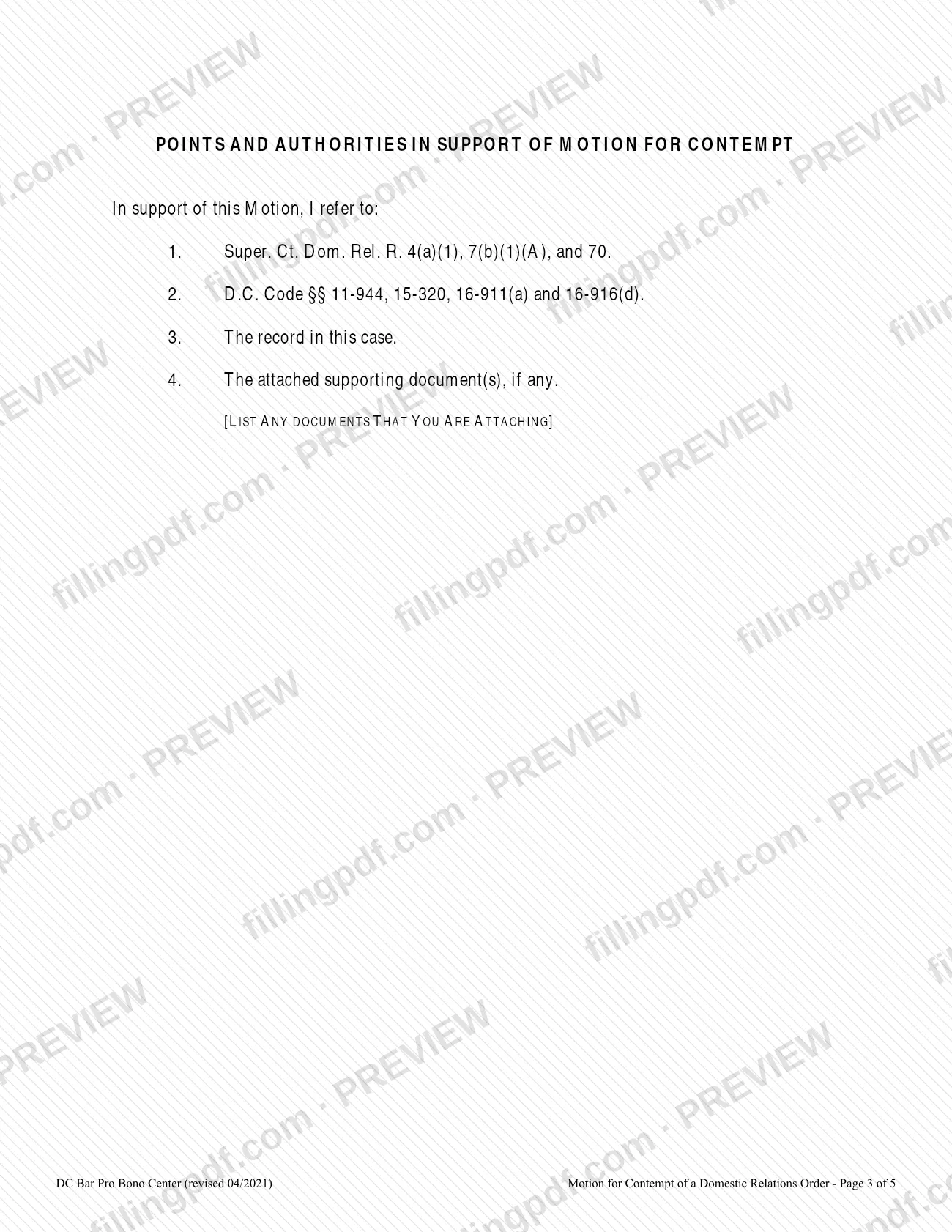
Page 3 is the Points and Authorities, which cites Super. Ct. Dom. Rel. R. 4(a)(1), 7(b)(1)(A) and 70 and D.C. Code §§ 11-944, 15-320, 16-911(a) and 16-916(d), and has space to list attached documents. Pages 4 and 5 explain how to serve the motion and prove service.
Who needs to file Motion for Contempt (Domestic Relations Order) – District of Columbia?
The main user is a plaintiff or defendant in a Domestic Relations Branch case in D.C. Superior Court who believes the other party has violated an order entered in that case. On the form you state whether you are the plaintiff or the defendant.
The form covers violations of these parts of an order:
- legal custody;
- physical custody;
- visitation;
- alimony;
- distribution of marital property;
- distribution of marital debt;
- any other part of the order, which you describe in the Other line.
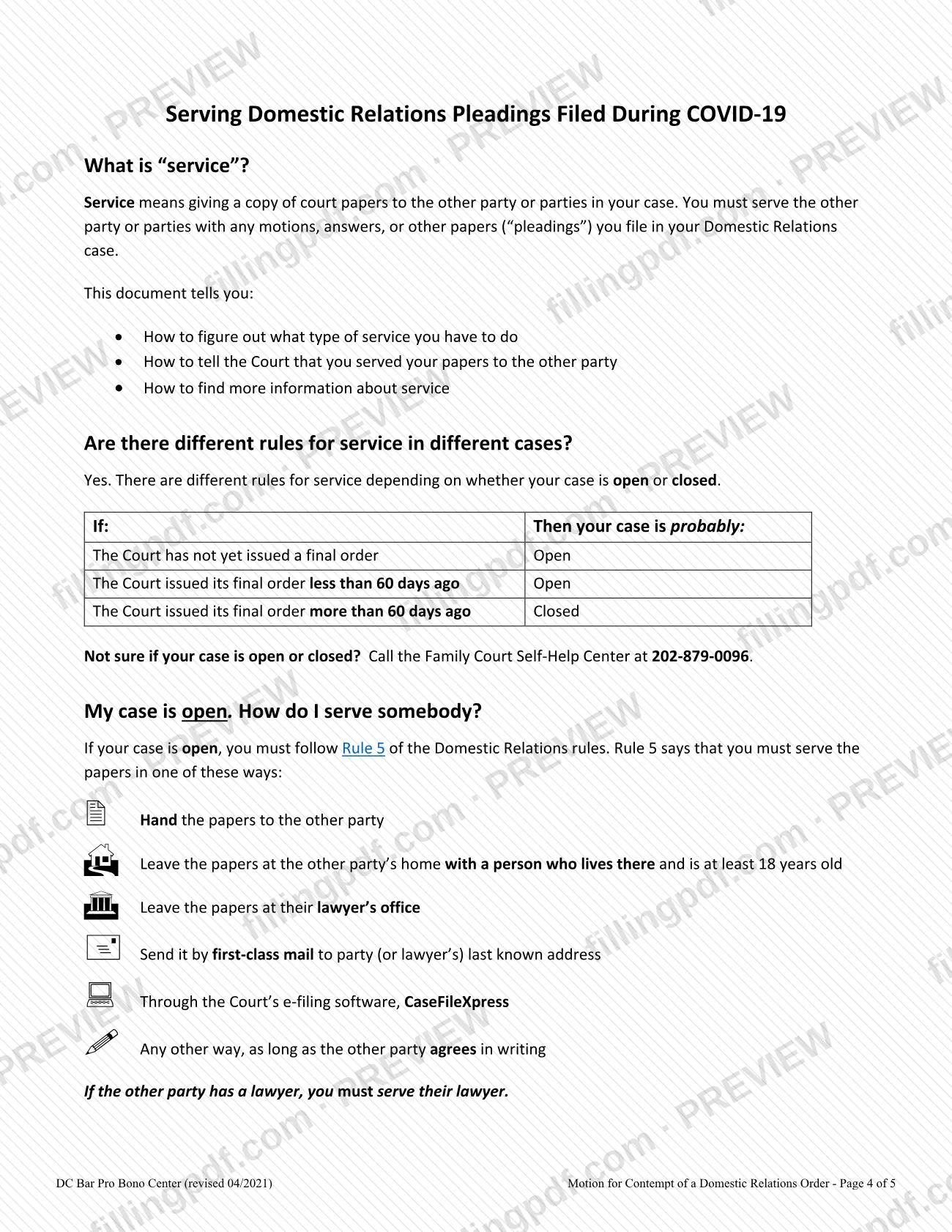
The form is used whether the case is open or closed. The court treats a case as probably open if no final order has issued or the final order is less than 60 days old, and as probably closed if the final order is more than 60 days old. This changes how you serve the motion, not whether you may use the form. If you are not sure whether your case is open or closed, call the Family Court Self-Help Center at 202-879-0096.
When to file Motion for Contempt (Domestic Relations Order) – District of Columbia
File the motion when the other party has violated a part of an order entered in your domestic relations case. The form prints no deadline of its own.
The date of the final order matters in two places. On the Request for Relief, the box asking the court to issue a Notice of Motion when you file is marked "check this box if you are filing this motion 60 days or more after the final order in this case." On the service pages, a case with no final order, or a final order issued less than 60 days ago, is probably open, and a case with a final order issued more than 60 days ago is probably closed. Open and closed cases follow different service rules (Rule 5 and Rule 4). If you are not sure which applies, call the Family Court Self-Help Center at 202-879-0096.
Documents you need
- Supporting documents you attach to the motion, if any; list each one under item 4 of the Points and Authorities page ("attached supporting document(s), if any").
- Rule 5 Proof of Service form, if your case is open: complete it after you serve the other party and file it with the court.
- Rule 4 affidavit, if your case is closed: use the version that matches how you served the papers, and file it after service.
- Rule 4 affidavit for service by text or email, when you served the summons and motion that way.
- Rule 4 affidavit for service by certified mail, when you served the summons and motion that way.
- Rule 4 affidavit for hand delivery, when someone else handed the papers to the other party or to a person who lives with them.
How to fill out Motion for Contempt (Domestic Relations Order) – District of Columbia
Enter the case caption
Print the plaintiff's name and the defendant's name at the top, then the DRB case number and the judge's name.
Answer the consent question
Check yes or no for "Does the Other Party Consent to this Motion?" Then print your name and check PLAINTIFF or DEFENDANT to show your role.
Enter the date of the order
In item 2, write the date of the order the other party violated. Item 1, the court's authority, is printed.
Check the part violated
In item 3, check every part of the order that applies: legal custody, physical custody, visitation, alimony, distribution of marital property or debt. Use Other to describe any different part.
Describe how the order was violated
In item 4, write what the other party did or failed to do that violated the order, using the lines provided.
Choose your requests for relief
Check what applies: grant the motion and enter sanctions; a Notice of Motion when you file (for filings 60 days or more after the final order); and a NOHODA, only if you want the court to be able to issue a bench warrant if the other party does not appear.
Request or decline an oral hearing
Check DO or DO NOT request an oral hearing in front of the judge on the motion.
Sign and add contact details
Sign (or add slashes on both sides of your name to sign electronically), date, print your name, and enter phone number, home address lines 1 and 2 and email. Check SUBSTITUTE ADDRESS if you wrote someone else's address because you fear harassment or harm.
List attached documents
On the Points and Authorities page, item 4, list any documents you are attaching. Leave the cited rules and D.C. Code sections as printed.
Review, download and plan service
Check each entry, then download or print the completed PDF from FillingPDF. Read the service pages to decide whether your case is open or closed and how you will serve the other party, as described under How to submit.
How to submit Motion for Contempt (Domestic Relations Order) – District of Columbia
The form is captioned for the Superior Court of the District of Columbia, Family Court, Domestic Relations Branch, but it prints no filing address or portal. For help with filing, call the Family Court Self-Help Center at 202-879-0096. The form's service pages cover what you must do after the motion is prepared: you must serve the other party, then tell the court that you did.
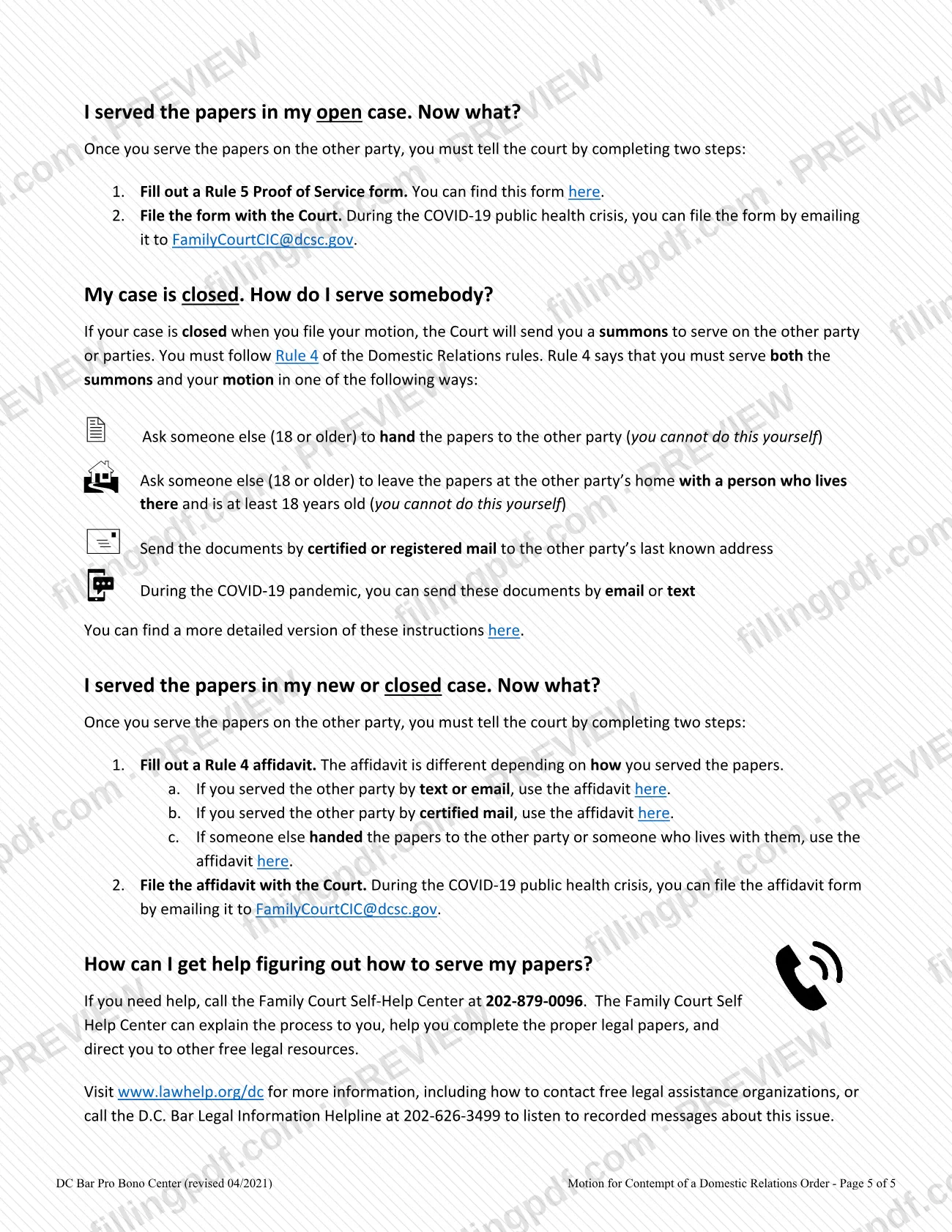
- Open case (Rule 5): serve the papers by handing them to the other party; leaving them at the other party's home with a person who lives there and is at least 18; leaving them at the other party's lawyer's office; first-class mail to the last known address of the party or lawyer; the court's e-filing software, CaseFileXpress; or another way the other party agrees to in writing. If the other party has a lawyer, serve the lawyer. Then complete a Rule 5 Proof of Service form and file it. During the COVID-19 public health crisis it can be emailed to [email protected].
- Closed case (Rule 4): the court sends you a summons. You must serve the summons and your motion by having someone 18 or older hand them to the other party or leave them at the other party's home with a person who lives there and is at least 18 (you cannot do this yourself), or by certified or registered mail to the last known address. During the COVID-19 pandemic, email or text is also allowed. Then file the Rule 4 affidavit that matches your method, which can be emailed to [email protected] during the COVID-19 public health crisis.
FillingPDF lets you fill out and download the PDF; submission follows the channels above.
Common mistakes to avoid
- Checking the NOHODA box when you do not want the court to have the power to issue a bench warrant; the form says to check it only if you want that power if the other party does not appear.
- Leaving the Notice of Motion box unchecked when you file 60 days or more after the final order; the form says to check it in that situation.
- Serving papers yourself in a closed case; under Rule 4 someone else who is 18 or older must hand or leave the papers, unless you serve by certified or registered mail.
- Using first-class mail in a closed case; Rule 4 calls for certified or registered mail, while first-class mail is a Rule 5 method for open cases.
- Serving the other party directly when they have a lawyer; in an open case you must serve their lawyer.
- Serving the papers but not telling the court; you must file a Rule 5 Proof of Service form (open case) or a Rule 4 affidavit (closed case).
- Signing electronically without slashes; the form says to add slashes on both sides of your name, /like this/.
- Signing outside the United States and its territories without meeting the additional requirements in Super. Ct. Dom. Rel. R. 2(c)(1)(B).
- Writing someone else's address in the home address lines without checking the SUBSTITUTE ADDRESS box.
Frequently asked questions
What is a motion for contempt of a domestic relations order?
It is the D.C. Superior Court form you use to ask the court to find that the other party violated a domestic relations order. You identify the order and the date it was entered, check the part violated, describe what happened and request sanctions and, if you wish, a hearing.
Which kinds of order violations does this form cover?
Item 3 lists legal custody, physical custody, visitation, alimony, distribution of marital property and distribution of marital debt, plus an Other line for anything else. You check every part that applies and explain the violation in item 4.
When should I check the NOHODA box?
Check it only if you want the court to have the power to issue a bench warrant if the other party does not appear at the hearing on your motion. NOHODA stands for Notice of Hearing and Order Directing Appearance, and the form lists it as a separate request.
How do I serve a motion for contempt in DC?
It depends on whether your case is open or closed. In an open case, Rule 5 allows hand delivery, leaving papers at the home or lawyer's office, first-class mail, CaseFileXpress, or written agreement. In a closed case, Rule 4 requires service of the summons and motion by another adult or by certified or registered mail.
How do I know if my case is open or closed?
Generally, it is probably open if the court has not issued a final order or issued one less than 60 days ago, and probably closed if the final order is more than 60 days old. If you are unsure, call the Family Court Self-Help Center at 202-879-0096.
Do I have to tell the court after I serve the other party?
Yes. In an open case, complete and file a Rule 5 Proof of Service form. In a closed case, file the Rule 4 affidavit that matches your method of service. During the COVID-19 public health crisis, either can be emailed to [email protected].
Can I sign the motion for contempt electronically?
The form says you can sign electronically by adding slashes on either side of your name, /like this/. If you sign outside the United States, Puerto Rico, the U.S. Virgin Islands or a U.S. territory or possession, additional requirements in Super. Ct. Dom. Rel. R. 2(c)(1)(B) apply before you sign.
Can I fill out the motion for contempt online?
Yes. You can fill out the PDF online on FillingPDF and download or print it. FillingPDF is an independent service and does not file or serve the motion; you file and serve it through the court's channels.
Is the motion for contempt available in Spanish?
The District of Columbia Courts' form page offers this form in English, Spanish and Amharic. This page covers the English version, revised 04/2021.
Ready to fill out Motion for Contempt (Domestic Relations Order) – District of Columbia?
Fill out Motion for Contempt (Domestic Relations Order) – District of Columbia now