
The proof of service form (Rule 5) is the form that the Superior Court of the District of Columbia, Family Court, Domestic Relations Branch, provides so you can certify that you served copies of your court papers on the other party or their lawyer. It records the date, the papers served, who received them and how they were delivered, and it ends with a declaration under penalty of perjury. On this page you can fill out the form online on FillingPDF and download or print the completed PDF; the original is published by the District of Columbia Courts.
Last updated
What is PROOF OF SERVICE FORM (RULE 5) – District of Columbia?
The PROOF OF SERVICE FORM (RULE 5) is the Superior Court of the District of Columbia, Family Court, Domestic Relations Branch form on which you certify to the court when, how and on whom you served copies of your papers.
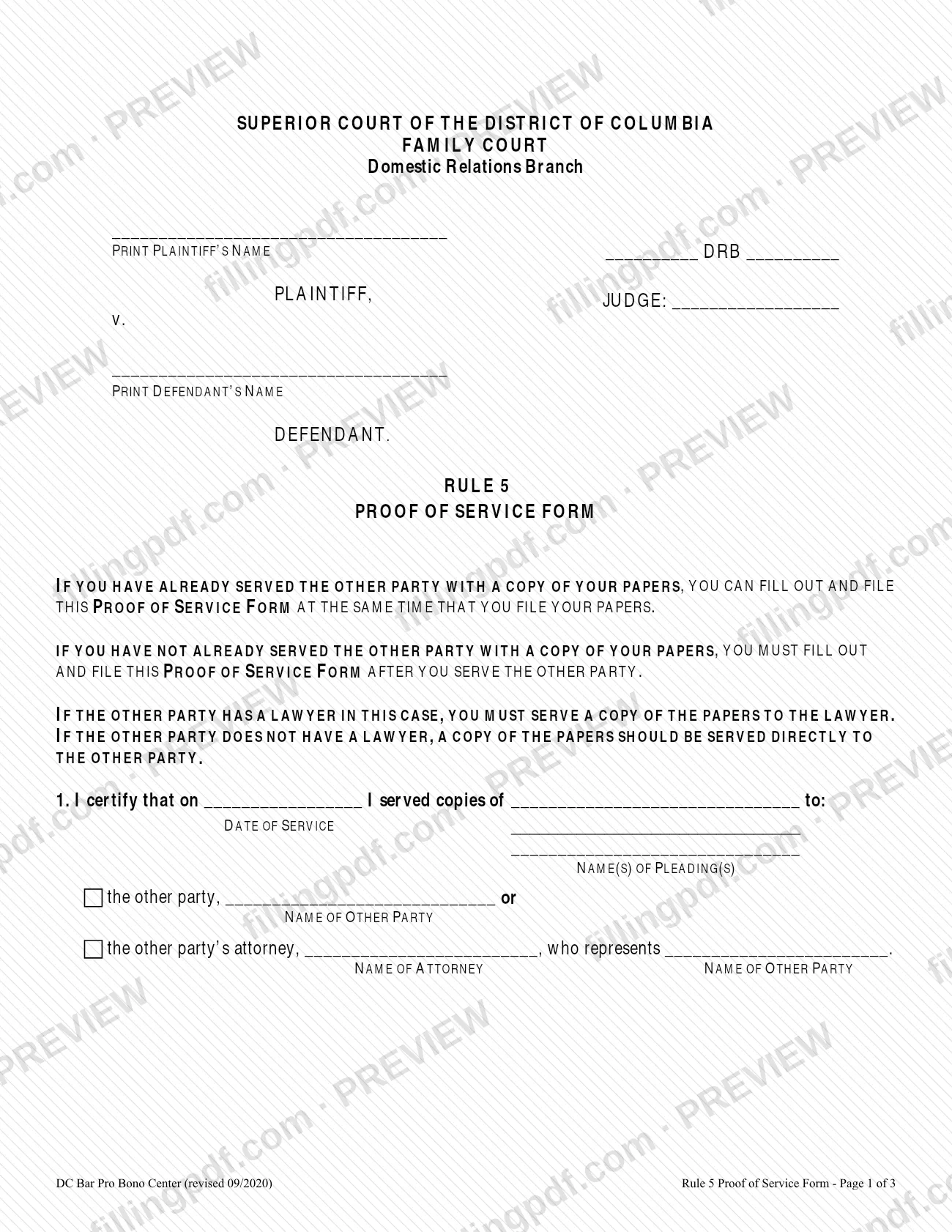
The DC Courts forms page describes it as the form you can use to show the court that you properly served court documents on the other party or their lawyer. The form has three pages and is headed with the case caption: the plaintiff's name, the DRB case number, the judge and the defendant's name. The footer credits the DC Bar Pro Bono Center and shows the revision date, 09/2020.
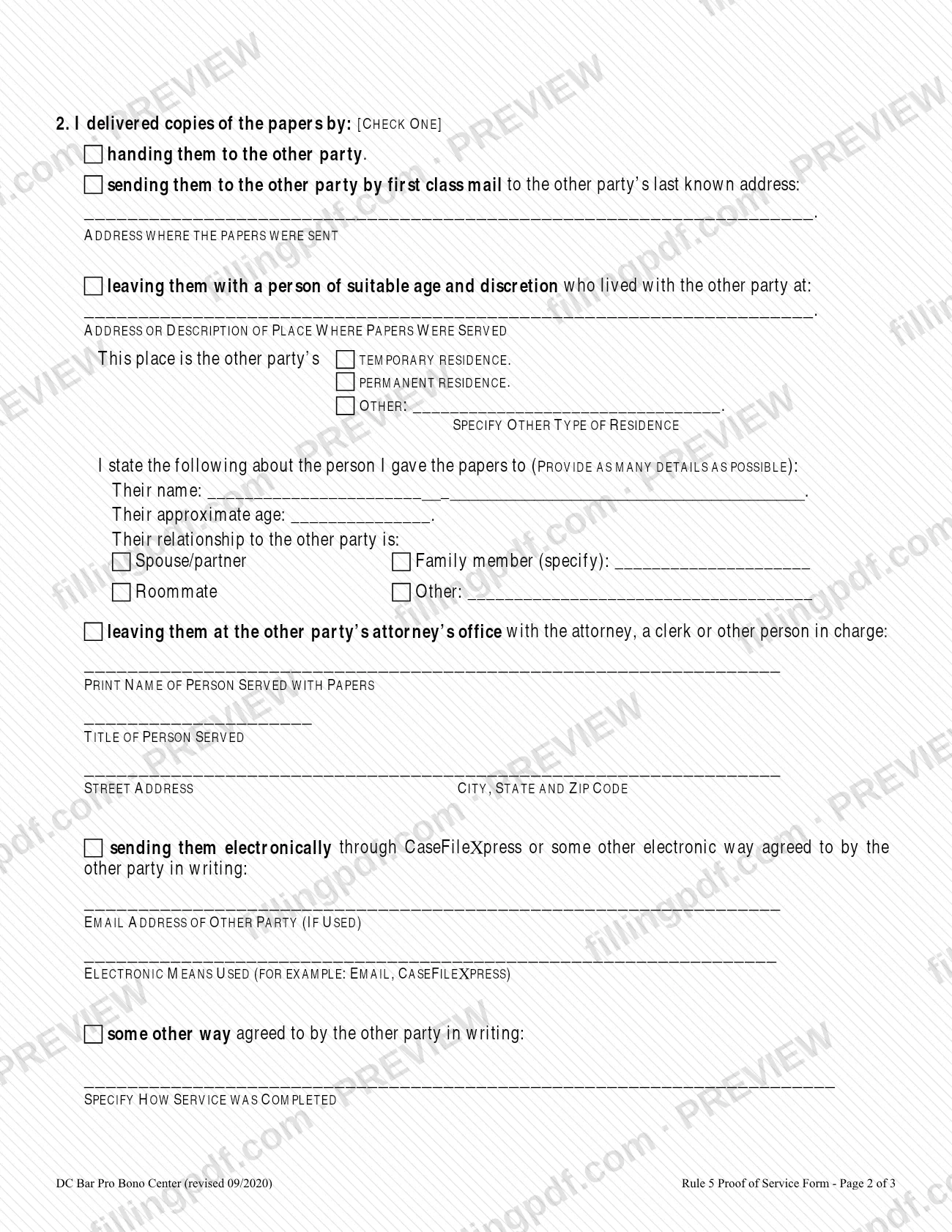
Completing it produces a signed certification with two parts. Line 1 identifies the date of service, the pleading or pleadings served and the person who received them: the other party, or the other party's attorney and the party that attorney represents. Line 2 states the method of delivery, and you check only one. The choices are handing the papers to the other party, first class mail, leaving them with a person of suitable age and discretion who lived with the other party, leaving them at the other party's attorney's office, sending them electronically, or another way the other party agreed to in writing.
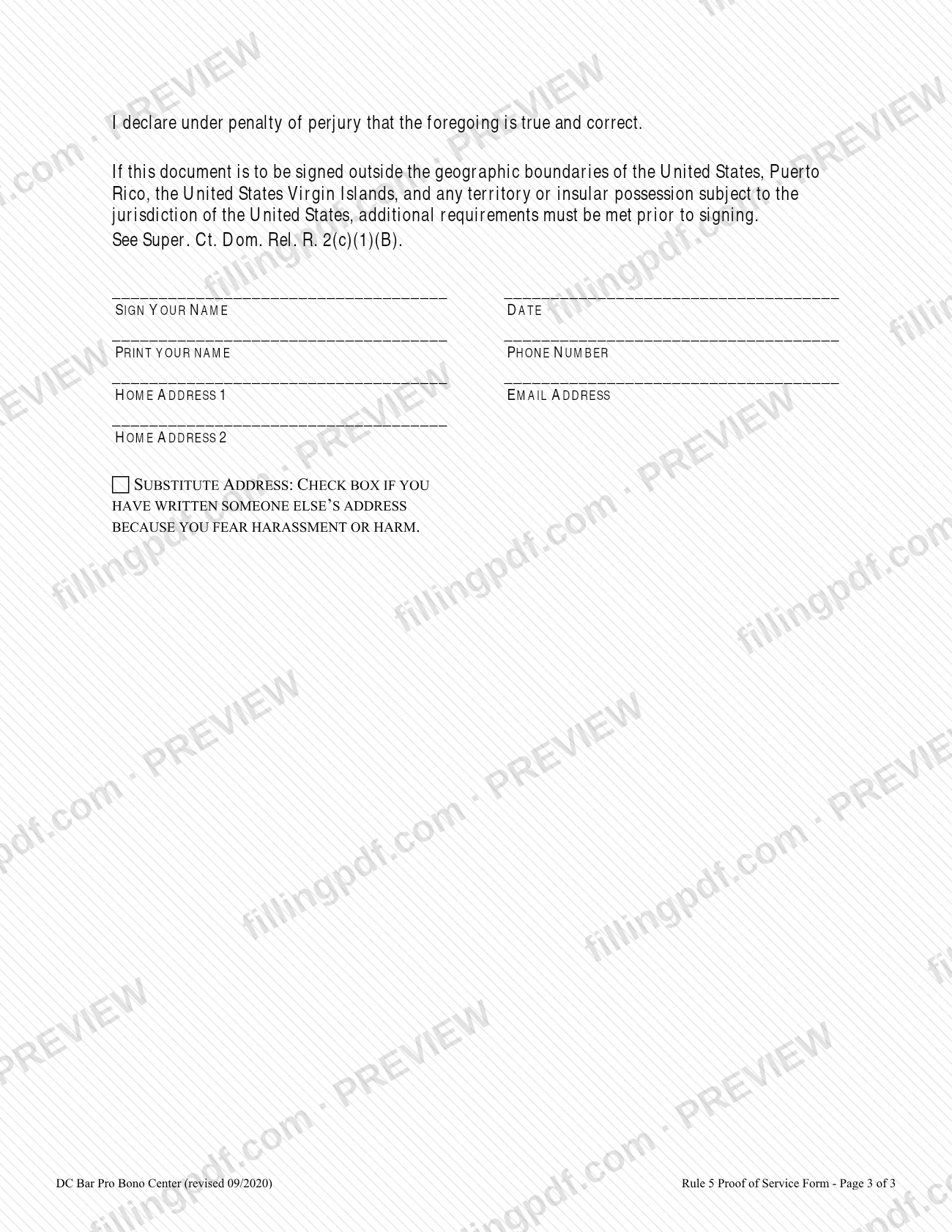
You then declare under penalty of perjury that the information is true and correct, and sign, date and give your contact details. The form refers to Super. Ct. Dom. Rel. R. 2(c)(1)(B) for signing outside the United States and its territories.
Who needs to file PROOF OF SERVICE FORM (RULE 5) – District of Columbia?
The person who served copies of papers in a Domestic Relations Branch case completes this form, because it is written in the first person ("I served") and is signed by that person under penalty of perjury. In the caption you enter the plaintiff and defendant names, the DRB case number and the judge.
The form sorts filers into two situations:
- If you have already served the other party with a copy of your papers, you can fill out and file the form at the same time that you file your papers.
- If you have not yet served the other party, you must fill out and file the form after you serve them.
It also sets who receives the papers. If the other party has a lawyer in the case, you must serve a copy of the papers on the lawyer. If the other party does not have a lawyer, a copy should be served directly on the other party.
If you are signing from outside the United States, Puerto Rico, the U.S. Virgin Islands or any territory or insular possession subject to U.S. jurisdiction, additional requirements must be met before you sign; the form points to Super. Ct. Dom. Rel. R. 2(c)(1)(B).
When to file PROOF OF SERVICE FORM (RULE 5) – District of Columbia
File the form after the papers have been served, or at the same time as the papers if you have already served them. The form says that if you have already served the other party, you can fill out and file it when you file your papers. If you have not served yet, you must serve first and then fill out and file it. The form prints no separate deadline or number of days. The date you enter on line 1 must be the date the papers were actually served.
How to fill out PROOF OF SERVICE FORM (RULE 5) – District of Columbia
Complete the case caption
At the top of page 1, print the plaintiff's name and the defendant's name, and enter the DRB case number and the judge's name.
Enter the date and papers served
On line 1, write the date of service and the name or names of the pleadings you served.
Identify who received the papers
On line 1, check the other party and print their name, or check the other party's attorney and print the attorney's name and the name of the party the attorney represents. If the other party has a lawyer in the case, serve the lawyer.
Choose one delivery method
On line 2, check only one method: handing the papers to the other party, first class mail, leaving them with a person of suitable age and discretion, leaving them at the attorney's office, electronic service, or another agreed way.
Add mailing or residence details
For first class mail, enter the other party's last known address. For leaving the papers with a person who lived with the other party, enter the address or a description of the place and check Temporary residence, Permanent residence or Other (specify).
Describe the person you gave papers to
Print their name and approximate age, then check their relationship: Spouse/partner, Family member (specify), Roommate or Other. Provide as many details as possible.
Complete attorney's office details
If you left the papers at the attorney's office, print the name and title of the person served (the attorney, a clerk or other person in charge) and the street address, city, state and ZIP code.
Complete electronic or other service
For electronic service, enter the other party's email address if used and the electronic means, for example email or CaseFileXpress. For another agreed way, specify how service was completed; the other party must have agreed in writing.
Sign and date the declaration
Sign your name and enter the date under the declaration made under penalty of perjury. Add slashes on either side, like /this/, to sign electronically.
Add your contact information
Print your name, phone number, email address and home address on Home Address 1 and 2. Check the substitute address box only if you wrote someone else's address because you fear harassment or harm.
Review and download the completed PDF
Check that the date, the papers named, the recipient and the one delivery method agree with what actually happened. Download or print the completed PDF from FillingPDF and file it as described under How to submit.
How to submit PROOF OF SERVICE FORM (RULE 5) – District of Columbia
The form tells you to file it but does not name a filing address, portal or office, so follow the court's instructions for your Domestic Relations Branch case.
- When to file: with your papers, if service is already done, or after you serve the other party, if it is not.
- Court information: the DC Courts page for this form is https://www.dccourts.gov/court-resources/search-forms/proof-of-service-form-rule-5.
- CaseFileXpress: the form mentions CaseFileXpress only as one way of serving the other party electronically (line 2), and only when the other party agreed in writing. It does not present it as a filing channel.
Sign the form before you file it, using ink or slashes on either side of your name, such as /your name/, to sign electronically. FillingPDF lets you fill out and download the PDF; submission follows the court's channels, not this site.
Common mistakes to avoid
- Filing the form before you have served the other party when you have not yet served; the form says you must file it after service in that case.
- Serving the other party directly when they have a lawyer in the case; the form says you must serve a copy on the lawyer.
- Checking more than one delivery method on line 2; the form says to check one.
- Choosing electronic service without the other party's written agreement; email, CaseFileXpress or another electronic way requires it.
- Leaving out details about a person of suitable age and discretion: their name, approximate age and relationship to the other party.
- Using an address other than the other party's last known address when you serve by first class mail.
- Signing outside the United States or its territories without meeting the additional requirements in Super. Ct. Dom. Rel. R. 2(c)(1)(B).
- Typing your name without slashes on either side when signing electronically, or leaving the signature and date blank.
- Writing someone else's address in your address spaces out of fear of harassment or harm without checking the substitute address box.
Frequently asked questions
What is a proof of service form?
A proof of service form is your signed statement to the court that you served your papers on the other party or their lawyer. The DC Superior Court's PROOF OF SERVICE FORM (RULE 5) records the date, the papers served, who received them and how they were delivered.
When do I file the Rule 5 proof of service form?
If you already served the other party, you can file it at the same time as your papers. If you have not served yet, you must serve first and then fill out and file the form. The form sets no separate deadline in days.
Who do I serve if the other party has a lawyer?
You must serve a copy of the papers on the lawyer. Only if the other party has no lawyer should the papers be served directly on the other party. Line 1 of the form lets you check the other party or the other party's attorney.
What delivery methods does the DC proof of service form list?
You check one: handing the papers to the other party, first class mail to the last known address, leaving them with a person of suitable age and discretion, leaving them at the attorney's office, sending them electronically, or another way agreed to in writing.
Can I serve papers by email or CaseFileXpress?
Yes, but only through CaseFileXpress or another electronic way the other party agreed to in writing. The form asks for the other party's email address, if used, and the electronic means, such as email or CaseFileXpress.
Can I sign the proof of service form electronically?
Yes. The form says to add slashes on either side of your name, like /this/, to sign electronically. You sign a declaration under penalty of perjury that the information is true and correct, so enter only what actually happened.
What if I sign the form outside the United States?
Additional requirements must be met before you sign if you are outside the United States, Puerto Rico, the U.S. Virgin Islands or any territory or insular possession under U.S. jurisdiction. The form refers you to Super. Ct. Dom. Rel. R. 2(c)(1)(B).
Can I use a different address on the form for safety?
Yes. Check the substitute address box if you wrote someone else's address in your home address spaces because you fear harassment or harm. The form still asks for your name, phone number and email address.
Can I fill out the proof of service form online on FillingPDF?
You can fill out the PDF online on FillingPDF and download or print it. FillingPDF is independent of the DC Courts and does not file the form or serve your papers; filing follows the court's channels.
Ready to fill out PROOF OF SERVICE FORM (RULE 5) – District of Columbia?
Fill out PROOF OF SERVICE FORM (RULE 5) – District of Columbia now