

The Proposed Order, printed as Findings of Fact, Conclusions of Law, and Order of the Court, is a template of the Superior Court of the District of Columbia, Family Court, Mental Health & Habilitation Branch. It records what the court finds, concludes and orders after a respondent's annual review of commitment. The DC Courts page describes it as a sample order the court may use to decide whether a respondent remains committed after an annual review hearing. On this page you can fill out the form online on FillingPDF and download or print the completed PDF; the original is published by the DC Courts at the official link below.
Last updated
What is Proposed Order – District of Columbia?
Proposed Order, titled Findings of Fact, Conclusions of Law, and Order of the Court, is a template of the Superior Court of the District of Columbia's Family Court (Mental Health & Habilitation Branch) that records the findings, conclusions and order after a respondent's annual review of commitment.
The DC Courts describe it as a sample order the court may use to decide whether a respondent remains committed after an annual review hearing. It has three parts:
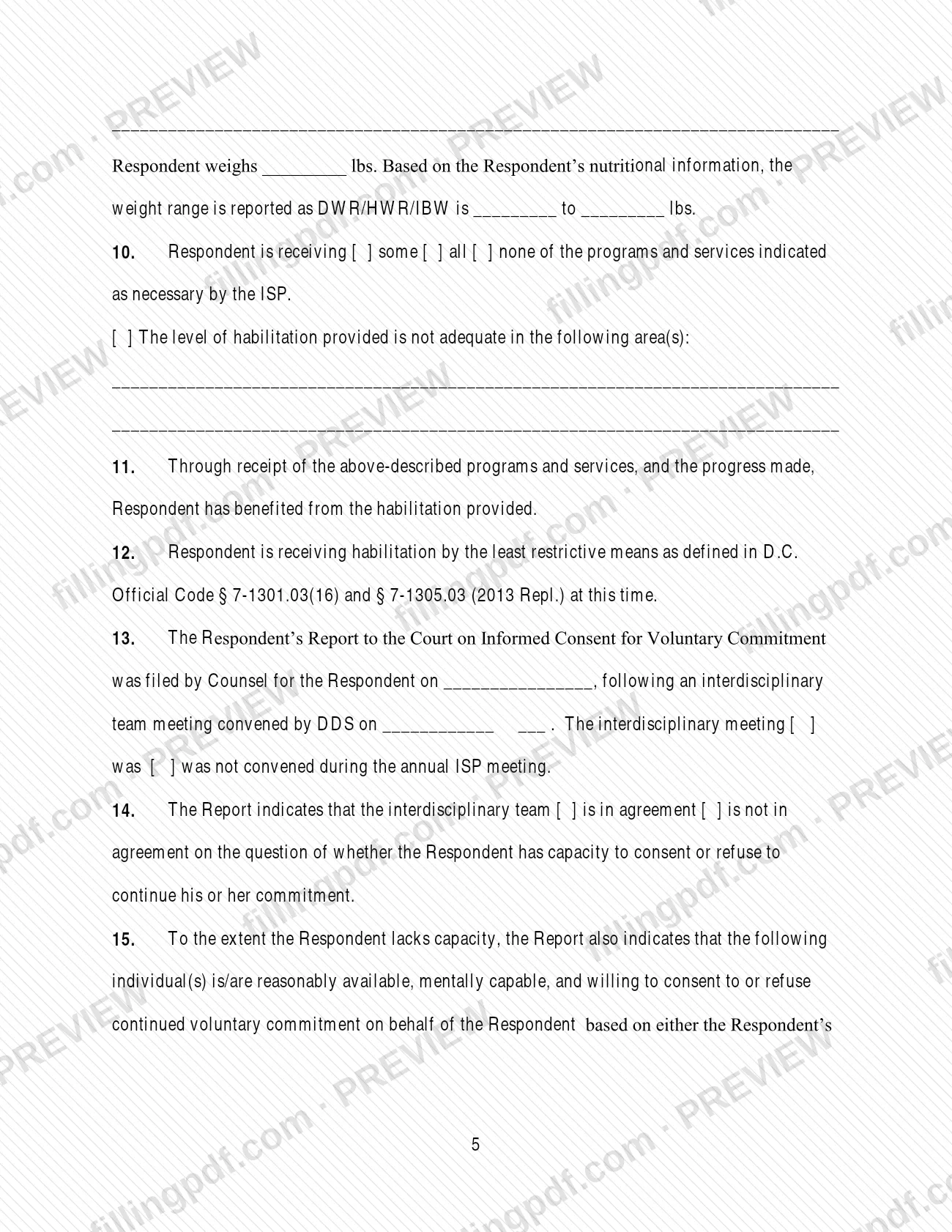
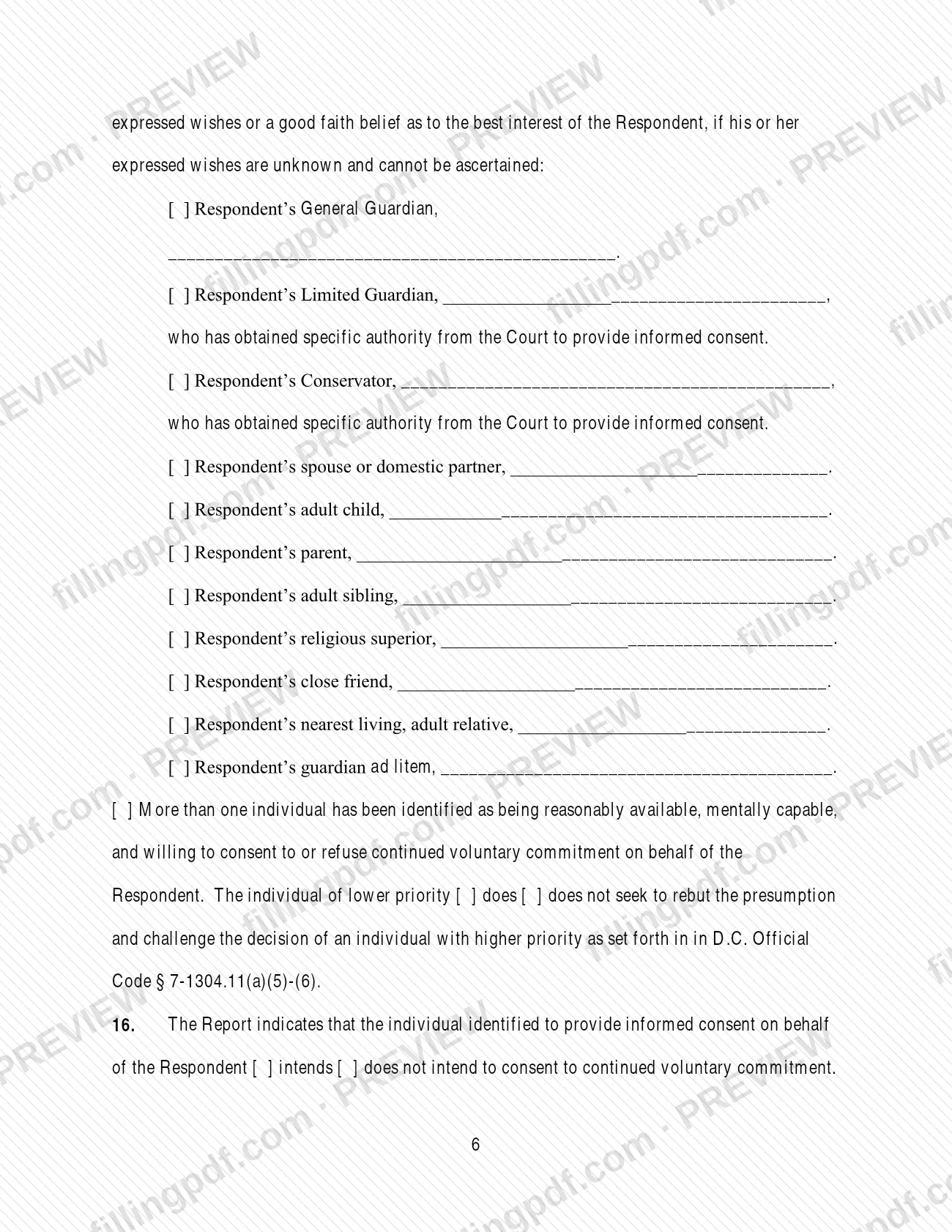
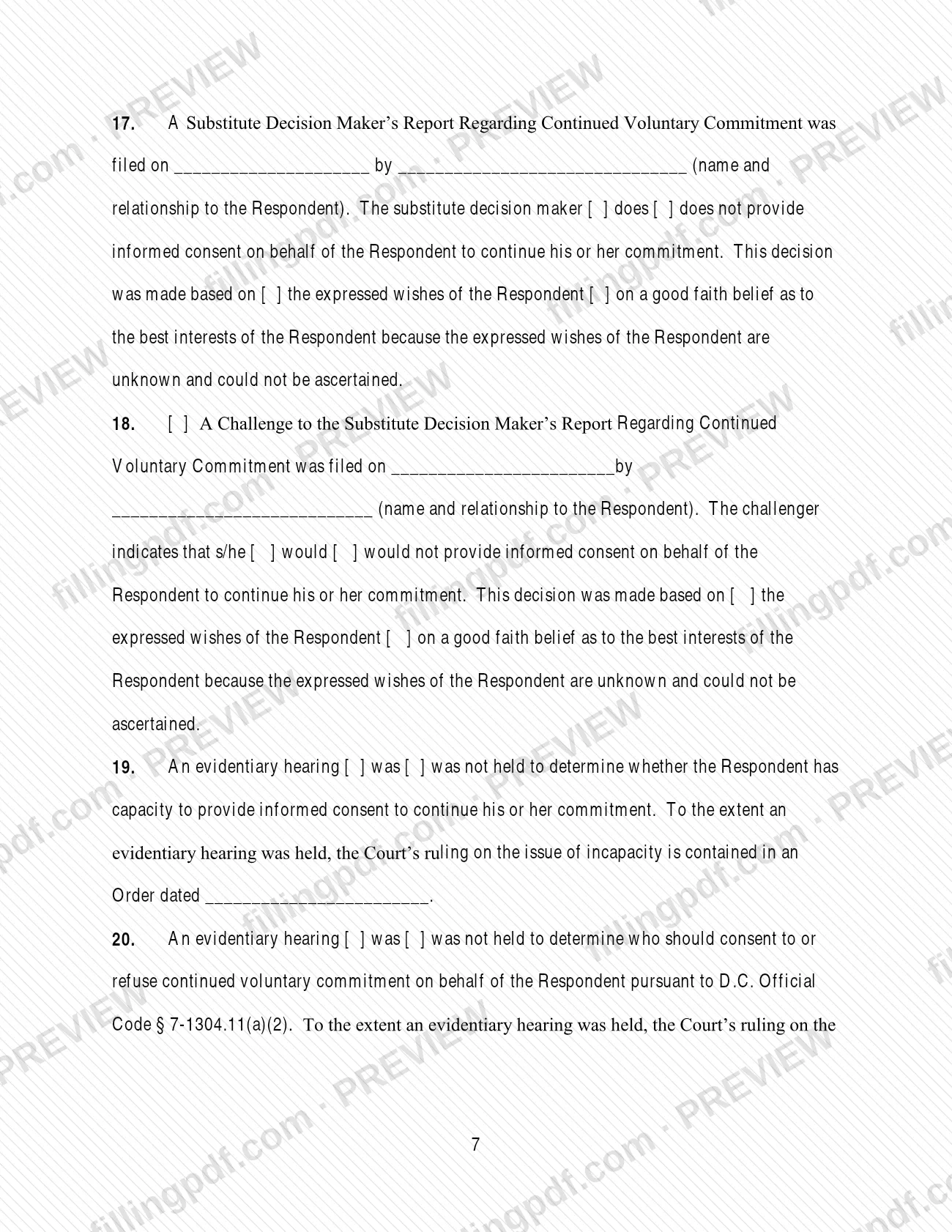
- Findings of Fact, numbered 1 to 21. They cover the respondent's age and diagnoses, the basis for habilitation, the residence and day program, community activities, finances, medications and medical needs, the level of habilitation, and the informed-consent process for continued voluntary commitment.
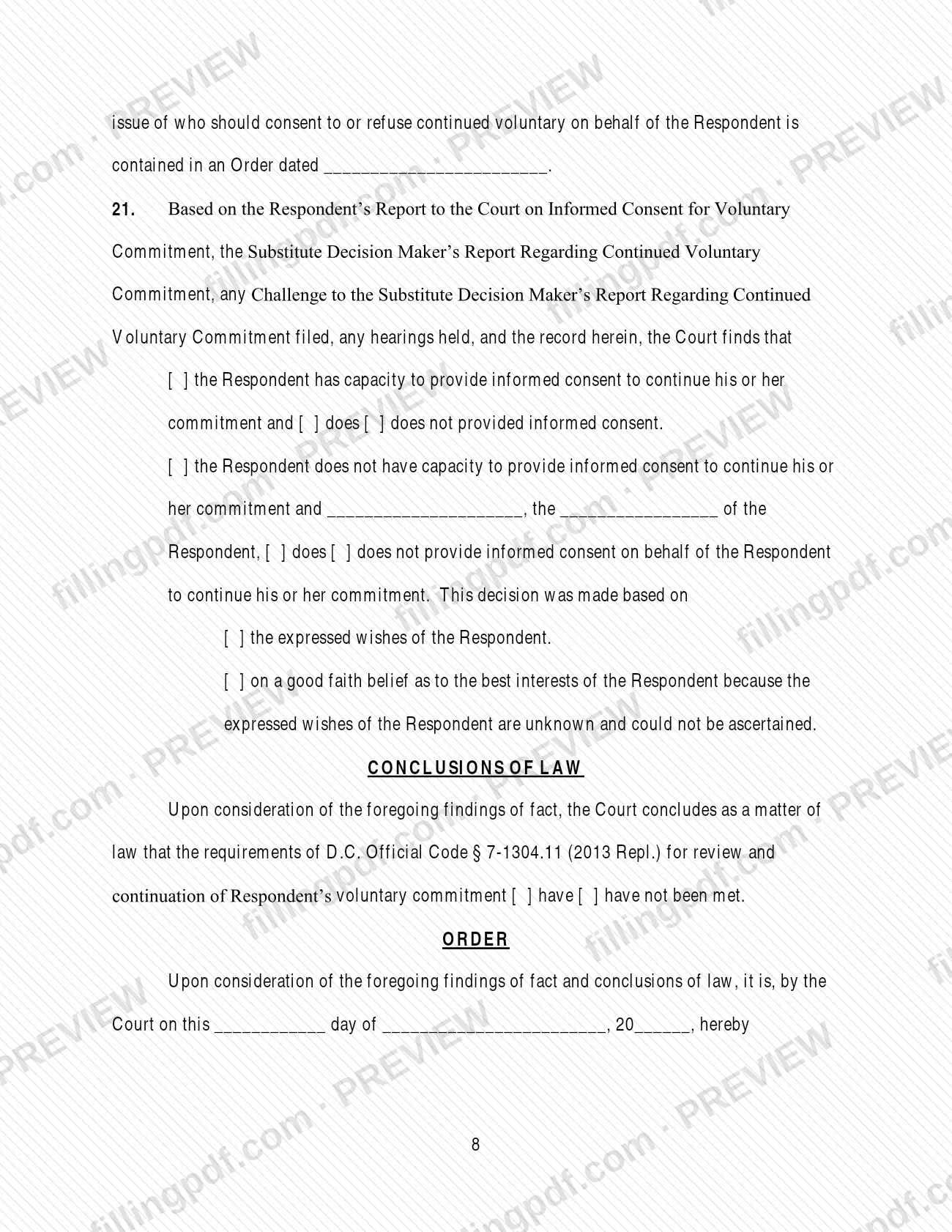
- Conclusions of Law, stating whether the requirements of D.C. Official Code § 7-1304.11 (2013 Repl.) for review and continuation of the voluntary commitment have or have not been met.
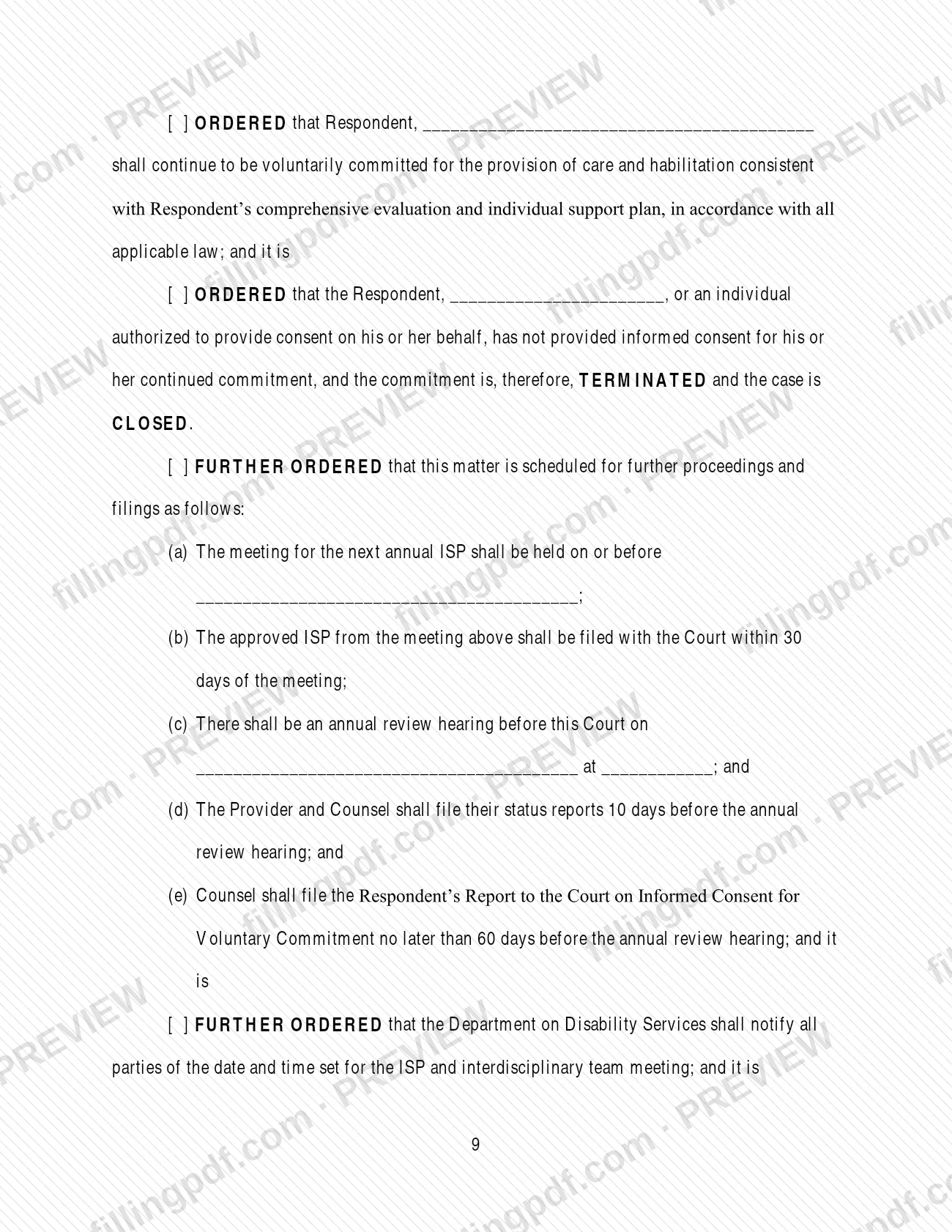
- Order, in which the court either continues the voluntary commitment or terminates it and closes the case, and may set the next ISP meeting, the next annual review hearing and related filing dates.
The opening paragraph says the court finds the facts beyond a reasonable doubt. The template refers to the Individual Support Plan ("ISP"), the Provider's Status Report and the Department on Disability Services (DDS). It is specific to an annual review of commitment and ends with a COPIES TO list. The form was revised May 29, 2018, and prints Magistrate Judge Diane S. Lepley's name in the caption and on the signature line.
Who needs to file Proposed Order – District of Columbia?
The template serves the annual review hearing of a respondent whose commitment is reviewed in the Mental Health & Habilitation Branch of the D.C. Superior Court Family Court. The DC Courts page calls it a sample order the court may use; it does not say who must prepare it, so confirm with the court who drafts and submits the order in your case.
People and offices the form itself names:
- The Respondent, whose name, age, diagnoses, residence, day program, finances and medical information fill the findings.
- Respondent's Counsel and the Provider, whose status reports the order refers to, and the residential provider, listed under COPIES TO.
- DDS, which the form names as the agency that certifies the residential provider and day program; the COPIES TO list includes its Assistant General Counsel and Court Liaison.
- Decision makers, such as a general or limited guardian, conservator, family member, close friend or guardian ad litem, who may consent or refuse on the Respondent's behalf if the Respondent lacks capacity.
- The court: the signature line carries the name of the magistrate judge.
Do not use it for a proceeding other than an annual review of commitment; its opening paragraph and findings are written for that hearing.
When to file Proposed Order – District of Columbia
The template is used for the annual review of commitment: its opening paragraph refers to the date the matter came before the Court for the Respondent's annual review, the date of the ISP meeting and the date the assessments, evaluations and ISP were filed. No separate deadline for the order itself is printed on the form.
The order then sets the next cycle, when the court checks the further-proceedings paragraph:
- the next annual ISP meeting, on or before a date the court fills in;
- the approved ISP filed with the Court within 30 days of that meeting;
- the next annual review hearing, with date and time;
- the Provider's and Counsel's status reports filed 10 days before that hearing;
- the Respondent's Report to the Court on Informed Consent for Voluntary Commitment filed no later than 60 days before that hearing.
If the court terminates the commitment, the order says the case is closed.
Documents you need
- Provider's Status Report: the order incorporates it and draws habilitation, medication and medical information from it, so have it at hand.
- Individual Support Plan (ISP): the order cites its meeting date, its filing date and its physical and lab test results.
- Respondent's psychological report: finding 1 asks for its date and the cognitive and adaptive diagnoses.
- Report to the Court on Informed Consent for Voluntary Commitment: findings 13 to 16 ask for its filing date and the interdisciplinary team's position.
- Substitute Decision Maker's Report Regarding Continued Voluntary Commitment: finding 17 asks for its filing date and author, if one was filed.
- Challenge to the Substitute Decision Maker's Report: finding 18 asks for its filing date and author, only if a challenge was filed.
- Any prior order on capacity or on who should consent: findings 19 and 20 ask for its date, only if an evidentiary hearing was held.
How to fill out Proposed Order – District of Columbia
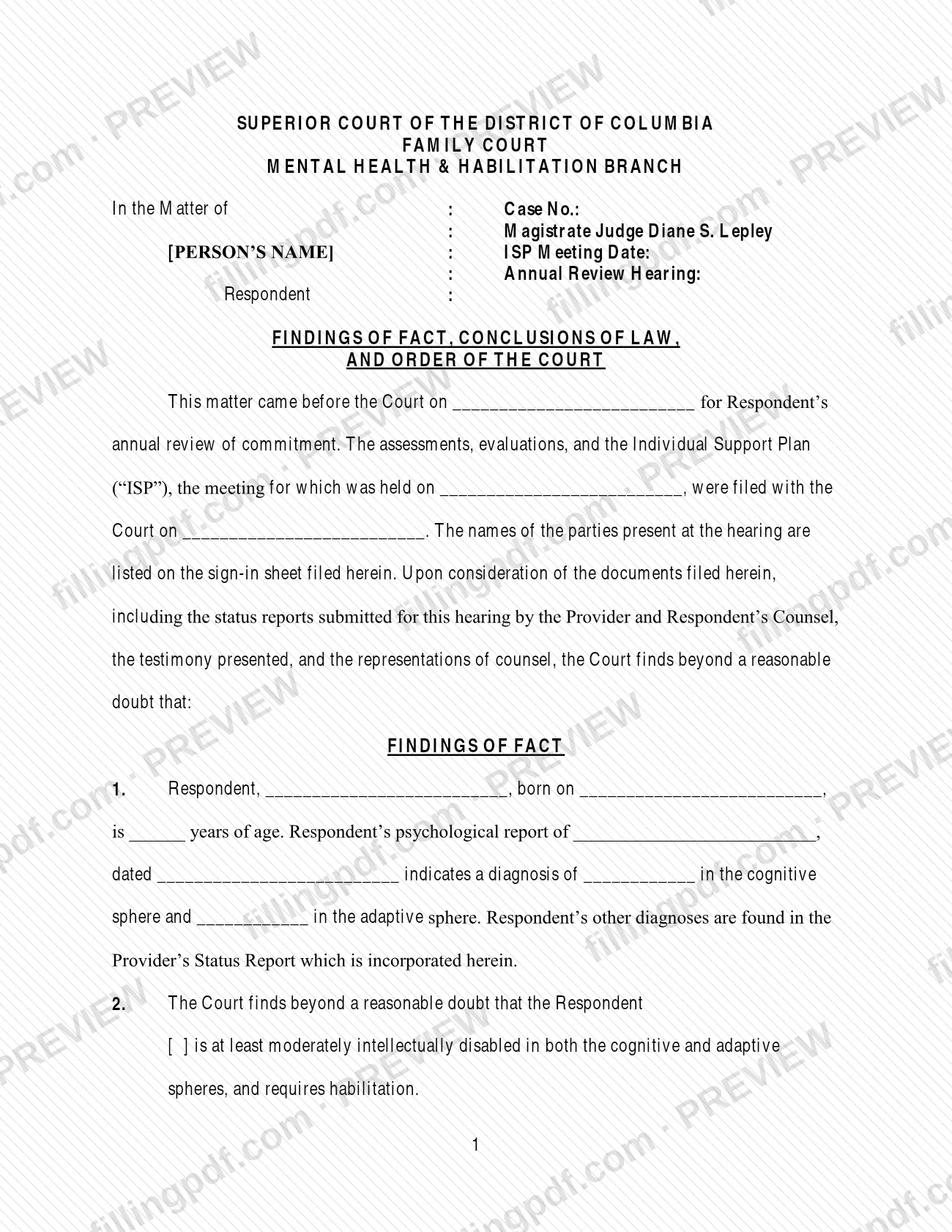
Complete the case caption
Enter the Case No., the ISP Meeting Date and the Annual Review Hearing date, and replace [PERSON'S NAME] with the Respondent's name.
Fill in the opening paragraph
Enter the date the matter came before the Court for the annual review, the date of the ISP meeting and the date the assessments, evaluations and ISP were filed.
Enter Respondent details in finding 1
Give the Respondent's name, date of birth and age, the date of the psychological report, and the diagnoses in the cognitive and adaptive spheres.
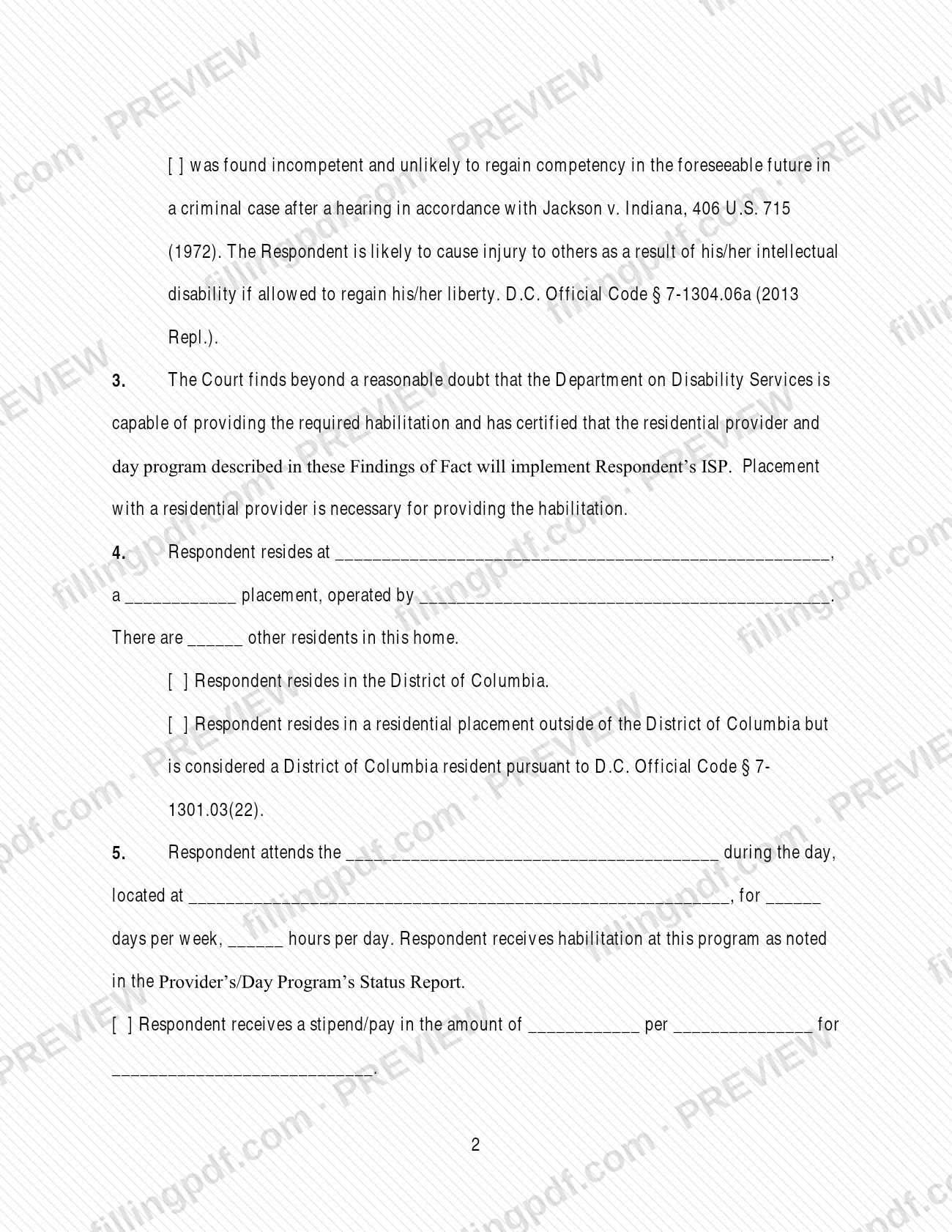
Mark the basis in finding 2
Check the box that applies: at least moderately intellectually disabled in both spheres and requiring habilitation, or found incompetent in a criminal case after a Jackson v. Indiana hearing and likely to cause injury to others.
Describe residence and day program
In findings 4 and 5, enter the residence address, placement type, operator and number of other residents, check the residency box, then the day program, its address, days and hours, and whether a stipend is received.
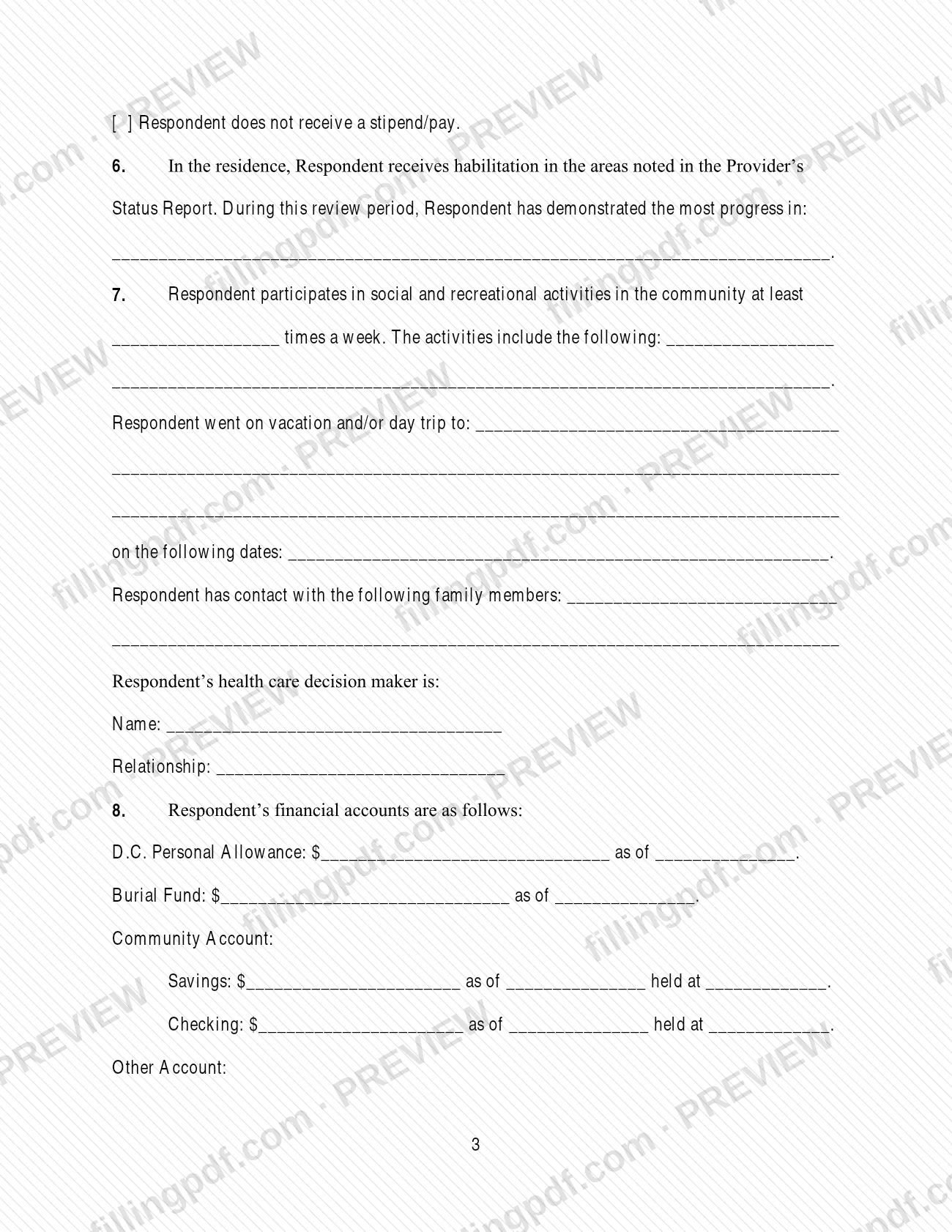
Record progress, activities and finances
In findings 6 to 8, enter the areas of most progress, community activities and their frequency, vacations or trips, family contacts, the health care decision maker, and each account balance with its as-of date and institution, plus the monthly allowance and benefits.
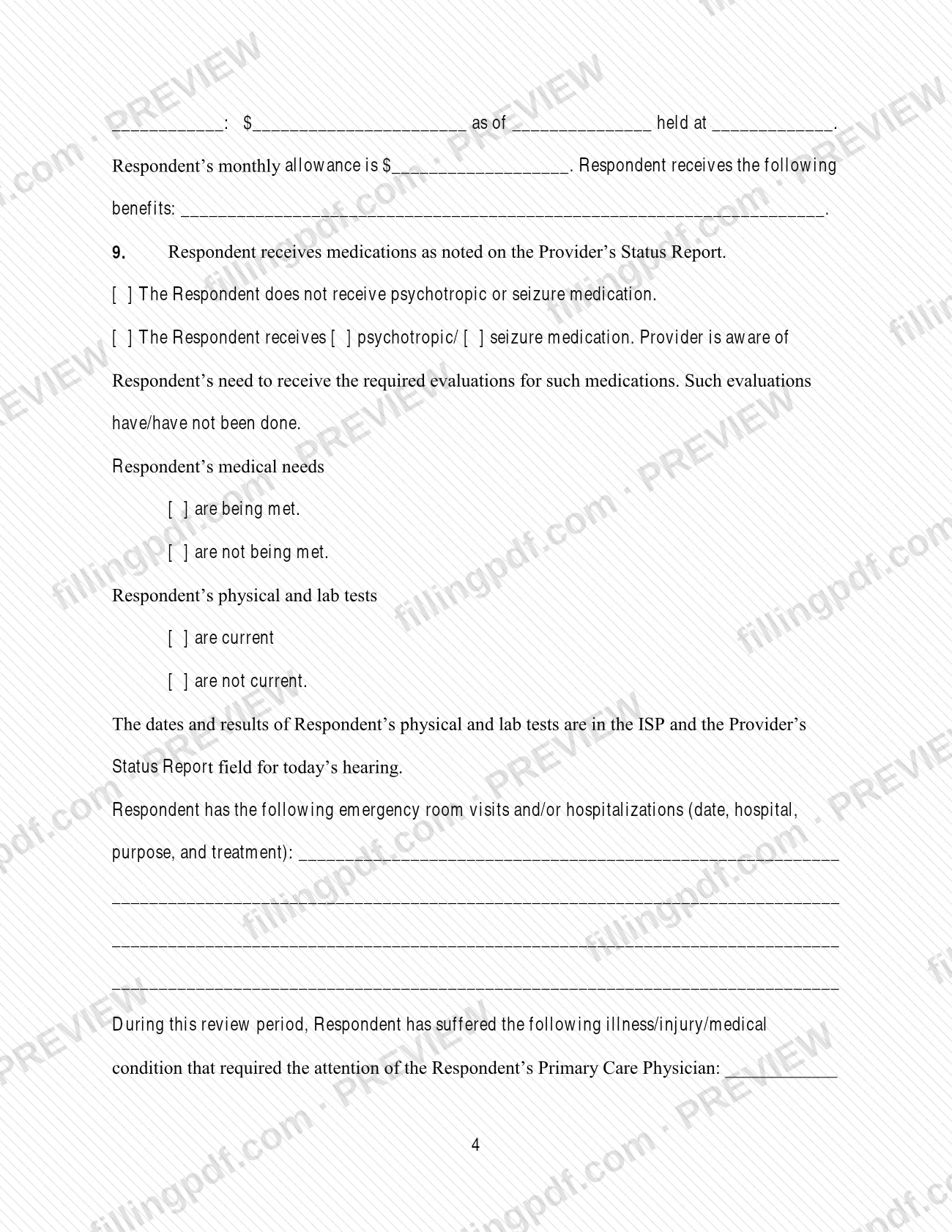
Complete medical and service findings
In findings 9 and 10, check the medication, medical needs, test and program-and-services boxes, then enter weight and weight range, emergency room visits, hospitalizations, illnesses and any area where habilitation is inadequate.
Complete the informed-consent findings
In findings 13 to 21, enter the report filing dates, check the team-agreement and decision-maker boxes with names, and mark the capacity and consent findings, including any challenge or evidentiary hearing and the related order dates.
Mark the conclusion of law
Check whether the requirements of D.C. Official Code § 7-1304.11 (2013 Repl.) for review and continuation of the voluntary commitment have or have not been met.
Select the order paragraphs
Enter the day, month and year, then check ORDERED to continue the commitment or ORDERED that it is terminated and the case closed. If further proceedings are set, fill in the ISP meeting date, the review hearing date and time, and any added ordering text.
Fill in COPIES TO
Enter the name and address of the Respondent, attorney, residential provider, advocate, the DDS Assistant General Counsel and Court Liaison names, and any family or other recipient.
Review and download the PDF
Check every checkbox and blank. The signature line carries the magistrate judge's printed name and is for the judge. Download or print the completed PDF from FillingPDF and send it as the court directs.
How to submit Proposed Order – District of Columbia
The form names no filing channel, e-filing portal or address for the order itself: it is a court order template, and the DC Courts page offers it as an English download. Ask the Family Court's Mental Health & Habilitation Branch how the proposed order should reach the judge in your case.
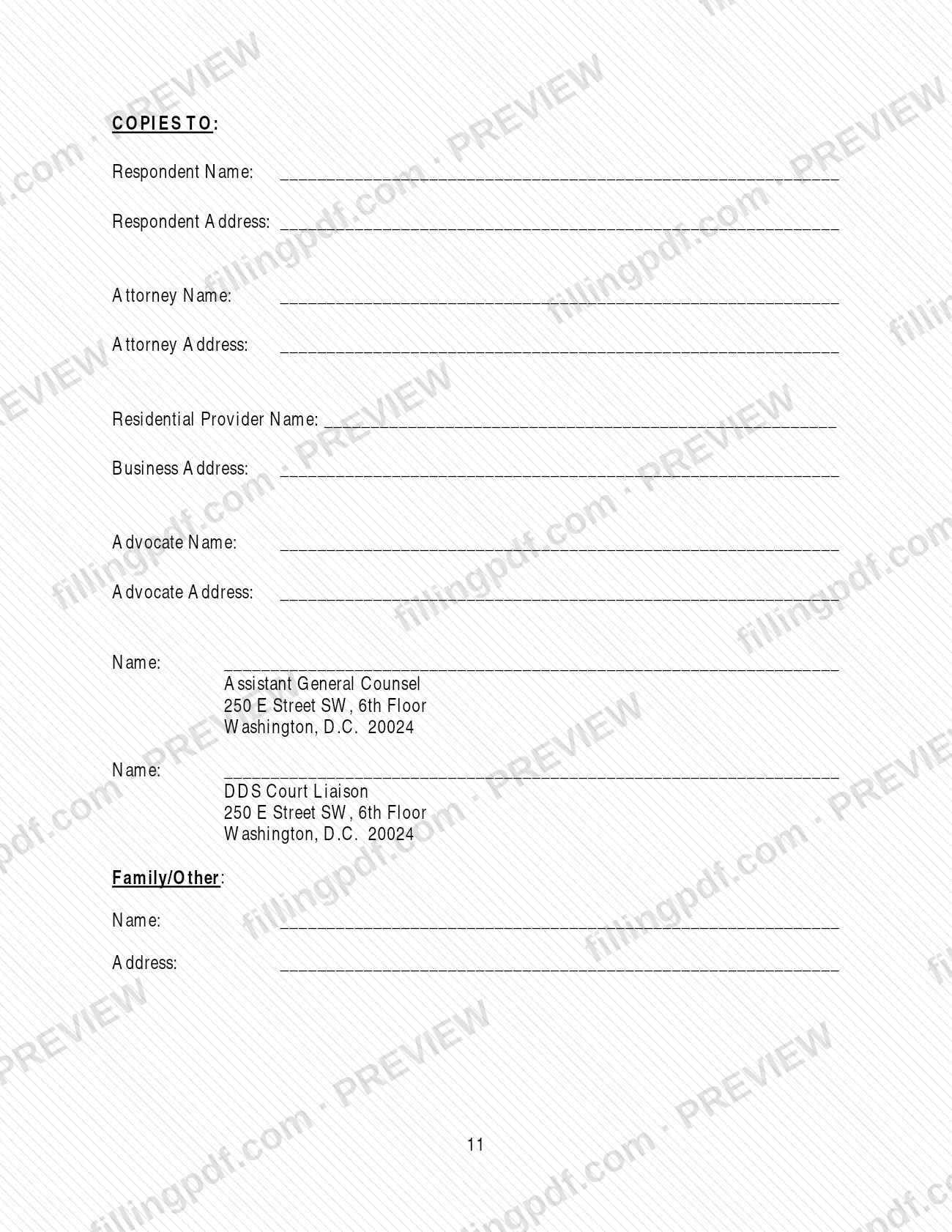
The form does list who receives copies once the order is entered, under COPIES TO:
- the Respondent (name and address);
- the Attorney (name and address);
- the Residential Provider (name and business address);
- the Advocate (name and address);
- an Assistant General Counsel and the DDS Court Liaison, both at 250 E Street SW, 6th Floor, Washington, D.C. 20024;
- Family/Other (name and address).
Enter each recipient's details in those blanks. FillingPDF lets you fill out and download the PDF; submission follows the court's channels, not this page.
Common mistakes to avoid
- Leaving the Case No., ISP Meeting Date or Annual Review Hearing in the caption blank, or leaving the [PERSON'S NAME] placeholder in place.
- Filling the opening paragraph's three dates incorrectly: the hearing date, the ISP meeting date and the date the assessments and ISP were filed are separate blanks.
- Marking both boxes of finding 2 or neither, instead of the one basis that applies: intellectual disability requiring habilitation, or a Jackson v. Indiana incompetency finding.
- Entering a financial figure in finding 8 without its as-of date or, for community and other accounts, the institution where it is held.
- Skipping the checkboxes in findings 9 and 10 on medication, medical needs, tests and the programs and services received.
- Checking the ORDERED paragraph to continue commitment while marking the conclusions of law as requirements 'have not been met', or the reverse.
- Checking the further-proceedings paragraph without filling in the dates for items (a) and (c) and the time of the hearing.
- Leaving the COPIES TO section blank, or omitting the respondent's, attorney's or residential provider's address.
Frequently asked questions
What is a proposed order in the D.C. Superior Court Mental Health & Habilitation Branch?
It is a template titled Findings of Fact, Conclusions of Law, and Order of the Court. The DC Courts describe it as a sample order the court may use to decide whether a respondent remains committed after an annual review hearing.
Can I fill out the Proposed Order online?
Yes. You can fill out the PDF online on FillingPDF and download or print it. FillingPDF is an independent service and does not file the order with the court, so you submit it through the channels the court directs.
What does the order decide at the end?
The court checks one of two paragraphs: the Respondent continues to be voluntarily committed for care and habilitation, or the commitment is terminated and the case closed because informed consent was not provided. Further orders may set the next dates.
What dates does the order set for next year?
If further proceedings are ordered: the next annual ISP meeting, the approved ISP filed within 30 days of that meeting, an annual review hearing date and time, status reports 10 days before the hearing, and the informed-consent report no later than 60 days before it.
Who signs the Proposed Order?
The signature line prints the name of Magistrate Judge Diane S. Lepley under the words IT IS SO ORDERED. The form has no other signature block, so the judge signs the entered order.
Who gets copies of the order?
The COPIES TO section lists the Respondent, attorney, residential provider, advocate, a DDS Assistant General Counsel and the DDS Court Liaison (both at 250 E Street SW, 6th Floor, Washington, D.C. 20024), and any family or other recipient.
Which revision of the Proposed Order is this?
The template is marked Revised: May 29, 2018. The PDF is published by the DC Courts at the official link on this page.
Ready to fill out Proposed Order – District of Columbia?
Fill out Proposed Order – District of Columbia now