
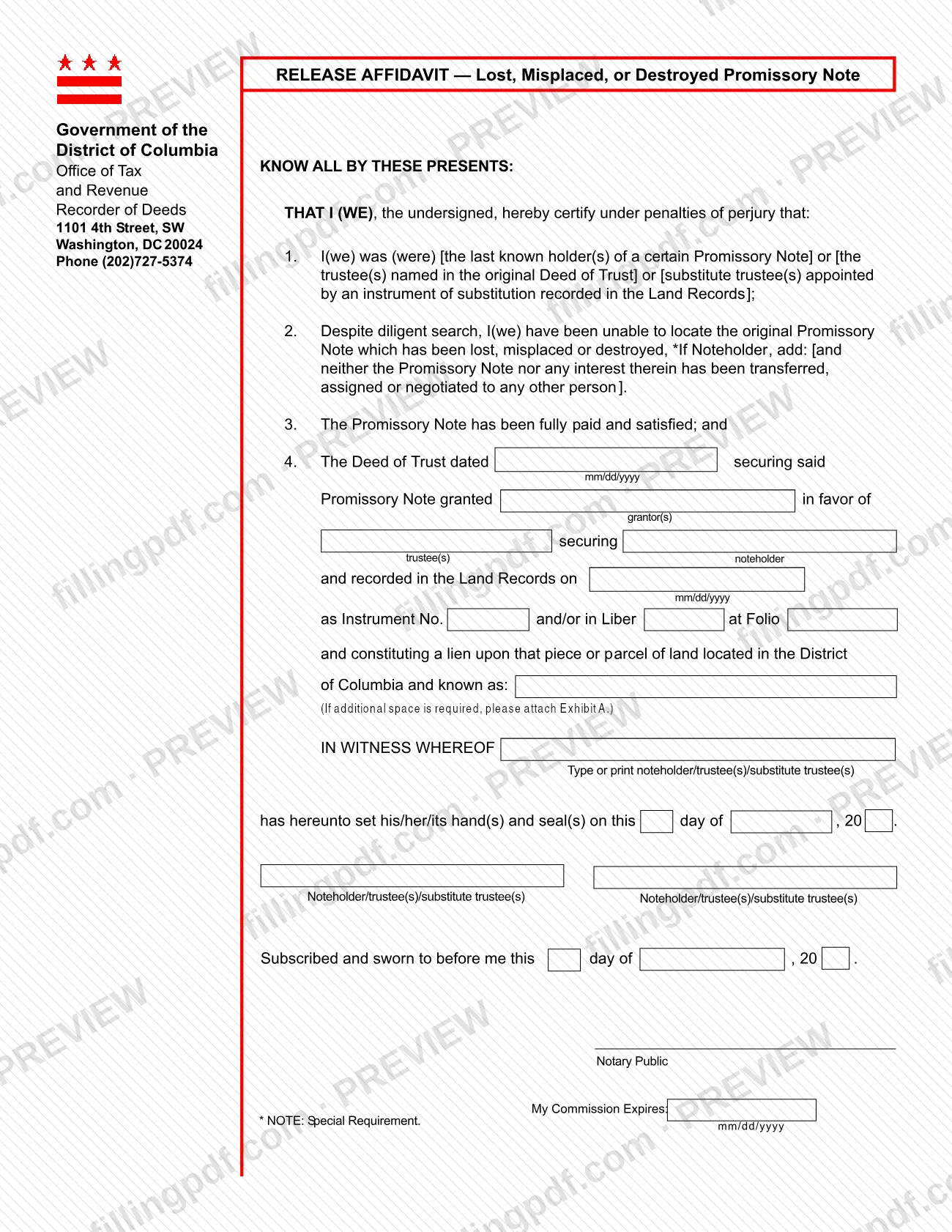
ROD 27, the Release Affidavit for a Lost, Misplaced, or Destroyed Promissory Note, is a sworn statement issued under the Recorder of Deeds of the DC Office of Tax and Revenue (OTR). It is used when the original promissory note secured by a Deed of Trust cannot be found but has been fully paid and satisfied. The person signing is the last known noteholder, the trustee named in the original Deed of Trust, or a substitute trustee. On this page you can fill out the form online on FillingPDF and download or print the completed PDF; the original PDF is published by OTR.
Last updated
What is ROD 27?
ROD 27, Release Affidavit — Lost, Misplaced, or Destroyed Promissory Note, is a sworn statement, made under penalties of perjury, in which a noteholder or trustee certifies that an original promissory note cannot be located, that it has been fully paid and satisfied, and which Deed of Trust secured it.
The form carries the letterhead of the Government of the District of Columbia, Office of Tax and Revenue, Recorder of Deeds. It has four numbered statements. The signer states that he, she or they were the last known holder of the Promissory Note, the trustee named in the original Deed of Trust, or a substitute trustee appointed by an instrument recorded in the Land Records. The signer then states that, despite diligent search, the original note has been lost, misplaced or destroyed, and that the note has been fully paid and satisfied.
The fourth statement identifies the Deed of Trust: its date, the grantor(s), the trustee(s) and noteholder, the date it was recorded in the Land Records, the Instrument No. and/or the Liber and Folio, and the piece or parcel of land in the District of Columbia that it places a lien on. If more space is needed for the property description, the form asks for an Exhibit A.
A noteholder must add an extra statement under the form's special requirement: that neither the Promissory Note nor any interest in it has been transferred, assigned or negotiated to any other person. The form ends with a signature block and a notary jurat.
Who needs to file ROD 27?
The main group is the person who holds the authority to certify that a paid-off note is lost: the last known holder (noteholder) of the Promissory Note, the trustee named in the original Deed of Trust, or a substitute trustee appointed by an instrument of substitution recorded in the Land Records. The form has room for more than one signer, so co-holders or co-trustees sign together.
Each signer must be able to state, under penalties of perjury, that:
- a diligent search has not found the original Promissory Note, which is lost, misplaced or destroyed;
- the Promissory Note has been fully paid and satisfied;
- the Deed of Trust described in the form secured that note and is a lien on land in the District of Columbia.
Noteholders also certify that neither the note nor any interest in it has been transferred, assigned or negotiated to anyone else; trustees and substitute trustees do not give that statement unless the form's special requirement applies to them.
The form is not for a note that has been found, and it does not describe any representative or attorney signing on a signer's behalf. A notary public must complete the jurat on the form.
When to file ROD 27
Use ROD 27 when the original promissory note secured by a Deed of Trust cannot be located after diligent search and the note has been fully paid and satisfied. That is the triggering event the form describes. No due date or filing window is printed on it, so the timing depends on when you need the release statement for the Deed of Trust. The form is dated at signing ("this ___ day of _, 20") and the notary's jurat carries its own date, so sign and notarize it on the same occasion. Contact the Recorder of Deeds at the phone number on the form for any timing requirement that applies to your Deed of Trust.
Documents you need
- Exhibit A: attach it only if the space on the form is not enough for the description of the piece or parcel of land in the District of Columbia that the Deed of Trust places a lien on.
How to fill out ROD 27
Confirm you can sign this affidavit
The form is for a last known noteholder, the trustee named in the original Deed of Trust, or a substitute trustee. Confirm the note was fully paid and the original cannot be found after diligent search.
Select your capacity in statement 1
Keep the wording that describes you: last known holder of the Promissory Note, trustee named in the original Deed of Trust, or substitute trustee appointed by an instrument recorded in the Land Records.
Add the noteholder statement if needed
In statement 2, if you are the noteholder, add the starred statement that neither the Promissory Note nor any interest in it has been transferred, assigned or negotiated to any other person.
Enter the Deed of Trust details
In statement 4, enter the date of the Deed of Trust (mm/dd/yyyy), the grantor(s), the trustee(s) and the noteholder it was granted in favor of.
Enter the recording information
Enter the date the Deed of Trust was recorded in the Land Records (mm/dd/yyyy), and its Instrument No. and/or the Liber and Folio.
Describe the property
Write the piece or parcel of land in the District of Columbia on which the Deed of Trust is a lien. If more space is needed, write that and attach Exhibit A.
Type or print the signer names
Under "Type or print noteholder/trustee(s)/substitute trustee(s)," enter the name of each person signing, and enter the day, month and year in the "IN WITNESS WHEREOF" line.
Sign before a notary public
Each noteholder, trustee or substitute trustee signs on the signature lines. The notary public completes the jurat with the date, signature and "My Commission Expires" entry.
Review and download the completed PDF
Check names, dates and the property description against the Deed of Trust, then download or print the completed PDF from FillingPDF and present it as described under How to submit.
How to submit ROD 27
The form prints no filing channel of its own. Its header identifies the office that issues it: Government of the District of Columbia, Office of Tax and Revenue, Recorder of Deeds, 1101 4th Street, SW, Washington, DC 20024, phone (202)727-5374.
- Contact: call the Recorder of Deeds at (202)727-5374 to confirm how and where to present the completed affidavit, and whether a fee applies. No fee amount is printed on the form.
- Before you send it: complete every statement, attach an Exhibit A if the property description needs more space, have each signer sign, and have a notary public complete the jurat (the "Subscribed and sworn to before me" block, with the notary's signature and commission expiration).
- Agency page: OTR lists the form at https://otr.cfo.dc.gov/publication/rod-27-release-affidavit-lost-misplaced-or-destroyed-promissory-note.
FillingPDF lets you fill out and download the PDF; submission follows the Recorder of Deeds' channels, not this site.
Common mistakes to avoid
- Signing without choosing your capacity in statement 1: last known holder of the Promissory Note, trustee named in the original Deed of Trust, or substitute trustee.
- Omitting the noteholder statement that neither the Promissory Note nor any interest in it has been transferred, assigned or negotiated, when you sign as noteholder.
- Leaving out the date of the Deed of Trust or the recording date in mm/dd/yyyy format.
- Giving no Instrument No. and/or Liber and Folio for the recorded Deed of Trust.
- Writing a property description that does not fit the space instead of attaching Exhibit A.
- Signing the affidavit but leaving the notary jurat ("Subscribed and sworn to before me") blank or without the commission expiration.
- Using the form when the note has not been fully paid and satisfied; statement 3 certifies that it has.
Frequently asked questions
What is ROD 27 used for?
ROD 27 is the Recorder of Deeds release affidavit for a lost, misplaced or destroyed promissory note. A noteholder or trustee swears that the original note cannot be found, that it has been fully paid and satisfied, and identifies the Deed of Trust that secured it.
Who signs the ROD 27 release affidavit?
The last known holder of the Promissory Note, the trustee named in the original Deed of Trust, or a substitute trustee appointed by an instrument recorded in the Land Records. The form has two signature lines for noteholders, trustees or substitute trustees.
Does ROD 27 have to be notarized?
The form includes a notary jurat reading "Subscribed and sworn to before me," with lines for the date, the notary public's signature and the commission expiration. Have the notary complete that block when the signers swear to the statements.
What extra statement do noteholders add to ROD 27?
Under the form's starred note, a noteholder adds that neither the Promissory Note nor any interest in it has been transferred, assigned or negotiated to any other person. The statement belongs in item 2 after the lost-note certification.
What if the property description does not fit on ROD 27?
The form says that if additional space is required, you attach Exhibit A. Use it for the description of the piece or parcel of land in the District of Columbia that the Deed of Trust places a lien on.
Where do I get help with Form ROD 27?
The form's header lists the Recorder of Deeds, Office of Tax and Revenue, 1101 4th Street, SW, Washington, DC 20024, phone (202)727-5374. Call that office to confirm how to present the completed affidavit.
Can I fill out ROD 27 online?
Yes. You can fill out the PDF online on FillingPDF and download or print it. FillingPDF is an independent service and does not file, record or notarize the affidavit; you present it to the Recorder of Deeds through its own channels.
Ready to fill out ROD 27?
Fill out ROD 27 now