
ROD 40 - Transfer-On-Death Revocation is the District of Columbia form that an owner signs to revoke a transfer-on-death (TOD) deed. It is issued by the Recorder of Deeds within the DC Office of Tax and Revenue (OTR). The revocation has no effect unless it is acknowledged and recorded before the owner's death. On this page you can fill out the form online on FillingPDF and download or print the completed PDF; the original PDF is published by OTR at otr.cfo.dc.gov.
Last updated
What is ROD 40?
ROD 40 - Transfer-On-Death Revocation is the District of Columbia form, titled Revocation of Transfer-on-Death Deed on its face, with which a property owner revokes all previous transfers of that property made by transfer-on-death (TOD) deed.
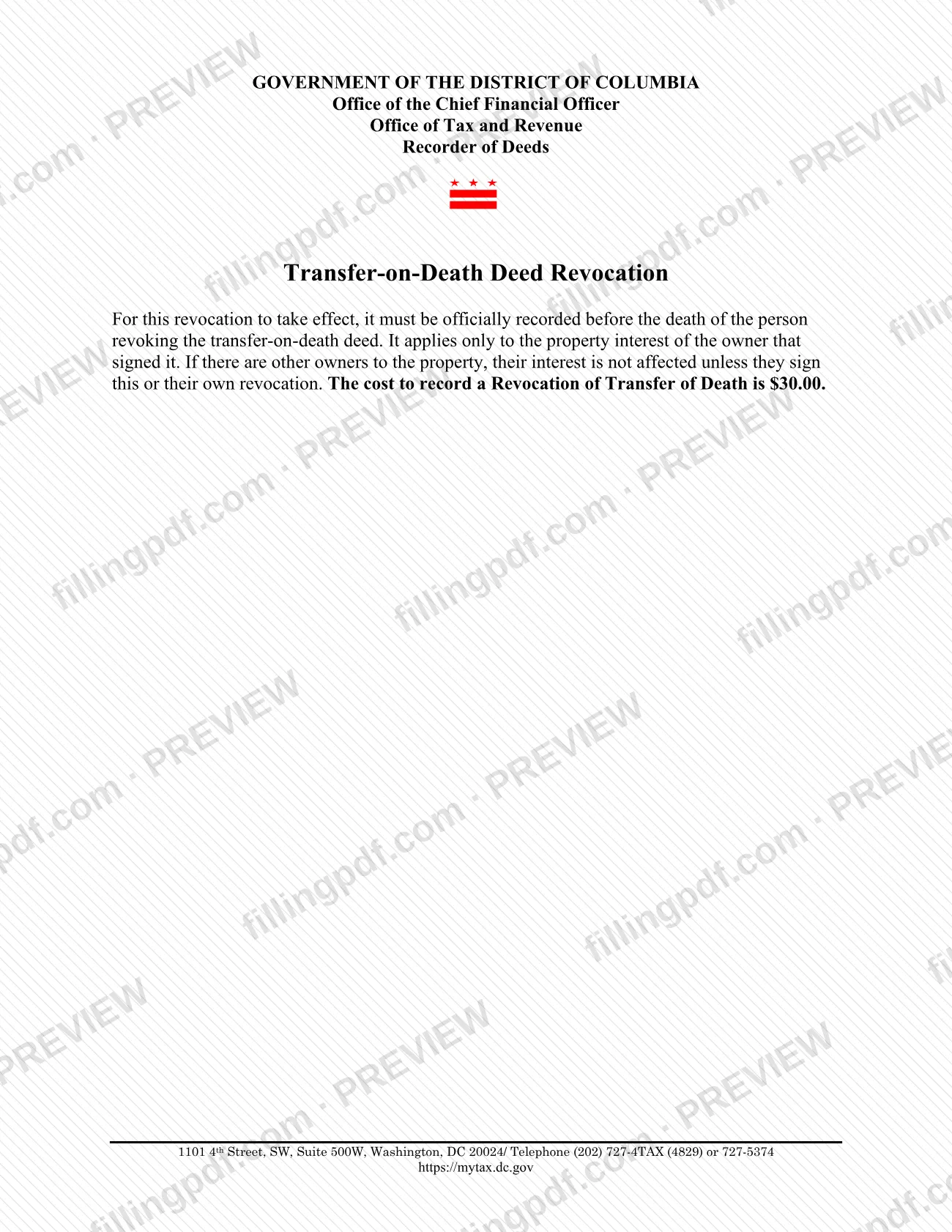
The form is issued under the Government of the District of Columbia, Office of the Chief Financial Officer, Office of Tax and Revenue, Recorder of Deeds. Its single operative statement reads: "I revoke all my previous transfers of this property by transfer on death deed."
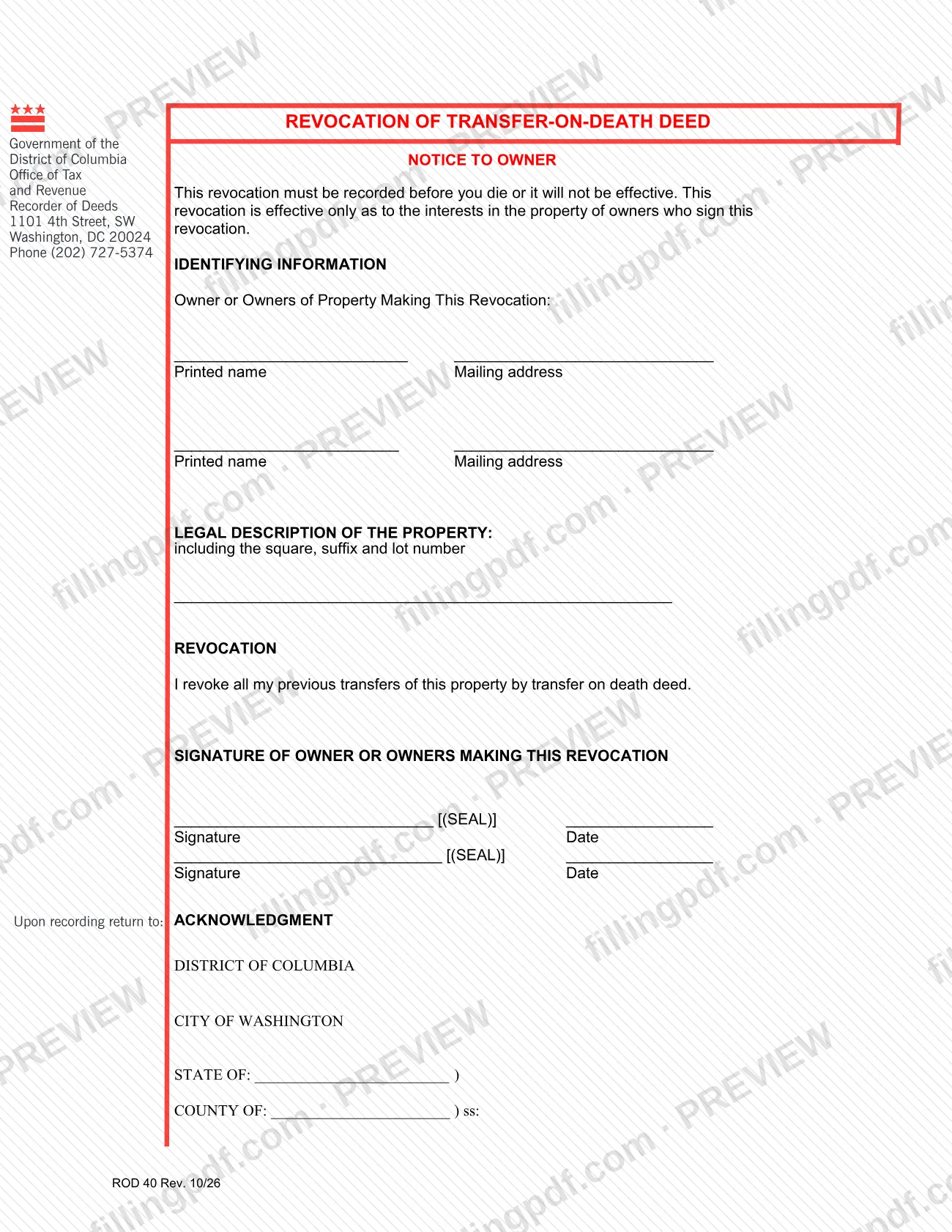
The form has four parts: identifying information for each owner making the revocation, the legal description of the property (including the square, suffix and lot number), the revocation statement with signature and date lines, and an acknowledgment block that a notary public completes.
Two limits are printed on the form. The revocation applies only to the property interest of the owner who signed it, so other owners are not affected unless they sign this revocation or their own. And it must be officially recorded before the death of the person revoking, or it will not be effective.
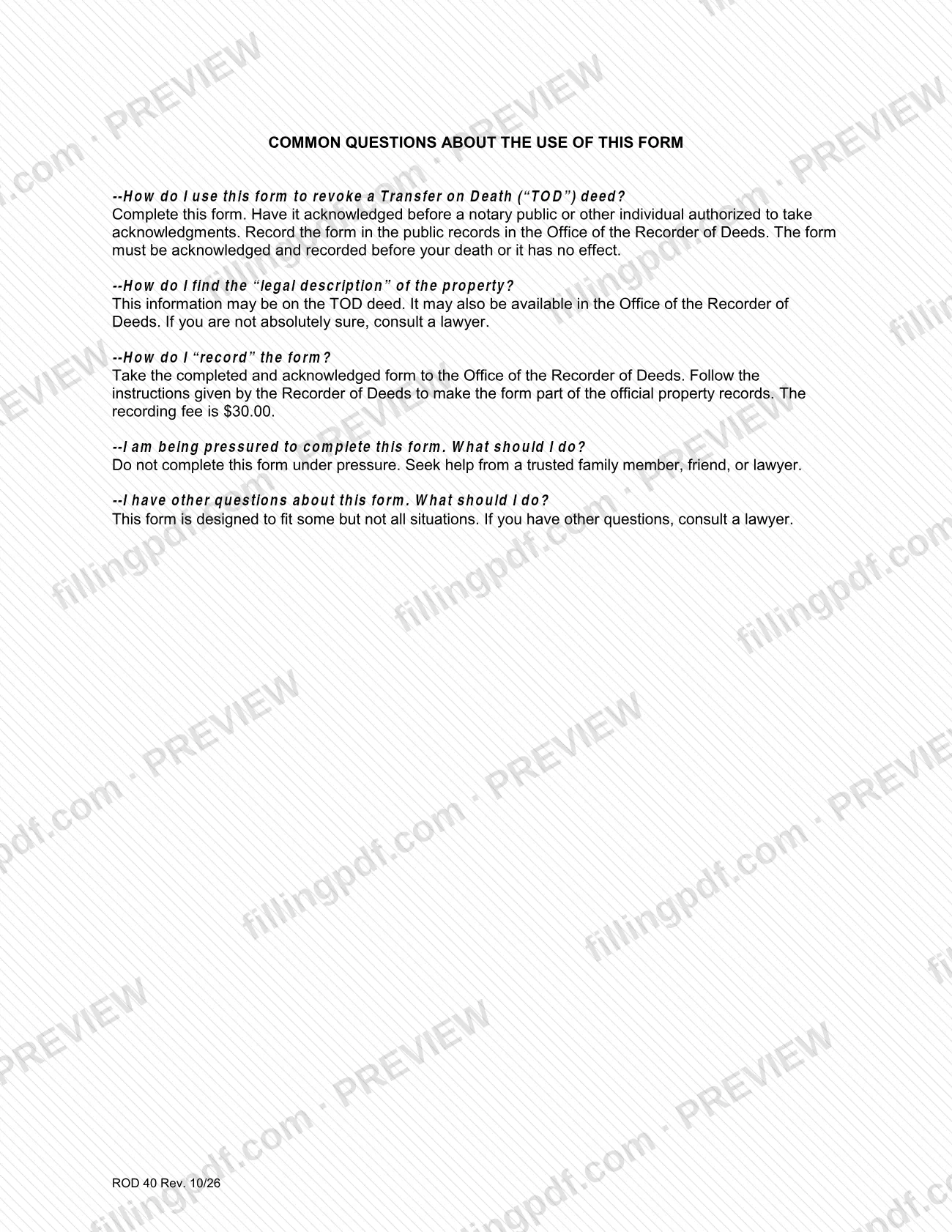
The printed questions and answers on the form describe it as designed to fit some but not all situations, and send readers with other questions to a lawyer.
Who needs to file ROD 40?
An owner of property in the District of Columbia who made a transfer-on-death deed and now wants to revoke it uses ROD 40. The form revokes all of that owner's previous transfers of the property by TOD deed.
- Sole owners sign alone.
- Co-owners: the revocation is effective only for the interests of owners who sign it. If there are other owners, their interest is not affected unless they sign this form or their own revocation. The form has two owner and two signature lines.
The form is not for situations it does not fit: its printed guidance says it is designed to fit some but not all situations and tells you to consult a lawyer if you have other questions. If you are not absolutely sure about the legal description of the property, the form also says to consult a lawyer.
If you are being pressured to complete this form, the form says not to complete it under pressure and to seek help from a trusted family member, friend or lawyer.
When to file ROD 40
The revocation must be acknowledged before a notary public (or another individual authorized to take acknowledgments) and recorded with the Office of the Recorder of Deeds before the death of the person revoking the TOD deed. The Notice to Owner on the form is blunt: if it is not recorded before you die, it will not be effective. The form sets no calendar deadline other than that, and it does not state a processing time. Because recording is what makes the revocation take effect, completing the form is not enough; the acknowledged form must also reach the Recorder of Deeds.
Documents you need
- Legal description of the property, including the square, suffix and lot number: take it from the TOD deed or look it up with the Office of the Recorder of Deeds; it is entered on the form itself.
- Notary acknowledgment: the form must be acknowledged before a notary public or other individual authorized to take acknowledgments; the acknowledgment block is printed on the form.
How to fill out ROD 40
List each owner's name and address
Under IDENTIFYING INFORMATION, "Owner or Owners of Property Making This Revocation," enter the printed name and mailing address of each owner who is revoking. Use the second pair of lines for a co-owner who is signing too.
Enter the legal description
Under LEGAL DESCRIPTION OF THE PROPERTY, write the description including the square, suffix and lot number. It may appear on the TOD deed or be available from the Office of the Recorder of Deeds.
Read the revocation statement
The REVOCATION section reads "I revoke all my previous transfers of this property by transfer on death deed." Nothing is entered here; it is the statement you are signing.
Sign and date as owner
Under SIGNATURE OF OWNER OR OWNERS MAKING THIS REVOCATION, each owner revoking signs on a Signature line and writes the Date. Only owners who sign are covered.
Fill in where to return the recording
In the box marked "Upon recording return to," enter the name and address to which the recorded revocation should be sent.
Have the notary complete the acknowledgment
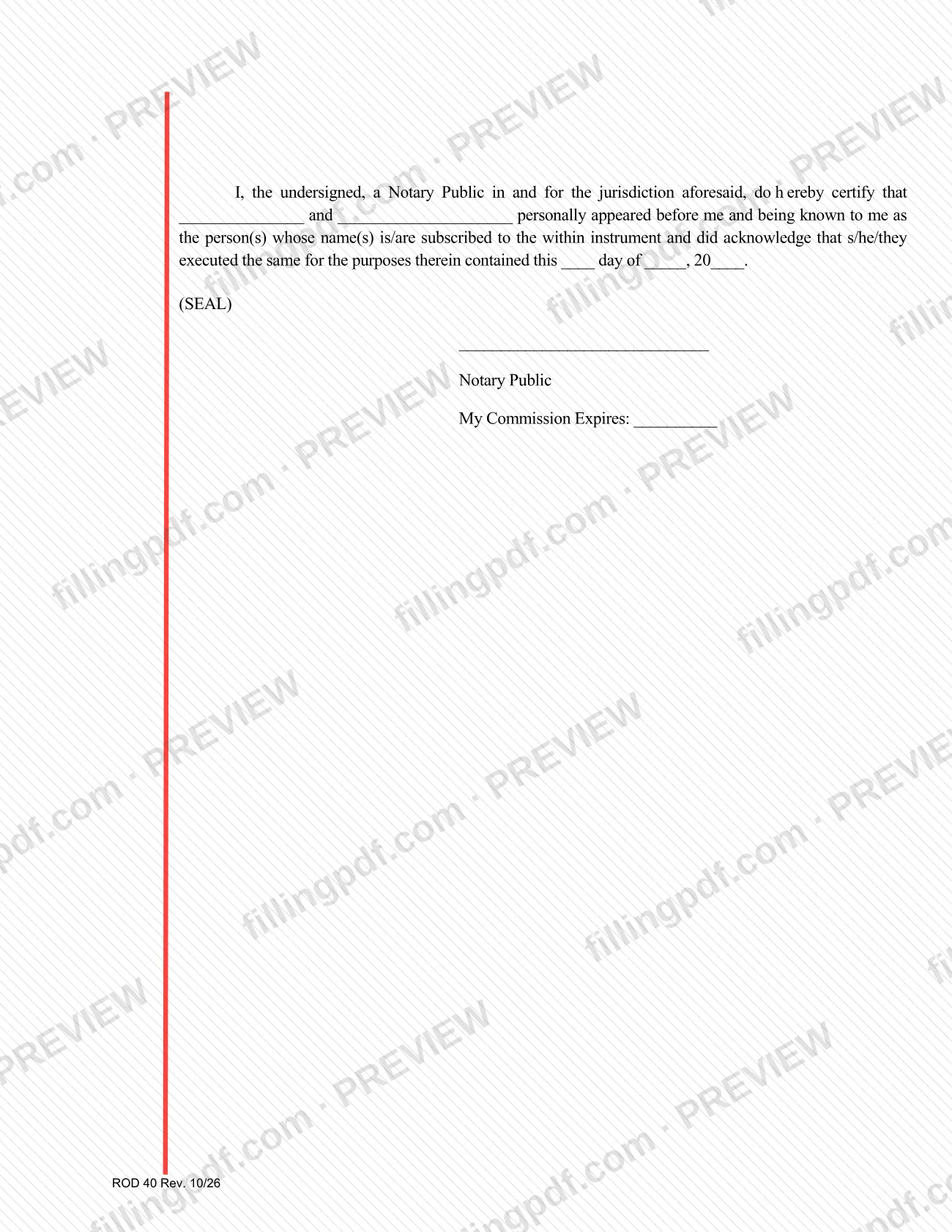
The ACKNOWLEDGMENT block, with its STATE OF and COUNTY OF lines, the owners' names, the day, month and year, the notary's signature and seal and the commission expiration date, is completed by the notary public or other authorized individual.
Review, sign and download the PDF
Check names, addresses and the legal description, then download or print the completed PDF from FillingPDF. After the acknowledgment, take it to the Recorder of Deeds as described under How to submit.
How to submit ROD 40
ROD 40 is recorded in person or through the instructions of the Office of the Recorder of Deeds: the form tells you to take the completed and acknowledged form to that office and follow the instructions the Recorder of Deeds gives you.
- Where: Office of Tax and Revenue, Recorder of Deeds, 1101 4th Street, SW, Suite 500W, Washington, DC 20024.
- Phone: (202) 727-5374 (Recorder of Deeds), or (202) 727-4TAX (4829).
- Website: https://mytax.dc.gov, printed on the form.
- What to bring: the completed form, signed by each owner making the revocation and acknowledged before a notary public or other authorized individual.
- Fee: a recording fee applies. The form states the amount; confirm the current fee with the Recorder of Deeds before you go, because this page does not list it.
The form has an "Upon recording return to" box for the address where you want the recorded document returned. FillingPDF lets you fill out and download the PDF; submission follows the Recorder of Deeds' channels above.
Common mistakes to avoid
- Leaving the form unrecorded: it is effective only if recorded with the Office of the Recorder of Deeds before the revoking owner's death.
- Skipping the acknowledgment before a notary public or other authorized individual; the form says it must be acknowledged and recorded or it has no effect.
- Assuming one owner's signature revokes the TOD deed for every co-owner; it applies only to the interest of owners who sign it.
- Omitting the square, suffix or lot number from the legal description, or guessing it when you are not absolutely sure; the form says to consult a lawyer.
- Leaving out the printed name and mailing address of an owner who is signing.
- Completing the form under pressure from someone else; the form says not to and to seek help from a trusted family member, friend or lawyer.
- Treating the form as suited to every situation when it is designed to fit only some; the form tells you to consult a lawyer with other questions.
- Arriving at the Recorder of Deeds without confirming the recording fee, which the Recorder's office can confirm.
Frequently asked questions
What is the ROD 40 form used for?
ROD 40 is the DC form an owner uses to revoke a transfer-on-death (TOD) deed. It states that the owner revokes all previous transfers of the property by TOD deed. It is issued by the Recorder of Deeds within the Office of Tax and Revenue.
Does a TOD deed revocation have to be recorded in DC?
Yes. The form says the revocation must be acknowledged and recorded before the death of the person revoking, or it has no effect. Take the completed, acknowledged form to the Office of the Recorder of Deeds and follow the instructions it gives.
Does ROD 40 need to be notarized?
It must be acknowledged before a notary public or another individual authorized to take acknowledgments. The form includes an acknowledgment block with a notary signature line, seal and commission expiration date for that purpose.
Does my co-owner's TOD deed get revoked too?
Not unless they sign. ROD 40 applies only to the property interest of the owner who signed it. Other owners' interests are not affected unless they sign this revocation or their own revocation.
Where do I record the TOD revocation in DC?
At the Office of the Recorder of Deeds, 1101 4th Street, SW, Suite 500W, Washington, DC 20024. The phone number printed on the form is (202) 727-5374, or (202) 727-4TAX (4829).
Is there a fee to record ROD 40?
Yes, a recording fee applies. The form states the amount, and this page does not repeat it, so confirm the current fee with the Recorder of Deeds at (202) 727-5374 before you go.
Where do I find the legal description of my property?
It may be on your TOD deed or available in the Office of the Recorder of Deeds. It must include the square, suffix and lot number. If you are not absolutely sure, the form says to consult a lawyer.
Can I fill out ROD 40 online?
You can fill out the PDF online on FillingPDF and download or print it. FillingPDF does not record or file it and is not affiliated with the DC Office of Tax and Revenue; you must still have it acknowledged and take it to the Recorder of Deeds.
Ready to fill out ROD 40?
Fill out ROD 40 now